
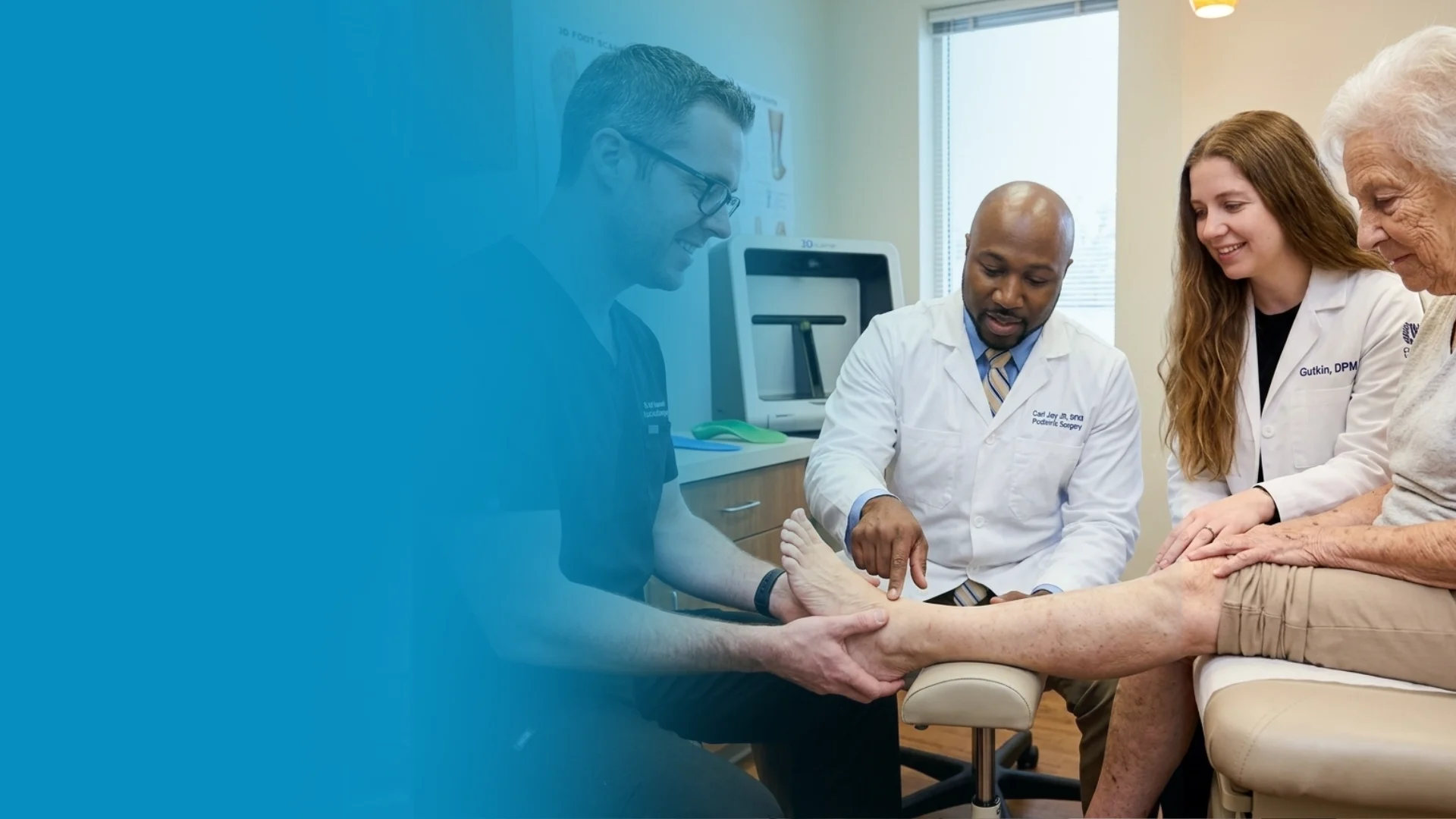

You are in the right place. Dr. Tom Biernacki, DPM, FACFAS — board-certified foot & ankle surgeon with 3,000+ surgeries — explains exactly what foot pain after physical therapy means and what actually works. Call (810) 206-1402 for a same-day appointment at our Howell or Bloomfield Township office.
Quick answer: Foot Pain After Physical Therapy has multiple potential causes including mechanical, neurological, vascular, and inflammatory. The patterns we see most often are overuse, poorly-fitted shoes, and biomechanical imbalance. Red flags requiring urgent evaluation: warmth/redness (infection), inability to bear weight (fracture), and unilateral swelling without injury (DVT). Call (810) 206-1402.
The most important clinical decision with Foot Pain After Physical Therapy isn’t which treatment to start with — it’s identifying the correct subtype. That changes everything. Call (810) 206-1402.
Dr. Tom’s Top Insole & Orthotic Picks
Medically reviewed by Dr. Tom Biernacki, DPM
Board-certified podiatric surgeon | Balance Foot & Ankle
Last reviewed: May 2026
Affiliate disclosure: As an Amazon Associate, Balance Foot & Ankle earns from qualifying purchases.
Dr. Tom’s Top Pain Relief Picks — Dr. Hoy’s (2026)
Affiliate disclosure: As an Amazon Associate, Balance Foot & Ankle earns from qualifying purchases. I personally use Dr. Hoy’s in my practice for patients who need topical relief.
| Product | Best For | Dr. Tom’s Take | Get It |
|---|---|---|---|
| Dr. Hoy’s Natural Pain Relief Gel 3.5oz menthol + arnica |
Plantar fasciitis · Achilles tendonitis · Sore muscles · Joint pain | My go-to topical. Cooling-then-warming sensation. No greasy residue. Non-NSAID alternative. | Buy Now |
| Dr. Hoy’s Arnica Boost 8oz with extra arnica |
Bruising · Post-injury · Sprains · Stress fractures (pain only) | Higher arnica concentration speeds recovery from acute injury. Use 4x daily for first 7 days. | Buy Now |
| Dr. Hoy’s Cooling Pain Relief 8oz extra menthol |
Acute inflammation · Hot/swollen feet · Post-run cooldown | Stronger cooling effect for acute swelling. Pair with ice for first 48 hours after injury. | Buy Now |
| Dr. Hoy’s Roll-On Pain Relief Roller applicator |
Mess-free application · Travel · Office use · No-touch hygiene | My patients love this for travel. Glides on without hand contact — cleanest application available. | Buy Now |
| Dr. Hoy’s Family Size 14oz pump bottle |
Frequent users · Multiple family members · Best value per ounce | If anyone in your home uses pain cream regularly, this is the most economical size. Same formula. | Buy Now |
Why I recommend Dr. Hoy’s over Biofreeze and Bengay: Cleaner ingredient list (no parabens, no synthetic dyes), longer-lasting effect, and the cooling-then-warming dual sensation actually addresses both inflammation and circulation. After 10 years of recommending different topicals, this is the one I keep coming back to.
Medically reviewed by Dr. Tom Biernacki, DPM · Board-Certified Podiatric Surgeon · Last reviewed: April 2026 · Editorial Policy
Related Conditions
In This Article
✅ Medically reviewed by Dr. Tom Biernacki, DPM — Board-Certified Podiatrist · Last updated April 6, 2026
Foot Pain After Physical Therapy — When You Need a Podiatrist’s Advanced Tools
Done With PT. Still in Pain?
Physical therapy helps most foot and ankle conditions. But for patients with chronic conditions, structural tissue changes, or degeneration, standard PT can reach a ceiling. If you’ve completed PT and your foot pain persists, advanced podiatric technology may accomplish what exercises alone cannot.
Why Some Conditions Don’t Resolve With PT
PT works through mechanical stimulation. Some tissue changes require direct biological intervention: calcifications that don’t respond to stretching, scar tissue at tendon insertions that doesn’t remodel with exercise, deep bone stress requiring electromagnetic stimulation, nerve damage needing cellular-level healing, and tendinosis (degeneration) vs. tendinitis (inflammation) — a distinction that completely changes optimal treatment.
What We Offer Beyond PT
We start with fresh in-office X-ray and ultrasound imaging to see exactly what’s happening in the tissue. Then targeted technology: EPAT shockwave for structural scar and tendon changes, MLS laser for residual inflammation and cellular repair, EMTT for deep tissue and bone issues PT never reached. Our technology frequently resolves conditions that were “stuck” after multiple PT courses.
✅ MLS Dual-Wavelength Laser — FDA-cleared
✅ EPAT Shockwave Therapy — 80%+ success rate
✅ Magnetotransduction (EMTT) — Deep electromagnetic healing
✅ 3D-Scanned Custom Orthotics
✅ Toenail Fungus Laser
✅ In-Office X-Ray & Ultrasound
✅ Diabetic Shoe Program — Medicare-covered
📞 (810) 206-1402 | Howell & Bloomfield Township
Call (810) 206-1402. Most patients see measurable improvement within 3–4 sessions. Howell and Bloomfield Township.
Why Do My Feet Still Hurt After Physical Therapy? A Podiatrist’s Explanation
When foot pain persists or recurs after a course of physical therapy, the most common explanations fall into several categories. The diagnosis was incomplete: physical therapy addresses movement and muscle function effectively, but cannot correct a misdiagnosed condition — if plantar fasciitis treatment was prescribed for what is actually tarsal tunnel syndrome or Baxter’s nerve entrapment, exercise-based therapy will not address the nerve compression that is driving symptoms. The structural driver was not addressed: physical therapy strengthens muscles and improves flexibility but cannot change the arch height, heel alignment, or forefoot position that loads the tissue at the site of pain on every step — custom orthotics addressing the structural component are often needed alongside exercises to produce durable improvement. The tissue damage is too significant for exercise alone: chronic plantar fasciitis with fascial degeneration (not just acute inflammation) may require MLS laser therapy, shockwave, or PRP injection to stimulate tissue regeneration rather than just managing the inflammatory response.
Michigan patients who have completed physical therapy for foot pain and remain symptomatic deserve a podiatric evaluation that re-examines the diagnosis, assesses the structural and biomechanical factors not addressed by PT, and identifies treatment options beyond exercise. At Balance Foot & Ankle, we frequently see patients who are several PT courses into their foot pain management and have made partial improvement but cannot achieve the full resolution they are looking for — in most cases, the gap between PT results and symptom-free function is addressable with targeted podiatric intervention. Call (810) 206-1402 to schedule a podiatric evaluation at our Howell or Bloomfield Township office and determine what is preventing your foot from fully healing.
Michigan patients who remain symptomatic after PT should also consider whether their footwear is undermining their rehabilitation progress. Patients who do their prescribed exercises faithfully but spend 8 hours a day in shoes that load the plantar fascia with every step cannot overcome the cumulative mechanical stress with exercises alone — the shoe and orthotic component of foot mechanics must be addressed alongside the muscle and flexibility components that PT optimizes. At Balance Foot & Ankle, we commonly complete the picture for PT non-responders by providing custom orthotics, footwear prescription, and injection or laser therapy that addresses the components their excellent PT program was not designed to target. The combination of well-structured PT plus podiatric structural management produces outcomes neither achieves alone. Call (810) 206-1402 for a post-PT evaluation at our Howell or Bloomfield Township office.
Related Treatment Guides
- Plantar Fasciitis & Heel Pain Treatment
- Custom 3D Orthotics
- Sports Foot & Ankle Injury Treatment
- Bunion Treatment
Michigan patients with foot and ankle conditions that have not responded to prior treatment — whether conservative care, physical therapy, or previous specialist evaluation — deserve a thorough re-evaluation that revisits the diagnosis and identifies treatment options that have not been tried. Balance Foot & Ankle‘s Howell and Bloomfield Township offices offer same-week appointments for most conditions, diagnostic imaging including digital X-ray and ultrasound performed in-office, and the full spectrum of regenerative treatment options including MLS laser, shockwave therapy, and EMTT. Our goal is not to repeat the treatments that have not worked, but to identify what has been missing and address it directly. Call (810) 206-1402 to schedule at our Howell office at 4330 E Grand River or our Bloomfield Township office at 43494 Woodward Ave #208.
Insurance Accepted
BCBS · Medicare · Aetna · Cigna · United Healthcare · HAP · Priority Health · Humana · View All →
Howell Office
4330 E Grand River Ave
Howell, MI 48843
Get Directions →
Bloomfield Township Office
43494 Woodward Ave, #208
Bloomfield Township, MI 48302
Get Directions →
Your Board-Certified Podiatrists



Ready to Get Back on Your Feet?
Same-week appointments available at both locations.
More Podiatrist-Recommended Foot Health Essentials
Hoka Clifton 10

Hoka Men’s Clifton 10 Black/White 10 Medium
- JACQUARD KNIT UPPER
- Lining Textile
Max-cushion everyday shoe — podiatrist favorite for walking and running.
PowerStep Pinnacle Insole

PowerStep Pinnacle Insoles, Orthotics for Plantar Fasciitis Relief, Made in USA Orthotic Insoles, Arch Support Inserts with Moderate Pronation, #1 Podiatrist Recommended (M 14-15)
- The Pinnacle Full length insoles for men & women provide maximum cushioning, from high activity to moderate support. The PowerStep arch support shape provides stability to the foot and ankle, helping to relieve foot pain.
- When you spend all day on your feet, every step counts. PowerStep insoles are a podiatrist-recommended orthotic to help relieve & prevent foot pain related to athletes, runners, Plantar Fasciitis, heel spurs & other common foot, ankle & knee injuries
- The Pinnacle plantar fasciitis insoles offer superior heel cushioning and arch support. The dual-layer cushioning is designed to reduce stress and fatigue, while PowerStep premium arch support is designed for plantar fasciitis relief.
- The PowerStep Pinnacle arch support inserts for men & women can be worn in a variety of shoe types such as; athletic, walking, running, work & some casual shoes. Orthotic Inserts are ordered by shoe size, no trimming required.
- Made in the USA & backed by a 30-day money-back guarantee. PowerStep orthotic inserts for men & women are designed for shoes where the factory insole can be removed. HSA & FSA Eligible
The podiatrist-recommended over-the-counter orthotic.
OOFOS Recovery Slide

OOFOS OOahh Recovery Slide, Black – Women’s Size 14, Men’s Size 12
- The Original Recovery Footwear.
- Finding Your Size – For your perfect fit, consult the “size chart” link above. Wear a half size? In general, we recommend that women who wear a ½ size size UP, and men who wear a ½ size size DOWN
- OOahh – An evolution of the OOriginal, the OOahh slide features our proven foundation of OOfoam technology + patented footbed design with a slide-style strap that has become a best-seller in the OOFOS line
- OOfoam Technology – Our revolutionary OOfoam technology absorbs 37% more impact than traditional footwear foams to reduce the stress on your feet, joints & back. Plus, the closed-cell foam is machine washable and designed to minimize odor
- Patented Footbed – Our patented footbed cradles and supports arches to reduce energy exertion in the ankles by up to 47% compared to competitors’ footwear. So walking is easier. Recovery is faster. And yOO feel better
Impact-absorbing recovery sandal — wear after long days on your feet.
As an Amazon Associate, Balance Foot & Ankle earns from qualifying purchases. Product recommendations are based on clinical experience; prices and availability shown above update live from Amazon.

When to See a Podiatrist
If foot or ankle pain has been bothering you for more than a few weeks, home care alone may not be enough. Balance Foot & Ankle offers same-week appointments at our Howell and Bloomfield Township clinics — no referral needed in most cases. Bring your current shoes and a short list of symptoms and we’ll build you a treatment plan in one visit.
Call Balance Foot & Ankle: (810) 206-1402 · Book online · Offices in Howell & Bloomfield Township
Pros & Cons of Conservative Care for foot care
Advantages
- ✓ Conservative care first
- ✓ Same-week appointments
- ✓ Multiple insurance accepted
Considerations
- ✗ Self-treatment can mask issues
- ✗ See a podiatrist if pain >2 weeks
Dr. Tom’s Recommended Products for foot care
Affiliate disclosure: As an Amazon Associate, Balance Foot & Ankle earns from qualifying purchases. We only recommend products we use with patients.
Footnanny Heel Cream Dr. Tom’s Pick
Best for: Daily moisturizer for cracked heels
Ready to Get Back on Your Feet?
Same-day appointments in Howell + Bloomfield Township. Most insurance accepted. Dr. Tom Biernacki, DPM & team.
Book Today — Same-Day Appointments Available
Call Now: (810) 206-1402
About Your Care Team at Balance Foot & Ankle
Dr. Tom Biernacki, DPM · Board-Certified Foot & Ankle Surgeon. Specializes in conservative-first care, minimally invasive bunion surgery, and complex reconstruction.
Dr. Carl Jay, DPM · Accepting new patients. Specializes in sports medicine, athletic injuries, and routine podiatric care.
Dr. Daria Gutkin, DPM, AACFAS · Accepting new patients. Specializes in surgical reconstruction and pediatric podiatry.
Locations: 4330 E Grand River Ave, Howell, MI 48843 · 43494 Woodward Ave Suite 208, Bloomfield Township, MI 48302
Hours: Mon–Fri 8:00 AM – 5:00 PM · (810) 206-1402
Visit Balance Foot & Ankle — Same-Day Appointments Available
Our podiatry team serves patients throughout Michigan including Howell, Brighton, and Bloomfield Township. If you’re dealing with heel pain, ingrown toenails, or a foot injury, we have same-day appointment availability.
Same-day appointments available. (810) 206-1402
Doctor Hoy’s Natural Pain Relief Gel
Natural topical pain relief I use in our clinic. Arnica + camphor formula — apply directly to the area 3–4x daily. ($20–25)
Related Care at Balance Foot & Ankle
Clinical foot and ankle services at our Howell and Bloomfield Township offices.
Get Expert Care at Balance Foot & Ankle
Same-week appointments at our Howell and Bloomfield Township offices. Board-certified podiatric surgeons. Most insurance accepted.
Ready for Expert Care?
Same-day appointments in Howell & Bloomfield Township, MI.
4.9★ | 1,123 Reviews | 3,000+ Surgeries
Or call: (810) 206-1402

Dr. Tom Biernacki, DPM is a board-certified foot & ankle surgeon (ABFAS & ABPM) at Balance Foot & Ankle Specialists in Southeast Michigan. With over a decade of clinical experience, he specializes in heel pain, bunions, diabetic foot care, sports injuries, and minimally invasive surgery. Dr. Biernacki is a member of the APMA and ACFAS, and his patient education content on MichiganFootDoctors.com and YouTube has made him one of the most-followed foot & ankle educators on YouTube.
More questions patients ask
Why do I still have foot pain after completing physical therapy and what should I do?
Persistent foot pain after PT often indicates an unresolved structural issue, incorrect diagnosis, incomplete treatment, or need for different interventions. Balance Foot & Ankle in Howell and Bloomfield Township reevaluates Michigan patients who haven't improved with PT, often finding correctable causes that benefit from podiatric-specific treatment. Call (810) 206-1402.
What does Balance Foot & Ankle offer when physical therapy hasn't resolved foot pain?
When PT fails, Balance Foot & Ankle offers diagnostic reassessment (MRI, ultrasound), new treatment modalities (MLS laser, EMTT, shockwave), custom orthotics addressing biomechanical causes, cortisone or PRP injections, and surgical evaluation when appropriate for Michigan patients. Call (810) 206-1402 for a second-opinion consultation.
Can custom orthotics help when physical therapy hasn't resolved plantar fasciitis?
Yes. Many plantar fasciitis cases persist because underlying biomechanical abnormalities — flat foot, overpronation, leg length discrepancy — haven't been corrected. Custom orthotics from Balance Foot & Ankle address these root causes that PT stretching alone cannot fix for Michigan patients. Call (810) 206-1402.
Should I see a podiatrist or orthopedic surgeon if PT hasn't helped my foot pain in Michigan?
Seeing Balance Foot & Ankle first is usually the right choice, as podiatrists specialize specifically in foot and ankle conditions. We can exhaust podiatric interventions and refer to orthopedic surgery only when truly needed, avoiding unnecessary referrals and procedures for Michigan patients. Call (810) 206-1402.
What advanced imaging does Balance Foot & Ankle use when foot pain persists after PT?
Balance Foot & Ankle orders MRI for soft tissue pathology (tendon tears, stress fractures, neuromas, Baxter's nerve), ultrasound for dynamic assessment and guided injections, and CT scan for complex bone pathology in Michigan patients whose foot pain persists despite physical therapy. Call (810) 206-1402.
Still have a question about coverage or cost? Book online and we will check your benefits before your visit: Book in Howell · Book in Bloomfield Township. Prefer to talk it through first? Call (810) 206-1402.