
Quick answer: A green tint under a finger- or toenail is usually green nail syndrome — a Pseudomonas bacterial infection that thrives in moisture, often under a lifted or damaged nail. It’s typically harmless but persistent; keep the nail dry, avoid trauma, and see a podiatrist, who may trim the lifted nail and prescribe a topical to clear it.
Ready to be seen? Book a real appointment time online, 24/7 — Howell or Bloomfield Hills. Takes about a minute, 24/7.
Not sure if it’s bacteria or fungus? Green nail syndrome is often mistaken for a toenail fungus infection, and the two are treated very differently. If the discoloration keeps coming back or the nail is lifting, a podiatrist can confirm the cause and safely clear the nail — sometimes with a medical pedicure. Michigan patients can book a visit at our Howell or Bloomfield Hills offices.
Medically reviewed by Dr. Tom Biernacki, DPM
Board-certified podiatric surgeon | Balance Foot & Ankle
Last reviewed: May 2026
A green toenail means one of two infections that require opposite treatments — applying antifungal to the wrong type extends treatment by 6+ months. Our podiatrists confirm the cause in under 5 minutes with a bedside test. Most urgent cares miss this distinction entirely. If yours appeared after moisture exposure, nail trauma, or recent pedicure, call (810) 206-1402 — same-week appointments in Howell & Bloomfield Hills.
Green discoloration under a nail is one of the most commonly misdiagnosed nail conditions. Patients — and unfortunately many clinicians — assume green nail is fungal and prescribe antifungal medication. Antifungals have zero effect on green nail syndrome because the cause is bacterial, not fungal. This leads to months of ineffective treatment while the condition persists.
This guide explains exactly what causes green nails, how to confirm the diagnosis, and the specific treatment protocol that works.
What Causes Green Nails?
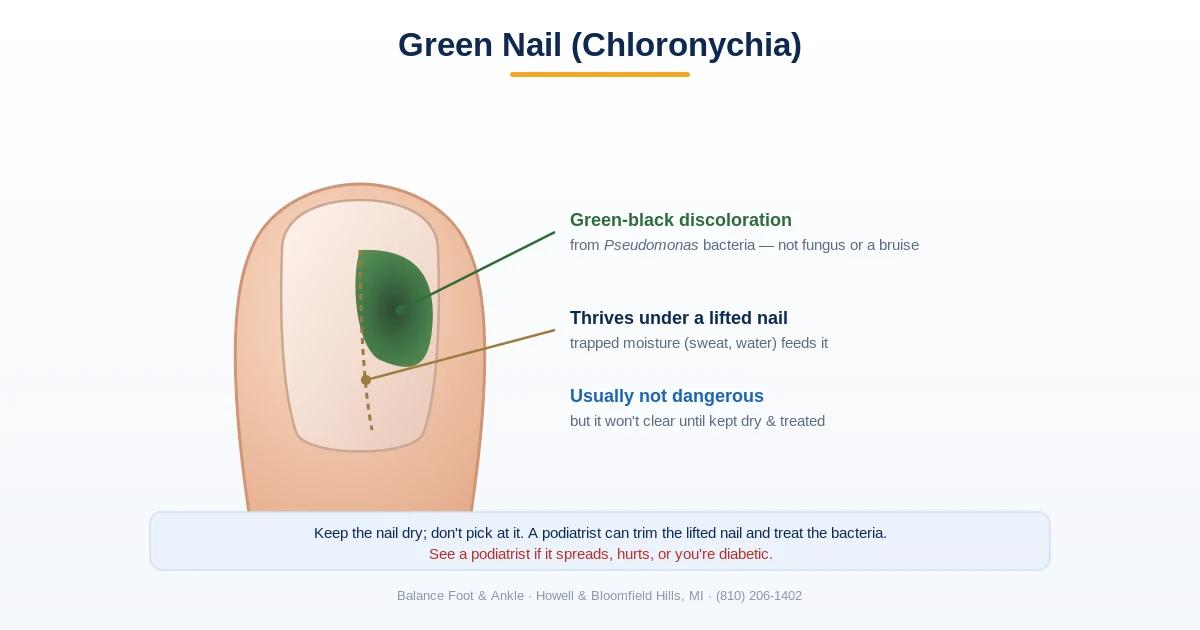
The green color under or within the nail plate is caused by pyocyanin — a blue-green pigment produced by Pseudomonas aeruginosa, a gram-negative opportunistic bacterium. Pseudomonas thrives in moist, warm environments and colonizes the space between a separated nail plate and nail bed (the subungual space or the space created by onycholysis).
The sequence of events that leads to green nail syndrome:
- Step 1 — Nail separation: The nail plate separates from the nail bed (onycholysis) due to any cause: trauma, fungal infection, psoriasis, contact dermatitis from nail products, or repetitive moisture exposure. This creates a pocket under the nail.
- Step 2 — Moisture accumulation: Water, soap, and organic material accumulate in the subungual pocket. Pseudomonas, which is ubiquitous in water and soil, enters this warm moist environment.
- Step 3 — Colonization and pigment production: Pseudomonas multiplies in the pocket and produces pyocyanin (blue-green) and pyoverdin (yellow-green fluorescent pigment). The combination appears as a green discoloration that can range from light green to dark blue-green.
Common risk factors: manicurists and nail technicians (repeated water exposure), housecleaners, healthcare workers, people who keep their nails long, anyone with a prior nail injury causing onycholysis, and people who use gel or acrylic nails (which can trap moisture).
Key takeaway: Green nail is caused by Pseudomonas aeruginosa bacteria producing a green pigment in the subungual space — not by fungus. The treatment is antiseptic soaks and antibacterial drops, not antifungal medication. Getting this diagnosis wrong wastes months of treatment.
Is a Green Toenail Dangerous?
For a healthy adult the honest answer is no. A green nail looks alarming out of all proportion to what is actually happening, and the reason is worth understanding: the color is a pigment, not tissue damage. Pseudomonas living in the space under a lifted nail releases that pigment, the pigment soaks into keratin, and keratin is already dead material. Nothing about the green itself indicates that the deeper tissue is infected, that circulation is failing, or that anything is dying.
Patients almost always arrive with one of four specific fears, so it is worth naming them directly. Green under a nail is not gangrene. It is not the nail rotting away. By itself it is not blood poisoning, and it is not an infection that has reached the bone. None of those conditions produce what this produces, which is a flat, painless, evenly tinted stain confined to the area where the nail has separated from its bed.
Why the reassurance holds, and where it stops
The reason a green nail stays harmless in most people is structural. The pocket under a lifted nail is open at the free edge, it is exposed to air, and the skin underneath is intact. Pseudomonas is an opportunist that thrives in that damp, shallow space, but an intact seal of skin gives it no route into living tissue. As long as that seal holds, the organism stays where it is and the problem stays cosmetic.
That reassurance stops in two situations. The first is when the seal is broken, which is what the warning signs listed further down this page are describing. The second is when the person cannot rely on their own pain as an alarm. Reduced sensation from neuropathy, or reduced blood flow from arterial disease, both remove the signal that would otherwise tell you something has changed, so a problem gets discovered late rather than early. If either applies to you, treat a green nail as a reason to be seen rather than a reason to wait. The specific criteria are set out in when to see a podiatrist below.
What a Green Nail Looks Like, and Why It Is Called Chloronychia
Chloronychia is the medical name for this condition, and it is worth knowing because it is the term you will see in a chart note or a dermatology text. It comes from the Greek for green nail, and it describes exactly the same thing as green nail syndrome. If a clinician writes chloronychia and a website says green nail syndrome, they are not describing two different problems.
The appearance is more specific than most people expect. The stain sits in a patch or a band rather than covering the whole nail, and its border follows the outline of the separated area rather than the shape of the nail. Pressing on it does not blanch it the way pressing on a bruise under skin briefly does. Wiping, scrubbing, and acetone do not lift it, because the pigment has soaked into the plate from underneath rather than settling on top. It is usually painless, and there is usually no smell.
A dark stripe running lengthwise is a different problem
One pattern should never be filed under green nail. A pigmented band that runs the length of the nail from the cuticle toward the tip, in brown to black rather than green, is a different category entirely. It reflects pigment being laid down by the nail as it grows rather than a stain acquired underneath it, and while most of these bands turn out to be benign, some are not. Any lengthwise dark band, and especially one that is widening, darkening, or extending onto the skin around the nail, should be examined in person rather than matched to photographs online.
Green from a bruise looks and behaves differently
Blood trapped under a nail after an injury can pass through a green phase as it breaks down, which is why some people arrive convinced they have an infection. Two features separate it. A bruise has a starting event, even a minor one such as a long descent in tight shoes, and it moves. Because the blood is fixed to the plate rather than to the bed, it travels toward the free edge as a discrete island with a visible gap opening behind it. A bacterial stain does not migrate that way while the pocket underneath it is still active.
How to Identify Green Nail Syndrome vs. Other Causes
Green nail syndrome has specific features that distinguish it from other nail discolorations:
- Color: Distinctly green — ranging from pale lime green to dark blue-green. The color is most intense at the area of nail plate separation and fades proximally. Fungal nail infection produces yellow, white, or brown discoloration but rarely true green.
- Location: The green discoloration typically starts at the distal or lateral nail edge and follows the margin of onycholysis. You can often see a distinct border between the green area and the normal (attached) nail.
- Nail plate: The nail plate itself may be relatively normal in thickness and texture, unlike fungal infection which causes thickening and crumbling.
- Smell: Pseudomonas colonization sometimes produces a characteristic musty or fruity odor from the affected area. Fungal infection typically has no distinctive odor.
- Onycholysis: There is almost always separation of the nail plate from the nail bed — the pocket where Pseudomonas lives. If the nail is firmly attached with no onycholysis, green nail syndrome is unlikely.
The definitive confirmation if needed: a bacterial culture swab of the subungual space will grow Pseudomonas aeruginosa. In practice, the characteristic green color in the context of onycholysis is pathognomonic enough that culture is typically reserved for cases that don’t respond to treatment.
Can green nail coexist with fungal infection? Yes — and this is common. Onychomycosis causes nail separation that then becomes colonized by Pseudomonas. In this case, both the fungal infection AND the bacterial colonization need to be treated. The green color is from Pseudomonas, but treating only the bacteria without the underlying fungus leads to recurrence.
Green Nail Syndrome Is Not a Fungus
Most people arrive at our offices calling this green nail fungus, and it is worth clearing up because the name drives the wrong treatment. Green nail syndrome is a bacterial colonization, not a fungal infection. The organism responsible is almost always Pseudomonas aeruginosa, a common environmental bacterium that thrives in damp places.
Where the green color actually comes from
The green is not the bacteria themselves. Pseudomonas produces two pigments as it grows: pyocyanin, which is blue-green, and pyoverdine, which is yellow-green and fluorescent. Together they stain the nail plate from underneath, which is why the discoloration looks like it is trapped inside or beneath the nail rather than sitting on top of it. The shade ranges from a faint yellow-green streak to a deep blue-black green depending on how long it has been growing and how much pigment has soaked into the keratin.
Why antifungal treatments do not clear it
This is the single most common reason a green nail persists for months. Antifungal creams, lacquers and oral antifungal medications work on fungal cell membranes. They have no meaningful activity against Pseudomonas. Someone can apply a topical antifungal faithfully for six months, do everything right, and watch the green nail stay exactly the same, because the medication was never aimed at the organism causing it.
The other half of the problem is the environment. Pseudomonas needs persistent moisture to establish itself. If a nail stays damp inside a shoe all day, or the toe sits in a warm humid sock, the colony simply re-establishes after any treatment. Killing the bacteria without drying the space under the nail tends to buy a few weeks, not a cure.
Fungus and bacteria can be present at the same time
Here is the nuance that makes self-diagnosis unreliable. A nail that has already been lifted off its bed by onychomycosis (true nail fungus) or by an old trauma creates exactly the warm, moist, sheltered pocket that Pseudomonas needs. So a green toenail can genuinely be a bacterial colonization sitting on top of an underlying fungal infection, or on top of a partially detached nail from an injury months earlier.
When that is the case, treating only the green gets rid of the color and the problem returns, because the lifted nail that let the bacteria in is still lifted. Treating only the fungus leaves the discoloration. Both have to be identified, and that is what an in-office assessment sorts out, rather than guessing from the color alone.
How we tell the difference in the office
- Where the color sits. Bacterial pigment stains the nail plate itself and stays put as the nail grows out, moving forward with the nail. Fungal discoloration is usually yellow-brown, tends to come with thickening and crumbling debris under the nail, and does not have that blue-green cast.
- Whether the nail is lifted. We check how far the nail has separated from the bed, because that separation is both the entry point and the thing that has to be managed for the result to hold.
- Whether anything needs to be cultured or sampled. If the picture is mixed, or if a nail has failed previous treatment, sampling settles what is actually growing rather than extending another course of the wrong medication.
- What is keeping the area wet. Occupational moisture, a nail that has been under acrylic or gel, long hours in closed shoes, or frequent water exposure all change what the plan needs to include.
Get a Green Toenail Diagnosed Properly
A green nail that has not budged after weeks of antifungal treatment is not a stubborn fungus. It is usually the wrong diagnosis, and it is straightforward to correct once someone looks at it. We see this regularly at both offices, and the assessment is quick.
Balance Foot & Ankle sees patients at our Howell podiatry office and our Bloomfield Hills podiatry office. Call (810) 206-1402 or start as a new patient here, and bring any products you have already tried so we are not repeating something that has already failed.
Treatment for Green Nail Syndrome
Treatment targets two things: eliminating the Pseudomonas colonization and removing the moist pocket where it lives.
Step 1 — Trim the separated nail: The loose, onycholytic portion of the nail should be trimmed back to the point where the nail is firmly attached to the bed. This eliminates the pocket. Do not try to preserve the lifted portion — it’s the problem. This is the most important single step.
Step 2 — Antiseptic soaks: Two effective options:
- Dilute bleach soak: 1 teaspoon of household bleach in 4 cups of water. Soak the affected nail for 5–10 minutes, twice daily. Pseudomonas is highly susceptible to chlorine. Bleach soaks are inexpensive and effective — the green color typically begins fading within 1–2 weeks.
- Acetic acid soak (white vinegar): 1 part white vinegar to 4 parts water. Same duration and frequency. Vinegar creates an acidic environment that Pseudomonas cannot tolerate. Slightly less aggressive than bleach but better tolerated for sensitive skin.
Step 3 — Keep the area dry: Pseudomonas requires moisture to persist. After soaking, dry the area thoroughly. Avoid prolonged water exposure (dishwashing, extended bathing without gloves). If water exposure is unavoidable, wear waterproof gloves. This is non-negotiable — no amount of antiseptic treatment overcomes constant moisture reexposure.
Step 4 — Topical antibiotics if needed: For moderate to severe or recurrent cases, topical antibiotic drops applied directly under the lifted nail can accelerate resolution. Options used off-label include:
- Ciprofloxacin ophthalmic drops (0.3%) — applied 2–3 drops under the nail twice daily
- Gentamicin ophthalmic drops — same application method
- Polymyxin B/neomycin/bacitracin combination topical
These require a prescription and are used when antiseptic soaks alone are not achieving resolution after 4 weeks.
Treatment timeline: The green pigment fades as new nail grows in — it does not disappear from the existing nail plate because the pigment is within the nail. The area of discoloration will shrink from the base as new, unaffected nail grows forward. Complete resolution takes as long as the nail takes to grow: 3–6 months for fingernails, 6–12 months for toenails.
Key takeaway: Trimming back the separated nail is the most critical step in treating green nail syndrome. Without removing the pocket where Pseudomonas lives, soaks and antibiotic drops cannot reach the organism effectively. Trim first, then treat.
Green Toenail Treatment Comparison: What Works and How Fast
Not every case of green nail syndrome requires the same treatment. The severity and location of Pseudomonas colonization determines which approach is fastest and most effective.
| Treatment | How It Works | Timeline | Best For | Evidence |
|---|---|---|---|---|
| Nail trimming + bleach soaks | Remove the onycholytic pocket; chlorine kills Pseudomonas on contact | 1–3 weeks to clear green color | Mild–moderate cases; first line | High — standard of care |
| White vinegar soaks | Acidic environment (pH <4.5) inhibits Pseudomonas growth | 2–4 weeks | Sensitive skin; bleach-intolerant patients | Moderate |
| Ciprofloxacin topical | Fluoroquinolone antibiotic penetrates nail bed | 2–6 weeks | Moderate–severe or recurrent cases | Moderate |
| Chlorhexidine drops | Antiseptic disrupts Pseudomonas cell membrane | 2–4 weeks | Combined with nail trimming in clinical setting | Moderate |
| Partial nail avulsion | Remove onycholytic nail under local anesthesia; eliminates pocket | Immediate relief + 2–4 months new nail | Severe or chronically recurrent cases | High — definitive |
Key point: Bleach or vinegar soaks without nail trimming rarely succeed because the pocket persists. The combination of mechanical removal + antiseptic is what works. Systemic antibiotics are rarely needed for Pseudomonas nail colonization.
The Most Common Treatment Mistake
Prescribing oral antifungal therapy (terbinafine, fluconazole) for green nail is the most common mistake. Pseudomonas is a bacterium — antifungals are completely inactive against it. Oral antibiotics (fluoroquinolones like ciprofloxacin) do have activity against Pseudomonas, but systemic antibiotic therapy is generally not indicated for superficial green nail syndrome — topical management is preferred to avoid promoting antibiotic resistance.
A 3-month course of oral terbinafine for what is actually Pseudomonas colonization wastes the patient’s time, exposes them to hepatotoxicity risk unnecessarily, and leaves the actual problem untreated.
Second most common mistake: treating the green color without addressing the onycholysis. If the nail separation persists — from ongoing psoriasis, continued fungal infection, or repetitive trauma — Pseudomonas will recolonize within weeks of completing treatment. The nail separation must be addressed simultaneously.
Green Under Acrylics, Gels, and Dip Powder
Nail technicians see this often enough to have their own word for it. A greenie is the patch of green that shows up under an enhancement between appointments, and it is the same organism and the same pigment described above. What differs is the environment that produced it, and that difference decides what has to happen next.
An enhancement bonds to the surface of the natural plate. When a corner of that bond releases, the result is not an opening but a closed pocket, warm and damp, with a rigid lid over it. Everyday water exposure gets in through the edge and then has nowhere to evaporate. That is close to an ideal environment for Pseudomonas, which is why the green so often appears under product rather than on a bare nail.
Why filling over it makes it worse
The instinct at the next appointment is to fill the lifted area and cover the discoloration. This is the single most counterproductive thing that can be done, because it seals the pocket rather than opening it. Buffing or drilling the green away does not help either, and understanding why makes the point clear: the pigment is inside the plate, so removing enough of it to reach clean keratin means thinning the nail badly, and the organism lives in the pocket rather than in the stain. Removing the color while leaving the pocket removes the evidence and keeps the cause.
What actually has to happen
The enhancement over the affected nail has to come off, and the nail has to stay uncovered while it is treated and while it dries out. Wearing polish over it during that period defeats the same purpose that filling over it does. Once the plate is dry and the separated area has grown out far enough to be trimmed away, enhancements can go back on, and the lifted edge that started it should be addressed at the same time so the pocket does not simply re-form. Expect the color to outlast the bacteria. Stained keratin does not turn clear when the organism is gone; it leaves with the nail, over the many months a nail needs to grow out completely. See the treatment comparison above for what to use in the meantime.
Other Causes of Green Nail Discoloration
While Pseudomonas is the most common cause, green nail discoloration can also result from:
- Nail polish pigment (external staining): Green or dark nail polishes can stain the nail plate, particularly if worn for extended periods or applied over damaged nail. This staining is superficial and fades with the nail growing out — it is not under the nail plate and has no associated nail separation.
- Aspergillus niger (rare fungal infection): This mold can occasionally infect nails and produce dark green to black pigmentation. It typically requires nail culture to distinguish from Pseudomonas. Treatment is antifungal (voriconazole or amphotericin B for significant infections), not antibacterial.
- Chromogenic bacteria other than Pseudomonas: Other gram-negative organisms can occasionally produce pigment in nails, though Pseudomonas is responsible for the vast majority of cases.
⚠️ When green nail requires urgent evaluation:
- Green discoloration spreading rapidly, with surrounding skin redness and swelling — possible deeper soft tissue infection
- Diabetic or immunocompromised patient with any nail infection
- Fever, swollen lymph nodes, or red streaking up the foot or hand with green nail — systemic Pseudomonas infection
- Green nail not responding to 4 weeks of correct antiseptic treatment
- Green nail in a patient on chemotherapy or other immunosuppressants
Green Toenail vs. Other Nail Discoloration: Quick Diagnostic Guide
Not all nail discoloration is green nail syndrome. The color and pattern of discoloration provide important clues before any test is run.
| Discoloration | Most Likely Cause | Key Distinguishing Feature |
|---|---|---|
| Green (under nail, localized) | Pseudomonas aeruginosa (green nail syndrome) | Separation of nail from bed (onycholysis); distinctive sweet odor |
| Yellow-brown, diffuse thickening | Onychomycosis (toenail fungus) | Crumbling, subungual debris; multiple toenails often involved |
| Black or brown streak (longitudinal) | Subungual melanoma or trauma | Hutchinson’s sign (pigment spreading to skin); see podiatrist immediately |
| White patches on nail surface | Keratin granulations (superficial white onychomycosis) | Scrapes off easily; linked to nail polish removal |
| Blue-black (entire nail) | Subungual hematoma (blood under nail) | Recent trauma history; nail may become painful then loosen |
| Yellow (nail polish staining) | Cosmetic staining, not infection | Clears after nail polish removal; no odor, no separation |
When to See a Podiatrist for a Green Toenail
Green nail syndrome is treatable but requires identification of the correct organism and the right antibiotic. See a podiatrist promptly if:
- The green discoloration has been present for more than 2 weeks
- The nail plate has separated from the nail bed (onycholysis)
- There is any pain, warmth, or swelling around the nail
- You are diabetic or have poor circulation — bacterial nail infections can progress rapidly
- Home treatment with bacitracin has not improved the appearance after 2 weeks
- You notice green discoloration on multiple nails simultaneously
Pseudomonas nail infections can co-exist with fungal onychomycosis, and treating only one component leads to recurrence. A combined bacterial + antifungal approach is sometimes needed.
Frequently Asked Questions
Is green nail contagious?
Pseudomonas aeruginosa is ubiquitous in water and soil — it is not meaningfully contagious person-to-person through casual contact. You do not need to isolate yourself or avoid touching others. Maintain basic hygiene — wash hands before and after touching the affected nail — but contagion is not a significant concern for healthy individuals.
Can green nail go away on its own?
Rarely, if the nail separation resolves spontaneously and the area dries out, Pseudomonas colonization can clear without treatment. In practice, it rarely resolves without intervention because the moist pocket persists. Treatment significantly accelerates resolution and prevents spread to adjacent nails.
Can I paint over a green toenail?
No — nail polish traps moisture and prevents the area from drying, which is the opposite of what you need. Avoid nail polish on affected nails until completely resolved. Gel or acrylic nails should also be removed and not reapplied until resolution.
Does green nail mean the nail will fall off?
Not necessarily. If the underlying onycholysis is mild and treated, the nail can reattach. If the nail separation is extensive, the nail may eventually fall off — but a new nail will grow in its place. Treating the Pseudomonas colonization promptly prevents the infection from worsening the nail separation.
What causes a green toenail?
Green toenail discoloration is almost always caused by Pseudomonas aeruginosa, a gram-negative bacterium that produces pyoverdin and pyocyanin — pigments that create a characteristic blue-green to dark green color. Pseudomonas colonizes the space between the nail plate and nail bed (onycholysis gap) where moisture accumulates. Common triggers: prolonged exposure to water (swimmer’s nail, dishwashing), trauma that lifts the nail plate, acrylic or gel nail wear that traps moisture, and immunosuppression. Less commonly, green discoloration can be caused by advanced toenail fungus producing a secondary pigment, bile-related jaundice (yellow-green systemically), or exposure to certain chemicals.
Is a green toenail contagious?
Pseudomonas green nail syndrome is not contagious in the typical sense — you cannot “catch” it from another person through normal contact. Pseudomonas aeruginosa is ubiquitous in the environment (found in water, soil, and wet surfaces) and colonizes nails only when a favorable microenvironment exists (moisture under a lifted nail plate). However, Pseudomonas can spread from one nail to another on the same person if the source — typically contaminated nail clippers, nail files, or wet footwear — is shared between nails. Use separate tools for affected and unaffected nails during treatment.
How is green nail syndrome treated?
Treatment has three components: (1) eliminate the moisture source — keep nails dry, avoid prolonged water exposure, and stop acrylic/gel applications; (2) antiseptic nail soaks — dilute bleach solution (1 teaspoon household bleach in 1 liter water) applied once daily for 5–10 minutes kills Pseudomonas effectively; (3) topical antibiotic — ciprofloxacin 0.3% ear drops or gentamicin applied under the nail edge twice daily for 2–4 weeks. For nails with significant onycholysis, a podiatrist may trim back the lifted nail plate to eliminate the protected space where Pseudomonas lives. Oral antibiotics are rarely needed unless periungual skin is infected.
How long does it take for a green toenail to go away?
With consistent treatment (moisture elimination + antiseptic soaks), the green discoloration stops advancing within 2–4 weeks. However, the green color already deposited in the nail plate does not disappear — it grows out with the nail at approximately 1mm per month. A full toenail replacement takes 12–18 months, so complete resolution of visible discoloration takes that long. If the onycholysis (nail separation) is addressed early, the nail can regrow cleanly from the matrix. The most common reason for treatment failure is continuing moisture exposure while applying antibiotics.
Can toenail fungus cause a green toenail?
Fungal nail infections (onychomycosis) typically produce yellow, brown, white, or black discoloration — rarely a true green. However, secondary Pseudomonas colonization of a fungally infected nail is common and produces the green color on top of the underlying fungal damage. In this dual-infection scenario, treating only the fungus will not resolve the green component — both organisms require targeted treatment. A podiatrist can take a nail clipping for fungal culture and sensitivity testing to confirm whether both organisms are present. Dual infection with fungus and Pseudomonas typically produces nails that are yellow-green to black-green with significant thickening and debris.
When should I see a podiatrist for a green toenail?
See a podiatrist if: the green discoloration involves more than 50% of the nail, spreads to adjacent nails, or progresses despite 3–4 weeks of home antiseptic treatment; the surrounding skin is red, swollen, or warm (suggesting periungual infection); you have diabetes, peripheral vascular disease, or immunosuppression and any nail discoloration; or the presentation is unclear — dark green to black-green discoloration can occasionally represent subungual melanoma or advanced nail bruising and should be evaluated by a specialist. Balance Foot & Ankle podiatrists offer same-week appointments for nail concerns. Call (810) 206-1402.
Does Pseudomonas nail infection hurt?
Pseudomonas green nail syndrome itself is usually painless — the discoloration is the primary symptom, not pain. Pain occurs when there is concurrent periungual infection (paronychia), when the lifted nail edge catches on socks or footwear, or when the nail has been trimmed or manipulated. If you notice significant tenderness, swelling, or warmth around the nail fold alongside the green discoloration, Pseudomonas has spread beyond the nail into the surrounding skin — this requires a podiatric evaluation and likely a course of oral ciprofloxacin.
Can I paint over a green toenail?
No — nail polish or gel over an infected nail traps moisture under the nail plate and creates the anaerobic, wet microenvironment that Pseudomonas thrives in. Painting over a green nail will worsen the infection and is the single most common reason home treatment fails. All nail products (regular polish, gel, acrylics, dip powder) must be removed and avoided for the entire treatment period — typically 8–12 weeks. Once the nail is fully clear and the onycholysis has healed, resuming nail products is safe, but acrylics and gel extensions should be avoided in patients with a history of Pseudomonas to prevent recurrence.
What happens if a green toenail is left untreated?
In a healthy adult the green stain is pigment sitting under the nail rather than an infection inside the nail itself, and it will eventually grow out — but that takes the six to twelve months a toenail needs to fully replace itself. The catch is that what allowed it, a nail lifted away from its bed trapping moisture underneath, does not resolve on its own, so the pocket stays colonized and the color keeps returning about as fast as it grows out. Left long enough, Pseudomonas can extend from that pocket into the surrounding nail fold and cause a painful, swollen paronychia, and repeated episodes can leave the nail permanently thickened or misshapen where the nail bed has been damaged. If you have diabetes, poor circulation, or a weakened immune system, do not wait it out — a soft-tissue infection of the toe in those circumstances can escalate quickly and needs to be seen.
In-Office Treatment at Balance Foot & Ankle
OTC antifungals clear only surface fungus — clinical options like laser treatment (PinPointe FootLaser or Nd:YAG) reach the nail matrix where the infection originates. We typically see 70–80% clearance after three to four sessions. Learn about laser toenail fungus treatment →
The National Library of Medicine notes that green nail syndrome is typically caused by Pseudomonas aeruginosa infection and responds well to topical antiseptic treatment.
Green under your nail?
A green nail is usually a bacterial (pseudomonas) infection that clears quickly with the right treatment. In Michigan? Our podiatrists can treat it fast. Same-week visits in Howell & Bloomfield Hills.
📅 Book an Appointment 📞 (810) 206-1402★ 4.9 from 1,123+ Google reviews · Same-week visits · We verify your insurance free — most visits are just a copay.
If your toenail is loose, lifting, or has already come off, see our related guide on what to do when a toenail falls off and how to help it grow back.
Related reading: Not every nail change signals infection — if your toenails turn white and chalky after removing polish, that surface change is usually keratin granulation rather than fungus. And when the discoloration is on the skin instead of the nail, here is why the bottoms of your feet can look yellow.
Why It Comes Back: Fixing the Environment, Not Just the Nail
The discoloration itself is the part that resolves most predictably. What frustrates people is the recurrence, and the reason is almost always that the treatment addressed the pigment while leaving the conditions that invited the organism in the first place. Pseudomonas aeruginosa is an opportunist rather than an aggressor: it does not invade healthy, attached nail. It needs two things, a moist environment and a physical space to occupy, and that space is the gap created where the nail plate has lifted away from the bed. Close the space and dry the environment and it has nowhere to return to. Leave either one in place and the color comes back within a few months, no matter how well the first course went.
- Keep the lifted portion trimmed back. The detached section is the reservoir. Trimming it back to where the nail is genuinely attached removes the habitat, and it is the single step that most reliably prevents recurrence. If the nail is thick, ridged, or awkward to cut safely at home, a medical pedicure debrides it properly — which matters considerably more if you are diabetic or have reduced sensation in your feet.
- Manage moisture at the sock, not just the shoe. Cotton holds sweat directly against the nail all day. Moisture-wicking and antimicrobial options are a genuine change to the environment rather than a marketing claim; see how the sock material actually affects nail infections.
- Rotate shoes and dry them properly between wears. A shoe worn daily never fully dries, and the inside of a damp shoe is a far better home for pseudomonas than your nail is. Two pairs alternated on a 48-hour cycle solves most of this; where that is not practical, UV shoe sanitising units are a reasonable adjunct, though they are not a substitute for drying.
- Do not put polish or gel over a lifted nail. This is the most common driver we see, and it is a genuinely counterintuitive one, because the polish is usually applied to hide the discoloration. Sealing a damp space is close to ideal for the organism. It is also why polish-related nail changes get confused with infection — the chalky white surface left after polish removal is keratin granulation, not fungus, and treating it as an infection makes it worse.
- Find out why the nail lifted in the first place. Onycholysis from repeated pressure against a shallow toe box will simply recur; correcting the fit is what stops the cycle, and shoes with real toe-box depth are the practical answer. Where the lifting is extensive, what to expect as the nail separates and regrows is worth reading.
- Be sceptical of soak-based home remedies. They are popular, they are cheap, and they mostly work by keeping the foot wet for twenty minutes a day — which is the opposite of what you want. We looked at the most widely recommended one in detail in our assessment of the Listerine soak.
One genuine caveat: if the nail is also thickened, crumbling, or yellowing beyond the green area, you may be dealing with a fungal infection with pseudomonas sitting on top of it, and the two need to be treated together or neither will clear. That distinction is difficult to make reliably by eye and is worth confirming on exam. Our Howell and Bloomfield Hills offices can be reached at (810) 206-1402.
The Bottom Line
Green nail is caused by Pseudomonas aeruginosa producing a green pigment in the pocket created by nail separation — not by fungus. The correct treatment is antiseptic soaks, nail trimming, moisture avoidance, and topical antibacterials if needed. Antifungals are not the answer. With the correct diagnosis and treatment, green nail syndrome resolves reliably, though complete nail clearing takes months as new nail grows forward.
Sources
- Chiriac A, et al. “Green nail syndrome.” JDDG. 2015.
- Scher RK, Tavakkol A. “Onychomycosis: diagnosis and definition of cure.” J Am Acad Dermatol. 2007.
- Rigopoulos D, et al. “Green nail syndrome: a review.” J Eur Acad Dermatol Venereol. 2019.
Book an appointment with a podiatrist
A green nail is almost always a bacterial infection rather than a bruise, and it clears far faster when the nail is treated in person than when it is left to grow out. Balance Foot & Ankle sees patients at two offices — Howell in Livingston County, and Bloomfield Hills in Oakland County.
Call (810) 206-1402 or use the form below and our team will find you an appointment time.

Dr. Tom Biernacki, DPM is a board-certified foot & ankle surgeon (ABFAS & ABPM) at Balance Foot & Ankle Specialists in Southeast Michigan. With over a decade of clinical experience, he specializes in heel pain, bunions, diabetic foot care, sports injuries, and minimally invasive surgery. Dr. Biernacki is a member of the APMA and ACFAS, and his patient education content on MichiganFootDoctors.com and YouTube has made him one of the most-followed foot & ankle educators on YouTube.
More questions patients ask
What causes a green toenail or fingernail?
Green discoloration under a nail is almost always caused by Pseudomonas aeruginosa — a bacterial infection that produces a green pigment (pyocyanin). It typically develops in nails that have separated from the nail bed (onycholysis), creating a moist space where the bacteria thrive. Less commonly, certain fungal infections can also cause green-black discoloration.
How do you treat a green toenail from Pseudomonas?
Treatment involves keeping the nail dry, trimming back the separated portion of the nail, and applying topical antibiotics (gentamicin drops or dilute acetic acid soaks). Severe cases may require oral antibiotics. Addressing the underlying nail separation is key — without fixing the environment, Pseudomonas will recur.
Is a green nail contagious?
Pseudomonas nail infections are not highly contagious between people but can spread between nails on the same person if the environment (moisture, nail separation) persists. Good foot hygiene, keeping nails dry, and addressing nail lifting early helps prevent spread. See a podiatrist if multiple nails are affected.
Is a green toenail fungal or bacterial?
Green toenails are bacterial — specifically Pseudomonas aeruginosa, which produces green-blue pigment. Fungal toenails are yellow-brown, not green. This distinction is critical because antifungal treatments will not work on a Pseudomonas infection. Correct treatment is topical antibiotics or diluted acetic acid (white vinegar).
How do you treat green toenail syndrome at home?
Trim the nail as short as tolerable, soak in 1:1 white vinegar and water for 10–15 minutes daily (acidic environment inhibits Pseudomonas), and apply topical ciprofloxacin or gentamicin if prescribed. Keep the nail dry — moisture is the primary driver of the infection.
Does green toenail syndrome go away on its own?
If the nail separation resolves and the area stays dry, mild cases may resolve. However, established Pseudomonas infection under the nail requires treatment. Applying antifungal products will delay healing. See a podiatrist for correct diagnosis and targeted treatment.
What causes green discoloration under the toenail?
Green toenail is caused by Pseudomonas aeruginosa bacterial growth under the nail. Predisposing factors: nail polish (creates moist environment), gel manicures (forms occlusive seal), trauma to nail, fungal infection (often co-occurs), prolonged moisture exposure, frequent water immersion. The bacteria produce blue-green pyocyanin pigment that stains the nail.
How do you treat green nail bed at home?
Home treatment: 1) Remove all nail polish/gel. 2) White vinegar soaks 15-20 minutes twice daily for 2 weeks. 3) Keep nails dry and clean. 4) File nail surface to thin. 5) Apply tea tree oil daily. 6) See podiatrist if no improvement in 2 weeks. Diabetic patients should see podiatrist promptly. Most cases resolve in 2-4 weeks.
Still have a question about coverage or cost? Book online and we will check your benefits before your visit: Book in Howell · Book in Bloomfield Township. Prefer to talk it through first? Call (810) 206-1402.