
![Lisfranc Injury Treatment & Recovery Time [Middle Foot Pain Cure!] | Balance Foot & Ankle](https://www.michiganfootdoctors.com/uploads/2021/04/lisfranc-injury-treatment-recovery-time-middle-foot-pain-cure.avif)
Quick answer: A Lisfranc injury is a disruption of the joints and ligaments in the middle of the foot (the tarsometatarsal, or Lisfranc, joint complex). It is easily mistaken for a simple sprain and is frequently missed on a first X-ray. Stable, non-displaced injuries can heal with 6 weeks of immobilization and protected weight-bearing in a cast or boot; displaced or unstable injuries need surgery (ORIF or fusion). Recovery commonly takes 3–6 months for milder injuries and 6–12 months after surgery. The single most important step is prompt evaluation by a foot & ankle specialist. Call (810) 206-1402.
Medically reviewed by Dr. Tom Biernacki, DPM, FACFAS — board-certified foot & ankle surgeon, Balance Foot & Ankle, Howell & Bloomfield Township, MI. Last reviewed June 2026.

What Is a Lisfranc Injury?
A Lisfranc injury is damage to the bones, the ligaments, or both in the middle of the foot. A cluster of small bones forms the arch of the midfoot, where the long metatarsal bones meet the smaller tarsal bones (the cuboid and the medial, middle, and lateral cuneiforms). Strong connective-tissue bands hold these bones together and give the joint its stability, allowing it to transfer force from the calf to the front of the foot. The injury is named after Jacques Lisfranc de St. Martin, a French surgeon.
A twisting fall, or a fall onto a foot that is pointed downward, can break one or more of these bones or shift them out of place. Injuries range from a mild ligament sprain to a complex fracture-dislocation involving several joints. Because the midfoot is the keystone of the arch, an untreated or poorly aligned Lisfranc injury can lead to chronic pain, a collapsed arch, and arthritis.

What Causes a Lisfranc Injury?
Lisfranc injuries occur from trauma to the foot. A low-energy version happens with a simple twist and fall on a downward-pointing foot — common in football and soccer players. A high-energy version results from direct trauma such as a fall from height or a motor-vehicle accident, and is far more likely to involve multiple fractures and dislocations of the midfoot.
Symptoms of a Lisfranc Injury
- Pain in the middle of the foot, especially tender to the touch
- Swelling on the top of the foot
- Bruising on the top or, characteristically, the bottom (plantar) surface of the midfoot
- Pain that worsens with standing, walking, or pushing off
- Difficulty or inability to bear weight
Plantar bruising — bruising on the sole of the foot — is an important warning sign and should always prompt imaging to rule out a Lisfranc injury. Symptom severity varies with the grade of injury and how recently it happened.
Why Lisfranc Injuries Are Often Missed
Diagnosis begins with a history and physical exam, looking for tenderness, swelling, deformity, and plantar bruising. To confirm the injury, weight-bearing X-rays are essential — a standard non–weight-bearing film can look normal even when the joint is unstable. Specialized foot views and comparison views of the opposite foot are often needed.
When X-rays are inconclusive, an MRI shows ligament damage and a CT scan shows the fine detail of the bones. These studies pick up subtle injuries that a single X-ray can miss. This is why a Lisfranc injury is so frequently mistaken for a simple ankle sprain or midfoot sprain — and why, if your pain is not improving after an emergency-room visit, it is worth being re-evaluated by a foot & ankle specialist.
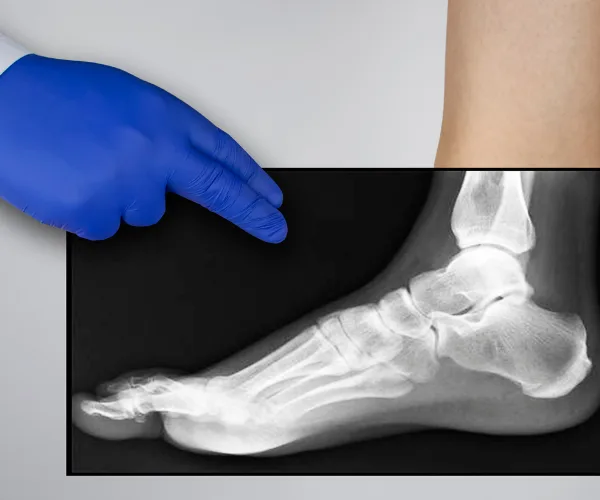
Lisfranc Injury Treatment
Non-Surgical (Conservative) Treatment
Non-surgical care is appropriate only when there are no fractures, the bones remain in normal alignment, and the ligaments are not completely torn — in other words, a stable injury. It typically includes:
- A non–weight-bearing cast or boot for about 6 weeks
- A weight-bearing cast or supportive boot after the first 6 weeks, as healing allows
- Pain control with appropriate anti-inflammatory or pain medication
- Serial X-rays to confirm the joint stays aligned as it heals
- A gradual, supervised return to activity, often with custom orthotic support
Staying off the foot during the initial healing period is critical. If repeat X-rays show any movement of the joint, surgery is recommended.

Surgical Treatment (ORIF)
If the joints are displaced or unstable, surgery restores the alignment and holds it while the foot heals. The most common procedure is open reduction and internal fixation (ORIF): the surgeon repositions the bones and secures them with plates and screws, and repairs torn ligaments as needed. Some or all of the hardware may be removed later, once the ligaments have healed.
Joint Fusion (Arthrodesis)
Less commonly, the surgeon performs a fusion as the initial procedure. Fusion permanently joins one or more midfoot bones into a single solid unit and is chosen when the joint damage is too severe to reconstruct — particularly for purely ligamentous injuries, where some surgeons prefer primary fusion. After either surgery, you wear a splint or cast and keep weight off the foot for several weeks.
Lisfranc Injury Recovery Time
Recovery depends on the severity of the injury and whether surgery was needed:
- Mild, stable sprain (no displacement): roughly 6 weeks of immobilization, with a gradual return to full activity over about 3 months.
- Displaced injury treated with surgery: about 6–8 weeks non–weight-bearing, followed by progressive weight-bearing in a boot. Full recovery commonly takes 6–12 months.
- Regaining motion and strength: physical therapy after immobilization or surgery usually adds 1–2 months and is essential for a good outcome.
The most common problem we see during recovery is a foot that becomes stiff and weak from disuse, which can lead to long-term arthritis. A structured rehab program protects against this.
What Can Go Wrong After a Lisfranc Injury?
The most common long-term complication is post-traumatic arthritis of the midfoot, which occurs in a large share of significant injuries and can cause ongoing pain. The risk is higher when the original injury damaged much of the joint cartilage. Arthritis can develop even after a technically successful surgery, and some patients eventually need a fusion to relieve it.
There is also a risk that the bones fail to heal properly, which can require a second operation. These risks are higher in people who smoke or who have diabetes or osteoporosis. Call your surgeon promptly if you develop a fever or chills, if your pain increases, or if your foot becomes numb.
When to See a Podiatrist
Sudden midfoot pain after a stumble, twist, or fall — especially with swelling or bruising on the sole of the foot, or trouble bearing weight — should be evaluated quickly. Lisfranc injuries are frequently missed, and delayed treatment is what leads to permanent arthritis. Balance Foot & Ankle offers same-week appointments with in-office weight-bearing imaging at our Howell and Bloomfield Township clinics.
Call Balance Foot & Ankle: (810) 206-1402 or book your evaluation online.
Frequently Asked Questions: Lisfranc Injury
Can a Lisfranc injury heal on its own?
It is unlikely. A truly minor, stable midfoot sprain may settle with immobilization, but only after imaging confirms the joint is stable. Because Lisfranc injuries are easy to mistake for an ordinary sprain, what feels like a minor injury can be much more serious — so it should always be evaluated.
Can a Lisfranc injury be misdiagnosed?
Yes — frequently. These injuries are uncommon, complex, and often missed, especially after an emergency-room visit. An initial X-ray may look normal, and only weeks later do the signs of a more significant injury become visible.
Can you walk on a Lisfranc injury?
Walking on an unstable Lisfranc injury can make it worse. If there is a fracture or a torn ligament, weight-bearing can shift the joint further out of place. We usually protect the foot in a walking boot and keep weight off it — sometimes with a knee scooter or crutches — until imaging confirms it is safe to load.
Does a Lisfranc injury always require surgery?
No. Mild ligament sprains without displacement can heal with immobilization. Displaced or unstable injuries — and most fracture-dislocations — usually need surgery to realign and stabilize the midfoot.
How long does recovery take?
A mild, stable sprain generally needs about 6 weeks of immobilization with a return to activity over roughly 3 months. After surgery for a displaced injury, expect 6–8 weeks non–weight-bearing and full recovery over 6–12 months, plus physical therapy to restore motion and strength.
What happens if a Lisfranc injury goes untreated?
Untreated injuries commonly lead to chronic pain, midfoot arthritis, a collapsed arch, and lasting instability. The foot can also become stiff and weak, which sometimes contributes to heel pain and other compensatory problems.
Is it safe to return to sports after a Lisfranc injury?
Only after full recovery and clearance from your podiatrist. Returning too soon risks re-injury and accelerates arthritis. A graded return-to-activity plan with your specialist is the safest path.
Get Expert Lisfranc Care in Howell & Bloomfield Township
Don’t risk permanent midfoot damage. Our board-certified foot & ankle surgeons provide accurate diagnosis with in-office imaging and a treatment plan tailored to your injury. Same-week appointments are available and most insurance is accepted.
Book online: Schedule your Lisfranc evaluation • Call: (810) 206-1402
- Howell: 4330 E Grand River Ave, Howell, MI 48843
- Bloomfield Township: 43494 Woodward Ave #208, Bloomfield Township, MI 48302
Related Treatment Guides
Medical References & Sources
- Myerson MS, et al. “Fracture dislocations of the tarsometatarsal joints: end results correlated with pathology and treatment.” Foot and Ankle. 1986;6(5):225–242.
- Nunley JA, Vertullo CJ. “Classification, investigation, and management of midfoot sprains: Lisfranc injuries in the athlete.” American Journal of Sports Medicine. 2002;30(6):871–878.
- Desmond EA, Chou LB. “Current concepts review: Lisfranc injuries.” Foot and Ankle International. 2006;27(8):653–660.
- American Orthopaedic Foot & Ankle Society — Foot Conditions
- American Podiatric Medical Association — Patient Education
Midfoot injury or Lisfranc concern?
Missed Lisfranc injuries cause lasting problems — they need prompt, expert evaluation. In Michigan? our specialists can image and treat it. Same-week visits in Howell & Bloomfield Township, most insurance accepted.
📅 Book an Appointment 📞 (810) 206-1402★ 4.9 from 1,123+ Google reviews · Same-week visits · We verify your insurance free — most visits are just a copay.

Dr. Tom Biernacki, DPM is a board-certified foot & ankle surgeon (ABFAS & ABPM) at Balance Foot & Ankle Specialists in Southeast Michigan. With over a decade of clinical experience, he specializes in heel pain, bunions, diabetic foot care, sports injuries, and minimally invasive surgery. Dr. Biernacki is a member of the APMA and ACFAS, and his patient education content on MichiganFootDoctors.com and YouTube has made him one of the most-followed foot & ankle educators on YouTube.
More questions patients ask
What is a Lisfranc injury and how is it treated?
A Lisfranc injury involves damage to the bones or ligaments of the midfoot (Lisfranc joint complex) — the connection between the midfoot bones and the metatarsals. It ranges from ligament sprains to fracture-dislocations. Treatment at Balance Foot & Ankle ranges from non-weight-bearing casting or booting for mild sprains to surgical stabilization with plates and screws for severe fracture-dislocations.
How long does Lisfranc injury recovery take?
Lisfranc injury recovery varies significantly by severity. Mild ligamentous sprains may recover in 3-6 months with conservative treatment. Surgical repairs for fracture-dislocations typically require 6-12 weeks non-weight-bearing followed by months of rehabilitation — with full recovery taking 9-18 months. Balance Foot & Ankle provides comprehensive Lisfranc injury care with appropriate imaging and individualized recovery planning.
What are the signs of a Lisfranc injury?
Signs of a Lisfranc injury include midfoot pain and swelling, bruising on the sole of the foot, inability to bear weight, and a palpable gap or shift at the midfoot. The classic sign is bruising across the plantar arch. Lisfranc injuries are often initially missed — if you have significant midfoot pain after an injury, see a podiatrist promptly. Balance Foot & Ankle provides expert evaluation including weight-bearing X-rays.
Does Lisfranc injury require surgery?
Lisfranc injuries with significant ligamentous instability or any fracture-dislocation generally require surgical stabilization to prevent chronic arthritis and deformity. Pure ligamentous sprains without displacement may be managed in a cast or boot with close monitoring. Balance Foot & Ankle evaluates Lisfranc injuries with stress X-rays and CT scan when needed to determine the optimal treatment approach. Call (810) 206-1402.
Still have a question about coverage or cost? Book online and we will check your benefits before your visit: Book in Howell · Book in Bloomfield Township. Prefer to talk it through first? Call (810) 206-1402.