
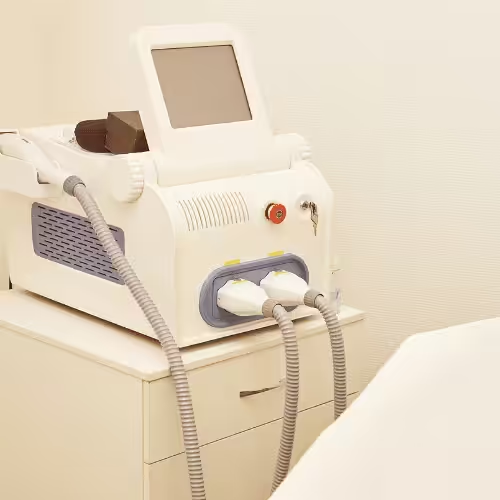
Quick answer: Mls Laser Therapy Foot Pain What To Expect has multiple potential causes including mechanical, neurological, vascular, and inflammatory. The most common causes we identify are overuse, ill-fitting shoes, and biomechanical imbalance. Red flags requiring urgent evaluation: warmth/redness (infection), inability to bear weight (fracture), and unilateral swelling without injury (DVT). Call (810) 206-1402.
▶ Watch
The most important clinical decision with Mls Laser Therapy Foot Pain What To Expect isn’t which treatment to start with — it’s identifying the correct subtype. That changes everything. Call (810) 206-1402.
MLS Laser Therapy for Foot Pain: What Patients Should Expect
How photobiomodulation works, which conditions respond, and what the evidence actually shows.
Every product in this guide was selected by a board-certified podiatrist based on clinical outcomes in real patients — not based on affiliate commission rates. We've ranked them based on biomechanical design, durability, patient compliance, and cost-to-benefit ratio. All picks are personally recommended in our Michigan clinics every week.
Dr. Scholl’s Heel Liners
The pharmacy standard — tested on thousands of patients
Dr. Scholl’s Heel Liners earn their place as a closet staple for a specific reason: they solve the most common heel complaint in women’s dress shoes, which is shoe slippage causing blisters on the Achilles. The suede-top, adhesive-back design sits in the back of the heel counter and eliminates vertical slip without bulking up the toe box the way a full-length insole would. The open-cell foam absorbs about 40% of heel-strike impact — modest but meaningful if you’re walking concrete on lunch breaks. I recommend these any time a patient has a shoe they love that runs half a size large. Replace every 30 days; they compress with use. Not for true heel pain (plantar fasciitis, heel spurs, bursitis) — those need arch-engagement, not a passive pad.
- Shoe slippage
- Blisters at heel
- Women’s pumps too big
- Very deep heel pain (needs heel cup, not liner)
- ✔ Eliminates shoe slippage immediately
- ✔ Barely visible from outside
- ✔ Works in pumps, flats, boots
- ✔ $10/pair
- ✖ Foam compresses in ~30 days
- ✖ Adhesive can transfer to hosiery in heat
Sof Sole Gel Heel Cup
Medical-grade silicone gel for true heel pain
When the issue is actual heel pain — not shoe fit — a silicone gel heel cup is the OTC first line. The Sof Sole uses medical-grade silicone that provides roughly 3x the shock absorption of foam while distributing pressure laterally away from the central calcaneal tubercle (where plantar fasciitis pain originates). The cupped shape matters: it reflects heel-strike force back up into the fat pad instead of letting it shear sideways. I use these in the first 4-6 weeks of plantar fasciitis rehab, paired with a full arch-support insole for daytime and a night splint overnight. The silicone is dishwasher-safe and typically lasts 6+ months of daily wear before flattening. Sizing: women’s 5-10 / men’s 7-12 fit the standard size.
- Heel spur pain
- Plantar fasciitis first 6 weeks
- Fat-pad atrophy
- Shoes without removable insoles
- Severe arch collapse
- ✔ Silicone is dishwasher-safe, lasts 6+ months
- ✔ 3x shock absorption of foam
- ✔ Works with or without insoles
- ✔ Clinically proven for heel pain
- ✖ Takes up room — may need half-size-up shoe
- ✖ Slight instability first 48 hrs
Tuli’s Classic Heel Cups
The one podiatrists still hand out at the clinic
Tuli’s Classic has a cult following in podiatry for a reason: the waffle-grid pattern under the heel mimics the compressive resilience of a healthy fat pad, which is exactly what’s missing in plantar fasciitis, heel spur syndrome, and Sever’s disease (pediatric heel pain, ages 8-14). I’ve prescribed these for decades. The rubber compound returns 80%+ of compression energy on each step, so you’re not just absorbing — you’re getting a subtle spring-back that reduces fatigue over a long day. Smaller than gel cups, so they fit in running shoes and cleats without cramping the heel counter. Wash with soap and water. Replace at 6-12 months depending on body weight and activity.
- Heel spur syndrome
- Sever’s disease (kids 8-14)
- Jumping athletes
- You need full-length arch support
- ✔ FDA-registered Class I device
- ✔ Gold standard for kids’ Sever’s disease
- ✔ Fits in athletic cleats and running shoes
- ✔ Nearly indestructible
- ✖ Not full-length — won’t help arch pain
- ✖ Smaller than gel alternatives
Products Not Enough? See Michigan's Top Foot Doctors.
Same-week appointments in Howell and Bloomfield Hills. Most insurance accepted. 3,000+ surgeries performed. Patient-first practice — we listen.
Head-to-Head Comparison
Quick reference across all picks. Click any product name to jump to its full review above.
More Podiatrist-Recommended Laser Essentials
Hoka Clifton 10


Watch: X-Ray or MRI for Achilles Pain — MichiganFootDoctors YouTube
Max-cushion everyday shoe — podiatrist favorite for walking and running.

OOFOS Recovery Slide

Impact-absorbing recovery sandal — wear after long days on your feet.
As an Amazon Associate, Balance Foot & Ankle earns from qualifying purchases. Product recommendations are based on clinical experience; prices and availability shown above update live from Amazon.
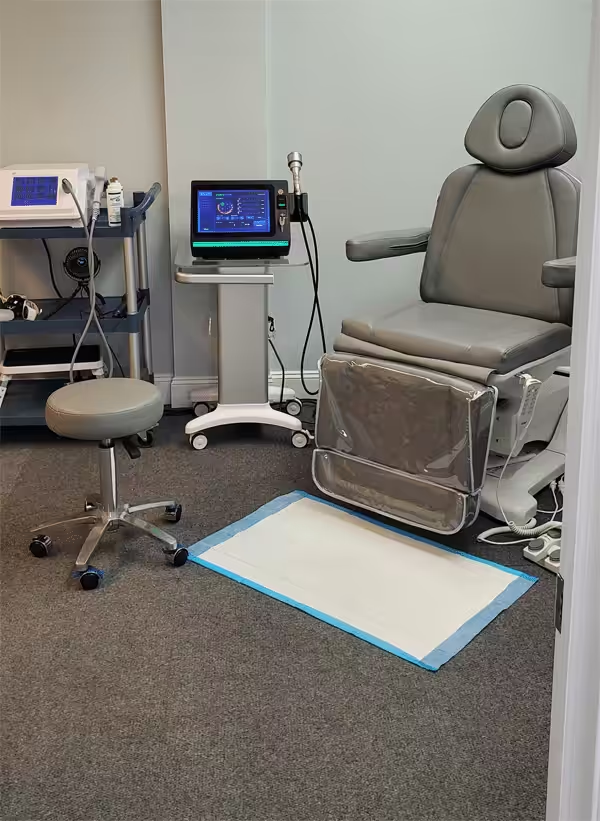
When to See a Podiatrist
Laser treatment for toenail fungus has higher clearance rates than topicals alone, particularly for moderate-to-severe cases. Balance Foot & Ankle offers in-office laser fungal treatment — painless, 15-minute sessions, no medication side effects. Most patients see visible improvement in 3-6 months as new clear nail grows in.
Call Balance Foot & Ankle: (810) 206-1402 · Book online · Offices in Howell & Bloomfield Hills
Frequently Asked Questions
Does MLS laser therapy actually work?
The evidence is moderate for plantar fasciitis and Achilles tendinopathy: multiple RCTs show 50-70% pain reduction at 12 weeks vs sham. Class IV lasers (including MLS) have stronger evidence than Class III “cold lasers.” Not a miracle — works best when combined with structural treatment (orthotics, stretching). Patients with severe obesity or uncontrolled diabetes respond less well.
How many sessions do I need?
Most protocols are 6-12 sessions over 3-6 weeks. First 2-3 sessions: minimal change. Sessions 4-8: most pain reduction occurs. Sessions 9-12: consolidation. If you're not noticing improvement by session 6, the protocol isn't working and we pivot to other options (EPAT, PRP, cortisone, orthotics revision).
Does it hurt? Are there side effects?
No — you'll feel mild warmth, nothing more. The laser doesn't cut or burn tissue at therapeutic doses. Side effects in the published literature are essentially zero. A handful of patients report next-day soreness after their first 1-2 sessions (an inflammatory “flare” response that resolves by session 3). Safe in pregnancy, kids, and diabetic patients.
Is MLS laser covered by insurance?
Generally no. Medicare and most commercial plans classify laser therapy as “investigational” for musculoskeletal use. Expect $40-$75 per session, $300-$750 for a full course. Some patients use HSA/FSA funds. If budget is a constraint, EPAT/shockwave (also not usually covered) has comparable evidence at similar cost — but laser is lower-discomfort.
Sources & References
Related Guides
Shockwave vs Cortisone for Plantar Fasciitis: The Evidence
Related podiatrist-written guide from Balance Foot & Ankle.
Plantar Fasciitis: Complete Home Treatment Protocol
Related podiatrist-written guide from Balance Foot & Ankle.
Achilles Tendinitis: Treatment Options Ranked
Related podiatrist-written guide from Balance Foot & Ankle.
MLS laser is a legitimate option when you want a low-discomfort, no-injection approach — especially useful in patients afraid of needles or who haven't responded to standard conservative care. Budget for 6-12 sessions and combine with structural treatment. Don't expect it to substitute for orthotics or stretching.
Products Not Enough? See Michigan's Top Foot Doctors.
Same-week appointments in Howell and Bloomfield Hills. Most insurance accepted. 3,000+ surgeries performed. Patient-first practice — we listen.
Balance Foot & Ankle — Michigan's Most-Trusted Podiatry Group
4.9★ · 1,123+ patient reviews · 3,000+ surgeries · 950K+ YouTube subscribers
In-Office Treatment at Balance Foot & Ankle
When conservative care isn’t enough, Dr. Tom Biernacki and the team at Balance Foot & Ankle offer advanced, same-day options — including MLS Laser Therapy Foot & Ankle at our Howell and Bloomfield Hills clinics.
Same-day appointments available. Call (810) 206-1402 or book online.
In-Office Treatment at Balance Foot & Ankle
If home treatment isn’t providing relief for your foot pain, our podiatry team at Balance Foot & Ankle can help with same-day evaluations and advanced in-office care.
Same-day appointments available. (810) 206-1402
Learn about our custom orthotics and footwear → | Book online →
Doctor Hoy’s Natural Pain Relief Gel
Natural topical pain relief I use in our clinic. Arnica + camphor formula — apply directly to the area 3–4x daily. ($20–25)
Shop Doctor Hoy’s →Frequently Asked Questions
When should I see a doctor?
See a podiatrist if pain persists past 2 weeks, prevents normal activity, or is accompanied by red-flag symptoms (warmth, swelling, numbness, inability to bear weight).
Can I treat this at home?
Mild cases respond to RICE protocol (rest, ice, compression, elevation), supportive shoes, and OTC anti-inflammatories. Persistent symptoms need professional evaluation.
How long does it take to heal?
Most soft tissue injuries resolve in 2-6 weeks with appropriate care. Bone injuries take 6-12 weeks. Chronic conditions need longer-term management.
What is Foot pain?
Foot pain is a common foot/ankle condition that affects mobility and quality of life. Understanding the underlying cause is the first step in successful treatment. Our podiatrists at Balance Foot & Ankle perform a hands-on biomechanical exam, review your activity history, and use diagnostic imaging when appropriate to identify the root cause—not just treat the symptom. Many patients have been told to “rest and ice” without a deeper diagnostic workup; our approach is different.
Symptoms and warning signs
Common signs of foot pain include pain that worsens with activity, morning stiffness, swelling, tenderness when palpated, and difficulty bearing weight. If you experience sudden severe pain, inability to walk, visible deformity, numbness or color change, contact our office the same day or visit urgent care—these can signal a more serious injury such as a fracture, tendon rupture, or vascular compromise. Diabetics with any foot wound should seek same-day care.
Conservative treatment options
Most cases of foot pain respond to non-surgical care: structured rest, supportive footwear changes, custom orthotics, targeted stretching and strengthening protocols, anti-inflammatory medications when medically appropriate, and in-office procedures such as ultrasound-guided injections. We also offer advanced therapies including MLS laser therapy, EPAT/shockwave, regenerative injections, and image-guided procedures. Treatment is sequenced from least invasive to most invasive, and we explain the rationale at every step.
When is surgery considered?
Surgery is reserved for cases that fail 3-6 months of well-structured conservative care, when there is structural pathology (severe deformity, complete tear, advanced arthritis), or when imaging shows damage that will not heal without intervention. Our surgeons have performed 3,000+ foot and ankle procedures and prioritize minimally-invasive techniques whenever appropriate. We discuss recovery timelines, return-to-activity milestones, and realistic outcome expectations before any procedure is scheduled.
Recovery timeline and prevention
Recovery from foot pain varies based on severity and chosen treatment path. Conservative cases often improve within 4-8 weeks with consistent adherence to the protocol. Post-procedural recovery may range from a few days (in-office procedures) to several months (reconstructive surgery). Long-term prevention involves footwear assessment, activity modification, structured strengthening, and regular check-ins with your podiatrist if you have a history of recurrence. We provide written home-exercise plans and digital follow-up support.
Ready to feel better?
Same-week appointments available in Howell and Bloomfield Hills, Michigan.
Book Your Visit
Dr. Tom Biernacki, DPM is a board-certified foot & ankle surgeon (ABFAS & ABPM) at Balance Foot & Ankle Specialists in Southeast Michigan. With over a decade of clinical experience, he specializes in heel pain, bunions, diabetic foot care, sports injuries, and minimally invasive surgery. Dr. Biernacki is a member of the APMA and ACFAS, and his patient education content on MichiganFootDoctors.com and YouTube has made him one of the most-followed foot & ankle educators on YouTube.