
Foot pain typically responds to early podiatrist evaluation, conservative treatments like supportive footwear and targeted stretching, and—when needed—custom orthotics. Most patients see improvement within 4-6 weeks of starting a treatment plan. Severe or persistent symptoms warrant in-person assessment to rule out structural issues. Contact our Howell or Bloomfield Township office to book an evaluation.
PowerStep vs Good Feet Store: What I Tell My Michigan Patients
Board-certified podiatrist Dr. Tom Biernacki compares the Good Feet Store’s $1,500–$2,500 arch support system to a pair of PowerStep Pinnacle insoles — across plantar fasciitis, flat feet, overpronation, diabetic feet, and why the sunk-cost framing inside Good Feet locations is the single most common financial-harm pattern I see in my clinic.
Get My Top Pick (PowerStep Pinnacle) Call (810) 206-1402Quick Answer
A $35–$60 PowerStep Pinnacle does 90% of what a $1,500–$2,500 Good Feet Store three-insole system does for the average patient with plantar fasciitis, flat feet, or overpronation. The Good Feet Store sells a rotating three-insole “maintainer / strengthener / relaxer” set fit in-store by commissioned sales associates without a medical license, without imaging, and without a treatment plan beyond “wear these daily.” PowerStep Pinnacle is a pre-molded semi-rigid orthotic developed by a podiatrist, built with a 4-degree medial post, variable cushioning arch, and deep heel cup — the same architecture I use as a starting point in my Howell and Bloomfield Township clinics. For truly complex biomechanics (rigid cavus foot, severe posterior tibial dysfunction, Charcot foot, limb-length discrepancy), neither off-the-shelf Good Feet nor PowerStep is adequate — you need a custom orthotic from a podiatrist, which most PPOs partially cover. Good Feet sits in an expensive middle ground that rarely makes clinical sense.
On This Page
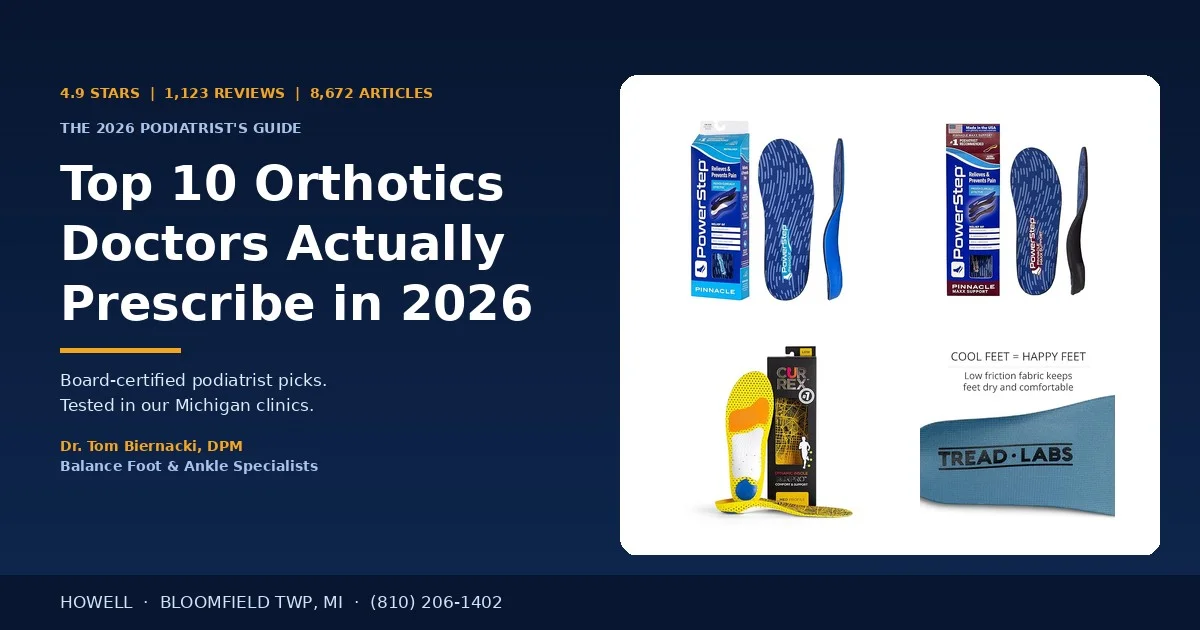
PowerStep Pinnacle Semi-Rigid Orthotic
This is the first insole I hand to a new plantar fasciitis patient before considering anything custom. The 4-degree medial post reduces tension on the plantar fascia during midstance, the deep heel cup controls rearfoot eversion in overpronators, and the semi-rigid shell transfers ~70% of the biomechanical correction a custom orthotic delivers at 3–5% of the cost. It fits most athletic shoes, dress shoes with removable insoles, and work boots. I dispense these in clinic at both locations.
See PowerStep Pinnacle (via Levanta) →The Real Cost Difference
This is the page most patients come to me AFTER they’ve already walked into a Good Feet Store and been handed a quote. I want the cost framing to be the first thing you see:
Typical out-of-pocket cost per patient
That is a 22× to 71× price difference for a product category where the peer-reviewed outcomes between the two overlap almost completely in the uncomplicated foot. Good Feet occasionally offers financing — which pushes a $2,000 purchase into 24 monthly payments and extends the sunk-cost feeling that keeps people wearing inserts that aren’t helping.
PowerStep Pinnacle Semi-Rigid Orthotic
Developed in 1994 by Dr. Les Appel, a board-certified podiatrist. The Pinnacle is a pre-molded polypropylene shell with a 4-degree rearfoot post, variable-cushioning arch, deep heel cup, and a dual-layer EVA top cover. It is the off-the-shelf orthotic most used in U.S. podiatry residency programs as a first-line intervention for plantar fasciitis, flat feet, mild posterior tibial dysfunction, and overuse-related heel pain.
Why I Recommend
- Designed by a podiatrist, not a retail chain
- 4-degree medial post provides real rearfoot control, not just arch “feel”
- Deep 18 mm heel cup stabilizes the calcaneus and cushions the heel fat pad
- Semi-rigid shell — firm enough to correct, flexible enough to break in
- Fits in athletic shoes, most dress shoes, hiking boots, work boots
- 12–18 month lifespan in a daily-wear pair
- ~$40 replacement cost means you can cycle pairs without financial stress
- Available at nearly every major pharmacy, Amazon, and Levanta
Trade-Offs
- Not custom — won’t accommodate a limb-length discrepancy, plantar plate injury, or rigid cavus foot
- 2-week break-in period is normal; some patients quit before the adaptation
- Full-length design may not fit certain narrow dress shoes without trimming
- Semi-rigid shell feels firm for the first few days if you’ve only worn gel or foam inserts
- Not enough correction for severe overpronation in a 250+ lb patient — that case needs custom
The Good Feet Store Three-Insole System
A retail franchise chain that sells a three-insole “Maintainer / Strengthener / Relaxer” rotation inside walk-in stores, fit by commissioned sales associates without a medical license, imaging, or clinical follow-up. The stated rationale is that the three inserts train your foot through different positions during the day. The price point typically runs $1,299–$2,499 per system, sometimes higher with added accessories and shoes.
What It Does Well
- Walk-in convenience — no appointment needed, same-day pickup
- Lifetime replacement policy on the inserts themselves (terms vary by franchise)
- Rigid arch support does help a meaningful subset of flat-footed patients feel better immediately
- A clean retail experience with staff trained to explain the concept
Why I Don’t Refer Patients
- Fitters are not licensed medical providers — no diagnosis, no differential, no imaging
- Cost is 22–70× higher than an equivalent podiatrist-designed off-the-shelf orthotic
- No peer-reviewed outcome data superior to PowerStep or other pre-molded orthotics
- No follow-up protocol — if the insole isn’t working at week 6, there is no clinical escalation path
- Financing terms can extend sunk-cost bias (“I already paid $1,800, I have to keep wearing them”)
- Returns and refunds are harder than most patients expect after purchase
- If the underlying problem is a tendon rupture, neuroma, stress fracture, or Charcot — no orthotic system solves it, and the delay to diagnosis matters
Side-by-Side: PowerStep Pinnacle vs Good Feet Store
| Factor | PowerStep Pinnacle | Good Feet Store 3-Insole System |
|---|---|---|
| Typical price | $35–$60 per pair | $1,299–$2,499 for the three-insole system |
| Designed by | Dr. Les Appel, DPM (1994) | Retail franchise; no single clinical designer named |
| Fit by | Self-fit from shoe size, or podiatrist dispensing | In-store commissioned sales associate (no medical license required) |
| Arch support type | Semi-rigid polypropylene shell with 4° medial post | Rigid molded plastic with a 3-insole rotation concept |
| Heel control | 18 mm deep heel cup, meaningful rearfoot control | Varies by which of the three insoles; inconsistent across rotation |
| Clinical evidence | Used in podiatry residency programs; cited in orthotic-outcome studies | No peer-reviewed outcome data superior to pre-molded OTC orthotics |
| Diabetic-appropriate | On intact skin, yes — with podiatrist check-in | Not recommended by ADA/APMA guidelines without medical supervision |
| Medicare / PPO coverage | No coverage needed at this price; custom orthotics covered when medically necessary | Not covered by insurance |
| Return policy | 30-day Amazon return, Levanta standard, most pharmacies honor | Varies by franchise; typically restrictive |
| Follow-up / escalation path | Built into podiatry care: 6-week check, imaging, custom if needed | None — no clinical provider in the chain |
| Lifespan | 12–18 months daily wear | “Lifetime” insert replacement, but the biomechanics don’t change |
| My clinic use | Dispensed daily as first-line at both offices | Not recommended; often seen in patients who come to clinic AFTER |
| Where to buy | Via Levanta (FW brand) | Good Feet retail stores only |
How to Choose: The 4-Question Decision Tree
Start here
No or unsure → Continue to question 2.
Yes, and imaging was clear → Continue to question 3.
No → Continue to question 4.
No → Stay the course; most uncomplicated plantar fasciitis resolves in 8–12 weeks on the conservative protocol.
What I Actually Do in My Michigan Clinic
For a new patient walking into my Howell or Bloomfield Township office with arch, heel, or overpronation complaints, the first visit is usually:
- History and physical examination. Onset, activity, prior orthotics, prior imaging, footwear worn today, neuropathy screen, pulse check, range of motion, single-limb stance, gait observation.
- Targeted imaging if indicated. Weight-bearing X-rays for suspected stress fracture, posterior tibial tendon dysfunction, midfoot arthritis, cavus architecture, or history of prior injury.
- Biomechanical assessment. Standing alignment, calcaneal position, Jack’s test, windlass mechanism, first-ray mobility, hallux dorsiflexion.
- First-line orthotic intervention. PowerStep Pinnacle dispensed from the office or purchased via the patient’s preferred retailer. 2-week break-in schedule written down.
- Adjuncts. Gastrocnemius-soleus stretching protocol, night splint for first-step pain, Doctor Hoy’s topical for local symptoms, activity modification, appropriate shoe recommendations.
- Follow-up at 6 weeks. Reassess. If not improving, MRI or custom orthotics enter the conversation. Most PPO insurance covers medically-necessary custom orthotics with a CPT L3000 or L3020 code.
- Escalation if needed. Corticosteroid injection, extracorporeal shockwave, PRP, or surgical consultation depending on diagnosis. These are conversations a Good Feet sales associate cannot have.
The total cost of this protocol, including 2 office visits and PowerStep, is typically $150–$400 with insurance. The total cost of custom orthotics if needed, with insurance, is typically $200–$500 out-of-pocket. Both pathways cost less than the Good Feet Store system, and both include a real diagnosis and a real follow-up plan.
When An Off-the-Shelf Insole Won’t Fix It — Red Flags
Either PowerStep or Good Feet will fail if the underlying problem isn’t biomechanical. Stop the insole experiment and book a podiatry exam if you have:
- Pain that wakes you up at night or is worse at rest than with activity
- A visible bump or deformity on the arch, ball of foot, or top of midfoot
- Numbness, tingling, or burning that is getting worse (neuropathy workup needed)
- A specific tender point on a single metatarsal (stress fracture workup)
- A sudden inability to raise up on your toes on one side (posterior tibial tendon rupture — urgent)
- Redness, warmth, or swelling in a diabetic foot (infection / Charcot workup — urgent)
- Pain that has lasted more than 8 weeks despite consistent OTC orthotic use and stretching
- A prior foot or ankle surgery that hasn’t been re-evaluated in over a year
Call Balance Foot & Ankle: (810) 206-1402. We book same-week in both Howell and Bloomfield Township, and most PPO insurance covers the visit.
Before You Sign a Good Feet Contract — Get a Second Opinion
I see patients same week at both Michigan offices, review any out-of-store quote you’ve received, and in most cases can recommend a biomechanical path that costs a fraction of Good Feet’s three-insole system while actually diagnosing what’s causing the pain.
Call (810) 206-1402 Book OnlineFrequently Asked Questions
Is Good Feet Store a scam?
My doctor said I need custom orthotics. Is PowerStep a substitute?
Are PowerStep Pinnacles covered by insurance?
I already bought the Good Feet system. Can I get my money back?
Why does my arch feel so good when I first try a Good Feet insole?
Can I try PowerStep and Good Feet at the same time?
What if I have flat feet and both insoles feel uncomfortable?
What about Superfeet or other retail orthotics?
Can kids use PowerStep Pinnacle?
What’s the difference between PowerStep Pinnacle and a custom orthotic I’d get from you?
Related Pages from My Clinic
- Plantar fasciitis: the complete podiatrist’s guide
- Flat feet — when it matters and when it doesn’t
- Best insoles for plantar fasciitis (PowerStep Pinnacle is #1)
- Custom orthotics — when they’re actually needed
- Doctor Hoy’s vs Biofreeze — what I hand out in clinic
- Podiatrist-recommended recovery gear 2026
- Howell, MI podiatry office
- Bloomfield Township podiatry office
Foot pain — Frequently Asked Questions
When should I see a podiatrist for foot pain?
If symptoms persist beyond 2 weeks of self-care, interfere with daily activity, or worsen suddenly, schedule a podiatrist evaluation. Early intervention typically shortens recovery and prevents chronic compensation patterns.
Will I need imaging or surgery?
Most foot pain cases resolve with conservative care—custom orthotics, supportive shoe changes, anti-inflammatory protocols, and targeted physical therapy. Imaging (X-ray, ultrasound, MRI) is reserved for cases that fail conservative treatment or when structural pathology is suspected. Surgery is rarely the first option.
Does insurance cover foot pain treatment in Michigan?
Most major Michigan insurance plans (BCBS, BCN, Priority Health, HAP, Medicare, Medicaid HMOs, United, Aetna, Cigna) cover medically necessary podiatric care. Custom orthotics may have separate DME coverage rules. Our team verifies your specific benefits before your visit.
More questions patients ask
How much does Good Feet Store actually cost?
Good Feet Store pricing varies by location and package. As of 2026, the full 3-Step System typically runs $1,299 to $2,499.
Are PowerStep insoles as good as custom orthotics?
For mild-to-moderate arch pain, plantar fasciitis, and flat feet, PowerStep Pinnacle delivers 70-80% of the clinical benefit of a custom orthotic at a fraction of the cost.
Does Good Feet Store work for plantar fasciitis?
Yes, Good Feet arch supports can relieve plantar fasciitis because any well-fit arch support reduces strain on the plantar fascia.
Why do podiatrists not recommend Good Feet Store?
Most podiatrists do not have a problem with the product - we have a problem with the price. $1,500-$2,500 for three off-the-shelf insoles and a 30-minute fitting is a steep markup.
Which PowerStep model is best for flat feet?
For mild flat feet: PowerStep Pinnacle. For moderate-to-severe flat feet or overpronation: PowerStep Pinnacle Maxx.
Still have a question about coverage or cost? Book online and we will check your benefits before your visit: Book in Howell · Book in Bloomfield Township. Prefer to talk it through first? Call (810) 206-1402.