
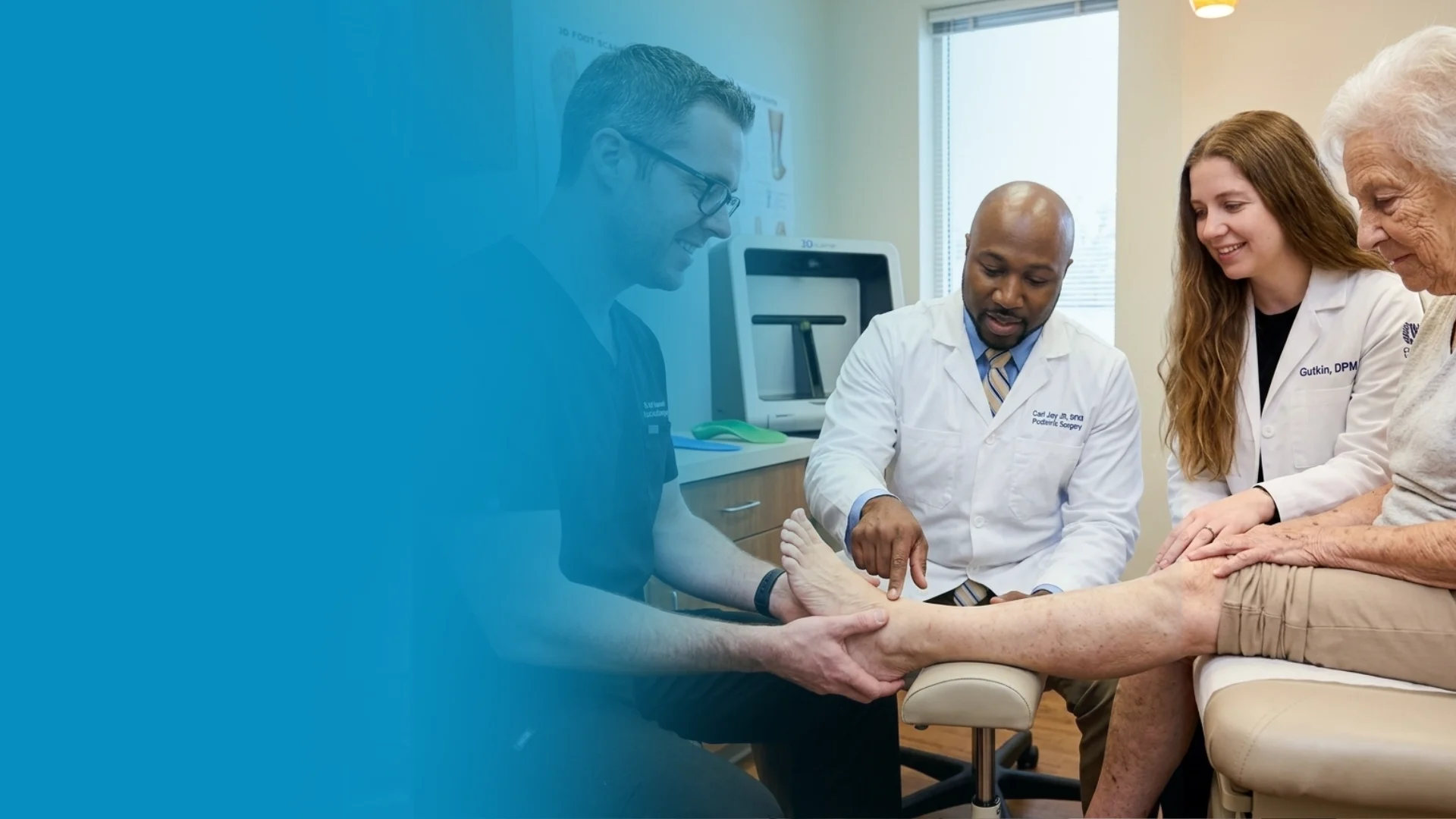
You are in the right place. Dr. Tom Biernacki, DPM, FACFAS — board-certified foot & ankle surgeon with 3,000+ surgeries — explains exactly what tarsal tunnel syndrome treatment means and what actually works. Book online or call (810) 206-1402 for a same-week appointment at our Howell or Bloomfield Township office.
Quick answer: Treatment for tarsal tunnel syndrome treatment michigan follows a stepwise approach: 1) conservative care first (rest, ice, supportive footwear, OTC anti-inflammatories), 2) physical therapy and targeted exercises, 3) in-office treatments (injections, custom orthotics) if conservative fails at 4-6 weeks, 4) surgery for refractory cases. Most patients resolve at step 1 or 2. Book online, or call (810) 206-1402.
Medically reviewed by Dr. Tom Biernacki, DPM · Board-Certified Podiatric Surgeon · Last reviewed: April 2026 · Editorial Policy
In This Article
Related Conditions
Medically reviewed by Dr. Tom Biernacki, DPM
Board-certified podiatric surgeon | Balance Foot & Ankle
Last reviewed: May 2026
Quick Answer
Tarsal Tunnel Syndrome Treatment in Michigan — The Foo relates to foot pain — typically caused by overuse, footwear, or biomechanics. Most patients improve in 6-12 weeks with conservative care. Same-week appointments in Howell + Bloomfield Township: (810) 206-1402.
Tarsal Tunnel Syndrome Treatment in Michigan — The Foot’s Carpal Tunnel
Tarsal Tunnel: Often Misdiagnosed, Always Treatable
Tarsal tunnel syndrome is compression of the posterior tibial nerve as it passes through a narrow canal on the inner ankle. Like carpal tunnel in the wrist, it causes burning pain, numbness, tingling, and electric-shock sensations — but in the sole and toes. At Balance Foot & Ankle in Howell and Bloomfield Township, we diagnose and treat tarsal tunnel syndrome using both conservative and advanced technology approaches.
Symptoms
Burning, shooting, or tingling pain along the inner ankle and sole, symptoms worsening with prolonged standing and improving with rest, electric-shock sensations into the heel or toes, and a positive Tinel’s sign (tapping over the tarsal tunnel reproduces symptoms). Some patients present with vague arch pain that mimics plantar fasciitis.
Causes
Flat feet (overpronation) stretching and compressing the nerve, ankle swelling from venous insufficiency or edema, ganglion cysts or space-occupying lesions, post-traumatic scar tissue from prior ankle sprains, inflammatory arthritis, and idiopathic causes.
Treatment
Conservative: custom orthotics correcting overpronation (the most common cause) and reducing nerve tension, anti-inflammatory management, activity modification. When conservative care doesn’t provide adequate relief, our technology adds significant value — REMY laser therapy directly over the tarsal tunnel reduces nerve inflammation and promotes nerve healing; EMTT provides deep electromagnetic nerve stimulation often producing relief in patients who failed conservative care.
✅ REMY Class IV Laser — FDA-cleared
✅ EPAT Shockwave Therapy — non-surgical, in-office
✅ Magnetotransduction (EMTT) — Deep electromagnetic healing
✅ 3D-Scanned Custom Orthotics
✅ Toenail Fungus Laser
✅ In-Office X-Ray & Ultrasound
✅ Diabetic Shoe Program — Medicare-covered
📞 (810) 206-1402 | Howell & Bloomfield Township
Call (810) 206-1402. Tarsal tunnel is frequently misdiagnosed as plantar fasciitis — accurate diagnosis makes all the difference.
Tarsal Tunnel Syndrome Treatment in Michigan: Diagnosis, Conservative Care, and Surgery
Tarsal tunnel syndrome — compression of the posterior tibial nerve as it passes through the tarsal tunnel behind the medial malleolus — is one of the most commonly misdiagnosed foot conditions in Michigan, frequently confused with plantar fasciitis (they can coexist), peripheral neuropathy, and generalized heel pain. The distinguishing clinical features: burning pain, tingling, and numbness along the inner ankle and plantar foot, often radiating to the heel and arch; a positive Tinel’s sign (reproduction of symptoms with percussion over the tarsal tunnel); and symptoms that characteristically worsen with prolonged standing and walking and improve with rest. The diagnosis is confirmed by clinical examination and, when clinical findings are equivocal, nerve conduction velocity testing that shows slowed conduction at the tarsal tunnel. At Balance Foot & Ankle, electrodiagnostic confirmation is arranged through our neurology referral network before surgical intervention is considered.
Conservative management for tarsal tunnel syndrome in Michigan includes: custom orthotics designed to reduce tension on the posterior tibial nerve by controlling hyperpronation and reducing the valgus loading that compresses the tunnel; corticosteroid injection into the tarsal tunnel (effective in 50–70% of cases for significant symptom reduction); REMY laser therapy targeting the compressed nerve; and activity modification to reduce provocative loading. Surgical tarsal tunnel release — in which the flexor retinaculum is divided to decompress the nerve — is reserved for patients who have failed 3–6 months of conservative care with objective electrodiagnostic evidence of nerve compression. Michigan patients with suspected tarsal tunnel syndrome who have been told their foot pain is “just plantar fasciitis” and have not responded to plantar fasciitis treatment should call Balance Foot & Ankle at (810) 206-1402 for a targeted diagnostic evaluation.
Related Treatment Guides
- Tarsal Tunnel Syndrome Treatment
- Posterior Tibial Tendon Dysfunction Treatment
- Plantar Fasciitis & Heel Pain Treatment
- Custom 3D Orthotics
Michigan patients who have been diagnosed with plantar fasciitis but have not responded to standard treatment — particularly those with numbness, tingling, or burning on the inner ankle alongside their heel pain — should discuss tarsal tunnel syndrome as a possible contributing or alternative diagnosis with their podiatrist. The two conditions can coexist (a common scenario where hyperpronation both loads the plantar fascia and compresses the tarsal tunnel simultaneously), and treating only the plantar fasciitis while missing the tarsal tunnel component explains many chronic plantar heel pain treatment failures. At Balance Foot & Ankle, we routinely evaluate for tarsal tunnel syndrome in patients with plantar heel pain who have not responded to conservative plantar fasciitis management. Call (810) 206-1402 to schedule a diagnostic evaluation at our Howell or Bloomfield Township office.
Medical References & Sources
- American Podiatric Medical Association — Patient Education
- American Orthopaedic Foot & Ankle Society — Foot Conditions
Join 950,000+ Learning About Foot Health
Dr. Tom shares honest medical advice, supplement reviews, and treatment guides you won’t find anywhere else.
📍 Located in Michigan?
Our board-certified podiatrists treat this condition at two convenient locations. Most new patients are seen the same week.
Insurance Accepted
BCBS · Medicare · Aetna · Cigna · United Healthcare · HAP · Priority Health · Humana · View All →
Howell Office
4330 E Grand River Ave
Howell, MI 48843
Get Directions →
Bloomfield Township Office
43494 Woodward Ave, #208
Bloomfield Township, MI 48302
Get Directions →
Your Board-Certified Podiatrists



Ready to Get Back on Your Feet?
Same-week appointments available at both locations.
More Podiatrist-Recommended Foot Health Essentials
Hoka Clifton 10

Hoka Men’s Clifton 10 Black/White 10 Medium
- JACQUARD KNIT UPPER
- Lining Textile
Max-cushion everyday shoe — podiatrist favorite for walking and running.
PowerStep Pinnacle Insole

PowerStep Pinnacle Insoles, Orthotics for Plantar Fasciitis Relief, Made in USA Orthotic Insoles, Arch Support Inserts with Moderate Pronation, #1 Podiatrist Recommended (M 14-15)
- The Pinnacle Full length insoles for men & women provide maximum cushioning, from high activity to moderate support. The PowerStep arch support shape provides stability to the foot and ankle, helping to relieve foot pain.
- When you spend all day on your feet, every step counts. PowerStep insoles are a podiatrist-recommended orthotic to help relieve & prevent foot pain related to athletes, runners, Plantar Fasciitis, heel spurs & other common foot, ankle & knee injuries
- The Pinnacle plantar fasciitis insoles offer superior heel cushioning and arch support. The dual-layer cushioning is designed to reduce stress and fatigue, while PowerStep premium arch support is designed for plantar fasciitis relief.
- The PowerStep Pinnacle arch support inserts for men & women can be worn in a variety of shoe types such as; athletic, walking, running, work & some casual shoes. Orthotic Inserts are ordered by shoe size, no trimming required.
- Made in the USA & backed by a 30-day money-back guarantee. PowerStep orthotic inserts for men & women are designed for shoes where the factory insole can be removed. HSA & FSA Eligible
The podiatrist-recommended over-the-counter orthotic.
OOFOS Recovery Slide

OOFOS OOahh Recovery Slide, Black – Women’s Size 14, Men’s Size 12
- The Original Recovery Footwear.
- Finding Your Size – For your perfect fit, consult the “size chart” link above. Wear a half size? In general, we recommend that women who wear a ½ size size UP, and men who wear a ½ size size DOWN
- OOahh – An evolution of the OOriginal, the OOahh slide features our proven foundation of OOfoam technology + patented footbed design with a slide-style strap that has become a best-seller in the OOFOS line
- OOfoam Technology – Our revolutionary OOfoam technology absorbs 37% more impact than traditional footwear foams to reduce the stress on your feet, joints & back. Plus, the closed-cell foam is machine washable and designed to minimize odor
- Patented Footbed – Our patented footbed cradles and supports arches to reduce energy exertion in the ankles by up to 47% compared to competitors’ footwear. So walking is easier. Recovery is faster. And yOO feel better
Impact-absorbing recovery sandal — wear after long days on your feet.
As an Amazon Associate, Balance Foot & Ankle earns from qualifying purchases. Product recommendations are based on clinical experience; prices and availability shown above update live from Amazon.


When to See a Podiatrist
If foot or ankle pain has been bothering you for more than a few weeks, home care alone may not be enough. Balance Foot & Ankle offers same-week appointments at our Howell and Bloomfield Township clinics — no referral needed in most cases. Bring your current shoes and a short list of symptoms and we’ll build you a treatment plan in one visit.
Call Balance Foot & Ankle: (810) 206-1402 · Book online · Offices in Howell & Bloomfield Township
In-Office Treatment at Balance Foot & Ankle
When conservative care isn’t enough, Dr. Tom Biernacki and the team at Balance Foot & Ankle offer advanced, same-day options — including Tarsal Tunnel Release Michigan at our Howell and Bloomfield Township clinics.
Same-week appointments available. Call (810) 206-1402 or book online.
Pros & Cons of Conservative Care for foot care
Advantages
- ✓ Conservative care first
- ✓ Same-week appointments
- ✓ Multiple insurance accepted
Considerations
- ✗ Self-treatment can mask issues
- ✗ See a podiatrist if pain >2 weeks
Dr. Tom’s Recommended Products for foot care
Affiliate disclosure: As an Amazon Associate, Balance Foot & Ankle earns from qualifying purchases. We only recommend products we use with patients.
Footnanny Heel Cream Dr. Tom’s Pick
Best for: Daily moisturizer for cracked heels
Ready to Get Back on Your Feet?
Same-week appointments in Howell + Bloomfield Township. Most insurance accepted. Dr. Tom Biernacki, DPM & team.
Book Today — Same-Week Appointments Available
Call Now: (810) 206-1402
About Your Care Team at Balance Foot & Ankle
Dr. Tom Biernacki, DPM · Board-Certified Foot & Ankle Surgeon. Specializes in conservative-first care, minimally invasive bunion surgery, and complex reconstruction.
Dr. Carl Jay, DPM · Accepting new patients. Specializes in sports medicine, athletic injuries, and routine podiatric care.
Dr. Daria Gutkin, DPM, AACFAS · Accepting new patients. Specializes in surgical reconstruction and pediatric podiatry.
Locations: 4330 E Grand River Ave, Howell, MI 48843 · 43494 Woodward Ave Suite 208, Bloomfield Township, MI 48302
Hours: Mon–Fri 8:00 AM – 5:00 PM · (810) 206-1402
In-Office Treatment at Balance Foot & Ankle
If home treatment isn’t providing relief for your tarsal tunnel syndrome treatment michigan, our podiatry team at Balance Foot & Ankle can help with same-week evaluations and advanced in-office care.
Same-week appointments available. (810) 206-1402
Doctor Hoy’s Natural Pain Relief Gel
Natural topical pain relief I use in our clinic. Arnica + camphor formula — apply directly to the area 3–4x daily. ($20–25)
Ready for Expert Care?
Same-week appointments in Howell & Bloomfield Township, MI.
4.9★ | 1,193+ Reviews | 3,000+ Surgeries
Or call: (810) 206-1402
