
Quick answer:Toenail changes — thickening, discoloration, lifting, ridges, or a dark streak — can mean fungus, injury, psoriasis, or, rarely, melanoma. Our Michigan podiatrists diagnose the cause (sometimes with a quick nail test or biopsy), treat it, and evaluate any suspicious dark streak promptly. Book online, or call (810) 206-1402.
Medically reviewed by Dr. Tom Biernacki, DPM · Board-Certified Podiatric Surgeon · Last reviewed: April 2026 · Editorial Policy
Quick Answer
Toenail Changes — What They Mean Michigan Podiatrist relates to toenail conditions — typically caused by fungal infection or trauma. Most patients improve in 6-12 months for nail regrowth with conservative care. Same-week appointments in Howell + Bloomfield Township: (810) 206-1402.

Medically reviewed by Dr. Tom Biernacki, DPM — Board-Certified Podiatric Surgeon — Balance Foot & Ankle, Howell & Bloomfield Township, MI. Last updated April 2026.
▶ Watch
Your toenails tell a story. Changes in toenail color, thickness, texture, or attachment can be cosmetically concerning, occasionally painful, and sometimes a signal of a serious underlying condition. At Balance Foot & Ankle, Dr. Tom Biernacki evaluates toenail changes with a clinician’s eye — distinguishing between common benign conditions and the rare but important findings that require additional investigation.
Yellow or Discolored Toenails
Most likely cause: Onychomycosis (fungal nail infection) — Yellow, brown, white, or orange discoloration with nail thickening is almost always fungal. Dermatophyte fungi invade the nail plate, causing progressive discoloration, crumbling, and thickening. Diagnosis is confirmed by nail clipping culture or PAS stain — not just visual appearance alone. Treatment options include topical antifungals (Jublia, Kerydin), oral terbinafine or itraconazole (most effective), or laser nail treatment. A confirmed positive culture before starting oral medication is medically sound practice.
Other causes of yellow nails: Yellow nail syndrome (associated with lymphedema and respiratory conditions); psoriatic nails (yellow-orange discoloration with pitting); prolonged use of certain medications; or simply staining from nail polish.
Black or Dark Toenails
Most likely cause: Subungual hematoma — A bruise under the nail from trauma (dropping something on the foot, running in tight shoes) causes blood to pool under the nail plate, appearing black or dark purple. Most hematomas resolve over weeks as the nail grows out. Large, painful hematomas can be drained by piercing the nail plate (trephination) for immediate relief. Always confirm the black discoloration is a hematoma and not melanoma.
Important: Subungual melanoma — Dark pigmentation under the nail that cannot be attributed to trauma requires urgent evaluation to rule out subungual melanoma — a rare but serious skin cancer. Features raising concern: dark streak in the nail (melanonychia) that is widening, has irregular borders, or is accompanied by pigmentation on the surrounding skin fold (Hutchinson’s sign). Any unexplained dark nail stripe warrants a biopsy referral.
Thick or Distorted Toenails
Fungal infection (onychomycosis) is again the most common cause of nail thickening. Other causes: onychogryphosis (ram’s horn nail) — extreme nail curvature and thickening from repeated trauma or poor nail hygiene, common in elderly patients; subungual exostosis — a bone spur growing under the nail causes the nail to lift and distort; psoriasis — produces pitting, onycholysis, and subungual hyperkeratosis (thickening under the nail).
Lifting or Separating Toenails (Onycholysis)
Separation of the nail plate from the nail bed can be caused by fungal infection, trauma, psoriasis, thyroid disease, medication side effects (especially certain chemotherapy agents, tetracyclines, and quinolone antibiotics), or simply from wearing nail polish long-term. The separated nail provides a dark, moist space where secondary bacterial infections can occur. Trimming the separated nail back and keeping the area dry is important while the underlying cause is treated.
White Spots on Toenails
Small white spots (leukonychia punctata) are usually harmless — caused by minor nail matrix trauma (bumping the nail during growth). They grow out with the nail over weeks. Diffuse whitening of the entire nail can indicate systemic conditions including liver disease, kidney disease, or hypoalbuminemia and warrants evaluation.
Get Your Toenails Evaluated in Michigan
Don’t ignore toenail changes — most are treatable and some warrant urgent evaluation. Balance Foot & Ankle provides expert toenail evaluation and treatment at southeast Michigan offices. Call (810) 206-1402 to schedule with Dr. Biernacki.
More Podiatrist-Recommended Foot Health Essentials
Hoka Clifton 10


Max-cushion everyday shoe — podiatrist favorite for walking and running.

OOFOS Recovery Slide

Impact-absorbing recovery sandal — wear after long days on your feet.
As an Amazon Associate, Balance Foot & Ankle earns from qualifying purchases. Product recommendations are based on clinical experience; prices and availability shown above update live from Amazon.

When to See a Podiatrist
If foot or ankle pain has been bothering you for more than a few weeks, home care alone may not be enough. Balance Foot & Ankle offers same-week appointments at our Howell and Bloomfield Township clinics — no referral needed in most cases. Bring your current shoes and a short list of symptoms and we’ll build you a treatment plan in one visit.
Call Balance Foot & Ankle: (810) 206-1402 · Book online · Offices in Howell & Bloomfield Township
Frequently Asked Questions
How can I tell if my dark toenail is a bruise or melanoma?
A bruise (hematoma) has a clear history of trauma, grows out with the nail over 3–6 months, and has distinct borders. Melanoma typically appears as a longitudinal dark streak in the nail, may be widening over time, and often has no traumatic history. When in doubt — especially without a clear traumatic cause — have a podiatrist evaluate urgently. The consequences of missing a melanoma are far greater than the minor inconvenience of a biopsy.
Is toenail fungus curable?
Yes, but it takes time and the right treatment. Oral terbinafine (Lamisil) taken for 12 weeks achieves cure in approximately 70–80% of cases — the highest success rate of any treatment. Topical antifungals (Jublia, Kerydin) are safer but achieve only 15–25% cure rates. Laser treatment varies significantly in reported outcomes. Complete nail clearing after treatment takes 9–12 months as the new healthy nail grows out. Recurrence is common without preventive measures.
Can thick toenails be thinned by a podiatrist?
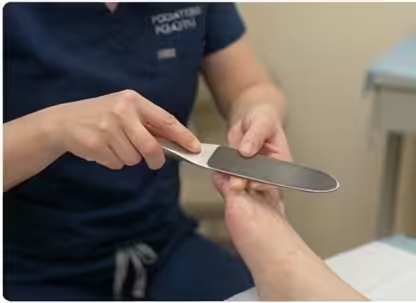
Yes. Professional nail debridement (burring and filing of thickened nails) is a routine podiatric service. This is especially important for diabetic and elderly patients who cannot safely manage their own nails. Reducing nail thickness relieves pressure pain from tight shoes and reduces the nail’s infection reservoir. Medicare covers podiatric nail care when medically indicated.
Dr. Tom’s Recommended Products for Toenail Problems
📍 Located in Michigan?
Our board-certified podiatrists treat this condition at two convenient locations. Most new patients are seen the same week.
These are products I personally use and recommend to my patients at Balance Foot & Ankle.
- Nail Tek Intensive Therapy II — Restores brittle, discolored, and damaged nails — base coat that strengthens nail plate after trauma or fungal damage
- Kerasal Fungal Nail Renewal — Visibly improves nail appearance for both fungal and non-fungal discoloration within 8 weeks
- Professional Toenail Clipper — Harperton Nail Nipper — Stainless steel curved jaw cuts thick or ingrown toenails cleanly — prevents nail trauma and subungual hematoma
Affiliate disclosure: As an Amazon Associate, Balance Foot & Ankle earns from qualifying purchases. We only recommend products we trust for our own patients.
Join 950,000+ Learning About Foot Health
Dr. Tom shares honest medical advice, supplement reviews, and treatment guides you won’t find anywhere else.
Subscribe on YouTube →Medically Reviewed by: Dr. Tom Biernacki, DPM — Board-Certified Podiatrist, Balance Foot & Ankle Specialists

Insurance Accepted
BCBS · Medicare · Aetna · Cigna · United Healthcare · HAP · Priority Health · Humana · View All →
Howell Office
4330 E Grand River Ave
Howell, MI 48843
Get Directions →
Bloomfield Township Office
43494 Woodward Ave, #208
Bloomfield Township, MI 48302
Get Directions →
Your Board-Certified Podiatrists



Ready to Get Back on Your Feet?
Same-week appointments available at both locations.
Book Your AppointmentPros & Cons of Conservative Care for toenail conditions
Advantages
- ✓ Most cases resolve at home
- ✓ Same-week appointments available
- ✓ Permanent fix exists
Considerations
- ✗ Recurrence common without prevention
- ✗ Diabetics need professional care
Dr. Tom’s Recommended Products for toenail conditions
Affiliate disclosure: As an Amazon Associate, Balance Foot & Ankle earns from qualifying purchases. We only recommend products we use with patients.
Tolcylen Antifungal Solution Dr. Tom’s Pick
Best for: Most effective topical for fungus
Ready to Get Back on Your Feet?
Same-week appointments in Howell + Bloomfield Township. Most insurance accepted. Dr. Tom Biernacki, DPM & team.
Book Today — Same-Week Appointments Available
Call Now: (810) 206-1402
About Your Care Team at Balance Foot & Ankle
Dr. Tom Biernacki, DPM · Board-Certified Foot & Ankle Surgeon. Specializes in conservative-first care, minimally invasive bunion surgery, and complex reconstruction.
Dr. Carl Jay, DPM · Accepting new patients. Specializes in sports medicine, athletic injuries, and routine podiatric care.
Dr. Daria Gutkin, DPM, AACFAS · Accepting new patients. Specializes in surgical reconstruction and pediatric podiatry.
Locations: 4330 E Grand River Ave, Howell, MI 48843 · 43494 Woodward Ave Suite 208, Bloomfield Township, MI 48302
Hours: Mon–Fri 8:00 AM – 5:00 PM · (810) 206-1402
Visit Balance Foot & Ankle — Same-Week Appointments Available
Our podiatry team serves patients throughout Michigan including Howell, Brighton, and Bloomfield Township. If you’re dealing with heel pain, ingrown toenails, or a foot injury, we have same-week appointment availability.
Same-week appointments available. (810) 206-1402
Doctor Hoy’s Natural Pain Relief Gel
Natural topical pain relief I use in our clinic. Arnica + camphor formula — apply directly to the area 3–4x daily. ($20–25)
Shop Doctor Hoy’s →Ready for Expert Care?
Same-week appointments in Howell & Bloomfield Township, MI.
4.9★ | 1,123 Reviews | 3,000+ Surgeries
Or call: (810) 206-1402

Dr. Tom Biernacki, DPM is a board-certified foot & ankle surgeon (ABFAS & ABPM) at Balance Foot & Ankle Specialists in Southeast Michigan. With over a decade of clinical experience, he specializes in heel pain, bunions, diabetic foot care, sports injuries, and minimally invasive surgery. Dr. Biernacki is a member of the APMA and ACFAS, and his patient education content on MichiganFootDoctors.com and YouTube has made him one of the most-followed foot & ankle educators on YouTube.