

Quick answer:A bruised toenail is blood trapped under the nail after stubbing the toe or wearing tight shoes, leaving it dark and tender. It usually grows out over months. See a podiatrist if the pain is severe, the toe may be fractured, or a dark area appears with no injury. Call (810) 206-1402.
The most important clinical decision with Toenail Trauma Bruise isn’t which treatment to start with — it’s identifying the correct subtype. That changes everything. Call (810) 206-1402.
Dr. Tom’s Top Toenail Fungus Picks (2026)
Affiliate disclosure: As an Amazon Associate, Balance Foot & Ankle earns from qualifying purchases.
Dr. Tom’s Top Pain Relief Picks — Dr. Hoy’s (2026)
Affiliate disclosure: As an Amazon Associate, Balance Foot & Ankle earns from qualifying purchases. I personally use Dr. Hoy’s in my practice for patients who need topical relief.
| Product | Best For | Dr. Tom’s Take | Get It |
|---|---|---|---|
| Dr. Hoy’s Natural Pain Relief Gel 3.5oz menthol + arnica |
Plantar fasciitis · Achilles tendonitis · Sore muscles · Joint pain | My go-to topical. Cooling-then-warming sensation. No greasy residue. Non-NSAID alternative. | Buy Now |
| Dr. Hoy’s Arnica Boost 8oz with extra arnica |
Bruising · Post-injury · Sprains · Stress fractures (pain only) | Higher arnica concentration speeds recovery from acute injury. Use 4x daily for first 7 days. | Buy Now |
| Dr. Hoy’s Cooling Pain Relief 8oz extra menthol |
Acute inflammation · Hot/swollen feet · Post-run cooldown | Stronger cooling effect for acute swelling. Pair with ice for first 48 hours after injury. | Buy Now |
| Dr. Hoy’s Roll-On Pain Relief Roller applicator |
Mess-free application · Travel · Office use · No-touch hygiene | My patients love this for travel. Glides on without hand contact — cleanest application available. | Buy Now |
| Dr. Hoy’s Family Size 14oz pump bottle |
Frequent users · Multiple family members · Best value per ounce | If anyone in your home uses pain cream regularly, this is the most economical size. Same formula. | Buy Now |
Why I recommend Dr. Hoy’s over Doctor Hoy’s Natural Pain Relief and Bengay: Cleaner ingredient list (no parabens, no synthetic dyes), longer-lasting effect, and the cooling-then-warming dual sensation actually addresses both inflammation and circulation. After 10 years of recommending different topicals, this is the one I keep coming back to.
Medically reviewed by Dr. Tom Biernacki, DPM · Board-Certified Podiatric Surgeon · Last reviewed: April 2026 · Editorial Policy
Related Conditions
Quick Answer
A black toenail is usually trauma, sometimes fungus, and occasionally melanoma. Trauma grows out with the nail; pigment that is new, widening, or spreads onto surrounding skin needs biopsy. Same-week appointments in Howell + Bloomfield Township: (810) 206-1402.
Medically reviewed by Dr. Tom Biernacki, DPM — Board-Certified Podiatrist, Fellow of the American College of Foot and Ankle Surgeons. Updated April 2026.
What Causes a Black Toenail?
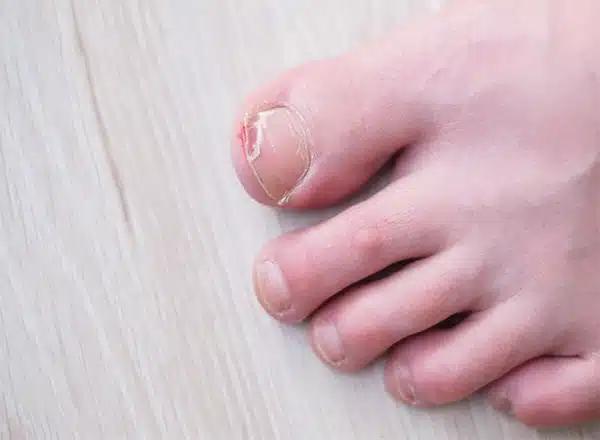

A black or dark toenail is one of the most common reasons patients visit a podiatrist, and getting the diagnosis right matters significantly—because the causes range from completely benign (a bruise under the nail from running) to potentially serious (subungual melanoma). The three most important causes are subungual hematoma (blood under the nail from trauma), onychomycosis (nail fungus with dark pigmentation), and melanonychia or subungual melanoma (dark pigmentation from nail cells or cancer). Each has distinct features that help distinguish them, though nail biopsy is sometimes the only way to be certain.
Subungual Hematoma: The Traumatic Black Toenail
Subungual hematoma—blood pooling between the nail plate and nail bed—is the most common cause of a dark toenail. It results from direct trauma (dropping something on the toe, stubbing the toe) or from repetitive microtrauma in athletes, particularly runners and hikers. In runners, the mechanism is the toe repeatedly striking the front of the shoe during downhill running or prolonged distance. The hallmark features: there is typically a history of injury or heavy athletic activity, the discoloration appears within hours to days of the causative event, the color is dark red to purple-black, and the discoloration grows out with the nail over 6–9 months (the nail growth duration).
A subungual hematoma causing significant pressure under the nail produces throbbing pain—sometimes severe enough to require drainage. Trephination (drilling a small hole through the nail to decompress the blood) provides immediate pain relief and can be performed by a podiatrist. For large hematomas (involving more than 25–50% of the nail area), evaluation for an underlying nail bed laceration or distal phalanx fracture may be appropriate. Small to moderate hematomas without significant pain do not require treatment—they resolve as the nail grows out.
Fungal Nail with Dark Discoloration
Onychomycosis (nail fungus) most commonly causes white, yellow, or brown discoloration with thickening and debris. However, certain fungal species—particularly Trichophyton violaceum and some Candida species—can produce dark brown to black discoloration. Fungal dark nails are distinguished by: thickening of the nail plate, crumbling or debris under the nail, multiple nails often affected, associated athlete’s foot, and the absence of a history of trauma. KOH preparation (examining nail scrapings under microscope) or nail culture confirms the diagnosis. Treatment is with oral antifungals (terbinafine or itraconazole) for the full course—topical antifungals alone do not effectively penetrate the nail plate for established infections.
Melanonychia and Subungual Melanoma
A dark streak running lengthwise under the nail (longitudinal melanonychia) requires careful evaluation. While benign streaks from nail nevi (moles) are common—particularly in individuals with darker skin tones—subungual melanoma presents identically and must be distinguished. Features concerning for melanoma include: Hutchinson’s sign (pigmentation extending from the nail onto the surrounding skin), width greater than 3mm, irregular color variation within the streak, recent change in a previously stable streak, and new-onset in an adult over 50. Any dark streak without a clear traumatic history that does not grow out with the nail should be evaluated by a podiatrist or dermatologist—nail matrix biopsy is the definitive diagnostic test.
Preventing Runner’s Black Toenail
Runners can significantly reduce subungual hematomas by: wearing properly fitted running shoes with adequate toe box space (thumb’s width between the longest toe and the shoe end), replacing shoes before they are excessively worn down, lacing shoes to prevent the foot from sliding forward (especially downhill), trimming toenails straight across and not too short, and wearing moisture-wicking socks. Toenails that are too long repetitively strike the shoe; those cut too short leave the nail bed vulnerable to shoe pressure. If black toenails recur with every marathon, this usually indicates a fitting problem with the shoe rather than a training error.
Frequently Asked Questions
Should I drain a black toenail?
Draining a black toenail (trephination) is recommended when the subungual hematoma is causing significant throbbing pain—the procedure immediately relieves pressure and pain. It is not necessary for hematomas that are not painful or only mildly uncomfortable. Draining should be performed by a healthcare provider using sterile technique; attempting to drain it at home by removing or cutting the nail risks introducing infection. If the hematoma involves more than half the nail area, evaluation for an underlying nail bed laceration or fracture is appropriate before drainage. In diabetic patients or those on blood thinners, evaluation before any nail procedure is advisable. Small, painless hematomas need no treatment—they grow out on their own.
How long does it take for a black toenail to grow out?
Toenails grow approximately 1–2mm per month—much slower than fingernails. A subungual hematoma affecting the entire nail takes 6–9 months to fully grow out and be replaced by new nail. Partial hematomas affecting only a portion of the nail may clear in 3–6 months depending on location. During the growing-out process, the nail may partially or fully separate from the nail bed (onycholysis) before falling off—this is normal. The new nail grows underneath and the discolored nail is replaced. If the discoloration does not move distally (toward the tip) as months pass, it is not growing out and should be re-evaluated—this is one feature distinguishing a non-healing hematoma from a melanonychia that warrants biopsy.
When should I see a doctor for a black toenail?
See a podiatrist for a black toenail when: the pain is severe enough to affect walking or sleep (trephination can provide relief), you cannot identify a clear traumatic cause for the discoloration, the dark area doesn’t move distally with nail growth after 2–3 months, you notice pigmentation spreading onto the skin around the nail (Hutchinson’s sign), the nail has a dark longitudinal streak rather than a diffuse hematoma appearance, you have diabetes or circulation problems (any nail injury warrants evaluation), or if the nail appears infected (increasing redness, warmth, drainage). When in doubt, have it evaluated—distinguishing a harmless bruise from a potential melanoma is something a podiatrist or dermatologist can usually assess clinically.
Visit Balance Foot & Ankle — Same-Day Appointments Available
Our podiatry team serves patients throughout Michigan including Howell, Brighton, and Bloomfield Township. If you’re dealing with heel pain, ingrown toenails, or a foot injury, we have same-day appointment availability.
Same-day appointments available. (810) 206-1402
Medical References & Sources
- American Podiatric Medical Association — Nail Disorders
- PubMed Research — Subungual Hematoma in Runners
- PubMed Research — Melanonychia and Nail Melanoma
Dr. Tom Biernacki, DPM is a board-certified podiatric surgeon at Balance Foot & Ankle in Howell and Bloomfield Township, Michigan. He evaluates and treats nail conditions including subungual hematoma, nail fungus, and suspicious nail pigmentation, and performs nail procedures including trephination and nail biopsy.
Dr. Tom’s Recommended Products for Toenail Problems
📍 Located in Michigan?
Our board-certified podiatrists treat this condition at two convenient locations. Same-day appointments often available.
These are products I personally use and recommend to my patients at Balance Foot & Ankle.
- Nail Tek Intensive Therapy II — Restores brittle, discolored, and damaged nails — base coat that strengthens nail plate after trauma or fungal damage
- Kerasal Fungal Nail Renewal — Visibly improves nail appearance for both fungal and non-fungal discoloration within 8 weeks
- Professional Toenail Clipper — Harperton Nail Nipper — Stainless steel curved jaw cuts thick or ingrown toenails cleanly — prevents nail trauma and subungual hematoma
Affiliate disclosure: As an Amazon Associate, Balance Foot & Ankle earns from qualifying purchases. We only recommend products we trust for our own patients.
👟 Dr. Tom’s Pick: CURREX RunPro Insoles for Runners
CURREX RunPro are biomechanically tuned running insoles with 3 arch profiles (low, medium, high) to match your foot type. Unlike generic insoles, they’re engineered specifically for the high-impact demands of running — reducing pronation stress and metatarsal loading.
View CURREX RunPro on Amazon →📧 Get Dr. Tom’s Free Lab Test Guide
Discover the 5 lab tests every person over 35 should ask their doctor about — explained in plain English by a board-certified physician.
Affiliate disclosure: As an Amazon Associate, Balance Foot & Ankle earns from qualifying purchases.
Join 950,000+ Learning About Foot Health
Dr. Tom shares honest medical advice, supplement reviews, and treatment guides you won’t find anywhere else.
Subscribe on YouTube →
Insurance Accepted
BCBS · Medicare · Aetna · Cigna · United Healthcare · HAP · Priority Health · Humana · View All →
Howell Office
4330 E Grand River Ave
Howell, MI 48843
Get Directions →
Bloomfield Township Office
43494 Woodward Ave, #208
Bloomfield Township, MI 48302
Get Directions →
Your Board-Certified Podiatrists



Ready to Get Back on Your Feet?
Same-week appointments available at both locations.
Book Your AppointmentPros & Cons of Conservative Care for toenail conditions
Advantages
- ✓ Most cases resolve at home
- ✓ Same-week appointments available
- ✓ Permanent fix exists
Considerations
- ✗ Recurrence common without prevention
- ✗ Diabetics need professional care
Dr. Tom’s Recommended Products for toenail conditions
Affiliate disclosure: As an Amazon Associate, Balance Foot & Ankle earns from qualifying purchases. We only recommend products we use with patients.
Tolcylen Antifungal Solution Dr. Tom’s Pick
Best for: Most effective topical for fungus
Ready to Get Back on Your Feet?
Same-day appointments in Howell + Bloomfield Township. Most insurance accepted. Dr. Tom Biernacki, DPM & team.
Book Today — Same-Day Appointments Available
Call Now: (810) 206-1402
About Your Care Team at Balance Foot & Ankle
Dr. Tom Biernacki, DPM · Board-Certified Foot & Ankle Surgeon. Specializes in conservative-first care, minimally invasive bunion surgery, and complex reconstruction.
Dr. Carl Jay, DPM · Accepting new patients. Specializes in sports medicine, athletic injuries, and routine podiatric care.
Dr. Daria Gutkin, DPM, AACFAS · Accepting new patients. Specializes in surgical reconstruction and pediatric podiatry.
Locations: 4330 E Grand River Ave, Howell, MI 48843 · 43494 Woodward Ave Suite 208, Bloomfield Township, MI 48302
Hours: Mon–Fri 8:00 AM – 5:00 PM · (810) 206-1402

Dr. Tom Biernacki, DPM is a board-certified foot & ankle surgeon (ABFAS & ABPM) at Balance Foot & Ankle Specialists in Southeast Michigan. With over a decade of clinical experience, he specializes in heel pain, bunions, diabetic foot care, sports injuries, and minimally invasive surgery. Dr. Biernacki is a member of the APMA and ACFAS, and his patient education content on MichiganFootDoctors.com and YouTube has made him one of the most-followed foot & ankle educators on YouTube.