

Lace-up, stirrup, sleeve, hinged — each brace serves a different purpose. Here is how to pick.
You are in the right place. Dr. Tom Biernacki, DPM, FACFAS — board-certified foot & ankle surgeon with 3,000+ surgeries — explains exactly what ankle brace types and when to use each means and what works. Call (810) 206-1402 for same-day appointment at Howell or Bloomfield Township.
Quick answer: Ankle Brace Types When To Use Each Guide is a common foot/ankle topic that affects many patients. Effective treatment starts with a targeted diagnosis, conservative-first treatment, and escalation only when needed. We treat this regularly at our Howell and Bloomfield Township practices. Call (810) 206-1402.
Medically reviewed by Dr. Tom Biernacki, DPM · Board-Certified Podiatric Surgeon · Last reviewed: April 2026 · Editorial Policy
The most important clinical decision with Ankle Brace Types When To Use Each Guide isn’t which treatment to start with — it’s identifying the correct subtype. That changes everything. Call (810) 206-1402.
Quick Answer
Ankle Brace Types Guide 2026 Podiatrist relates to foot pain — typically caused by overuse, footwear, or biomechanics. Most patients improve in 6-12 weeks with conservative care. Same-week appointments in Howell + Bloomfield Township: (810) 206-1402.
▶ Watch
Medically Reviewed by Dr. Tom Biernacki, DPM — Board-Certified Podiatrist, Balance Foot & Ankle Specialists, Michigan. Last updated April 2026.
The ankle brace market offers dozens of products across several fundamentally different design categories — and selecting the wrong type for your specific condition provides minimal benefit at best, and may delay appropriate treatment at worst. Understanding the mechanical principles behind each brace type helps patients and providers make evidence-based choices that match the device to the clinical indication.
Why Ankle Bracing?
Ankle braces work through two distinct mechanisms:
- Mechanical restraint: Physically limiting the range of ankle motion that would stress injured structures or produce re-injury
- Proprioceptive enhancement: Stimulating skin mechanoreceptors through compression and contact, improving the subconscious neuromuscular response time that prevents the ankle from rolling before voluntary muscle contraction can occur
Most functional braces primarily work through proprioception rather than true mechanical restraint — an important point when patients expect a brace to “hold” their ankle the way a cast does.
Types of Ankle Braces
Compression Sleeves
Simple elastic sleeves provide mild compression and moderate proprioceptive enhancement without meaningful mechanical restraint. Appropriate for: mild ankle swelling, general ankle support during low-risk activities, and maintenance compression during recovery. Not appropriate as primary protection for unstable ankles.
Lace-Up Ankle Braces (Functional Braces)
Lace-up braces (e.g., McDavid 195, Swede-O, ASO) provide circumferential support with figure-8 strapping that limits inversion and eversion while allowing near-normal dorsiflexion and plantarflexion. This is the most evidence-based brace type for chronic lateral ankle instability and return-to-sport after lateral ankle sprains.
Appropriate for: Chronic ankle instability, return to sport after Grade 1–2 sprains, prevention of re-sprain in high-risk athletes, and functional ankle support during activity.
Research demonstrates lace-up braces reduce lateral ankle sprain recurrence by approximately 50% in athletes with prior sprain history — one of the strongest evidence bases in sports medicine bracing.
Air Stirrup / Hinged Brace
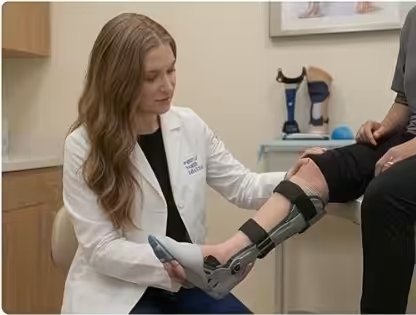
Hinged braces with bilateral air bladders (e.g., Aircast A60) provide rigid lateral support while allowing dorsiflexion and plantarflexion through a hinge. The air bladders compress soft tissue to reduce swelling and provide proprioceptive feedback.
Appropriate for: Acute ankle sprain management (Grade 1–2), early return to weight bearing after sprain, and support during acute inflammatory phases. Not ideal as a long-term sport brace — bulkier and less tolerated in cleated footwear.
Rigid Splint / Short Leg Walking Boot (CAM Walker)
Walking boots completely immobilize the ankle in the sagittal plane and provide significant protection from rotational stress. Used for: acute Grade 3 ankle sprains, stress fractures, tendon injuries requiring relative rest, and post-surgical protection during early healing phases.
Walking boots are not long-term bracing solutions — they produce muscle atrophy and proprioceptive loss with extended use. Transition to functional bracing as soon as the clinical situation allows.
Custom AFO (Ankle-Foot Orthosis)
Custom AFOs are prescribed for neurological conditions (foot drop from tibialis anterior rupture, peroneal nerve palsy, spasticity), severe chronic instability unresponsive to functional bracing, and post-surgical support requiring precise orthotic control. These are prescription medical devices fabricated to the patient’s anatomy.
When Bracing Is Not Enough
Bracing is a management tool, not a cure. Patients with chronic ankle instability who rely on bracing for all activity without completing a proper rehabilitation program are deferring rather than treating the underlying problem. Physical therapy addressing peroneal strength, proprioceptive function, and neuromuscular control is the definitive non-surgical treatment. When rehabilitation fails, surgical reconstruction (Broström procedure) provides lasting correction that bracing cannot replicate.
Ankle Problems That Keep Coming Back? Get a Proper Evaluation.
Dr. Biernacki evaluates ankle instability and prescribes appropriate bracing at Balance Foot & Ankle — Bloomfield Township and Howell, MI.
📞 (810) 206-1402 |
📧 Get Dr. Tom’s Free Lab Test Guide
Discover the 5 lab tests every person over 35 should ask their doctor about — explained in plain English by a board-certified physician.
📍 Located in Michigan?
Our board-certified podiatrists treat this condition at two convenient locations. Same-day appointments often available.
More Podiatrist-Recommended Foot Health Essentials
Hoka Clifton 10


Max-cushion everyday shoe — podiatrist favorite for walking and running.

OOFOS Recovery Slide

Impact-absorbing recovery sandal — wear after long days on your feet.
As an Amazon Associate, Balance Foot & Ankle earns from qualifying purchases. Product recommendations are based on clinical experience; prices and availability shown above update live from Amazon.
When to See a Podiatrist
If foot or ankle pain has been bothering you for more than a few weeks, home care alone may not be enough. Balance Foot & Ankle offers same-week appointments at our Howell and Bloomfield Township clinics — no referral needed in most cases. Bring your current shoes and a short list of symptoms and we’ll build you a treatment plan in one visit.
Call Balance Foot & Ankle: (810) 206-1402 · Book online · Offices in Howell & Bloomfield Township
Watch: Dr. Tom explains

Podiatrist-recommended products
As an Amazon Associate, Dr. Tom earns from qualifying purchases.
Reduces dependence on bracing.
View on Amazon →Controls inversion stress.
View on Amazon →Compression support for mild instability.
View on Amazon →Topical comfort during recovery.
View on Amazon →Related resources
Ready to solve this? Book today.
Same-week appointments · Howell & Bloomfield Township · 4.9★ (1,123+ reviews)
☎ (810) 206-1402Book Online →Pros & Cons of Conservative Care for foot care
Advantages
- ✓ Conservative care first
- ✓ Same-week appointments
- ✓ Multiple insurance accepted
Considerations
- ✗ Self-treatment can mask issues
- ✗ See a podiatrist if pain >2 weeks
Dr. Tom’s Recommended Products for foot care
Affiliate disclosure: As an Amazon Associate, Balance Foot & Ankle earns from qualifying purchases. We only recommend products we use with patients.
Footnanny Heel Cream Dr. Tom’s Pick
Best for: Daily moisturizer for cracked heels
Ready to Get Back on Your Feet?
Same-day appointments in Howell + Bloomfield Township. Most insurance accepted. Dr. Tom Biernacki, DPM & team.
Book Today — Same-Day Appointments Available
Call Now: (810) 206-1402
About Your Care Team at Balance Foot & Ankle
Dr. Tom Biernacki, DPM · Board-Certified Foot & Ankle Surgeon. Specializes in conservative-first care, minimally invasive bunion surgery, and complex reconstruction.
Dr. Carl Jay, DPM · Accepting new patients. Specializes in sports medicine, athletic injuries, and routine podiatric care.
Dr. Daria Gutkin, DPM, AACFAS · Accepting new patients. Specializes in surgical reconstruction and pediatric podiatry.
Locations: 4330 E Grand River Ave, Howell, MI 48843 · 43494 Woodward Ave Suite 208, Bloomfield Township, MI 48302
Hours: Mon–Fri 8:00 AM – 5:00 PM · (810) 206-1402
In-Office Treatment at Balance Foot & Ankle
If home treatment isn’t providing relief for your foot and ankle injuries, our podiatry team at Balance Foot & Ankle can help with same-day evaluations and advanced in-office care.
Same-day appointments available. (810) 206-1402
Frequently Asked Questions
When should I see a podiatrist?
If symptoms persist past 2 weeks, affect your normal activity, or are accompanied by red-flag symptoms (warmth, redness, swelling, inability to bear weight).
What does treatment cost?
Most diagnostic visits and conservative treatments are covered by Medicare and major insurers. Out-of-pocket costs vary by your specific plan.
How quickly can I get an appointment?
Most non-urgent cases see us within 5 business days. Urgent cases (sudden pain, possible fracture) typically same or next business day.

Dr. Tom Biernacki, DPM is a board-certified foot & ankle surgeon (ABFAS & ABPM) at Balance Foot & Ankle Specialists in Southeast Michigan. With over a decade of clinical experience, he specializes in heel pain, bunions, diabetic foot care, sports injuries, and minimally invasive surgery. Dr. Biernacki is a member of the APMA and ACFAS, and his patient education content on MichiganFootDoctors.com and YouTube has made him one of the most-followed foot & ankle educators on YouTube.