
Quick answer: The best shoes for 12-hour shifts combine firm arch support, ample cushioning, a roomy toe box, and a slip-resistant sole — HOKA, Brooks, and New Balance lead for nurses, teachers, and workers on their feet. Choose a removable insole so you can add orthotics, and replace the shoes every 6–12 months as cushioning breaks down.
The best shoes for 12-hour shifts have a different requirement than running shoes or casual footwear — they need zero break-in time, a firm heel counter and structured arch support that hold up past hour 6, and a removable footbed that accepts custom orthotics. The brands that top ‘best nurse shoe’ lists often fail on one of these criteria. Call (810) 206-1402 — podiatrist footwear consultation in Michigan.
Quick Answer: Best Shoes for 12-Hour Shifts (Podiatrist Picks 2026)

The best shoes for 12-hour shifts in 2026 — based on what we put working nurses, teachers, line cooks, and retail staff in at Balance Foot & Ankle — share five mechanical features: firm heel counter, structured arch support, moderate cushioning (NOT maximum), a moderate 4–12mm heel-to-toe drop, and wide toe box. Our top podiatrist-tested picks for 12+ hour shifts are the HOKA Bondi 9, Brooks Ghost 16, ASICS Gel-Kayano 31, New Balance 1080v14, and the Dansko Professional clog for kitchen and medical settings. Maximum-cushioned shoes (HOKA Clifton, On Cloud) are popular but tend to fatigue the small foot stabilizers over a long shift — most workers do better with structured cushioning instead. Custom orthotics inside any of these models dramatically extend the comfort window beyond 8 hours.
The most common mistake: Choosing maximum-cushion “pillow” shoes (HOKA Clifton, On Cloud Originals) because they feel great in the first 30 minutes. Maximum cushion absorbs energy that your foot muscles would otherwise use to stabilize — by hour 6 your intrinsics fatigue and arch fall worsens. Structured cushioning with a firm midfoot is what carries you through hour 12 of a shift.
Why these recommendations: I personally use the products on this page with patients in my Howell and Bloomfield Township clinics. When you buy through the links here, Balance Foot & Ankle earns a small commission at no cost to you — and it helps fund the free educational content I make on YouTube. I will never recommend a product I wouldn’t use on my own family.
⭐ Doctor’s Top Pick for 12-Hour Shifts
HOKA Bondi 9
The shoe I put more shift workers in than any other. Maximum stack height (36mm) with a firm heel counter and a wide, structured platform — cushion that doesn’t collapse by hour 9. 4mm drop, available in wide (2E) for feet that swell at end-of-shift, and it accepts a custom orthotic without crowding the toe box.
The 5 Mechanical Features That Matter for All-Day Standing
- Firm heel counter. Squeeze the back of the shoe between thumb and forefinger — it should NOT collapse. A firm heel counter controls subtalar joint motion and dramatically reduces calf fatigue over a long shift.
- Structured arch support. A noticeable arch shape under the medial midfoot. Should feel supportive, not “missing.” This is what prevents plantar fasciitis and posterior tibial tendon strain after hour 6.
- Moderate cushioning (NOT maximum). Aim for the middle range: enough shock absorption to relieve ground reaction force, not so much that your foot can’t stabilize. Think Brooks Ghost — not HOKA Mach.
- Moderate heel-to-toe drop (4–12mm). The exact number matters less than a firm, structured midfoot. But zero-drop shoes load the Achilles and plantar fascia more aggressively over standing — fine for runners but punishing for standers. Avoid Altra and Lems for all-day standing unless you’ve conditioned to them.
- Wide toe box. Toes need room to splay during weight-bearing. A pointed or narrow toe box compresses the forefoot all day and is the #1 cause of bunion pain progression and Morton’s neuroma flare-ups.
These criteria track with the footwear guidance published by the American Podiatric Medical Association (APMA) — and the stakes are real: peer-reviewed evidence links prolonged occupational standing to lower-limb pain, fatigue, and musculoskeletal symptoms (Waters & Dick, Rehabilitation Nursing, 2015).
Podiatrist’s Top 10 Shoes for 12-Hour Shifts (2026)
1. HOKA Bondi 9 — Best Overall (Nurses, Teachers, Retail)
Heavily cushioned but structured — that distinction is the whole reason it tops this list. The Bondi’s 36mm stack absorbs hard-floor impact, but unlike softer maximum-cushion shoes the platform is wide and the heel counter genuinely firm, so your foot’s stabilizers aren’t fighting a marshmallow at hour 10. The 4mm drop keeps the Achilles comfortable, wide (2E) sizing handles end-of-shift swelling, and the removable footbed takes a custom orthotic cleanly. In my clinic this is the single most consistent performer across ICU nurses, retail staff, and warehouse workers. Holds its cushion to roughly 600 miles.

2. Brooks Ghost 16 — Best Balanced Cushion
The Ghost 16 is the balanced option — cushioning that’s soft enough for comfort but never mushy, with a 12mm drop that unloads the Achilles and calf on long walking blocks. It’s the shoe I recommend to teachers and floor nurses who alternate between standing lectures and 10,000-step days, and it looks dress-casual enough for a classroom. The midsole keeps its rebound deep into its lifespan instead of going flat at month three. Multiple widths available; accepts an orthotic easily.

3. ASICS Gel-Kayano 31 — Best for Overpronators
If your arches collapse inward — flat feet, early posterior tibial tendon dysfunction, recurring shin splints — the Kayano 31 is the pick. The medial support system posts up the inside edge and keeps the midfoot firm under load, which is exactly what fails by hour 8 in an unsupported shoe. FF Blast+ cushioning carries repeated lifting and walking without bottoming out. It runs slightly narrow, so size into the wide variant if your feet swell on shift. This is the shoe that most consistently quiets overpronation-driven heel and arch pain in my working patients.

4. New Balance 1080v14 — Best Plush Comfort
Fresh Foam X in a plusher, more forgiving package — the 1080v14 is the comfort-first choice for ER nurses and retail staff who want cushion closer to the Bondi but with a more traditional running-shoe feel. 6mm drop, wide widths across the entire size run (a New Balance specialty), and a stable enough platform that the plushness doesn’t turn into fatigue. If the Bondi feels too bulky and the Ghost too firm, this is the middle path.

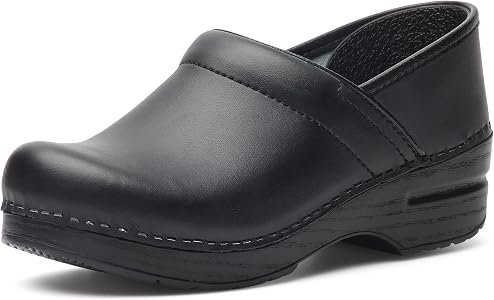
5. Dansko Professional — Best for Kitchen & Medical
The classic clog has survived four decades in hospitals and kitchens for a reason. The polyurethane outsole resists compression through an entire shift (foam midsoles can’t), the rocker shape reduces forefoot pressure during stationary standing, and the sealed leather upper shrugs off spills and bodily fluids. The trade-off: it’s not built for fast walking or sprint-to-the-bedside work — for that, choose the Bondi. For OR nurses, line cooks, pharmacists, and anyone working a short-radius station, it remains unbeatable.
6. Saucony Triumph 22 — Best for Heavy Walkers
PWRRUN+ midsole, 10mm drop, reliable arch support. For workers logging 15,000+ steps per shift. The foam is soft underfoot but recovers its shape between steps instead of packing out, which is what heavy walkers actually need by hour 10. Sizing runs true, and the padded heel collar keeps lockdown secure even when feet swell late in a shift.

7. HOKA Gaviota 5 — Best Stability + Cushion
HOKA’s max-stability model. Wide platform, H-Frame for overpronation, 6mm drop. For workers who need both cushion AND support. Think of it as the Bondi for flat-footed workers: similar cushion volume, but a firmer medial structure that resists arch collapse through a full shift. It runs roomy through the midfoot and pairs well with a custom orthotic.

8. Brooks Adrenaline GTS 24 — Best Daily Support Workhorse
GuideRails support system, 12mm drop, classic workhorse — and one of the most battle-tested stability shoes on the market. The GuideRails control excess knee and rearfoot motion, which matters on hard floors. Choose this if you’ve used Brooks before and like the firm support feel.

9. ASICS GT-2000 13 — Best Budget Stability
Excellent value — typically $100–$140 depending on colorway. FlyteFoam midsole, 8mm drop, mild stability. Good entry point if you’ve never owned a “real” work shoe. The guidance geometry gives mild, unobtrusive pronation control rather than a rigid post, so it suits a wide range of feet. Durability per dollar is the best on this list.

10. Klogs Naples — Best Slip-On Clog Alternative
Slip-on, slip-resistant, leather upper, made in USA. Easy on/off for breaks, dishwasher-safe outsole. Best for kitchen staff and nurses who need to slip in/out quickly. The cushioned footbed is removable for orthotics, the outsole is certified slip-resistant, and the leather upper wipes clean at the end of a kitchen shift. Note: the Naples runs on women’s sizing — men should choose the Dansko above.

Top 5 Compared: Specs at a Glance
| Shoe | Drop | Support style | Widths | Best for | Link |
|---|---|---|---|---|---|
| HOKA Bondi 9 ⭐ | 4mm | Structured max-cushion | B/D/2E | 12+ hr mixed standing/walking | Amazon → |
| Brooks Ghost 16 | 12mm | Balanced neutral | B/D/2E | Teachers, walk-heavy shifts | Amazon → |
| ASICS Gel-Kayano 31 | 10mm | Stability (medial) | B/D/2E | Flat feet, overpronators | Amazon → |
| New Balance 1080v14 | 6mm | Plush neutral | 2A–4E | Plush feel, wide feet | Amazon → |
| Dansko Professional | Rocker | Rigid PU clog | Reg/Wide | OR, kitchen, stationary | Amazon → |
By Job Type: Specific Recommendations
| Job | Top Pick | Why |
|---|---|---|
| ICU / ER Nurse | HOKA Bondi 9 | 12+ hr shifts, mix of standing + sprinting |
| OR Nurse | Dansko Professional | Stationary, spill-resistant, autoclave-friendly |
| Teacher (K-12) | Brooks Ghost 16 | Balanced cushion, looks dress-casual |
| Retail / Cashier | New Balance 1080v14 | Plush, wide widths, durable |
| Restaurant / Line Cook | Dansko or Klogs Naples | Slip resistance, spill-proof, easy clean |
| Construction / Trades | Steel-toe options | See our work boots guide |
| Warehouse / Manufacturing | ASICS Gel-Kayano 31 | Stability for repeated lifting + walking |
| Hairstylist / Barber | Brooks Ghost 16 | Comfort + professional appearance |
Adding a Custom Orthotic — The Single Biggest Upgrade
Even the best shoe is built for an “average” foot. If you stand 8+ hours daily and have ANY of the following — plantar fasciitis, flat feet, high arches, knee pain, low back pain at end-of-shift, recurring shin splints — adding a custom orthotic transforms a good work shoe into a great one. Most patients pay $0–$200 out of pocket with insurance. Read our orthotic cost guide for Michigan →
Not ready for custom yet? The over-the-counter insole I prescribe most often for shift workers is the PowerStep Pinnacle Maxx — a deep heel cradle that locks rearfoot position and a semi-rigid arch shell that supports the midfoot through a full shift. Drop it into any shoe on this list with a removable footbed. It’s a $40–$50 upgrade that often prevents the cortisone injection we’d otherwise be doing three months later.
![Best Insoles & Orthotics 2026 [Flat Feet, Plantar Fasciitis, Bunions]](https://www.michiganfootdoctors.com/wp-content/cache/flying-press/6bd94d933d6cb50dfcfc88e26a6f460e.jpg)
Shoe Rotation: Why You Need 2 Pairs (Not 1)
The single best thing you can do for your feet at work is alternate between two pairs of shoes day-to-day. This:
- Lets the midsole foam decompress overnight — wearing the same shoe daily reduces midsole life by 40%.
- Lets the upper dry fully — sweat-soaked uppers grow bacteria and cause fungal infections.
- Distributes pressure differently — small variations in shoe geometry prevent overuse patterns.
- Extends total shoe lifespan — rotated pairs decompress between wears, so each pair lasts meaningfully longer than one pair worn daily.
When to Replace Your Work Shoes
- 500–600 miles of walking — at typical shift step counts, roughly every 6 months
- Visible compression of the midsole foam — press your thumb into the heel; foam should bounce back quickly
- Sole tread worn smooth at the heel or forefoot
- New foot pain that wasn’t there before
- Side-to-side rocking when standing still — heel counter has failed
Foot Pain at End-of-Shift? Get a 30-Minute Biomechanical Evaluation
Most worker foot pain has a fixable mechanical cause. Same-day appointments at Howell & Bloomfield Township.
Frequently Asked Questions
Are HOKA shoes good for standing all day?
HOKA Bondi and Gaviota — yes. They have firm heel counters and structured cushioning. HOKA Clifton and Mach — less so for very long shifts because the cushion is maximum and tends to allow the foot to fatigue. Match the HOKA model to your shift length: Bondi/Gaviota for 12-hour shifts, Clifton for 4–6 hour shifts.
Are zero-drop shoes bad for standing all day?
Generally yes, for most people who haven’t conditioned to them. Zero-drop shoes load the Achilles tendon and plantar fascia more aggressively over prolonged standing. Workers transitioning to zero-drop should do so gradually over months — not as their primary work shoe from day one.
How much should I spend on work shoes?
$120–$180 is the typical price range for a quality work shoe. Below $80, the midsole foam doesn’t have the durability to hold up to 8+ hour days. Above $200 you’re paying for branding/aesthetics — the additional cost rarely improves the mechanical function for standing.
Can compression socks replace good shoes?
No — they’re complementary. Compression socks improve venous return and reduce leg swelling; good shoes prevent the mechanical foot problems. Workers with leg swelling at end-of-shift benefit from 15–20 mmHg knee-high compression in addition to a quality work shoe.
Are Crocs OK for nurses?
Crocs can be acceptable for stationary nursing roles (OR circulation, ICU bedside) but inadequate for ER, floor nursing, and pediatrics where running and rapid transitions are needed. The lack of a firm heel counter is the main issue. If you wear Crocs, use the strap behind your heel — not in clog mode — for actual support.
Bottom Line
The best shoes for 12-hour shifts combine structured cushioning, a firm heel counter, moderate drop, and a wide toe box. Our top picks are the HOKA Bondi 9, Brooks Ghost 16, ASICS Gel-Kayano 31, New Balance 1080v14, and Dansko Professional. Add a custom orthotic if you stand 8+ hours daily. Rotate between two pairs. Replace every 500–600 miles. If foot pain persists despite good shoes, schedule a biomechanical evaluation at (810) 206-1402 — most worker foot pain has a fixable mechanical cause.
Related Reading at Balance Foot & Ankle
Our podiatrists treat the underlying cause, not just the symptom. Same-week appointments at our Howell and Bloomfield Township, Michigan offices.
Same-Week Appointments in Howell & Bloomfield Township
Three board-certified podiatric surgeons. 1,123+ five-star reviews. Most insurance accepted.
For a complete clinical overview: Podiatrist-Recommended Shoes Guide — shoe recommendations for every foot condition
📋 Dr. Tom Biernacki, DPM, FACFAS answers:
Twelve-hour shifts are among the most biomechanically demanding work schedules I treat, and footwear choice makes an enormous difference in patient outcomes. My non-negotiables for shift workers are: a firm, supportive midsole (not a soft, compressible foam), a moderate heel-to-toe drop (4–12mm — what matters more is a firm, structured midfoot), a roomy toe box to prevent forefoot crowding over long hours, and a removable insole so custom orthotics can be added. I strongly recommend rotating between two pairs of shoes throughout the week — wearing the same pair every shift compresses the midsole without recovery time, cutting effective support in half. Models I trust for 12-hour shifts include the HOKA Bondi and Gaviota, Brooks Ghost and Adrenaline GTS, the New Balance 1080 series, and the ASICS Gel-Kayano. The HOKA Clifton is fine for shorter 4–6 hour shifts, but its softer maximum cushion tends to fatigue the foot’s stabilizers across a full 12 hours. Always replace work shoes every 500 to 600 miles of wear — for most full-time shift workers that’s roughly every six months, far sooner than most people think.

Dr. Tom Biernacki, DPM is a board-certified foot & ankle surgeon (ABFAS & ABPM) at Balance Foot & Ankle Specialists in Southeast Michigan. With over a decade of clinical experience, he specializes in heel pain, bunions, diabetic foot care, sports injuries, and minimally invasive surgery. Dr. Biernacki is a member of the APMA and ACFAS, and his patient education content on MichiganFootDoctors.com and YouTube has made him one of the most-followed foot & ankle educators on YouTube.