
Medically reviewed by Dr. Tom Biernacki, DPM
Board-certified podiatric surgeon | Balance Foot & Ankle
Last reviewed: May 2026
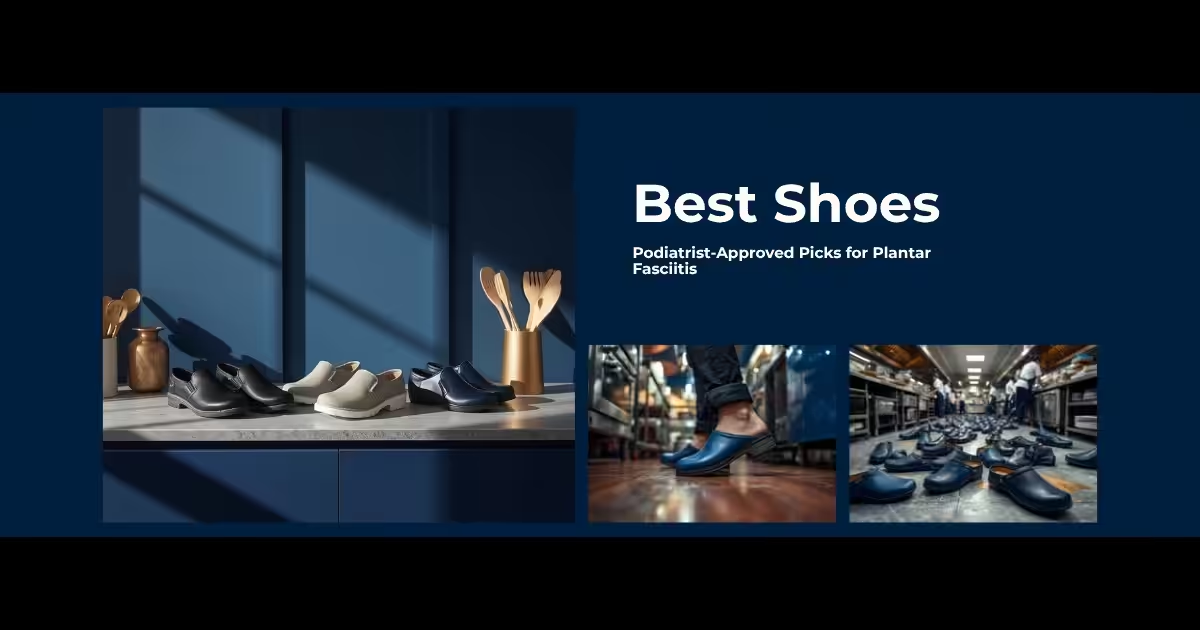

Shoes for chefs with plantar fasciitis face demands that consumer footwear doesn’t — slip resistance on wet surfaces, closed-toe safety requirements, and sustained standing on concrete or tile for 10+ hours. The shoe that works for morning runs fails by hour 6 on a kitchen floor. Call (810) 206-1402 — plantar fasciitis treatment for workers on their feet.
Restaurant kitchen work creates some of the worst conditions for plantar fasciitis that exist. Chefs and line cooks stand on hard tile or concrete floors for 10–14 hours per shift. They pivot constantly, carry heavy loads, navigate tight galley spaces, and deal with wet, greasy, and thermally extreme floor conditions. On top of this, the kitchen environment demands footwear that meets slip-resistance standards (ASTM F1677 or equivalent), is easy to clean, and can handle heat exposure near the line.
Standard restaurant shoes — old Crocs, cheap kitchen clogs, flat slip-resistant sneakers — provide minimal arch support and no heel cup. For cooks with plantar fasciitis, these shoes make every shift more painful. This guide covers the best footwear options for kitchen professionals with plantar fasciitis, heel spurs, or general foot pain.
Disclosure: This review contains affiliate links. If you purchase through our links, we may earn a small commission at no extra cost to you. This does not influence our clinical recommendations.
What Kitchen Work Does to Your Feet
The kitchen environment creates a specific biomechanical challenge. Hard concrete and quarry tile floors have zero give — every heel strike sends impact directly through the foot without any surface-level absorption. Slip-resistant outsoles necessary for kitchen safety are typically made from denser rubber compounds that transmit rather than absorb vibration. Prolonged standing in this environment causes progressive fat pad atrophy in the heel and ball of the foot, increasing plantar fascia loading over years of kitchen work.
The constant pivoting required in a kitchen — turning from cutting board to range, reaching across a station, plating — creates repetitive medial-lateral forces that stress the plantar fascia attachment differently than simple walking. Cooks with flat feet or overpronation are particularly vulnerable because this lateral movement creates additional strain on the posterior tibial tendon and medial arch.
For kitchen professionals with plantar fasciitis, the right shoe needs to address all of these factors simultaneously: cushioning for hard surfaces, arch support for prolonged standing, lateral stability for pivoting, slip resistance for safety, and durability for the work environment.
Best Shoes for Chefs with Plantar Fasciitis 2026
1. Dansko Professional — Best Clog for Kitchen Use
The Dansko Professional is the most clinically appropriate kitchen clog available and has been a staple recommendation in podiatric practice for kitchen workers for decades. The rocker-bottom sole reduces the amount of ankle dorsiflexion required with each step — directly reducing plantar fascia tension at push-off. The deep heel cup stabilizes the calcaneus and compresses the heel fat pad for shock absorption on hard floors.
The Dansko’s wide, stable base provides lateral stability for pivoting, and its uppers are waterproof and easy to wipe clean. The slip-resistant outsole meets restaurant safety standards. Dansko clogs run large — order a half to full size down from your normal size. Available in wide widths for patients with bunions or wide forefoot.
Best for: Line cooks, chefs, all kitchen staff who prefer a traditional clog, flat feet, plantar fasciitis
Not ideal for: Kitchens requiring closed-toe athletic shoes for safety, patients who dislike the elevated heel height
2. Hoka Transport — Best Athletic Shoe for Kitchen Work
The Hoka Transport is Hoka’s work-style casual shoe — built on the Bondi platform with a thick CMEVA midsole and Hoka’s signature meta-rocker geometry, but styled for non-athletic environments. For chefs who prefer an athletic shoe over a clog, the Transport provides Hoka’s best-in-class cushioning in a more kitchen-appropriate silhouette than standard running shoes.
The meta-rocker sole reduces plantar fascia loading by limiting the angle of dorsiflexion at toe-off — the same mechanism that makes the Bondi effective for plantar fasciitis. The thick midsole stack provides substantial cushioning for hard kitchen floors. The Hoka Transport has a slip-resistant outsole appropriate for most kitchen environments.
3. Skechers Work Relaxed Fit — Best Budget Option
Skechers’ Work series offers OSHA-compliant slip resistance and meaningful memory foam cushioning at significantly lower price points than Dansko or Hoka. The Relaxed Fit line provides a wider toe box than standard Skechers, accommodating most foot types including mild bunions. While Skechers’ memory foam compresses more quickly than higher-grade foams, the Work Relaxed Fit remains a strong value option for kitchen workers who replace shoes every 6 months anyway.
4. Birkenstock Super-Birki — Best Non-Slip Clog for Plantar Fasciitis
The Birkenstock Super-Birki is Birkenstock’s kitchen and hospitality clog — a closed-toe, non-slip version of the classic Birkenstock design with a PU foam midsole (more cushioned and moisture-resistant than cork) and a slip-resistant rubber outsole. It carries the full Birkenstock arch support and heel cup in a kitchen-appropriate construction. For patients who respond well to Birkenstock arch support and want that footbed in a kitchen-safe format, the Super-Birki is the direct recommendation.
5. OOFOS OOmg — Best Between-Shift Recovery Shoe
The OOFOS OOmg is not a kitchen work shoe — it does not have slip-resistant outsoles appropriate for active line cooking. However, it is one of the most effective recovery tools for kitchen workers with plantar fasciitis. Wearing OOFOS immediately before and after shifts reduces the cumulative impact load on the plantar fascia during transition and recovery periods. Keep a pair in your locker: change into them the moment service ends.
Kitchen Insoles for Plantar Fasciitis
Even the best kitchen shoe benefits from an upgraded insole for plantar fasciitis patients. The insoles that come with most work shoes are functional but not clinically supportive. Adding an over-the-counter orthotic insert to your Dansko or kitchen sneaker can provide the arch support that keeps symptoms under control during long shifts.
PowerStep Pinnacle Green: The most widely recommended OTC arch support for plantar fasciitis. Its firm heel cup and high-profile arch are appropriate for the wide toe box of most kitchen clogs. Works particularly well in Dansko Professional and similar roomy-fit clogs.
Check PowerStep Pinnacle Green on Amazon →
Powerstep Pinnacle Maxx: A dual-layer insole with a firm orthotic base and cushioned top cover — a balance between structure and cushioning appropriate for prolonged standing on hard floors.
Check Powerstep Pinnacle Maxx on Amazon →
Anti-Fatigue Mats: The Other Half of the Solution
No shoe can fully compensate for standing on bare concrete. If you have any control over your kitchen environment, anti-fatigue mats at your primary work station are one of the highest-impact interventions for plantar fasciitis in kitchen workers. The best anti-fatigue mats for kitchen use are beveled-edge rubber mats with 3/4” to 1” compression foam cores — deep enough to provide real impact absorption without creating a tripping hazard.
Key Takeaway for Kitchen Workers
Dansko Professional clogs for the shift, OOFOS for recovery. Add PowerStep Pinnacle Green insoles to your Danskos. Request anti-fatigue mats at your station if possible. Replace kitchen shoes every 6 months — worn-out cushioning on a hard kitchen floor is one of the most common plantar fasciitis triggers in food service workers.
DASS Medical Compression Socks — Dr. Tom’s Pick
I recommend DASS compression socks (15–20 mmHg) to patients who stand all day, experience morning foot and ankle swelling, or have circulatory issues. Graduated compression improves venous return, reduces fatigue, and takes measurable pressure off the plantar fascia — especially during the first few hours of activity.
Shop SB SOX Compression Socks on Amazon →Affiliate disclosure: Balance Foot & Ankle earns a commission from qualifying Amazon purchases.
Foot Petals Comfort Inserts — Dr. Tom’s Pick for Women’s Footwear
Women’s dress shoes and heels rarely fit the foot correctly — too narrow, no arch support, and thin insoles. Foot Petals’ Tip Toes and Heavenly Heelz inserts slip into any shoe to cushion high-pressure zones, prevent slipping, and reduce forefoot and heel pain without changing shoe size.
Shop Foot Petals on Amazon →Affiliate disclosure: Balance Foot & Ankle earns a commission from qualifying Amazon purchases.
Frequently Asked Questions
Are Crocs good for chefs with plantar fasciitis?
Standard Crocs Classic are not appropriate for plantar fasciitis — they are flat, provide no meaningful arch support, and allow the foot to slide laterally inside the clog. Crocs does make a non-slip work clog (the Crocs At Work) that has better lateral stability and a firmer heel, but it still lacks the arch support and heel cup of Dansko or Birkenstock Super-Birki. If you must wear Crocs, add a PowerStep Pinnacle Green insole and limit total shift hours in them.
How often should I replace kitchen shoes for plantar fasciitis?
Kitchen shoes in active food service use should be replaced every 6–9 months, significantly more often than the standard 12-month guideline for casual footwear. Kitchen floor impacts are more severe than walking on standard surfaces, and the combination of moisture, heat, and constant standing accelerates midsole compression. When your kitchen shoes feel noticeably less cushioned than when new, replace them — worn cushioning on hard floors is a primary driver of plantar fasciitis flares in kitchen workers.
Can custom orthotics be worn in kitchen shoes?
Yes — most kitchen clogs and work shoes have removable insoles that can be replaced with custom orthotics. Dansko Professional works well with custom orthotics because its roomy last provides enough depth for a full-contact orthotic without compressing the toes. If you are a kitchen worker with significant plantar fasciitis, flat feet, or posterior tibial tendon dysfunction, custom orthotics in your Danskos are one of the most effective long-term interventions available.
When to See a Podiatrist
Kitchen workers frequently push through foot pain that requires professional treatment. If better shoes and insoles are not controlling your symptoms, a podiatric evaluation is warranted. Specific indications:
- Heel pain that is severe at the start of a shift and does not improve after the first hour
- Pain that worsens progressively across a shift rather than stabilizing
- Morning heel pain that takes more than 15 minutes to resolve
- Numbness or tingling in the heel, arch, or toes during or after shifts
- Foot pain that is limiting your ability to work full shifts
The podiatrists at Balance Foot & Ankle treat many food service professionals and understand the demands of kitchen work. Custom orthotics, shockwave therapy, and targeted injection therapy can address plantar fasciitis that footwear alone cannot control. Same-week appointments at our Michigan locations.
Foot Pain Surviving Your Shifts?
Balance Foot & Ankle treats plantar fasciitis, heel spurs, and all kitchen-worker foot conditions. Custom orthotics for your Danskos, shockwave therapy, and more. Same-week appointments in Michigan.
Our podiatrists treat the underlying cause, not just the symptom. Same-week appointments at our Howell and Bloomfield Township, Michigan offices.
Same-Week Appointments in Howell & Bloomfield Township
Three board-certified podiatric surgeons. 1,123+ five-star reviews. Most insurance accepted.
For a complete clinical overview: Plantar Fasciitis Treatment Guide — every treatment from stretching to surgery
What makes a shoe podiatrist-recommended?
Wide toe box, firm heel counter, adequate arch support, cushioned midsole, and at least a thumb-width of space past the longest toe.
How often should I replace my shoes?
Every 300-500 miles or 6-12 months — compressed midsole or worn outsole signals it’s time.
📋 Dr. Tom Biernacki, DPM, FACFAS answers:
Chefs and line cooks face a uniquely brutal combination of foot-damaging factors: concrete or tile floors with zero give, prolonged standing with minimal movement breaks, exposure to water and grease that degrades shoe materials quickly, and high heat environments that promote foot swelling. For my patients in the food service industry, I prioritize four things: slip-resistant outsoles rated for wet and oily surfaces, waterproof or water-resistant uppers that can be cleaned easily, a firm midsole with genuine arch support (not just soft foam), and a closed toe with a reinforced toe box for safety. Clogs with rocker soles — like Dansko Professional and HOKA Ora Recovery — are excellent because the rocker geometry actively reduces plantar fascia load during the push-off phase. Skechers Work and New Balance are also strong performers. I specifically warn against kitchen shoes that are all-foam or gel construction without a firm support layer — they feel great for the first two hours but bottom out and become flat platforms by the end of a service. Replace kitchen footwear every 6 months regardless of appearance; the breakdown is happening inside the midsole long before you see external wear.

Dr. Tom Biernacki, DPM is a board-certified foot & ankle surgeon (ABFAS & ABPM) at Balance Foot & Ankle Specialists in Southeast Michigan. With over a decade of clinical experience, he specializes in heel pain, bunions, diabetic foot care, sports injuries, and minimally invasive surgery. Dr. Biernacki is a member of the APMA and ACFAS, and his patient education content on MichiganFootDoctors.com and YouTube has made him one of the most-followed foot & ankle educators on YouTube.
More questions patients ask
What makes kitchen work hard on feet?
Concrete and tile floors transmit ground reaction forces with no absorption, concentrating impact at the heel and forefoot. Non-slip surfaces require the foot to grip slightly with each step, increasing plantar fascia tension. The combination of hard surfaces, prolonged standing, heat that softens shoe materials, and the need to move quickly in tight spaces creates a challenging biomechanical environment that accelerates plantar fasciitis, metatarsalgia, and Achilles problems.
Do anti-fatigue mats help with plantar fasciitis?
Yes — anti-fatigue mats reduce plantar fasciitis pain during standing by 30–40% by providing a compliant surface that reduces ground reaction forces. They do not replace footwear support but work synergistically. If mats aren't available in your workplace, compression socks and plantar fascia stretching during breaks are the most effective interventions for kitchen workers.
What type of insert helps most for kitchen workers with plantar fasciitis?
For kitchen workers, a semi-rigid custom orthotic with a deep heel cup and metatarsal pad is ideal — it provides plantar fascia support while distributing forefoot load. Full-length soft insoles compress quickly under body weight and lose effectiveness within hours. The orthotic must fit in your work shoes without causing toe box crowding.
Still have a question about coverage or cost? Book online and we will check your benefits before your visit: Book in Howell · Book in Bloomfield Township. Prefer to talk it through first? Call (810) 206-1402.