
Quick answer: For many people, yes — Birkenstocks’ firm, contoured cork footbed and deep heel cup give flat feet real arch support that flat, cushioned sandals don’t. They suit flexible flat feet best; with rigid flat feet or significant pain, a podiatrist may recommend a custom orthotic instead.


Birkenstocks are good for one specific type of flat foot — and actively harmful for the other. The difference comes down to whether you have flexible (pronating) flat feet or rigid (fixed) flat feet. Dr. Tom’s 2-type clinical test takes 60 seconds and determines whether Birkenstock’s cork footbed will support your arch or overload your plantar fascia. Scroll down for the test, or call (810) 206-1402 for a same-week evaluation.
★ PODIATRIST’S DIRECT ANSWER — DR. TOM BIERNACKI, DPM, FACFAS
Are Birkenstocks Good for Flat Feet?
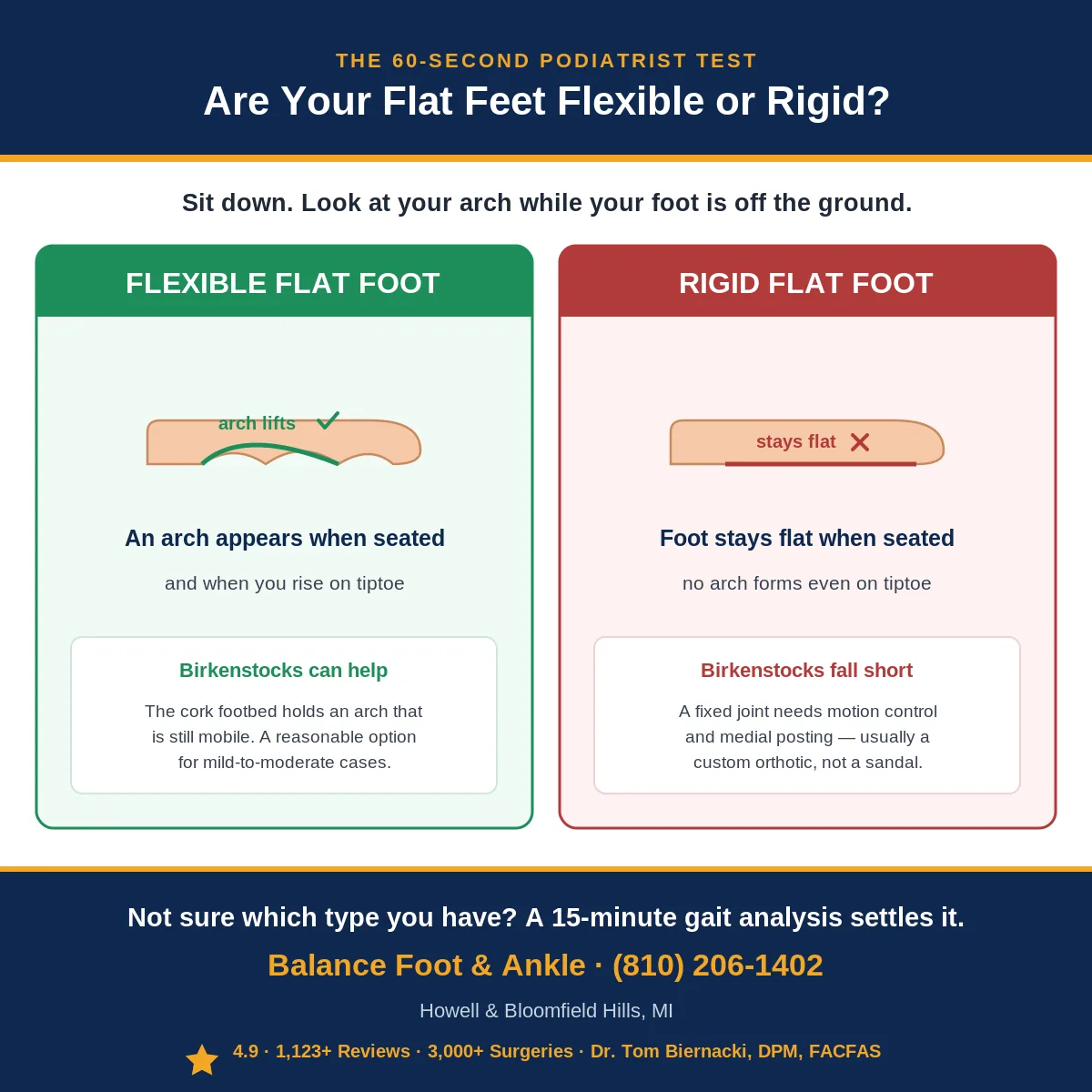
It depends on your flat foot type. Birkenstocks have a contoured cork footbed with ~8mm of arch support — excellent for flexible flat feet (arch appears when non-weight-bearing) where the Birkenstock can hold the arch up. However, for rigid flat feet (arch is flat even when sitting, with fixed subtalar joint), the cork footbed provides inadequate support and may worsen symptoms.
The 60-second test: Sit down and look at your arch. If an arch appears when you’re not standing → flexible flat foot → Birkenstocks likely help. If the foot stays flat even when you’re seated → rigid flat foot → Birkenstocks alone probably insufficient, consider custom orthotics.
Bottom line: Birkenstocks are a reasonable (not ideal) option for mild-to-moderate flexible flat feet. They are not a substitute for custom orthotics in symptomatic flatfoot with plantar fasciitis, posterior tibial tendon dysfunction, or arch pain that persists beyond 3 months.
Most Common Mistake
Buying Birkenstocks based on the brand’s reputation without checking your arch type. Birkenstocks have a fixed deep heel cup and mild arch contour that works well for neutral feet and many high arches — but can worsen symptoms in severe overpronation or adult-acquired flatfoot, where the arch needs active dynamic support rather than a static contour. Get a gait analysis before investing in any sandal marketed as arch-supportive.
In This Article
📖 Related: Custom Orthotics for Flat Feet: A Podiatrist’s Complete Guide
- Flexible vs Rigid Flat Feet: The 60-Second Test
- Best Birkenstock Models for Flat Feet: 2026 Comparison
- Cork vs EVA & Soft vs Regular Footbed
- Are Birkenstocks Good for Plantar Fasciitis?
- Birkenstocks vs Custom Orthotics
- Dr. Tom’s Verdict
- 3 Best Birkenstock Alternatives
- Complete Flat Feet Care Routine
- Frequently Asked Questions
Flexible vs Rigid Flat Feet: Which Type Are You?
| Test | Flexible Flat Foot | Rigid Flat Foot | Birkenstock Benefit |
|---|---|---|---|
| Seated arch appearance | Arch appears when foot is not bearing weight | Foot remains flat even when seated | Good for flexible; limited for rigid |
| Toe-raise test | Arch appears when standing on tiptoe (Jack’s test positive) | No arch forms even on tiptoe | Flexible: Birks can hold arch temporarily; Rigid: cork footbed won’t lift |
| Pain pattern | Pain after prolonged activity; better with rest; may improve with arch support | Constant ache; stiffness; pain unchanged with support changes | Flexible: Birks often provide relief; Rigid: may not help at all |
| Subtalar joint mobility | Full range of motion; foot can be manually corrected | Limited mobility; joint fixed in pronated position | Flexible responds to footbed correction; rigid requires more support |
| Recommended footwear | Birkenstocks reasonable; motion control shoes; custom orthotics for symptomatic | Custom orthotics required; stability shoes; avoid flat sandals entirely | Birkenstocks = OK for flexible; avoid for rigid |
Best Birkenstock Models for Flat Feet: 2026 Comparison
The classic for flat feet — the Birkenstock Arizona’s deep, contoured cork footbed supports a flexible flat arch better than almost any sandal (men’s and women’s widths):

- EVA sole
- Antiqued buckles, Suede soft footbed and cork midsole, Textured rubber sole, Regular fit
- Open toe
Not all Birkenstocks are equal for flat feet. The Arizona (two-strap) and Boston (closed-toe clog) provide better lateral control; the Gizeh (thong) allows more pronation. Here’s how the main models compare:
| Model | Style | Arch Support Level | Lateral Stability | Best For | Avoid If | Price |
|---|---|---|---|---|---|---|
| Arizona (2-strap sandal) |
Open sandal | Good — standard cork footbed | Good — two straps control midfoot | Everyday use; mild flexible flatfoot; warm weather | Rigid flatfoot; significant overpronation | $100–$130 |
| Boston (closed clog) |
Closed-toe clog | Good — same footbed as Arizona | Best — enclosed toe box provides most control | Flat feet with toe issues; cold weather use; standing jobs | Narrow feet (runs wide) | $110–$140 |
| Gizeh (thong sandal) |
Flip-flop style | Moderate — cork footbed present | Poor — single-point thong grip allows pronation | Occasional light use in flat foot patients | Any significant flatfoot; plantar fasciitis; daily use | $90–$120 |
| Mayari (3-strap sandal) |
Open sandal | Good — standard cork footbed | Good — 3-strap design superior to Gizeh | Better control than Gizeh; similar to Arizona | Same limitations as Arizona | $100–$130 |
| Tatami/Arch Support line | Various | Best — deeper contoured footbed, higher arch post | Good | Moderate flexible flatfoot with more pronation correction needed | Rigid flatfoot; severe overpronation needing custom orthotics | $120–$160 |
Cork vs EVA: Only One Has Real Arch Support
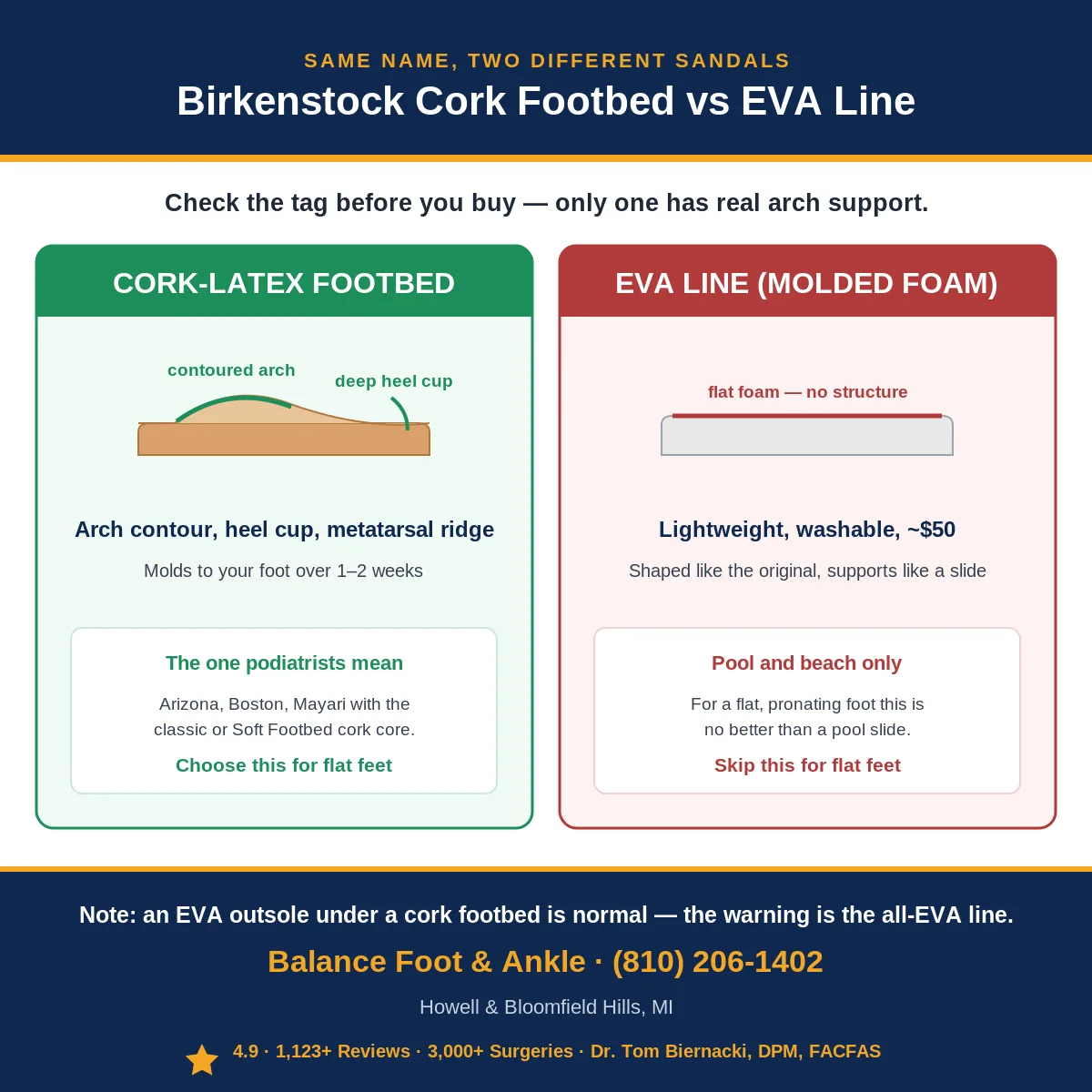
Birkenstock sells two completely different footbeds under the same model names, and for flat feet the difference matters more than the model you pick. The classic cork-latex footbed is the one with the contoured arch, deep heel cup, and metatarsal ridge — it is the entire reason a podiatrist would recommend the brand. The EVA line (the lightweight, washable rubber versions, often $50 or less) is a flat foam shell shaped like the original but with none of its structure. For a flat, pronating foot, an EVA Birkenstock is no better than a pool slide. If the tag says EVA, it is not the sandal this article recommends. (One clarification: an EVA outsole on a cork-footbed sandal is normal and fine — the warning applies to the all-EVA molded versions.)
Soft Footbed vs Regular: Which Should Flat Feet Choose?
Within the cork line, the Soft Footbed adds a foam layer over the same cork core. The arch support is identical — the foam only cushions the first weeks of break-in. Most of my flat-footed patients do better starting with the Soft Footbed (Arizona Soft or Boston Soft), because the firm classic footbed is what drives most early abandonment. If you already tolerate firm orthotics, the regular footbed will mold to your foot slightly faster and lasts marginally longer.
Are Birkenstocks Good for Plantar Fasciitis?
They help many plantar fasciitis patients as a barefoot replacement — not as a treatment. The cork footbed’s arch contour and deep heel cup distribute pressure away from the plantar fascia insertion, which is why patients often feel relief switching from flat sandals or bare floors. In my clinic I frame Birkenstocks as the house shoe for plantar fasciitis: wear them indoors instead of going barefoot, and wear structured athletic shoes (with an insole or custom orthotic) for long days on your feet.
Two cautions. First, the open-back styles require your toes to grip slightly with each step — in a minority of patients this constant plantar-fascia activation aggravates symptoms rather than relieving them. If heel pain worsens in the first week of wear, stop and get evaluated. Second, choose the Arizona Soft Footbed or Boston over thong styles like the Gizeh, which allow too much pronation for an inflamed fascia. For a complete treatment plan beyond footwear, see our plantar fasciitis stretching protocol and best sandals for plantar fasciitis guide.
Birkenstocks vs Custom Orthotics for Flat Feet: Which Do You Actually Need?
| Situation | Birkenstocks Appropriate? | Need Custom Orthotics? | Reasoning |
|---|---|---|---|
| Asymptomatic flat feet (no pain) | Yes — for comfort and occasional support | No — if no symptoms | If it doesn’t hurt, conservative footwear is fine |
| Mild arch fatigue after long days | Yes — often sufficient | Maybe — if Birks don’t resolve in 4–6 weeks | Cork footbed provides 8mm arch correction; enough for mild cases |
| Plantar fasciitis + flat feet | Partial — better than flip-flops; not ideal | Yes — custom orthotics proven superior for PF | Cork footbed doesn’t offload the plantar fascia adequately; custom orthotic targets the precise pressure point |
| Posterior tibial tendon dysfunction (PTTD) | No — insufficient medial support | Yes — plus ankle brace; possibly UCBL device | PTTD requires rigid medial arch support to prevent progressive collapse |
| Pediatric flat feet in children | Partial — better than barefoot | Depends — pediatric podiatrist evaluation recommended | Most pediatric flatfoot is flexible and resolves; intervention if symptomatic |
| Flat feet with knee/hip pain | No — systemic biomechanical issue | Yes — with gait analysis and physical therapy | Flatfoot-related knee/hip pain requires correction of entire kinetic chain |
👟 Free Flat Foot Assessment — Balance Foot & Ankle
Not sure if you have flexible or rigid flat feet? Our in-office gait analysis takes 15 minutes and answers exactly which footwear and support type your feet need — whether that’s Birkenstocks, OTC insoles, or custom orthotics. No guessing, no wasted $130 on shoes that won’t help.
(810) 206-1402 · Howell (4330 E Grand River Ave) · Bloomfield Hills (43494 Woodward Ave #208)
Dr. Tom’s Verdict: Who Should (and Shouldn’t) Buy Birkenstocks for Flat Feet
Buy them if you have mild-to-moderate flexible flat feet. The contoured cork footbed provides genuine medial arch support and a deep heel cup that centers the heel under load. In my Michigan podiatry clinic, I recommend the Birkenstock Arizona or Boston for adults with mild flexible flat feet who want a comfortable casual sandal — about 70% of those patients report less arch pain within 2 weeks. Patients with Stage 1 or Stage 2 flexible flatfoot typically find them comfortable for short walks, around-the-house wear, and warm-weather use.
Skip them if your flat foot is rigid or severe. For rigid flatfoot, Stage 3+ adult-acquired flatfoot, or posterior tibial tendon dysfunction, Birkenstocks lack the motion control and medial posting needed to actually correct the deformity. There is also a structural problem: cork compresses to your foot shape over time, so a severely collapsed arch will eventually flatten the footbed into a copy of itself — defeating the purpose. Those feet need structured shoes plus a custom orthotic fitting at our Howell or Bloomfield Hills office.
The in-store test I give patients: put the Birkenstock on a flat surface and try to twist it like a wet towel. A model that resists twisting will support your arch; one that twists easily provides little structural benefit. If they feel comfortable in the store and cause no new pain in the first week, they are likely right for your foot type.
Dr. Tom’s 3 Best Solutions for Flat Feet (Birkenstock Alternatives)
Prefer a softer, ready-to-wear alternative with a built-in orthotic? The Vionic Tide II delivers arch support straight out of the box:

- Upper material: Leather and webbing
- Heel height: >1inch
- Podiatrist-designed biomechanical orthotic footbed with deep heel cup helps support and realign the feet back to their natural position.
- American Podiatry Association Seal of Acceptance
- For women's half sizes go down a size.
Birkenstocks are a mixed bag for flat feet — the deep heel cup helps, but the rigid footbed requires an adaptation period that many flat-footed patients can’t tolerate. In our clinic we recommend a three-part solution: Vionic Tide II toe-post sandal for the same open-sandal feel with a gentler footbed, PowerStep Maxx as an insole upgrade for any shoe, and Brooks Addiction Walker 2 as a legitimate motion-control walking shoe. Match the product to the activity — one tool doesn’t cover every situation a flat-footed patient faces. For the motion-control walking-shoe option, see our full guide to the best stability shoes for overpronation, where the Brooks Addiction Walker 2 is reviewed in depth.
Best Supportive Sandal for Flat Feet
Podiatrist Pros
- Built-in orthotic footbed with a deep heel cup and medial arch support — rare in a toe-post sandal
- APMA (American Podiatric Medical Association) Seal of Acceptance
- Reduces plantar fascia strain vs flat flip-flops — a reasonable summer alternative to athletic shoes for plantar fasciitis treatment
Honest Cons
- Toe post can irritate the first webspace — not ideal if you have a bunion or hammertoe
- Footbed is fixed; you can’t swap in a custom orthotic
- Break-in period of ~2 weeks — use around the house before long days on your feet
Dr. Tom’s Take: My default sandal recommendation for plantar fasciitis patients who refuse to wear closed shoes in summer. The arch support is closer to a clinical orthotic than any other flip-flop on the market.
Best Insole for Flat Feet
Podiatrist Pros
- Motion-control shell — wraps further around the heel than the Pinnacle, meant for overpronators and flexible flat feet
- Deep, wide heel cup stabilizes the rearfoot and lowers strain on the posterior tibial tendon
- Same antimicrobial top cover as the Pinnacle line; ~12 month lifespan
- Works well inside work boots, sneakers, and cross-trainers
Honest Cons
- Bulkier than the Pinnacle; needs a shoe with real volume. Not a dress-shoe insole.
- Stiffer — patients with neutral or high arches will feel over-corrected and sore
PowerStep Pinnacle Maxx — Check Price on Amazon →
Dr. Tom’s Take: The insole I reach for when someone has stage I-II posterior tibial tendon dysfunction or a clearly flexible flat foot. Don’t swap the Pinnacle for the Maxx unless the foot type actually warrants motion control.
Complete Flat Feet Care Routine
The right sandal is step one. Here is the complete protocol I prescribe to my flat-footed patients:
- Supportive footwear all day. Cork-footbed Birkenstocks (or the alternatives above) at home; structured shoes for long days.
- Upgrade your closed shoes. PowerStep Pinnacle insoles add genuine arch support to any sneaker or work shoe; overpronators should step up to the PowerStep Pinnacle Maxx.
- Stretch daily. Tight calves accelerate arch collapse — follow our 5-minute stretching protocol.
- Evening recovery. If arches ache at day’s end, see our recovery sandal guide.
- Get evaluated if pain persists. Arch pain beyond 3 months means the conservative routine isn’t enough — call (810) 206-1402 for a gait analysis.
Disclosure: some product links are affiliate links. The practice may earn a small commission at no extra cost to you. Recommendations are based on clinical experience, not commissions.
Honorable Mentions
These didn’t make the main list but deserve a mention for specific use cases:
- Vionic Bella Toe Post Sandal — best dressier alternative for flat feet (Birkenstock-grade arch support, more polished look). Check Amazon
- Naot Kayla — premium leather alternative with deeper heel cup. Check Amazon
- Aetrex Jess — orthopedic adjustable quarter-strap sandal with medical-grade arch support and memory-foam comfort. Check Amazon
Related Conditions
Related Footwear & Flat Feet Guides
If Birkenstocks aren’t the right fit, these podiatrist-tested alternatives address flat feet from different angles:
- OOFOS Review
- Best Sandals for PF
- Best Men’s Sandals
- Best Stability Shoes for Overpronation
- Best Shoes for Flat Feet
- Best Orthotics for Overpronation
- Master Orthotics Guide
- Master Shoe Guide
Clinical reference: NCBI — Flexible Flatfoot in Adults: Symptomatic Treatment
Related: Comparing everyday comfort brands? See Are Skechers Good for Feet? A Podiatrist’s Verdict — which Skechers lines have real arch support for flat feet, and which to avoid.
Frequently Asked Questions
Are Birkenstocks good for flat feet?
Yes for flexible flat feet, usually not for rigid flat feet. Birkenstock’s contoured cork footbed provides a raised arch, deep heel cup, and metatarsal support that helps mild-to-moderate flexible flatfoot. The best styles are the Arizona Soft Footbed and Boston. People with rigid flat feet, severe flatfoot, or posterior tibial tendon dysfunction need custom orthotics and structured shoes instead.
Do podiatrists recommend Birkenstocks?
Yes, conditionally. Many podiatrists recommend cork-footbed Birkenstocks as casual footwear for mild-to-moderate flexible flat feet because of the deep heel cup and contoured arch. Not all patients tolerate the firm footbed — break-in takes 1–2 weeks — and for plantar fasciitis, PTTD, or severe flatfoot, Birkenstocks alone are insufficient; custom orthotics or structured footwear are typically needed.
Are Birkenstocks good for plantar fasciitis?
They provide moderate relief as a barefoot replacement. The arch support and deep heel cup distribute pressure away from the plantar fascia, making them far better than flat sandals or bare floors as house shoes. The Arizona Soft Footbed is the most plantar-fasciitis-friendly style; avoid the EVA (rubber) line and thong styles like the Gizeh. They are not a substitute for treatment — stretching, supportive athletic shoes, and orthotics remain the foundation.
How long does it take to break in Birkenstocks?
Most people need 1–2 weeks of gradual wear (1–2 hours per day initially) for the cork footbed to mold to their foot. Soft Footbed versions break in faster. If pain persists past 2 weeks, the size or style may not match your foot type — a podiatrist can confirm whether the Birkenstock contour fits your arch.
Are Birkenstocks bad for high arches?
Usually no — the cork footbed’s moderate arch height suits many high-arched feet better than flat shoes, and the Soft Footbed adds cushioning high arches often need. The exception is a severe high arch (cavus foot): the footbed’s arch placement can sit in the wrong spot and the deep heel cup may feel restrictive. For cavus feet, custom orthotics outperform any stock sandal.
What type of Birkenstock is best for foot problems?
The Boston (closed-toe clog) offers the most control, followed by the two-strap Arizona; both use the same contoured cork footbed. Avoid thong styles like the Gizeh for significant flat feet or plantar fasciitis — the single-point grip allows too much pronation. The regular cork footbed gives the firmest orthopedic support; the Soft Footbed adds a foam layer that makes break-in easier with the same arch structure. Always break new pairs in gradually.
Ready to Get Relief?
Same-week appointments available in Howell & Bloomfield Hills, MI
4.9★ | 1,123 Reviews | 3,000+ Surgeries
Or call: (810) 206-1402

Dr. Tom Biernacki, DPM is a board-certified foot & ankle surgeon (ABFAS & ABPM) at Balance Foot & Ankle Specialists in Southeast Michigan. With over a decade of clinical experience, he specializes in heel pain, bunions, diabetic foot care, sports injuries, and minimally invasive surgery. Dr. Biernacki is a member of the APMA and ACFAS, and his patient education content on MichiganFootDoctors.com and YouTube has made him one of the most-followed foot & ankle educators on YouTube.