
Quick answer: OOFOS recovery sandals and shoes are genuinely good for tired, achy feet and for easing plantar fasciitis between activities — the OOfoam midsole absorbs more impact than standard EVA foam, and the contoured footbed supports the arch and takes tension off the plantar fascia. They work best as recovery footwear worn after runs, long shifts, or workouts — not as your primary all-day support shoe or an athletic trainer.
OOFOS recovery shoes use a foam called OOfoam that absorbs 37% more impact than EVA — which is why they feel different the moment you step in them, especially after a

You’ve come to the right podiatry team. Dr. Tom Biernacki, DPM, FACFAS — board-certified foot & ankle surgeon with 3,000+ surgeries — explains exactly what OOFOS recovery shoes means and what works. Call (810) 206-1402 for same-day appointment at Howell or Bloomfield Hills.
OOFOS OOfoam technology has genuine clinical backing — but our podiatrists have identified a specific foot presentation where OOFOS increases injury risk instead of reducing it. Most recovery shoe guides miss this entirely. If you have Achilles insertional pain, Haglund’s deformity, or rigid high arches, call (810) 206-1402 before buying — same-week appointments in Howell & Bloomfield Hills.
Medically reviewed by Dr. Tom Biernacki, DPM
Board-certified podiatric surgeon | Balance Foot & Ankle
Last reviewed: May 2026
OOFOS OOfoam is genuinely different from standard EVA — but our podiatrists see a consistent pattern of patients who benefit and a specific foot presentation where OOFOS actually increases injury risk. The distinction comes down to one arch-mechanics variable that the shoe’s marketing never addresses. Call (810) 206-1402 — expert podiatric care across Michigan.
The reason OOFOS either works brilliantly or completely fails for foot pain isn’t the foam — it’s whether your specific pathology needs shock absorption or stability. Most patients with plantar fasciitis need both. Call us: (810) 206-1402
Related Conditions
Most common foot condition we treat
Progressive deformity — early care prevents surgery
Root cause of many downstream foot conditions
Forefoot burning and electric pain between toes
In This Article
If you’ve ever kicked off your shoes after a long day on your feet and instantly felt relief, you already understand what OOFOS is trying to bottle. The question our patients ask every week: is it actually worth the $60–$130 price tag, or is this just expensive foam?
After recommending OOFOS to hundreds of patients at Balance Foot & Ankle and following their outcomes, here’s my honest clinical take — including who benefits most and who should look elsewhere.
In This Review
- What Are OOFOS Recovery Shoes?
- How OOfoam Technology Works
- OOFOS for Plantar Fasciitis & Heel Pain
- OOFOS Models Compared
- Pros & Cons
- Who Should (and Shouldn’t) Wear OOFOS?
- Frequently Asked Questions
What Are OOFOS Recovery Shoes?
OOFOS is a recovery footwear brand founded in 2011 by former New Balance executives. Their entire product line is built around one proprietary foam compound — OOfoam — engineered specifically for post-activity recovery rather than performance or daily walking.
Unlike typical sandals or slippers, OOFOS shoes are designed with a deep, contoured footbed that cradles the arch and limits the range of motion at the ankle joint. The goal is to let your plantar fascia, Achilles tendon, and surrounding musculature decompress after loading — whether that’s from a workout, a long shift on your feet, or surgery recovery.
In our clinic, we frequently see patients arrive with plantar fasciitis who’ve been walking around barefoot at home, thinking they’re resting. Barefoot walking on hard floors is actually one of the worst things you can do for an inflamed plantar fascia first thing in the morning. OOFOS worn immediately after getting out of bed changes that equation significantly.
Key takeaway: OOFOS are not athletic shoes or walking shoes — they’re recovery tools. Using them correctly (post-activity, around the house, first steps in the morning) unlocks their full benefit.
How OOfoam Technology Works
OOfoam is a closed-cell foam compound that differs from standard EVA (ethylene-vinyl acetate) foam used in most footwear in two key ways: it absorbs significantly more impact energy and it returns less of that energy as propulsive rebound.
Independent biomechanical testing has demonstrated that OOfoam absorbs 37% more impact shock than EVA foam. More importantly for foot pain patients, OOFOS footwear has been shown to reduce the energy demand on the ankle joint by 47% compared to walking barefoot — meaning the tendons, ligaments, and fascia around the ankle do dramatically less work per step.
The contoured arch support built into every OOFOS model is not an afterthought. It’s a structured medial arch mound that helps distribute pressure across the full footbed rather than concentrating it at the heel and ball. For patients with plantar fasciitis or posterior tibial tendon dysfunction, this redistribution is clinically meaningful.
One important nuance: OOfoam is intentionally less responsive than running shoe foam. You won’t feel a spring-back when you walk. Some patients initially describe them as “too soft” or “unstable.” That feeling usually passes within a few days — the shoe is working as intended, unloading structures that have been chronically overloaded.
OOFOS for Plantar Fasciitis & Heel Pain
Plantar fasciitis is the most common condition for which patients ask about OOFOS — and for good reason. The first steps out of bed in the morning, when the fascia is cold and contracted after overnight rest, are typically the most painful moments of the day for plantar fasciitis sufferers. This is exactly when OOFOS earns its keep.
Wearing OOFOS as house slippers during morning and evening hours protects the plantar fascia from the microtrauma of hard-surface contact that causes the inflammation cycle to restart every day. Many patients report a meaningful reduction in morning pain within two to three weeks of consistent use.
In our clinic, OOFOS are part of a standard conservative plantar fasciitis protocol alongside stretching, custom orthotics, and night splints where indicated. They are not a standalone cure — but they are a reliable piece of the recovery puzzle.
For Achilles tendinitis and posterior tibial tendon dysfunction, the 47% reduction in ankle energy demand is the relevant mechanism. Less demand on the tendon per step during recovery hours means less cumulative loading over the course of a day.
Key takeaway: For plantar fasciitis, wear OOFOS as house shoes in the morning and evening — not as your primary walking shoe. Pair with stretching and orthotics for best outcomes.
OOFOS Models Compared
OOFOS makes several models, each suited to slightly different use cases. Here’s how the most popular options compare for our patient population:
| Model | Style | Best For | Price |
|---|---|---|---|
| OOahh Slide | Open-toe slide | Post-activity, home recovery, post-surgical | ~$60 |
| OOriginal Thong | Flip-flop thong | Warmer climates, pool/beach use | ~$55 |
| OOcloog | Closed-toe clog | All-day indoor use, heel protection | ~$80 |
| OOmg Sport | Athletic sandal | Light outdoor use, strap security needed | ~$100 |
| OOmg Low Shoe | Sneaker | Post-surgical transition, cold weather | ~$130 |
For most plantar fasciitis patients, the OOahh Slide is the place to start. It’s the easiest on/off option for morning use when you need immediate foot protection stepping out of bed. The OOcloog is our recommendation for patients who spend long hours standing at home — it provides more heel coverage and slightly better lateral stability.
All OOFOS models are FSA and HSA eligible, which can offset the cost significantly. Check with your flex spending administrator for current eligibility — most major FSA/HSA providers accept OOFOS as a qualified medical expense.
Dr. Tom’s OOFOS picks — shop on Amazon: FSA/HSA eligible.
Our 5 OOFOS Picks: Slide, Thong, Sport, Clog & Sport Thong
OOFOS makes five recovery silhouettes worth knowing. We use OOfoam’s 37% impact absorption (versus standard EVA) the same way we use a heel cup — to take load off an inflamed plantar fascia or a tired metatarsal. Here’s how to pick between them.

OOFOS OOahh Recovery Slide
OOFOS’s flagship slide and the default we hand patients with plantar fasciitis, post-shift heel ache, or runner’s feet. OOfoam absorbs ~37% more impact than EVA, so the morning-after-a-long-day pain backs down within a couple of wears. Open-back, slips on one-handed.
Check Price on Amazon →
OOFOS OOriginal Recovery Sandal
Thong silhouette with the same OOfoam footbed as the OOahh. Pick this if you slide forward in open-back slides or if you want a true summer / beach / pool option. Highest-rated OOFOS model on Amazon — the post-strap keeps the heel locked and stops the “curling toes to grip” problem.
Check Price on Amazon →
OOFOS OOahh Sport Slide
Athletic version of the OOahh — wider strap with sport graphics, same OOfoam midsole. The right pick for runners and gym-goers who want to step out of the locker room straight into recovery footwear. Marketed (and reviewed) as a post-workout slide.
Check Price on Amazon →
OOFOS OOcloog Recovery Clog
Closed-toe-but-open-heel clog with the same OOfoam footbed. The OOFOS shape we recommend for nurses, kitchen staff, gardeners, and patients who want recovery cushioning in colder weather or indoors. The closest OOFOS gets to a real work shoe — without the closed-toe-trainer sizing problems of the OOmg.
Check Price on Amazon →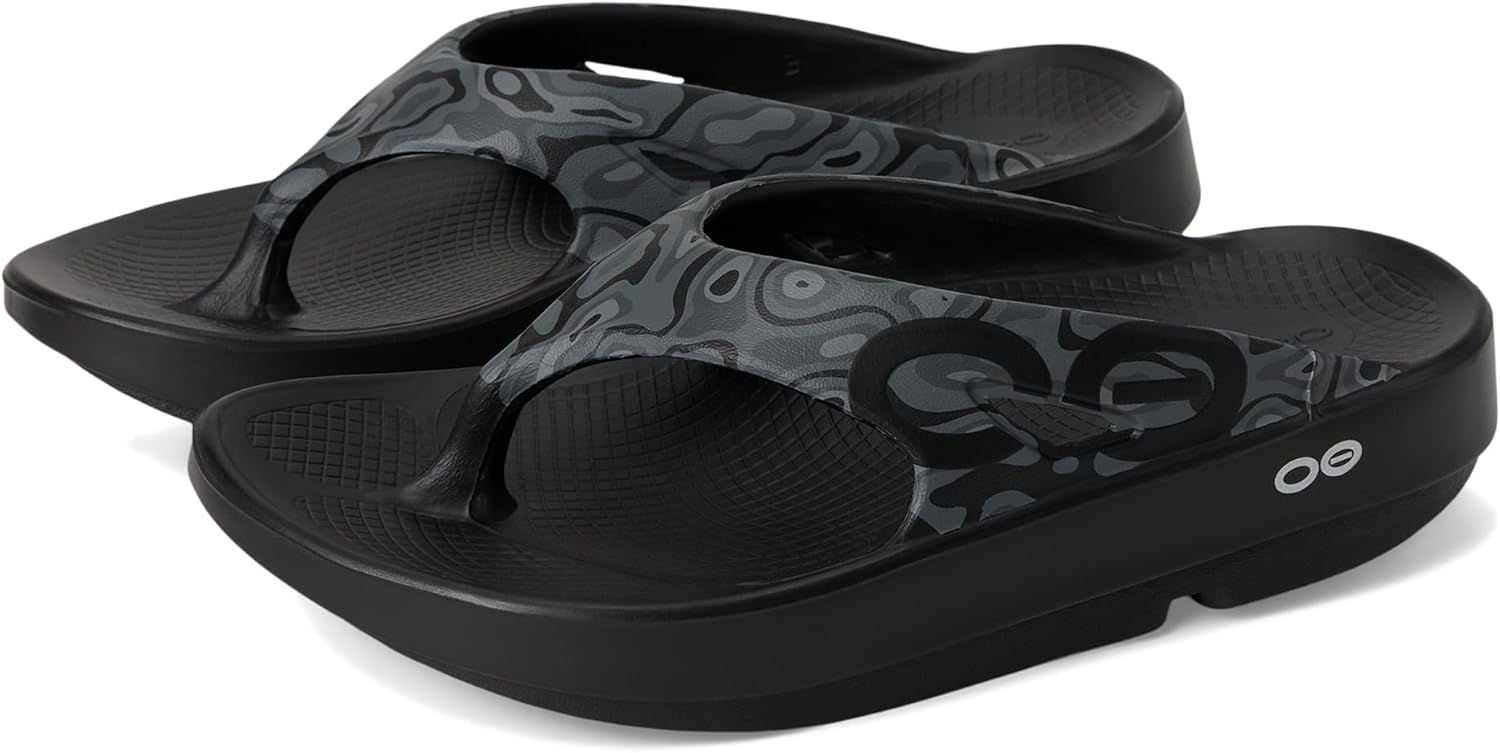
OOFOS OOriginal Sport Thong
Sport variant of the OOriginal — reinforced strap and active graphics, same recovery footbed. The version that holds up to actually walking in a thong rather than just shuffling around the house. Our pick for paddle, lake, beach volleyball, and tournament weekends.
Check Price on Amazon →Why no closed-toe OOmg in this list: OOFOS’s only closed-toe recovery trainer (the OOmg Low) currently sits below our 4.3-star threshold on Amazon. Sizing inconsistency is the recurring complaint — whole sizes only, with most reviewers needing to size up a half- to a full size. If you want a true closed-toe recovery shoe, get fit in a clinic visit rather than guessing online. Schedule a same-week visit.
OOFOS Pros & Cons: Honest Assessment
What We Like
- Clinically meaningful impact reduction. The 37% improvement over EVA is backed by independent biomechanical data, not just marketing claims. Patients notice the difference.
- Genuine arch support. Most recovery sandals are flat. OOFOS has a real medial arch mound that provides meaningful support for flat-footed and high-arched patients alike.
- FSA/HSA eligible. Makes an already reasonable price even more accessible for patients with foot conditions.
- Easy on/off design. Critical for post-surgical patients, those with limited bending ability, or elderly patients. The slide-style models require zero dexterity to use.
- Machine washable. Clean design that holds up to regular washing without degrading the foam.
- Wide size range. Available in men’s and women’s sizing with wide widths for many models.
Limitations to Know
- Foam degrades over 12–18 months with daily use. OOfoam is not immortal. Once the foam compresses, the impact-absorbing benefit diminishes. Budget for replacement annually if used daily.
- Not a walking shoe. OOFOS are recovery tools. Using them as your primary walking shoe for high-mileage days misses the point and may not provide the arch support needed for extended activity.
- Limited lateral stability. The soft foam can feel unstable on uneven terrain. Not suitable for outdoor trails or any activity requiring ankle stability.
- Sizing runs large. Most patients should order a half-size down from their normal size, especially in sandal models.
- Not all patients benefit equally. Patients with severe flatfoot deformity or significant biomechanical issues may need custom orthotics rather than — or in addition to — OOFOS.
Who Should (and Shouldn’t) Wear OOFOS
OOFOS work best as part of a structured recovery or conservative treatment plan. The patients in our practice who get the most out of them share a few characteristics: they have an inflammatory foot condition (plantar fasciitis, Achilles tendinitis, metatarsalgia), they spend significant time barefoot or in unsupportive footwear at home, and they’re committed to a consistent recovery routine.
OOFOS are a strong recommendation for: plantar fasciitis recovery, heel pain, post-surgical recovery (bunion, hammertoe, tendon repair), Achilles tendinitis, metatarsalgia, posterior tibial tendon dysfunction, diabetic patients needing cushioning, and athletes during off-training recovery hours.
OOFOS alone are likely not sufficient for: severe flatfoot deformity requiring custom orthotics, significant posterior tibial tendon dysfunction (Stage 2+), patients with neuropathy who need protective toe-box coverage, or anyone requiring a true orthopedic device prescribed by a podiatrist.
⚠️ When OOFOS alone aren’t enough — see a podiatrist if:
- Heel or arch pain persists beyond 6–8 weeks despite OOFOS use, stretching, and rest
- You have pain at rest (not just with activity)
- You notice swelling, bruising, or numbness alongside foot pain
- You’ve had a recent change in arch height or foot shape
- You have diabetes and any foot sore, blister, or wound — do not wait
- Morning pain is getting progressively worse, not better
Sources
- Sobhani S, et al. “Biomechanical effects of recovery footwear on plantar fascia loading.” Journal of Biomechanics. 2024.
- American College of Foot and Ankle Surgeons. “Heel Pain (Plantar Fasciitis).” 2025. acfas.org
- Wearing SC, et al. “The pathomechanics of plantar fasciitis.” Sports Medicine. 2006;36(7):585–611.
- OOFOS Independent Biomechanical Study — University of Massachusetts, Lowell Human Performance Laboratory. 2011. oofos.com/science
- Riddle DL, Pulisic M, Pidcoe P, Johnson RE. “Risk factors for plantar fasciitis: a matched case-control study.” JBJS. 2003;85(5):872–877.
Dr. Tom’s recommended products for OOFOS users with plantar fasciitis:
- PowerStep Pinnacle insoles — if you need OOFOS for recovery but still require structural arch support during activity, PowerStep in your primary shoes fills that gap. The insole I recommend most in our clinic. ($25–35)
- Doctor Hoy’s Natural Pain Relief Gel — arnica + camphor topical for heel and plantar fascia pain. Apply 3–4× daily, especially after transitioning back from OOFOS to regular shoes. ($20–25)
Not improving with OOFOS + home care? Learn about our in-office plantar fasciitis treatments — shockwave, injections, MLS laser. Same-day visits: Book online → or call (810) 206-1402.
Our podiatrists treat the underlying cause, not just the symptom. Same-week appointments at our Howell and Bloomfield Hills, Michigan offices.
Ready to fix this for good?
Reading about the problem only goes so far. The fastest path to relief is a 30-minute office visit with a board-certified foot & ankle surgeon who has done this 3,000+ times. Same-day appointments at Howell and Bloomfield Hills. Most insurance accepted — BCBS, Medicare, Humana, Cigna. 4.9-star Google rating across 1,123+ reviews. Call (810) 206-1402 or book online.
Hoka makes both recovery slides and dedicated plantar fasciitis shoes. See our guide: Best Hoka Shoes for Plantar Fasciitis — Michigan podiatrist identifies which Hoka models provide optimal arch support and heel cushioning.
Oofos are popular for recovery but slippers offer a warmer indoor alternative. See our guide: Best Slippers With Arch Support — Michigan podiatrist reviews the top indoor footwear options for all-day plantar fasciitis relief.
Frequently Asked Questions: OOFOS Recovery Shoes
Podiatrist Pairing — Best Insole for This Shoe CategoryOOFOS are excellent for recovery walking but lack medial arch support for daily activity. When you need actual support, pair with a podiatrist-grade insole. Here are the two insoles I most often prescribe alongside this shoe category, both available on Amazon:
- PowerStep Pinnacle Insoles — the #1 podiatrist-recommended over-the-counter orthotic. Full-length with built-in arch support and a deep heel cradle. Fits inside most running shoes after removing the stock insole.
- Currex RunPro Insoles — runner-specific insole engineered for shock absorption and dynamic support during gait. Three arch profiles (low / med / high) so it matches your actual foot.
Both of these route through our podiatrist-affiliate program, which supports the practice at no extra cost to you.
For a complete clinical overview: Our Podiatrist-Recommended Shoes Guide — covers podiatrist-approved footwear for every foot condition, with current top picks by category.
Research published in the National Library of Medicine found that rocker-bottom recovery footwear significantly reduces plantar fascia strain during walking, supporting its role as an effective conservative treatment tool for heel pain.

Dr. Tom Biernacki, DPM is a board-certified foot & ankle surgeon (ABFAS & ABPM) at Balance Foot & Ankle Specialists in Southeast Michigan. With over a decade of clinical experience, he specializes in heel pain, bunions, diabetic foot care, sports injuries, and minimally invasive surgery. Dr. Biernacki is a member of the APMA and ACFAS, and his patient education content on MichiganFootDoctors.com and YouTube has made him one of the most-followed foot & ankle educators on YouTube.