

Watch: Stiff Big Toe Joint Pain(Hallux Rigidus) TREATMENT [Exercises, Taping] — MichiganFootDoctors YouTube
Safety update: FDA recall (October 2024)
In October 2024 the maker of the Cartiva synthetic cartilage implant recalled every implant size (FDA Class 2 recall Z-0598-2025). The reason: patients may have a higher-than-expected rate of revision, removal, the implant sinking or shifting, pain, nerve damage, or the implant breaking up. Hospitals and surgery centers were told to set aside their remaining stock and send it back.
If you already have a Cartiva implant and notice new or worsening big-toe pain, stiffness or swelling, book a check. An x-ray shows whether the implant has sunk or moved, and there are good options if it has.
Source: FDA Medical Device Recalls database, recall Z-0598-2025
Cartiva Implant for Big Toe Arthritis
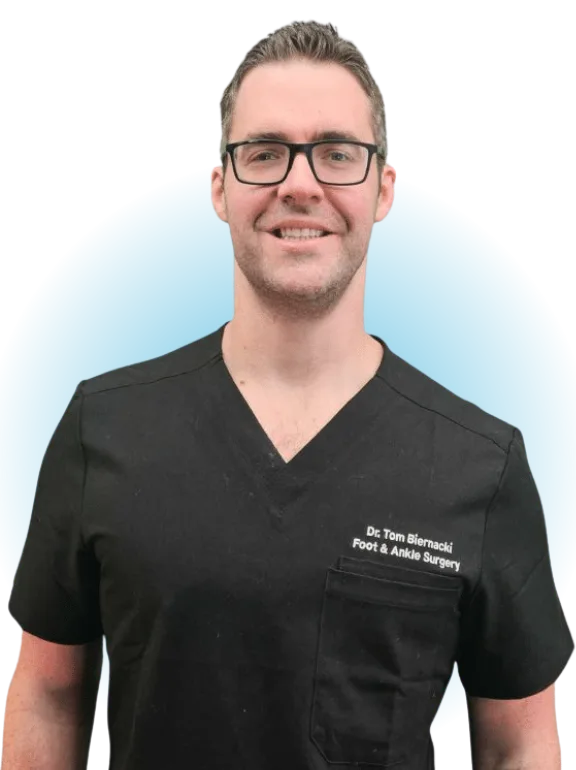
Quick answer: Cartiva Implant is a specialized surgical option. Dr. Tom Biernacki, DPM can determine if it’s right for you.
Who’s a Candidate
Patients who’ve failed conservative treatment, have specific deformity patterns, and meet the criteria for the procedure.
Recovery
Typically 6-12 weeks before return to all activities. Walking boot for 6 weeks. Physical therapy starts week 4.
Schedule a Surgical Consult
Call (810) 206-1402.
AAOS: Big Toe Joint Replacement — Cartiva Implant
In-Office Treatment at Balance Foot & Ankle
If home treatment isn’t providing relief for your foot and ankle conditions, our podiatry team at Balance Foot & Ankle can help with same-week evaluations and advanced in-office care.
Same-week appointments available. (810) 206-1402
VitaMedica Arnica Gel
Arnica gel plus 15 plant compounds for sore feet, plantar fasciitis flares and post-activity soreness. Apply a thin layer to the sore area.
Shop VitaMedica Arnica Gel →
Dr. Tom Biernacki, DPM is a board-certified foot & ankle surgeon (ABFAS & ABPM) at Balance Foot & Ankle Specialists in Southeast Michigan. With over a decade of clinical experience, he specializes in heel pain, bunions, diabetic foot care, sports injuries, and minimally invasive surgery. Dr. Biernacki is a member of the APMA and ACFAS, and his patient education content on MichiganFootDoctors.com and YouTube has made him one of the most-followed foot & ankle educators on YouTube.
More questions patients ask
What is the Cartiva implant for the big toe?
Cartiva (synthetic cartilage implant) is an FDA-approved device for treating hallux rigidus (big toe arthritis) as an alternative to joint fusion. It is a 9mm cylindrical implant made of polyvinyl alcohol hydrogel — a material that mimics the water content and stiffness of natural cartilage — that is pressed into a prepared hole in the first metatarsal head. By replacing the worn cartilage surface, Cartiva allows continued big toe motion without the permanent stiffness of fusion.
How does Cartiva compare to first MTP joint fusion?
The MOTION trial (the pivotal FDA study) showed Cartiva produced equivalent pain relief and functional improvement to fusion at 2 years, while preserving motion. However, longer-term data (3–5 years) shows higher revision rates for Cartiva (approximately 20–25%) compared to fusion, with many patients eventually requiring conversion to fusion when the implant fails or subsides. Fusion remains the gold standard for advanced hallux rigidus — Cartiva is best for patients with moderate disease who strongly wish to avoid joint stiffness and understand the higher revision risk.
Who is the ideal candidate for a Cartiva implant?
Ideal Cartiva candidates have Grade 2–3 hallux rigidus with painful loss of motion, have failed conservative treatment, and have a strong preference to maintain some big toe motion (important for yoga, barefoot activities, flexible footwear). They should be counseled that 20–25% require revision surgery within 5 years. Patients with advanced arthritis (Grade 4), significant sesamoid arthritis, or very high physical demands (distance runners, weightlifters) are better served by joint fusion, which has superior long-term durability and lower revision rates.
What is recovery like after Cartiva implant surgery?
Cartiva recovery is faster than fusion: patients walk in a surgical shoe immediately after surgery; return to regular shoes at 3–4 weeks; return to low-impact activity at 6–8 weeks; return to sport at 3 months. Physical therapy with aggressive first MTP joint motion exercises begins within 2 weeks — maintaining range of motion in the early post-operative period is critical for achieving the motion-preservation benefit of the implant. Fusion recovery, by comparison, requires longer protected weight-bearing (6–8 weeks) and takes 4–6 months for full activity.
Still have a question about coverage or cost? Book online and we will check your benefits before your visit: Book in Howell · Book in Bloomfield Township. Prefer to talk it through first? Call (810) 206-1402.