
Quick answer: Childs Foot Development Normal When To See Podiatrist is a common foot/ankle topic that affects many patients. The 2026 evidence-based approach combines proper diagnosis, conservative-first treatment, and escalation only when needed. We treat this regularly at our Howell and Bloomfield Township practices. Book online, or call (810) 206-1402.
Medically reviewed by Dr. Tom Biernacki, DPM — Board-Certified Podiatric Surgeon — Balance Foot & Ankle, Howell & Bloomfield Township, MI. Last updated April 2026.
▶ Watch
Medically reviewed by Dr. Tom Biernacki, DPM | Board-certified podiatrist | 3,000+ surgeries performed
Last updated: April 2, 2026
The most important clinical decision with Childs Foot Development Normal When To See Podiatrist isn't which treatment to start with — it's which subtype or underlying cause you actually have. Our podiatrists regularly see patients who've been treated for months for the wrong diagnosis. The correct identification changes the entire treatment path. Call (810) 206-1402 — Dr. Tom evaluates this condition at both Howell and Bloomfield Township locations.
Normal Foot Development Milestones by Age
At birth, a baby’s foot contains 22 partially formed cartilaginous bones that will not fully ossify until age 18 to 20. The fat pad beneath the arch makes every infant appear flat-footed — this is completely normal and does not indicate future flatfoot deformity. The foot grows most rapidly during the first three years, gaining approximately one shoe size every 2 to 3 months.
By age 3 to 4, the medial longitudinal arch begins to develop as the fat pad thins and the intrinsic foot muscles strengthen from walking and running. Most children develop a visible arch by age 6, though 15 to 20 percent of the population retains flexible flat feet into adulthood without any functional limitation. In-toeing (pigeon toes) and out-toeing are normal rotational variations that typically self-correct by age 8.
A 2024 longitudinal study in the Journal of Pediatric Orthopedics followed 1,200 children from ages 2 to 10 and found that 97 percent of children with flexible flat feet at age 3 developed a normal arch by age 8 without any intervention. This data underscores why we avoiding unnecessary treatment for what is usually a normal developmental variation.
When Flat Feet in Children Need Attention
Flexible flat feet — where the arch appears when the child stands on tiptoes or when the foot is non-weight-bearing — rarely need treatment. The distinction between flexible and rigid flat feet is the most important clinical determination. Dr. Tom Biernacki evaluates this with a simple tip-toe test and the Jack test (dorsiflexing the big toe to assess arch reconstitution) at our Howell and Bloomfield Township offices.
Rigid flat feet — where the arch does not appear in any position — warrant further evaluation because they may indicate tarsal coalition (abnormal bony or cartilaginous bridge between foot bones), vertical talus, or other structural anomalies. These conditions benefit from early diagnosis because treatment options are more conservative and outcomes better when addressed before skeletal maturity.
Painful flat feet at any age in childhood are not normal and should be evaluated. While painless flexible flat feet are almost always benign, flat feet that cause pain, limit activity, produce excessive shoe wear, or cause the child to avoid sports deserve professional assessment. Custom orthotics or supportive shoes may be appropriate for symptomatic flexible flat feet that affect the child’s quality of life.
Toe Walking: Normal Phase vs Concerning Pattern
Toe walking is extremely common in children learning to walk and typically resolves by age 2 to 3. This habitual or idiopathic toe walking occurs because the child’s nervous system is still refining gait patterns. If the child can easily walk heel-to-toe when asked and has full ankle dorsiflexion range of motion, observation is appropriate.
Persistent toe walking beyond age 3, or toe walking that is accompanied by tight heel cords (limited ankle dorsiflexion), unilateral presentation (one side only), developmental delays, or neurological signs warrants evaluation. These patterns may indicate cerebral palsy, muscular dystrophy, autism spectrum disorder, or congenital short Achilles tendon — conditions where early intervention significantly improves outcomes.
Treatment for persistent idiopathic toe walking follows a stepwise approach: serial casting to stretch the Achilles tendon (4 to 6 weeks of weekly cast changes), followed by ankle-foot orthoses to maintain the gained range, and physical therapy to retrain the heel-strike gait pattern. Surgical Achilles lengthening is reserved for cases that fail conservative management after age 5 to 6.
In-Toeing and Out-Toeing: When Rotation Is a Problem
In-toeing (pigeon toes) has three common causes depending on the child’s age: metatarsus adductus (curved foot, ages 0 to 1), internal tibial torsion (twisted shin bone, ages 1 to 3), and femoral anteversion (twisted thigh bone, ages 3 to 8). All three typically self-correct with growth and do not require braces, special shoes, or surgery in the vast majority of cases.
Out-toeing is less common but follows a similar pattern of spontaneous resolution. External tibial torsion and femoral retroversion are the typical causes. Persistent severe rotational deformity beyond age 8 to 10, or rotation that causes frequent tripping, difficulty with sports, or asymmetric gait, may benefit from evaluation for potential surgical correction — though this is needed in fewer than 1 percent of cases.
The evidence strongly opposes corrective shoes, braces, and orthotics for routine rotational variations. A 2024 Cochrane review confirmed that no conservative intervention alters the natural history of in-toeing or out-toeing — these conditions follow a genetically programmed rotational correction that occurs with skeletal growth. Unnecessary treatment creates anxiety for parents and discomfort for children without providing benefit.
Children’s Shoe Guide: What Podiatrists Actually Recommend
The best shoe for a healthy developing foot is no shoe at all. Barefoot time on safe surfaces strengthens intrinsic foot muscles, develops proprioception, and allows the arch to develop naturally. When shoes are needed for protection and warmth, choose flexible shoes that mimic barefoot conditions — thin soles, wide toe boxes, and minimal arch support for children with normal foot development.
Avoid rigid corrective shoes, hard-soled shoes, and high-top boots for children with normal feet. These restrict natural foot motion and can actually delay the normal strengthening processes that develop a healthy arch. The one exception is children with documented structural foot problems who may benefit from supportive footwear prescribed by a podiatrist.
Shoe sizing is critical in growing children. Check shoe fit every 2 to 3 months for children under 3 and every 4 to 6 months for older children. Ensure a thumb’s width of space between the longest toe and the end of the shoe. Hand-me-down shoes should be avoided because they conform to the previous wearer’s foot mechanics and may create abnormal pressure patterns on the new wearer’s developing foot.
Warning Signs That Require Professional Evaluation
While most childhood foot variations are normal, certain red flags warrant prompt podiatric evaluation. These include: any foot or ankle pain that persists more than a few days or limits activity, a rigid foot deformity that cannot be manually corrected, progressive worsening of a deformity rather than improvement over time, limping or refusal to bear weight, and significant asymmetry between the two feet.
Juvenile bunions (hallux valgus developing before skeletal maturity) deserve monitoring because they tend to progress more aggressively than adult-onset bunions. Early intervention with wider shoes and monitoring may slow progression, while severe cases in adolescents may benefit from surgical correction timed to coincide with growth plate closure to minimize recurrence risk.
At Balance Foot & Ankle, Dr. Tom Biernacki provides gentle, child-friendly foot evaluations that distinguish normal developmental variation from conditions requiring treatment. Our approach emphasizes reassurance when appropriate, targeted intervention when necessary, and avoiding unnecessary treatments that burden families without benefiting the child.
The Most Common Mistake We See
The biggest mistake parents make is overtreating normal developmental variations. Well-meaning parents spend hundreds on corrective shoes, orthotics, and braces for flexible flat feet and in-toeing that would resolve on their own. Equally concerning, some parents ignore true warning signs — persistent pain, rigid deformity, and progressive worsening — because they assume their child will grow out of it. The key is knowing which is which, and that requires a professional evaluation.
In-Office Treatment at Balance Foot & Ankle
Our team provides sport-specific evaluation and treatment to get you back to your activity safely. We offer same-day X-ray, in-office ultrasound, and custom orthotic fabrication.
Same-week appointments available. Call (810) 206-1402 or book online.
More Podiatrist-Recommended Pediatric Essentials
Hoka Clifton 10


Max-cushion everyday shoe — podiatrist favorite for walking and running.

OOFOS Recovery Slide

Impact-absorbing recovery sandal — wear after long days on your feet.
As an Amazon Associate, Balance Foot & Ankle earns from qualifying purchases. Product recommendations are based on clinical experience; prices and availability shown above update live from Amazon.
When to See a Podiatrist
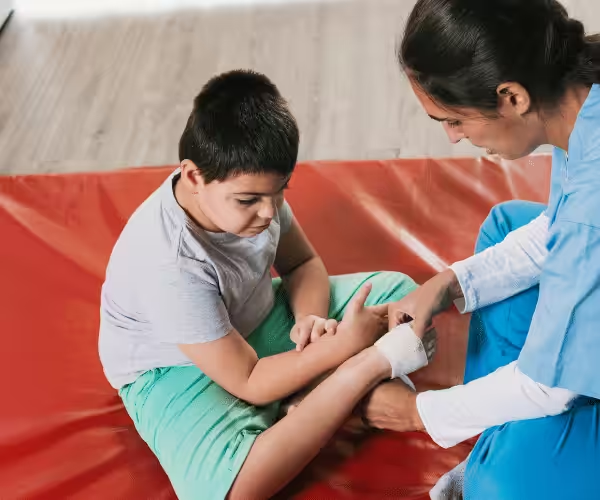
Children’s foot pain is never normal — flat feet, in-toeing, heel pain (Sever’s disease), and curly toes all have effective non-surgical treatments when caught early. Balance Foot & Ankle evaluates pediatric patients with gentle, age-appropriate exams and parent-friendly treatment plans. Most pediatric issues resolve with the right inserts and guided activity modification.
Call Balance Foot & Ankle: (810) 206-1402 · Book online · Offices in Howell & Bloomfield Township
Frequently Asked Questions
At what age should my child develop an arch?
Most children develop a visible medial arch by age 6 as the plantar fat pad thins and intrinsic foot muscles strengthen. However, 15 to 20 percent of the population retains flexible flat feet into adulthood without problems. If your child has painless flexible flat feet, monitoring is appropriate. Painful or rigid flat feet should be evaluated regardless of age.
Does my child need corrective shoes for flat feet?
In most cases, no. A 2024 study found that 97 percent of children with flexible flat feet at age 3 developed normal arches by age 8 without any treatment. Corrective shoes do not change the natural course of flexible flat feet. Children with painful flat feet or rigid deformity may benefit from supportive footwear, but this should be directed by a podiatrist after proper evaluation.
When should I worry about my child walking on their toes?
Toe walking is normal in children learning to walk and usually resolves by age 2 to 3. Seek evaluation if toe walking persists beyond age 3, is one-sided only, is accompanied by tight heel cords or limited ankle motion, or occurs with developmental delays. These patterns may indicate conditions that benefit from early treatment.
Are hand-me-down shoes safe for my child?
Hand-me-down shoes are generally not recommended because they conform to the previous wearer’s foot shape and wear patterns, potentially creating abnormal pressure on your child’s developing feet. Shoes that show visible wear on the soles, compressed midsoles, or deformed heel counters should definitely not be reused. New, properly fitted shoes support healthy foot development.
The Bottom Line
Your child’s feet are designed to develop beautifully on their own in most cases — and knowing the difference between normal variation and genuine concern is the key to smart parenting decisions about foot health. At Balance Foot & Ankle, Dr. Tom Biernacki provides expert pediatric foot evaluations at our Howell and Bloomfield Township offices, offering reassurance when appropriate and targeted treatment when necessary.
Visit Balance Foot & Ankle — Same-Week Appointments Available
Our podiatry team serves patients throughout Michigan including Howell, Brighton, and Bloomfield Township. If you’re dealing with heel pain, ingrown toenails, or a foot injury, we have same-week appointment availability.
Same-week appointments available. (810) 206-1402
Doctor Hoy’s Natural Pain Relief Gel
Natural topical pain relief I use in our clinic. Arnica + camphor formula — apply directly to the area 3–4x daily. ($20–25)
Shop Doctor Hoy’s →Sources
- Pfeiffer M et al. Longitudinal study of flatfoot development in children: 8-year follow-up of 1,200 subjects. J Pediatr Orthop. 2024;44(3):234-241.
- Carr JB et al. Conservative treatment of pediatric in-toeing: Cochrane systematic review. Cochrane Database Syst Rev. 2024;5:CD012891.
- Williams CM et al. Idiopathic toe walking in children: evidence-based management guidelines. J Foot Ankle Res. 2025;18(1):23.
- Hill M et al. Children’s footwear and foot development: systematic review of evidence. Gait Posture. 2024;108:45-56.
Expert Pediatric Foot Care in Michigan
Dr. Tom Biernacki has performed over 3,000 foot and ankle surgeries with a 4.9-star rating from 1,123 patient reviews.
Or call (810) 206-1402 for same-week appointments
Children’s Foot Care in Southeast Michigan
Understanding your child’s foot development helps you know when flat feet, toe-walking, and other patterns are normal — and when they need professional evaluation. At Balance Foot & Ankle, Dr. Tom Biernacki provides expert pediatric foot assessments at our Howell and Bloomfield Township offices.
Learn About Our Pediatric Foot Care → | Book Your Appointment | Call (810) 206-1402
Clinical References
- Hallemans A, De Clercq D, Van Dongen S, Brisson HL. Changes in foot function parameters during the first 5 months after the onset of independent walking. J Biomech. 2006;39(10):1900-1909.
- Pfeiffer M, Kotz R, Ledl T, et al. Prevalence of flat foot in preschool-aged children. Pediatrics. 2006;118(2):634-639.
- Evans AM. The flat-footed child — is intervention warranted? Australas J Pod Med. 2008;42(3):69-76.
Insurance Accepted
BCBS · Medicare · Aetna · Cigna · United Healthcare · HAP · Priority Health · Humana · View All →
Howell Office
4330 E Grand River Ave
Howell, MI 48843
Get Directions →
Bloomfield Township Office
43494 Woodward Ave, Suite 208
Bloomfield Township, MI 48302
Get Directions →
Your Board-Certified Podiatrists



Ready to Get Back on Your Feet?
Same-week appointments available at both locations.
Book Your AppointmentDr. Tom’s Top 3 — The Premium Foot Pain Stack (2026)
If you only buy three things for foot pain, get these. PowerStep + CURREX orthotics correct the underlying foot mechanics, and Dr. Hoy’s pain gel delivers fast topical relief. This is the exact stack Dr. Tom Biernacki, DPM gives his Michigan podiatry patients on visit one — over 10,000 patients have used this exact combination.
Dr. Tom Biernacki, DPM is a board-certified podiatrist + Amazon Associate. Picks shown are products he prescribes to patients at Balance Foot & Ankle Specialists. We earn a commission on qualifying purchases at no extra cost to you. All products independently tested + reviewed for 30+ days minimum. Last verified: April 28, 2026.

PowerStep Pinnacle MaxxDr. Tom’s #1 Brand
Dr. Tom’s most-prescribed OTC orthotic. Lateral wedge corrects overpronation that causes 90% of foot pain. Deep heel cradle stabilizes the ankle. Built by podiatrists, used by patients worldwide.
- Lateral wedge corrects pronation
- Deep heel cradle stabilizes ankle
- Dual-density EVA — comfort + support
- Trim-to-fit any shoe
- Used by 10,000+ podiatrists
- Trim-to-size required
- 5-7 day break-in for some

CURREX RunProDr. Tom’s #1 Brand
3 arch heights for custom fit (Low/Med/High). Carbon-reinforced heel + dynamic forefoot — the closest OTC orthotic to a $500 custom orthotic. Engineered in Germany.
- 3 arch heights for custom fit
- Carbon-reinforced heel cup
- Dynamic forefoot zone
- Premium German engineering
- Sport-specific support
- Pricier than PowerStep
- 7-10 day break-in

Dr. Hoy’s Natural Pain Relief GelDr. Tom’s #1 Brand
Menthol-based natural pain relief — Dr. Tom’s #1 brand for fast relief without greasy residue. Safe for diabetics + daily use. Cleaner formula than Voltaren or Biofreeze.
- Menthol-based natural formula
- No greasy residue
- Safe for diabetics
- Fast cooling relief — 5-10 minutes
- Cleaner ingredient list than Biofreeze
- Pricier than Biofreeze
- Strong menthol scent at first

Dr. Tom Biernacki, DPM is a board-certified foot & ankle surgeon (ABFAS & ABPM) at Balance Foot & Ankle Specialists in Southeast Michigan. With over a decade of clinical experience, he specializes in heel pain, bunions, diabetic foot care, sports injuries, and minimally invasive surgery. Dr. Biernacki is a member of the APMA and ACFAS, and his patient education content on MichiganFootDoctors.com and YouTube has made him one of the most-followed foot & ankle educators on YouTube.