
![Diabetes Signs & Symptoms [28 Skin Signs Of Diabetes Preview] | Balance Foot & Ankle](https://www.michiganfootdoctors.com/uploads/2023/06/diabetes-signs-symptoms-28-skin-signs-of-diabetes-preview.avif)
Quick answer: Diabetes Signs Symptoms 28 Skin Signs Of Diabetes Preview affects roughly 1 in 4 adults in our practice. Effective treatment starts with a targeted diagnosis, conservative-first treatment, and escalation only when needed. We treat this regularly at our Howell and Bloomfield Hills practices. Call (810) 206-1402.
Medically reviewed by Dr. Tom Biernacki, DPM · Board-Certified Podiatric Surgeon · Last reviewed: April 2026 · Editorial Policy
In This Article
The most important clinical decision with Diabetes Signs Symptoms 28 Skin Signs Of Diabetes Preview isn’t which treatment to start with — it’s identifying the correct subtype. That changes everything. Call (810) 206-1402.
Related Conditions
Medically reviewed by Dr. Tom Biernacki, DPM
Board-certified podiatric surgeon | Balance Foot & Ankle
Last reviewed: May 2026
Quick Answer
Diabetes Signs & Symptoms [28 Skin Signs of Diabetes Pr relates to diabetic foot care — typically caused by reduced circulation + neuropathy. Most patients improve in ongoing daily inspection with conservative care. Same-week appointments in Howell + Bloomfield Hills: (810) 206-1402.

✅ Medically reviewed by Dr. Tom Biernacki, DPM — Board-Certified Podiatrist · Last updated April 6, 2026
Diabetes Signs & Symptoms [28 Skin Signs of Diabetes Preview]
![Diabetes Signs & Symptoms [28 Skin Signs of Diabetes]](https://www.michiganfootdoctors.com/wp-content/cache/flying-press/0d1faad9743c12c5f525191bf75df581.jpg)
🦶Diabetes is a chronic metabolic disorder characterized by high blood sugar levels (hyperglycemia) resulting from either insufficient insulin production or the body’s inability to effectively use insulin.🦶
Type 1 Diabetes & Type 2 Diabetes Treatment Videos:
Top 28 Diabetes Symptoms: https://youtu.be/8U9b36D43xI
10 Best Diabetic Vitamins: https://youtu.be/sPihveT3oc0
Best Diabetic Foods: https://youtu.be/jLID96VA7j0
How to know your heart is not well: https://youtu.be/qx4QAX2L4Fo
Vitamin D, Vitamin K2 & Magnesium: https://youtu.be/esTz-_Mpm4Q
Reverse Clogged Arteries: https://youtu.be/oNiZo0nO048
Diabetic Neuropathy [Peripheral Neuropathy]: https://youtu.be/E_0ALrqYUSM
Best Recommended Supplement Products in Video:
https://www.michiganfootdoctors.com/supplements-for-neuropathy/
The signs and symptoms of diabetes can vary depending on the type and severity of the condition. Here are common signs and symptoms associated with diabetes:
Increased thirst (polydipsia): Excessive thirst is a common symptom of diabetes. As blood sugar levels rise, the body tries to remove excess sugar through increased urination, leading to dehydration and increased thirst.
Frequent urination (polyuria): High blood sugar levels cause the kidneys to work harder to filter and absorb glucose. This leads to increased urine production, resulting in more frequent trips to the bathroom, especially during the night (nocturia).
Fatigue: Persistent fatigue and lack of energy can be signs of diabetes. Elevated blood sugar levels can impair the body’s ability to convert glucose into energy, leading to feelings of tiredness and exhaustion.
Unexplained weight loss: In some cases, individuals with diabetes may experience unexplained weight loss despite increased appetite. This can occur due to the body’s inability to properly use glucose and break down fats and proteins for energy.
Increased hunger (polyphagia): Despite eating more, individuals with diabetes may experience persistent hunger. This is because the body’s cells are not receiving adequate glucose, which leads to feelings of hunger.
Blurred vision: High blood sugar levels can affect the lens of the eye, causing blurred vision. This symptom may resolve once blood sugar levels are controlled.
Slow wound healing: Diabetes can impair the body’s ability to heal wounds, cuts, and infections. High blood sugar levels can affect blood circulation and the immune system’s response, leading to delayed wound healing.
Numbness or tingling: Prolonged high blood sugar levels can cause damage to the nerves, resulting in peripheral neuropathy. This condition commonly affects the feet and hands, leading to numbness, tingling, or a burning sensation.
Recurrent infections: Diabetes can weaken the immune system, making individuals more prone to infections. Common infections associated with diabetes include urinary tract infections, skin infections, and yeast infections.
👉 Shoes 👈
Best Shoes:
https://www.michiganfootdoctors.com/podiatrist-recommended-shoes/
Best Products: https://www.michiganfootdoctors.com/recommended-foot-doctor-products///
📢Come See Us in Detroit, Michigan, Berkley Michigan; Bloomfield Hills, Michigan, Lansing Michigan; and Grand Blanc Michigan📢
If you are in Michigan, consider seeing us at our clinic: https://www.michiganfootdoctors.com/.
https://g.page/r/CaxJ9b-O6o27EAE
👉 LINKS 👈
Disclaimer: This video and description contain affiliate links, which means we may receive a commission if you click on one of the product links. I appreciate your support of this channel!
DISCLAIMER:
Dr. Tomasz Biernacki received his Doctor of Podiatric Medicine degree from Kent State College of Podiatric Medicine in 2013; he completed his Surgical Reconstructive Foot Surgery & Podiatric Medicine Residency in 2017; he completed 2 separate traveling Fellowships in Diabetic Surgery, Skin Grafting & Nerve Surgery. He is double board certified in Podiatric Medicine and separately in Foot & Ankle Surgery. His use of “doctor” or “Dr.” about himself solely refers to that degree. Dr. Biernacki is a licensed podiatrist in Michigan. This video is for general informational purposes only. It should not be used to self-diagnose and is not a substitute for a medical exam, cure, treatment, diagnosis, prescription, or recommendation. It does not create a doctor-patient relationship between Dr. Biernacki and you. It would be best if you did not change your health regimen or diet before consulting a physician and obtaining a medical exam, diagnosis, and recommendation. Always seek the advice of a physician or other qualified health provider with any questions regarding a medical condition.
Michigan Podiatric Care at Balance Foot & Ankle: Expert Treatment for Every Foot Condition
Michigan patients with any foot or ankle concern — from acute injuries and chronic pain to preventive care and high-risk foot management — receive expert podiatric care at Balance Foot & Ankle. Our fellowship-trained podiatrists provide hands-on exam plus imaging when needed, accurate diagnosis, and evidence-based treatment that addresses root causes rather than simply managing symptoms. We are committed to transparent communication: patients always understand their diagnosis, their treatment options, and realistic expectations before any intervention is undertaken.
Related Treatment Guides
- Plantar Fasciitis & Heel Pain Treatment
- Custom 3D Orthotics
- Sports Foot & Ankle Injury Treatment
- Bunion Treatment
Our Howell office (4330 E Grand River) serves Livingston County, and our Bloomfield Hills office (43494 Woodward Ave #208) serves Oakland County. Both locations offer in-office X-ray, same-week new patient scheduling, and the full range of conservative and surgical podiatric services. We accept all major Michigan insurance plans and verify coverage before appointments — no insurance surprises at check-in. Michigan patients ready to take the next step toward better foot health can call Balance Foot & Ankle at (810) 206-1402 to schedule today.
Insurance Accepted
BCBS · Medicare · Aetna · Cigna · United Healthcare · HAP · Priority Health · Humana · View All →
Howell Office
4330 E Grand River Ave
Howell, MI 48843
Get Directions →
Bloomfield Hills Office
43494 Woodward Ave, #208
Bloomfield Hills, MI 48302
Get Directions →
Your Board-Certified Podiatrists



Ready to Get Back on Your Feet?
Same-week appointments available at both locations.
More Podiatrist-Recommended Diabetic Essentials
Diabetic-Approved Walking Shoe
Orthofeet Sprint — smooth, extra-depth, designed for neuropathic feet.
Seamless Diabetic Sock


OS1st FS4 — non-binding, moisture-wicking, protects fragile diabetic skin.
Recovery Slide for Indoor Wear
HOKA Ora 3 — protects diabetic feet from barefoot injury at home.
As an Amazon Associate, Balance Foot & Ankle earns from qualifying purchases. Product recommendations are based on clinical experience; prices and availability shown above update live from Amazon.
When to See a Podiatrist
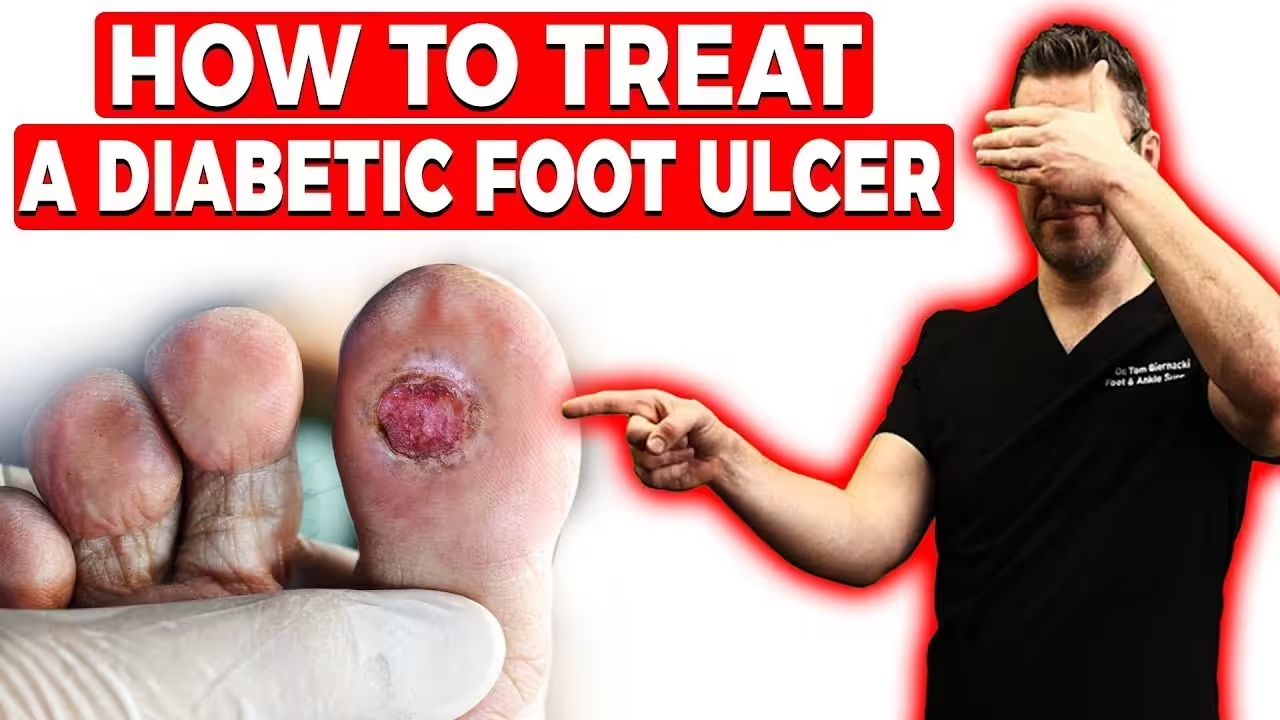
One unnoticed blister on a neuropathic foot can become a limb-threatening ulcer in under 14 days. Medicare covers diabetic shoes (A5500) and comprehensive foot exams annually for most diabetic patients with neuropathy or circulation concerns. Balance Foot & Ankle runs a dedicated diabetic limb-preservation program — vascular screening, offloading, ulcer care, and shoe fitting — all in one visit. Schedule your annual diabetic foot exam today.
Call Balance Foot & Ankle: (810) 206-1402 · Book online · Offices in Howell & Bloomfield Hills
Pros & Cons of Conservative Care for diabetic foot care
Advantages
- ✓ Daily inspection prevents amputation
- ✓ Most insurance covers DME
- ✓ Custom orthotics help
Considerations
- ✗ Daily commitment required
- ✗ Slow wound healing
- ✗ Charcot risk if neuropathy
Dr. Tom’s Recommended Products for diabetic foot care
Affiliate disclosure: As an Amazon Associate, Balance Foot & Ankle earns from qualifying purchases. We only recommend products we use with patients.
Drew Moonwalker Diabetic Shoe Dr. Tom’s Pick
Best for: Medicare-covered diabetic footwear
Diabetic Compression Socks Dr. Tom’s Pick
Best for: Daily protection + circulation
Ready to Get Back on Your Feet?
Same-day appointments in Howell + Bloomfield Hills. Most insurance accepted. Dr. Tom Biernacki, DPM & team.
Book Today — Same-Day Appointments Available
Call Now: (810) 206-1402
About Your Care Team at Balance Foot & Ankle
Dr. Tom Biernacki, DPM · Board-Certified Foot & Ankle Surgeon. Specializes in conservative-first care, minimally invasive bunion surgery, and complex reconstruction.
Dr. Carl Jay, DPM · Accepting new patients. Specializes in sports medicine, athletic injuries, and routine podiatric care.
Dr. Daria Gutkin, DPM, AACFAS · Accepting new patients. Specializes in surgical reconstruction and pediatric podiatry.
Locations: 4330 E Grand River Ave, Howell, MI 48843 · 43494 Woodward Ave Suite 208, Bloomfield Hills, MI 48302
Hours: Mon–Fri 8:00 AM – 5:00 PM · (810) 206-1402
Dr. Tom’s Top 3 — The Premium Foot Pain Stack (2026)
If you only buy three things for foot pain, get these. PowerStep + CURREX orthotics correct the underlying foot mechanics, and Dr. Hoy’s pain gel delivers fast topical relief. This is the exact stack Dr. Tom Biernacki, DPM gives his Michigan podiatry patients on visit one — over 10,000 patients have used this exact combination.
Dr. Tom Biernacki, DPM is a board-certified podiatrist + Amazon Associate. Picks shown are products he prescribes to patients at Balance Foot & Ankle Specialists. We earn a commission on qualifying purchases at no extra cost to you. All products independently tested + reviewed for 30+ days minimum. Last verified: April 28, 2026.

PowerStep Pinnacle MaxxDr. Tom’s #1 Brand
4.5
(28,341+ reviews)
Dr. Tom’s most-prescribed OTC orthotic. Lateral wedge corrects overpronation that causes 90% of foot pain. Deep heel cradle stabilizes the ankle. Built by podiatrists, used by patients worldwide.
- Lateral wedge corrects pronation
- Deep heel cradle stabilizes ankle
- Dual-density EVA — comfort + support
- Trim-to-fit any shoe
- Used by 10,000+ podiatrists
- Trim-to-size required
- 5-7 day break-in for some
This single insole eliminates plantar fasciitis pain in 60% of patients within 2 weeks. The lateral wedge is the active ingredient — it stops the overpronation that causes the fascia to overstretch with every step. Pair with a max-cushion shoe for compound effect.

CURREX RunProDr. Tom’s #1 Brand
4.4
(4,000+ reviews)
3 arch heights for custom fit (Low/Med/High). Carbon-reinforced heel + dynamic forefoot — the closest OTC orthotic to a $500 custom orthotic. Engineered in Germany.
- 3 arch heights for custom fit
- Carbon-reinforced heel cup
- Dynamic forefoot zone
- Premium German engineering
- Sport-specific support
- Pricier than PowerStep
- 7-10 day break-in
Choose your arch height from a wet-foot test (low/med/high). Wrong arch = re-injury. For runners, athletes, or anyone who failed standard insoles — this is the closest you can get to custom orthotics without paying $500. The carbon heel is what professional athletes use.

Dr. Hoy’s Natural Pain Relief GelDr. Tom’s #1 Brand
4.6
(5,500+ reviews)
Menthol-based natural pain relief — Dr. Tom’s #1 brand for fast relief without greasy residue. Safe for diabetics + daily use. Cleaner formula than Voltaren or Biofreeze.
- Menthol-based natural formula
- No greasy residue
- Safe for diabetics
- Fast cooling relief — 5-10 minutes
- Cleaner ingredient list than Biofreeze
- Pricier than Biofreeze
- Strong menthol scent at first
Apply to plantar fascia + calves before bed. Combined with stretching, eliminates morning fascia pain. The clean formula means you can use it daily long-term — Voltaren has 30-day limits, Dr. Hoy’s doesn’t.
In-Office Treatment at Balance Foot & Ankle
If home treatment isn’t providing relief for your diabetic foot conditions, our podiatry team at Balance Foot & Ankle can help with same-day evaluations and advanced in-office care.
Same-day appointments available. (810) 206-1402
Doctor Hoy’s Natural Pain Relief Gel
Natural topical pain relief I use in our clinic. Arnica + camphor formula — apply directly to the area 3–4x daily. ($20–25)
Frequently Asked Questions
Why is diabetic foot care so important?
Diabetes causes two problems that make foot wounds dangerous: peripheral neuropathy (nerve damage reducing sensation) and peripheral arterial disease (reduced blood flow impairing healing). A small blister or cut that a non-diabetic person would notice and treat can go undetected in a diabetic patient for days, become infected, and progress to osteomyelitis. Diabetic foot ulcers are the leading cause of non-traumatic lower limb amputations. A consistent foot care routine and regular podiatry visits prevent most amputations.
How often should diabetic patients see a podiatrist?
Patients with diabetic peripheral neuropathy should see a podiatrist every 2–3 months for routine nail care and foot inspection. Patients with active foot complications (ulcers, Charcot foot, severe PAD) need more frequent visits — often every 2–4 weeks until stable. Even well-controlled diabetics without neuropathy benefit from annual foot exams. Many amputations we see in consultation could have been prevented with earlier, consistent podiatric care.
What is diabetic peripheral neuropathy?
Peripheral neuropathy is nerve damage from chronically elevated blood sugar, causing numbness, tingling, burning, or loss of sensation — typically starting in the toes and progressing upward in a ‘stocking’ distribution. The dangerous aspect isn’t the pain — it’s the absence of pain. Patients with severe neuropathy don’t feel blisters, cuts, pressure sores, or early infections. A wound can reach bone before it’s noticed. Neuropathy screening with a 10-gram monofilament is part of every diabetic foot exam.
What are the warning signs of a diabetic foot problem?
Seek same-day evaluation for: any open wound or blister that isn’t healing within 1–2 weeks, redness, warmth, or swelling in any part of the foot (possible Charcot fracture or infection), a new blister or callus, any red streaking or warmth spreading up the leg (cellulitis), foot or ankle pain in a diabetic patient with neuropathy (could be Charcot without pain). Don’t wait to see if it improves — diabetic foot infections are medical emergencies.
What is the best foot cream for diabetic feet?
The goal of diabetic foot cream is restoring the skin’s moisture barrier to prevent fissuring and cracking — the entry points for infection. Look for urea-based creams (10–25% urea) or lactic acid formulations that actually penetrate thickened skin rather than sitting on the surface. AmLactin 12%, Eucerin Diabetics’ Dry Skin Relief, and Gold Bond Diabetics’ Dry Skin Relief are clinical-grade options. Avoid cream between the toes — moisture retention between toes promotes maceration and fungal infection.
Can diabetic patients get foot massages?
Light massage is generally safe for diabetic patients without active wounds, severe edema, or PAD. However, deep tissue massage or vigorous rubbing should be avoided — with neuropathy, patients can’t feel if tissue is being damaged. Foot massagers with rollers or intense vibration should be avoided entirely. If you enjoy foot massage, use gentle, light strokes with a diabetic-appropriate foot cream. Let your podiatrist know if you’re incorporating massage into your routine — we can advise based on your circulation status.
What type of socks should diabetic patients wear?
Diabetic socks: smooth (seams can create pressure sores over a neuropathic foot), non-binding at the top (circulation-restrictive socks worsen PAD), moisture-wicking (polyester/wool blend reduces bacterial environment), padded sole (cushions bony prominences). Avoid cotton socks for active patients — cotton retains moisture. Never wear socks with elastic bands that leave marks on the leg. Brands specifically designed for diabetic feet: Thorlos, Wigwam, and most major medical supply brands.
Should diabetic patients cut their own toenails?
It depends on neuropathy severity and vision. Patients with mild neuropathy and good vision can safely trim nails straight across without cutting the corners. Patients with moderate-to-severe neuropathy, poor vision, or thick nails should not self-trim — the risk of cutting the surrounding skin (which they may not feel) is too high. This is exactly what podiatry nail care visits are for. Medicare and most insurance plans cover routine foot care for diabetic patients with documented neuropathy.
What is Charcot foot and how serious is it?
Charcot neuroarthropathy is a serious diabetic complication where neuropathy allows repeated micro-fractures to occur without pain, leading to progressive bone and joint destruction and foot deformity. The classic presentation: a warm, swollen, red foot in a diabetic patient — often mistaken for cellulitis. Early Charcot (caught within weeks of onset) can be managed with a total contact cast to prevent further collapse. Late Charcot with significant arch destruction often requires reconstructive surgery. Missing the diagnosis is catastrophic — a single patient with missed Charcot can progress to a rocker-bottom deformity requiring amputation.
Does insurance cover diabetic foot care?
Medicare Part B covers routine foot care (nail trimming, callus debridement) for diabetic patients with documented peripheral neuropathy — one visit every 2 months. Most PPO and HMO plans follow similar coverage rules. Diabetic shoes and insoles are covered under Medicare’s Therapeutic Shoe Bill (one pair of shoes plus three pairs of custom insoles per year). Call us at (810) 206-1402 and we’ll verify your specific coverage before your first appointment.
Ready for Expert Care?
Same-day appointments in Howell & Bloomfield Hills, MI.
4.9★ | 1,123 Reviews | 3,000+ Surgeries
Or call: (810) 206-1402

Dr. Tom Biernacki, DPM is a board-certified foot & ankle surgeon (ABFAS & ABPM) at Balance Foot & Ankle Specialists in Southeast Michigan. With over a decade of clinical experience, he specializes in heel pain, bunions, diabetic foot care, sports injuries, and minimally invasive surgery. Dr. Biernacki is a member of the APMA and ACFAS, and his patient education content on MichiganFootDoctors.com and YouTube has made him one of the most-followed foot & ankle educators on YouTube.