
Quick answer: Treatment for foot blister treatment follows a stepwise approach: 1) conservative care first (rest, ice, supportive footwear, OTC anti-inflammatories), 2) physical therapy and targeted exercises, 3) in-office treatments (injections, custom orthotics) if conservative fails at 4-6 weeks, 4) surgery for refractory cases. Most patients resolve at step 1 or 2. Call (810) 206-1402.
Foot or ankle pain that isn’t getting better? A podiatrist can diagnose it in one visit — pick a real appointment time online, 24/7: Howell or Bloomfield Township. Takes about a minute, 24/7.
The most important clinical decision with Foot Blister Treatment isn’t which treatment to start with — it’s identifying the correct subtype. That changes everything. Call (810) 206-1402.
Dr. Tom’s Top Picks for Dress Shoes & Sandals (2026)
Affiliate disclosure: As an Amazon Associate, Balance Foot & Ankle earns from qualifying purchases.
| Product | Best For | Dr. Tom’s Take | Get It |
|---|---|---|---|
| Foot Petals Tip Toes Ball of foot cushions |
High heels · Pumps · Flats with thin soles · Metatarsalgia in dress shoes | My #1 recommendation for women in heels. Gel cushioning that actually stays in place. | Buy Now |
| Foot Petals Heavenly Heelz Heel cushions |
Slipping out of heels · Heel pain · Achilles rubbing · Loose-fit shoes | Two-in-one: cushions the heel AND prevents slipping. Saves a $200 pair of shoes. | Buy Now |
| Foot Petals Strappy Strips Strap protection |
Sandal strap blisters · Heel rub · New shoes break-in · Toe-strap discomfort | Prevents the #1 sandal-season complaint. Apply BEFORE the blister forms. | Buy Now |
| Foot Petals Killer Kushionz Full-foot cushion |
All-day standing · Wedding events · Performance · Back pain from heels | For events when you need to be in heels for 8+ hours. Gel pad reduces forefoot impact 40%. | Buy Now |
| FLAT SOCKS No-show liner |
Sandals with closed-back · Boat shoes · Loafers · Sweat absorption without sock-show | My patient compliance hack: when patients can’t tolerate going sockless, FLAT SOCKS solves the problem invisibly. | Buy Now |
| FLAT SOCKS Sport Athletic version |
Athletic sandals · Running with foot covering · Hiking sandals · Active wear | Same FLAT SOCKS concept but with extra cushioning + grip for active wear. Game-changer. | Buy Now |
Why I recommend Foot Petals over generic gel pads: They actually stay in place. Cheaper alternatives slide forward within 30 minutes; Foot Petals’ adhesive lasts a full day of wear and replaces clean.
Medically reviewed by Dr. Tom Biernacki, DPM · Board-Certified Podiatric Surgeon · Last reviewed: April 2026 · Editorial Policy
Related Conditions
Quick Answer
Foot Blister Treatment: How to Heal Fast and Prevent Recurre relates to foot pain — typically caused by overuse, footwear, or biomechanics. Most patients improve in 6-12 weeks with conservative care. Same-week appointments in Howell + Bloomfield Township: (810) 206-1402.
Medically reviewed by Dr. Tom Biernacki, DPM — Board-Certified Podiatric Surgeon — Balance Foot & Ankle, Howell & Bloomfield Township, MI. Last updated April 2026.
▶ Watch
What Causes Foot Blisters
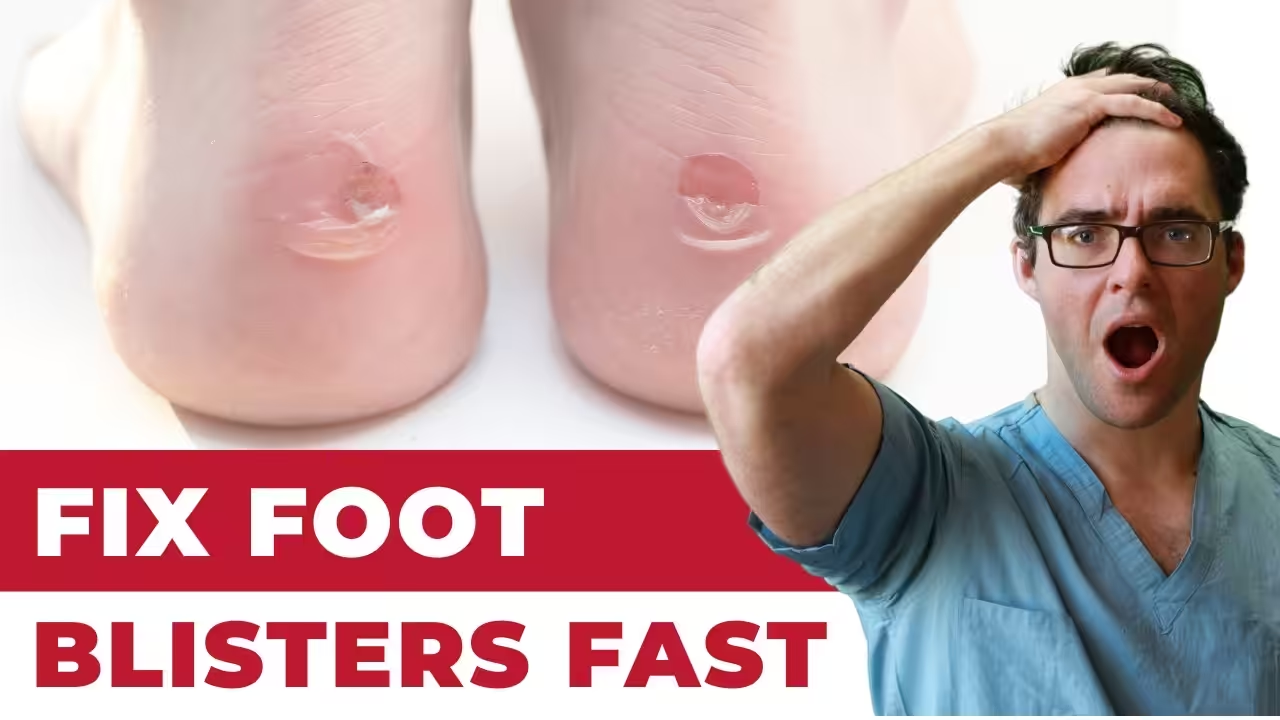
A foot blister is a fluid-filled bubble of skin that forms when repetitive friction separates the outer layers of skin (epidermis), allowing plasma to accumulate in the space. The most common locations are the heel, the ball of the foot under the metatarsal heads, and the tops or sides of the toes—wherever the foot experiences concentrated friction against a shoe or sock. New shoes, increased activity, and moist conditions all accelerate blister formation. Sweaty feet or wet socks reduce the friction threshold required to create a blister, which is why runners and hikers are so prone to them in warm weather or rain.
Blood blisters form when friction is severe enough to rupture small blood vessels, filling the blister cavity with blood rather than clear fluid. They are more painful but managed similarly to regular blisters. Friction blisters must be distinguished from blisters caused by contact dermatitis, burns, or—importantly—diabetic foot complications, where any blister represents a more serious concern requiring prompt medical evaluation.
Should You Pop a Foot Blister?
The intact blister roof (the overlying skin) is the best possible wound dressing—it keeps the wound sterile, maintains moisture for healing, and protects the raw base from pain and infection. If a blister is small, not painful, and not in a location subject to continued pressure, the best course is to leave it intact, apply a donut-shaped pad around it to relieve pressure, and allow it to reabsorb on its own over 3–7 days.
If a blister is large, tense, painful, or located where it will certainly rupture with continued activity (e.g., heel blister in someone who must keep walking), controlled drainage is appropriate. Clean the area with antiseptic, use a sterile needle to pierce the edge of the blister (not the center), gently express the fluid, and leave the overlying skin intact as a cover. Apply antibiotic ointment and cover with a non-stick dressing. Never remove the roof of a blister unless it is already torn and necrotic—exposing the raw base dramatically increases pain and infection risk.
Treating an Infected Blister
Signs of blister infection include increasing redness or warmth spreading beyond the blister edge, swelling, cloudy or yellow pus replacing clear fluid, increasing pain after the first 24 hours (healing blisters become less painful; infected ones become more painful), and fever or red streaking up the leg (signs of cellulitis or lymphangitis). An infected blister should be evaluated by a healthcare provider—it typically requires drainage, wound care, and oral antibiotics. Patients with diabetes, peripheral neuropathy, or poor circulation should seek evaluation promptly for any blister regardless of infection signs, as their compromised healing and sensation make complications more likely and harder to detect.
How to Prevent Foot Blisters
Prevention addresses the underlying causes: friction, moisture, and pressure concentration. The most effective prevention strategies are well-fitted footwear (shoes long enough and wide enough that no area of the foot experiences constant shoe contact), moisture-wicking synthetic socks (wool or polyester blends) that move sweat away from the skin, and application of friction-reducing products (body glide, petroleum jelly, specialized blister-prevention sticks) to known hot spots before activity. Double-layered socks designed specifically for blister prevention reduce inter-sock friction at problem areas. Breaking in new shoes gradually—wearing them for short periods and increasing duration over 1–2 weeks—allows the shoe to mold to the foot before extended activity creates blisters.
Moleskin applied prophylactically to known hot spots before hiking or athletic activity provides a friction-reducing barrier. For runners and hikers, taping techniques (paper tape or kinesiology tape) over blister-prone areas reduce friction effectively. If blisters recur in the same location despite these measures, an underlying bony prominence, hammertoe deformity, or abnormal pressure pattern may be contributing—a podiatric evaluation can identify structural causes and address them with padding, orthotics, or minor procedures.
Frequently Asked Questions
How long does a foot blister take to heal?
An intact, undrained blister typically reabsorbs and heals in 3–7 days if pressure and friction are removed. A drained blister (with the roof kept intact) heals similarly—the raw base re-epithelializes under the protective roof within 5–7 days. A blister where the roof has torn off completely takes 7–14 days to fully heal as new skin grows across the exposed base. Healing is faster when the wound is kept clean, moist (antibiotic ointment and non-stick dressing), and protected from further trauma. Infected blisters take longer and may take 2–3 weeks with antibiotic treatment. Diabetic patients typically have slower healing and should have any slow-healing blister evaluated by a podiatrist.
What is the best thing to put on a foot blister?
For an intact blister: a donut-shaped moleskin or foam pad placed around (not over) the blister to offload pressure, covered with a non-stick bandage to protect it. For a drained or torn blister: apply a thin layer of antibiotic ointment (bacitracin, Neosporin) to keep the wound moist and prevent infection, then cover with a non-stick dressing such as Telfa or a hydrocolloid blister bandage. Hydrocolloid dressings (like Compeed or Band-Aid Hydro Seal) are particularly effective for foot blisters—they create a moist healing environment, cushion the wound, and can be left in place for several days without disturbing the healing tissue. Change dressings when they become saturated or lift at the edges. Avoid alcohol or hydrogen peroxide directly on the blister base, as these damage healing tissue.
When should I see a doctor for a foot blister?
See a doctor for a foot blister if you have diabetes, peripheral neuropathy, or poor circulation (any blister is potentially serious in these patients); if the blister shows signs of infection—spreading redness, warmth, pus, increasing pain, fever, or red streaking up the leg; if the blister is extremely large or in a location making walking impossible; if the blister does not begin healing within 1–2 weeks; or if blisters recur repeatedly in the same location despite prevention efforts (suggesting an underlying structural problem). For otherwise healthy patients, most small-to-moderate foot blisters heal well with home care—clean the area, protect it from further friction, keep it moist, and watch for infection signs.
Medical References & Sources
- PubMed Research — Friction Blister Prevention and Treatment in Sports
- American Podiatric Medical Association — Blisters
- PubMed Research — Hydrocolloid Dressings for Blister Healing
📧 Get Dr. Tom’s Free Lab Test Guide
Discover the 5 lab tests every person over 35 should ask their doctor about — explained in plain English by a board-certified physician.
Dr. Tom Biernacki, DPM is a board-certified podiatric surgeon at Balance Foot & Ankle in Howell and Bloomfield Township, Michigan. He treats foot blisters, skin conditions, and the underlying structural problems—bony prominences, hammertoes, abnormal pressure patterns—that cause recurrent blisters.
Join 950,000+ Learning About Foot Health
Dr. Tom shares honest medical advice, supplement reviews, and treatment guides you won’t find anywhere else.
Subscribe on YouTube →Blister-Prevention Socks and Products
- Darn Tough Merino Wool Socks — Lifetime Guarantee
- Balega Hidden Comfort — Ultra-Padded Running Socks
- Body Glide Anti-Blister Balm — Friction Prevention
Amazon affiliate links — we may earn a small commission at no extra cost to you.
📍 Located in Michigan?
Our board-certified podiatrists treat this condition at two convenient locations. Same-day appointments often available.

Insurance Accepted
BCBS · Medicare · Aetna · Cigna · United Healthcare · HAP · Priority Health · Humana · View All →
Howell Office
4330 E Grand River Ave
Howell, MI 48843
Get Directions →
Bloomfield Township Office
43494 Woodward Ave, #208
Bloomfield Township, MI 48302
Get Directions →
Your Board-Certified Podiatrists



Ready to Get Back on Your Feet?
Same-week appointments available at both locations.
Book Your AppointmentPros & Cons of Conservative Care for foot care
Advantages
- ✓ Conservative care first
- ✓ Same-week appointments
- ✓ Multiple insurance accepted
Considerations
- ✗ Self-treatment can mask issues
- ✗ See a podiatrist if pain >2 weeks
Dr. Tom’s Recommended Products for foot care
Affiliate disclosure: As an Amazon Associate, Balance Foot & Ankle earns from qualifying purchases. We only recommend products we use with patients.
Footnanny Heel Cream Dr. Tom’s Pick
Best for: Daily moisturizer for cracked heels
Ready to Get Back on Your Feet?
Same-day appointments in Howell + Bloomfield Township. Most insurance accepted. Dr. Tom Biernacki, DPM & team.
Book Today — Same-Day Appointments Available
Call Now: (810) 206-1402
About Your Care Team at Balance Foot & Ankle
Dr. Tom Biernacki, DPM · Board-Certified Foot & Ankle Surgeon. Specializes in conservative-first care, minimally invasive bunion surgery, and complex reconstruction.
Dr. Carl Jay, DPM · Accepting new patients. Specializes in sports medicine, athletic injuries, and routine podiatric care.
Dr. Daria Gutkin, DPM, AACFAS · Accepting new patients. Specializes in surgical reconstruction and pediatric podiatry.
Locations: 4330 E Grand River Ave, Howell, MI 48843 · 43494 Woodward Ave Suite 208, Bloomfield Township, MI 48302
Hours: Mon–Fri 8:00 AM – 5:00 PM · (810) 206-1402
In-Office Treatment at Balance Foot & Ankle
If home treatment isn’t providing relief for your foot health, our podiatry team at Balance Foot & Ankle can help with same-day evaluations and advanced in-office care.
Same-day appointments available. (810) 206-1402
Doctor Hoy’s Natural Pain Relief Gel
Natural topical pain relief I use in our clinic. Arnica + camphor formula — apply directly to the area 3–4x daily. ($20–25)
Shop Doctor Hoy’s →Want to Listen Instead of Read?
If you’re recovering at home with foot pain and rest is part of the protocol, an audiobook subscription is a low-friction way to stay engaged without straining. Audible offers a 30-day free trial that includes one free book of your choice — health, fitness, or any genre.
Start a free 30-day Audible trial here. The trial includes credit for any audiobook — you keep it even if you cancel. Popular foot-recovery picks: Born to Run (Christopher McDougall) and Why We Sleep (Matthew Walker, MD).
Disclosure: as an Amazon Associate, we earn a small bounty if you start a trial. It costs you nothing and supports the practice.
Ready for Expert Care?
Same-day appointments in Howell & Bloomfield Township, MI.
4.9★ | 1,123 Reviews | 3,000+ Surgeries
Or call: (810) 206-1402

Dr. Tom Biernacki, DPM is a board-certified foot & ankle surgeon (ABFAS & ABPM) at Balance Foot & Ankle Specialists in Southeast Michigan. With over a decade of clinical experience, he specializes in heel pain, bunions, diabetic foot care, sports injuries, and minimally invasive surgery. Dr. Biernacki is a member of the APMA and ACFAS, and his patient education content on MichiganFootDoctors.com and YouTube has made him one of the most-followed foot & ankle educators on YouTube.