

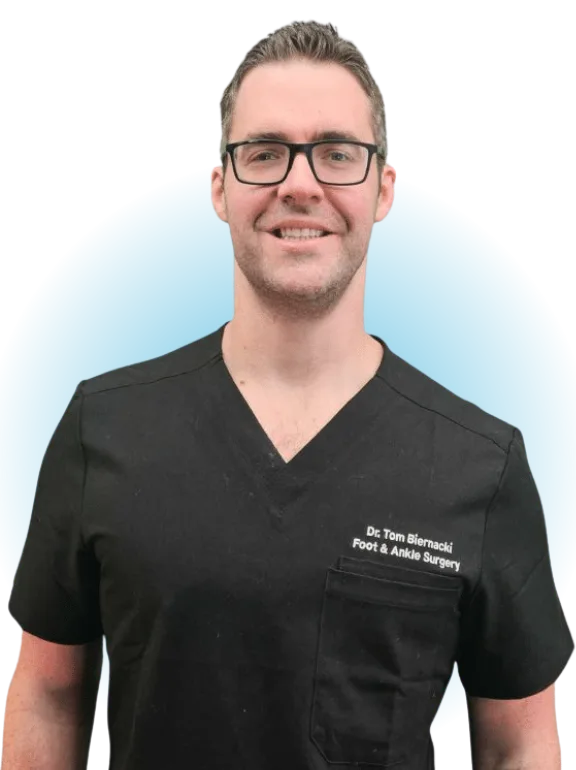
Medically Reviewed | Dr. Tom Biernacki, DPM | Board-Certified Podiatric Surgeon | Balance Foot & Ankle, Michigan

Why Nurses Have Foot Problems
Nursing involves 10-14 hours of continuous standing and walking on hard clinical floors with minimal seated rest. Studies show nurses walk an average of 4-5 miles per shift. The cumulative impact load on the plantar fascia, metatarsals, and lower limb vasculature is substantial. Common conditions: plantar fasciitis (medial heel pain), metatarsalgia (ball-of-foot pain from hard floor standing), lower limb edema (from prolonged dependent positioning of the legs), and cumulative stress injuries of the foot and ankle.
Footwear Selection
Footwear is the single most impactful intervention for clinical staff foot health. Key features: cushioned midsole — EVA or PU foam with shock absorption; arch support — structured midsole supporting the medial arch; wide toe box — prevents metatarsal compression and neuroma development; slip resistance — clinical requirement; replace every 6-9 months — midsole compression fatigue in high-use clinical footwear is significant. Top brands for clinical staff: Dansko Professional clogs (excellent arch support and rocker sole reducing forefoot push-off load), HOKA Bondi (maximum cushion for plantar fasciitis), New Balance Fresh Foam (wide-width options, excellent cushioning), Brooks Ghost (balance of cushion and support).
Compression Socks
Medical-grade graduated compression socks (15-20 mmHg for preventive use, 20-30 mmHg for established edema) significantly reduce lower limb swelling and fatigue in clinical staff. Studies show 20-40% reduction in end-of-shift ankle swelling with consistent compression sock use. Knee-high compression is more effective than ankle compression for clinical staff edema.
Exercise and Recovery
Post-shift foot elevation (legs above heart level for 15-20 minutes) dramatically reduces edema. Calf stretching post-shift prevents plantar fasciitis and Achilles issues. Intrinsic foot exercises (toe curls, short foot exercises) strengthen the small muscles of the foot that fatigue during prolonged standing. Orthotic insoles — particularly metatarsal pad variants — offload the ball of the foot on hard floors.
Dr. Tom's Product Recommendations
DASS Medical Compression Socks
⭐ Highly Rated
Medical-grade graduated compression specifically beneficial for nurses — reduces end-of-shift ankle swelling by 20-40% and lower limb fatigue during long clinical shifts.
DASS Medical
4.5
Disclosure: We earn a commission at no extra cost to you.
PowerStep Pinnacle Arch Support Insoles
⭐ Highly Rated
Clinician-recommended insoles for nurses — arch support and metatarsal cushioning reduce plantar fasciitis and ball-of-foot pain from hard floor standing.
PowerStep
4.6
Disclosure: We earn a commission at no extra cost to you.
✅ Pros / Benefits
- Compression socks reduce edema 20-40% — significant quality of life improvement
- Proper footwear selection dramatically reduces foot pain on long shifts
- Plantar fasciitis is highly responsive to appropriate footwear and orthotics
❌ Cons / Risks
- Compressed shift schedules limit recovery time between high-load shifts
- Hard clinical floors cannot be avoided — only mitigated with footwear and orthotics
- Budget constraints sometimes limit footwear quality — invest in shoes over other clinical gear
Dr. Tom Biernacki’s Recommendation
I treat a lot of nurses and healthcare workers. The most common mistake is wearing fashion-first clinical footwear. Your feet are your career — invest in them. A $140 pair of HOKA or Dansko every 9 months prevents the plantar fasciitis, neuromas, and varicosities that cost you months of treatment and time off work. Compression socks are the second most important intervention. Start your shift in them, not when your feet are already swollen.
— Dr. Tom Biernacki, DPM | Board-Certified Podiatric Surgeon | Balance Foot & Ankle
Frequently Asked Questions
What are the best shoes for nurses with plantar fasciitis?
HOKA Bondi for maximum cushioning, Dansko Professional clogs for arch support and rocker sole, New Balance Fresh Foam for wide-width options. Key features: adequate heel cushioning (>25 mm stack height), rigid midsole for arch support, and replace every 6-9 months.
Do compression socks help nurses?
Yes significantly. Medical-grade graduated compression (15-20 mmHg for prevention) reduces end-of-shift ankle swelling by 20-40% and lower limb fatigue. Put them on at the start of your shift, not after swelling has already developed — compression works best prophylactically.
How do I treat plantar fasciitis as a nurse?
Cannot stop working, so: maximum cushion shoes, orthotic insoles with deep heel cup, calf stretching before and after shifts, night splints to pre-stretch the fascia overnight, and cortisone injection if conservative measures don’t control it in 6-8 weeks. Continuing to work through plantar fasciitis is possible with proper management.
In-Office Treatment at Balance Foot & Ankle
If home treatment isn’t providing relief for your foot care nurses long shifts, our podiatry team at Balance Foot & Ankle can help with expert evaluations and advanced in-office care.
Book online 24/7. (810) 206-1402
VitaMedica Arnica Gel
Arnica gel plus 15 plant compounds for sore feet, plantar fasciitis flares and post-activity soreness. Apply a thin layer to the sore area.
Shop VitaMedica Arnica Gel →
Dr. Tom Biernacki, DPM is a board-certified foot & ankle surgeon (ABFAS & ABPM) at Balance Foot & Ankle Specialists in Southeast Michigan. With over a decade of clinical experience, he specializes in heel pain, bunions, diabetic foot care, sports injuries, and minimally invasive surgery. Dr. Biernacki is a member of the APMA and ACFAS, and his patient education content on MichiganFootDoctors.com and YouTube has made him one of the most-followed foot & ankle educators on YouTube.