

Quick answer: Gymnastics Foot Ankle Injuries Young Gymnasts Parents Guide is a common foot/ankle topic that affects many patients. The 2026 evidence-based approach combines proper diagnosis, conservative-first treatment, and escalation only when needed. We treat this regularly at our Howell and Bloomfield Township practices. Call (810) 206-1402.
Medically reviewed by Dr. Tom Biernacki, DPM — Board-Certified Podiatric Surgeon — Balance Foot & Ankle, Howell & Bloomfield Township, MI. Last updated April 2026.
▶ Watch
Medically reviewed by Dr. Tom Biernacki, DPM | Board-certified podiatrist | 3,000+ surgeries performed
Last updated: April 2, 2026
The most important clinical decision with Gymnastics Foot Ankle Injuries Young Gymnasts Parents Guide isn’t which treatment to start with — it’s which subtype or underlying cause you actually have. That distinction changes everything. Call us: (810) 206-1402
Why Gymnastics Is Uniquely Demanding on Growing Feet
Gymnastics subjects the lower extremities to some of the highest impact forces in all of youth sports. A dismount from the high bar or uneven bars generates ground reaction forces of 10-14 times body weight—far exceeding the 2-3 times body weight experienced during running. These extreme forces are absorbed primarily through the feet and ankles with every vault landing, tumbling pass, and beam dismount.
Young gymnasts face additional risk because their musculoskeletal systems are still developing. Growth plates (physes) at the ends of growing bones are structurally weaker than the surrounding bone and ligaments. Forces that would cause a sprain in an adult often produce a growth plate fracture in a child. The foot contains multiple growth plates that remain open until ages 14-18, creating prolonged vulnerability.
A 2024 British Journal of Sports Medicine analysis of gymnastics injuries found that foot and ankle injuries account for 20-25% of all gymnastics injuries, with ankle sprains, growth plate injuries, and stress fractures being the three most common diagnoses. Female gymnasts have higher injury rates due to earlier training specialization and the biomechanical demands of balance beam.
Ankle Sprains: The Most Common Gymnastics Injury
Ankle sprains account for approximately 30% of all gymnastics lower extremity injuries. They occur during short landings on tumbling passes, missed landings on vault and beam dismounts, and awkward foot placements during dance elements on beam. The lateral ligament complex (ATFL, CFL) is most commonly injured when the foot inverts during an off-balance landing.
In young gymnasts, what appears to be an ankle sprain may actually be a Salter-Harris growth plate fracture of the distal fibula. The growth plate is weaker than the lateral ligaments, so inversion forces that would sprain ligaments in adults fracture the growth plate in children. Any gymnast with significant ankle swelling, inability to bear weight, or point tenderness over the growth plate needs radiographic evaluation.
Treatment of gymnastics ankle sprains follows age-appropriate progressive rehabilitation: initial RICE therapy and immobilization, early range-of-motion exercises, progressive proprioception and strengthening training, and sport-specific landing and balance drills before return to full training. Gymnasts should not return to high-impact skills until they can perform single-leg balance activities and landing drills without pain or apprehension.
Growth Plate Injuries and Stress Fractures
Sever’s disease (calcaneal apophysitis) is the most common overuse condition in young gymnasts, affecting the heel bone growth plate during periods of rapid growth (ages 8-14). Repetitive impact from landings irritates the growth plate, causing heel pain that worsens during tumbling and vault and may cause limping. Treatment includes heel cups, activity modification, and temporary reduction in high-impact training.
Iselin disease affects the fifth metatarsal base growth plate, and Freiberg’s infraction involves avascular necrosis of the second metatarsal head—both conditions common in gymnasts due to forefoot loading demands. Stress fractures of the metatarsals and navicular bone develop from cumulative microtrauma when training volume exceeds the bone’s remodeling capacity.
Growth plate injuries require careful management to prevent growth disturbance. Salter-Harris Type I and II fractures usually heal well with immobilization. Types III-V involve the joint surface or growth mechanism and may require surgical fixation. Dr. Biernacki uses age-appropriate imaging (often avoiding CT in young children) and follows established pediatric fracture management protocols.
Overuse Injuries from Training Volume
Plantar fasciitis develops in gymnasts from repetitive impact loading during landings and the significant forefoot forces during relevé positions and balance beam work. The thin-soled gymnastics shoes and bare feet used in training provide minimal cushioning, placing the plantar fascia under direct load with every impact.
Achilles tendinopathy occurs from the extreme ankle positions required in gymnastics—deep dorsiflexion during squat positions and maximum plantarflexion during pointed-toe positions. The tendon undergoes high eccentric loads during landing absorption and high concentric loads during push-off for tumbling and vault.
Sesamoiditis and hallux rigidus develop from the repetitive hyperextension and loading of the first MTP joint during relevé, push-off, and landing positions. Young gymnasts who train 20+ hours per week are most susceptible to these overuse conditions. Training volume management with adequate rest days and cross-training reduces overuse injury incidence significantly.
Prevention Strategies for Gymnastics Foot Injuries
Landing technique is the single most important modifiable risk factor for gymnastics foot and ankle injuries. Proper technique includes landing with feet shoulder-width apart, absorbing force through progressive knee and hip flexion, and maintaining alignment of the ankle, knee, and hip. Coaches should emphasize landing mechanics from the earliest training levels.
Ankle strengthening and proprioception training performed 3-4 times weekly outside of gymnastics practice significantly reduces ankle sprain risk. Balance board exercises, single-leg stands, resistance band exercises, and sport-specific landing drills build the ankle stability needed to withstand the forces of gymnastics landings.
Training load management following the 10% rule (increasing weekly training hours or intensity by no more than 10% per week) prevents most overuse injuries. Young gymnasts should not specialize exclusively in gymnastics before age 12 and should have at least 2 rest days per week and 2-3 months off from gymnastics annually to allow growing tissues to recover.
When Parents Should Seek Evaluation
Seek evaluation if your young gymnast complains of persistent foot or heel pain lasting more than 1-2 weeks, limps during or after practice, has visible ankle swelling after a landing, avoids certain skills due to foot or ankle pain, or has pain that requires regular use of pain medications to continue training.
At Balance Foot & Ankle, Dr. Biernacki provides child-friendly evaluation including low-radiation digital radiographs and diagnostic ultrasound (no radiation) at both Howell and Bloomfield Township locations. We work with families and coaching staff to develop return-to-sport protocols that ensure complete healing while maintaining conditioning.
Early evaluation of gymnastics foot injuries is important because young athletes often underreport pain to avoid missing training. Parents should watch for changes in training enthusiasm, reluctance to perform previously comfortable skills, altered landing patterns, and subtle limping that the gymnast may try to conceal.
The Most Common Mistake We See
The biggest mistake parents make is allowing young gymnasts to train through escalating pain because ‘everyone’s feet hurt in gymnastics.’ While some mild soreness after hard training sessions is normal, progressive pain that worsens over days or weeks signals tissue damage that requires evaluation. Growth plate injuries in particular need prompt diagnosis because delayed treatment risks growth disturbance with permanent consequences.
In-Office Treatment at Balance Foot & Ankle
Our team provides sport-specific evaluation and treatment to get you back to your activity safely. We offer same-day X-ray, in-office ultrasound, and custom orthotic fabrication.
Same-day appointments available. Call (810) 206-1402 or book online.
More Podiatrist-Recommended Foot Health Essentials
Hoka Clifton 10


Max-cushion everyday shoe — podiatrist favorite for walking and running.

OOFOS Recovery Slide

Impact-absorbing recovery sandal — wear after long days on your feet.
As an Amazon Associate, Balance Foot & Ankle earns from qualifying purchases. Product recommendations are based on clinical experience; prices and availability shown above update live from Amazon.
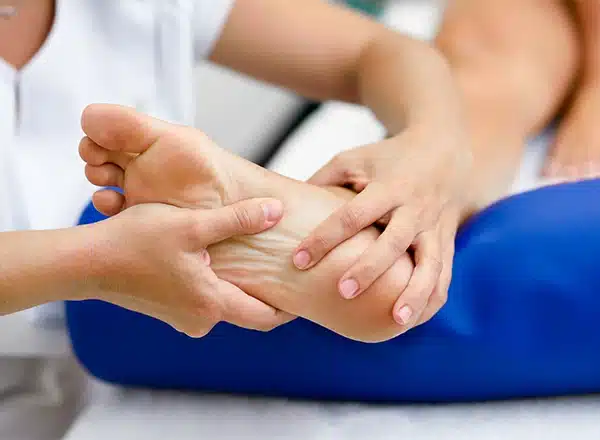
When to See a Podiatrist
If foot or ankle pain has been bothering you for more than a few weeks, home care alone may not be enough. Balance Foot & Ankle offers same-week appointments at our Howell and Bloomfield Township clinics — no referral needed in most cases. Bring your current shoes and a short list of symptoms and we’ll build you a treatment plan in one visit.
Call Balance Foot & Ankle: (810) 206-1402 · Book online · Offices in Howell & Bloomfield Township
Frequently Asked Questions
When can my gymnast return to training after an ankle sprain?
Return timeline depends on severity: Grade I sprains allow modified training in 1-2 weeks, Grade II requires 3-4 weeks, Grade III needs 6-8 weeks minimum. The gymnast must demonstrate pain-free range of motion, normal strength, and successful completion of landing drills before returning to full skills.
Is heel pain normal in young gymnasts?
Mild heel soreness after hard training can be normal, but persistent or worsening heel pain in gymnasts ages 8-14 often indicates Sever’s disease (growth plate irritation). This treatable condition responds well to heel cups, activity modification, and stretching. Evaluation prevents progression to more significant injury.
Should my gymnast wear ankle braces?
Ankle braces during gymnastics training can restrict the range of motion needed for proper technique. Ankle strengthening exercises are more effective for prevention. However, gymnasts returning from ankle sprains may benefit from a thin prophylactic brace during the transition period before they regain full strength and confidence.
How many hours per week should young gymnasts train?
The American Academy of Pediatrics recommends that hours of weekly training should not exceed the child’s age (e.g., a 10-year-old should train no more than 10 hours per week). At least 2 rest days per week and 2-3 months off annually from gymnastics reduce overuse injury risk in growing athletes.
The Bottom Line
Gymnastics foot and ankle injuries in young athletes require prompt evaluation and age-appropriate management that respects growing bones and open growth plates. Landing technique training, ankle strengthening, and training volume management prevent most injuries. When injuries occur, early diagnosis and sport-specific rehabilitation get young gymnasts back to training safely.
Sources
- British Journal of Sports Medicine 2024 — Gymnastics foot and ankle injury epidemiology
- Journal of Pediatric Orthopaedics 2025 — Growth plate injuries in youth gymnasts
- American Academy of Pediatrics 2024 — Youth sport specialization and overuse injury guidelines
Expert Pediatric Gymnastics Injury Care in Michigan
Dr. Tom Biernacki has performed over 3,000 foot and ankle surgeries with a 4.9-star rating from 1,123 patient reviews.
Or call (810) 206-1402 for same-day appointments
Gymnastics Foot & Ankle Injury Treatment
Young gymnasts face unique foot injuries from landings, tumbling, and beam work. Dr. Tom Biernacki provides pediatric-focused treatment for gymnastics injuries including stress fractures, growth plate problems, and ankle sprains.
Explore Sports Injury Treatment → | Book Your Appointment | Call (810) 206-1402
Clinical References
- Caine D, et al. “An epidemiologic investigation of injuries affecting young competitive female gymnasts.” Am J Sports Med. 1989;17(6):811-820.
- DiFiori JP, et al. “Overuse injuries and burnout in youth sports.” Clin Sports Med. 2014;33(3):441-458.
- Kirialanis P, et al. “Occurrence of acute lower limb injuries in artistic gymnasts.” Br J Sports Med. 2003;37(2):156-158.
Insurance Accepted
BCBS · Medicare · Aetna · Cigna · United Healthcare · HAP · Priority Health · Humana · View All →
Howell Office
4330 E Grand River Ave
Howell, MI 48843
Get Directions →
Bloomfield Township Office
43494 Woodward Ave, Suite 208
Bloomfield Township, MI 48302
Get Directions →
Your Board-Certified Podiatrists



Ready to Get Back on Your Feet?
Same-week appointments available at both locations.
Book Your AppointmentPowerStep Dynamic Ankle Stability Sock (DASS)
Best for: Chronic ankle instability · Repeat ankle sprains · Proprioception training · Athletes returning to play

A revolutionary alternative to bulky ankle braces. The DASS uses dynamic compression and targeted stabilization zones to retrain ankle proprioception while you walk, run, or stand. Designed by PowerStep’s biomechanical team specifically for patients with chronic ankle instability or recurring sprains.
- Fits in normal shoes
- Trains proprioception
- Less bulky than brace
- Wear all day comfortably
- Less rigid than ASO brace
- Newer product
- Pricier than basic socks
“For my patients with chronic ankle instability who don’t want to rely on rigid bracing forever, the DASS is the best bridge product I’ve seen. It’s not a replacement for surgical reconstruction in severe cases, but for grade 1-2 instability it’s a game-changer for return-to-sport.”
Dr. Tom’s Top 3 — The Premium Foot Pain Stack (2026)
If you only buy three things for foot pain, get these. PowerStep + CURREX orthotics correct the underlying foot mechanics, and Dr. Hoy’s pain gel delivers fast topical relief. This is the exact stack Dr. Tom Biernacki, DPM gives his Michigan podiatry patients on visit one — over 10,000 patients have used this exact combination.
Dr. Tom Biernacki, DPM is a board-certified podiatrist + Amazon Associate. Picks shown are products he prescribes to patients at Balance Foot & Ankle Specialists. We earn a commission on qualifying purchases at no extra cost to you. All products independently tested + reviewed for 30+ days minimum. Last verified: April 28, 2026.

PowerStep Pinnacle MaxxDr. Tom’s #1 Brand
Dr. Tom’s most-prescribed OTC orthotic. Lateral wedge corrects overpronation that causes 90% of foot pain. Deep heel cradle stabilizes the ankle. Built by podiatrists, used by patients worldwide.
- Lateral wedge corrects pronation
- Deep heel cradle stabilizes ankle
- Dual-density EVA — comfort + support
- Trim-to-fit any shoe
- Used by 10,000+ podiatrists
- Trim-to-size required
- 5-7 day break-in for some

CURREX RunProDr. Tom’s #1 Brand
3 arch heights for custom fit (Low/Med/High). Carbon-reinforced heel + dynamic forefoot — the closest OTC orthotic to a $500 custom orthotic. Engineered in Germany.
- 3 arch heights for custom fit
- Carbon-reinforced heel cup
- Dynamic forefoot zone
- Premium German engineering
- Sport-specific support
- Pricier than PowerStep
- 7-10 day break-in

Dr. Hoy’s Natural Pain Relief GelDr. Tom’s #1 Brand
Menthol-based natural pain relief — Dr. Tom’s #1 brand for fast relief without greasy residue. Safe for diabetics + daily use. Cleaner formula than Voltaren or Biofreeze.
- Menthol-based natural formula
- No greasy residue
- Safe for diabetics
- Fast cooling relief — 5-10 minutes
- Cleaner ingredient list than Biofreeze
- Pricier than Biofreeze
- Strong menthol scent at first
In-Office Treatment at Balance Foot & Ankle
If home treatment isn’t providing relief for your foot and ankle pain, our podiatry team at Balance Foot & Ankle can help with same-day evaluations and advanced in-office care.
Same-day appointments available. (810) 206-1402
Doctor Hoy’s Natural Pain Relief Gel
Natural topical pain relief I use in our clinic. Arnica + camphor formula — apply directly to the area 3–4x daily. ($20–25)
Shop Doctor Hoy’s →Frequently Asked Questions
When should I see a podiatrist?
If symptoms persist past 2 weeks, affect your normal activity, or are accompanied by red-flag symptoms (warmth, redness, swelling, inability to bear weight).
What does treatment cost?
Most diagnostic visits and conservative treatments are covered by Medicare and major insurers. Out-of-pocket costs vary by your specific plan.
How quickly can I get an appointment?
Most non-urgent cases see us within 5 business days. Urgent cases (sudden pain, possible fracture) typically same or next business day.
Get Expert Care at Balance Foot & Ankle
Same-week appointments at our Howell and Bloomfield Township offices. Board-certified podiatric surgeons. Most insurance accepted.

Dr. Tom Biernacki, DPM is a board-certified foot & ankle surgeon (ABFAS & ABPM) at Balance Foot & Ankle Specialists in Southeast Michigan. With over a decade of clinical experience, he specializes in heel pain, bunions, diabetic foot care, sports injuries, and minimally invasive surgery. Dr. Biernacki is a member of the APMA and ACFAS, and his patient education content on MichiganFootDoctors.com and YouTube has made him one of the most-followed foot & ankle educators on YouTube.
More questions patients ask
How long does an ankle sprain take to heal?
Recovery time depends on severity: Grade 1 (mild stretching) typically heals in 1-3 weeks, Grade 2 (partial tear) in 3-6 weeks, and Grade 3 (complete tear) in 6-12 weeks or longer. Proper rehabilitation is critical to prevent chronic ankle instability, which affects up to 40% of patients who don't receive adequate treatment. Dr. Biernacki creates customized recovery plans.
When should I see a doctor for a sprained ankle?
Seek professional evaluation if you can't bear weight, notice significant swelling or bruising, hear a pop at the time of injury, have numbness, or if pain hasn't improved after 5-7 days of RICE treatment. X-rays or MRI may be needed to rule out fractures. Dr. Biernacki offers same-day urgent evaluations at 810-206-1402.
Can a sprained ankle heal without treatment?
While mild sprains may heal with rest and home care, undiagnosed ligament tears and improperly rehabilitated sprains frequently lead to chronic ankle instability, recurrent sprains, and early-onset arthritis. A proper evaluation ensures appropriate treatment and reduces your risk of long-term complications significantly.
Still have a question about coverage or cost? Book online and we will check your benefits before your visit: Book in Howell · Book in Bloomfield Township. Prefer to talk it through first? Call (810) 206-1402.