
Medically reviewed by Dr. Tom Biernacki, DPM
Board-certified podiatric surgeon | Balance Foot & Ankle, Howell & Bloomfield Township, MI
Last reviewed: May 2026

| Cause | Mechanism | Which Toes Affected | Associated Findings |
|---|---|---|---|
| Muscle Imbalance (Intrinsic-Extrinsic) | Intrinsic muscles weaken; extrinsic flexors overpower; PIP flexion contracture develops | 2nd–5th toes; 2nd most common | Often bilateral; worse with activity |
| Tight / Ill-Fitting Shoes | Toe box forces toe into sustained flexion; prevents active extension | Any toe; 2nd and 3rd most common | Shoe callus over PIP joint; corns |
| Long Second Toe (Morton Foot) | 2nd toe longer than hallux; crammed against shoe; develops flexion contracture | 2nd toe predominantly | Plantar callus; 2nd MTP synovitis |
| Hallux Valgus (Bunion) | Hallux pushes 2nd toe dorsally and medially; secondary 2nd toe hammertoe | 2nd toe; may affect 3rd | Bunion deformity; overcrowding of lesser toes |
| Neuromuscular Disease | Intrinsic muscle wasting from Charcot-Marie-Tooth; stroke; polio | Multiple toes; claw toe pattern | Weakness; atrophy; sensory loss |
| Trauma | PIP dislocation; fracture healing in flexion | Any toe; often single | Scar tissue; history of injury |
| Procedure | Deformity Type | Technique | Fixation | Recovery |
|---|---|---|---|---|
| Flexor Tenotomy (FDL Release) | Flexible mallet or hammertoe | Percutaneous stab; FDL cut at plantar DIP; toe straightens immediately | None — no implant | 1–2 weeks surgical sandal; immediate WB |
| PIP Arthroplasty (Condylectomy) | Rigid hammertoe; mild-moderate | Dorsal incision; PIP condyles resected; toe straightened | K-wire 4–6 weeks OR implant | 4–6 weeks surgical shoe; normal shoe 8–12 weeks |
| PIP Arthrodesis (Fusion) | Severe rigid hammertoe; recurrent | PIP joint surfaces removed; bone surfaces fused permanently straight | Intramedullary screw (SmartToe / StayFuse) or K-wire | 6–8 weeks; 3–4 months full recovery |
| MTP Release + Extensor Lengthening | Claw toe with MTP hyperextension | MTP capsule released; extensor digitorum longus lengthened via Z-plasty | Combined with PIP procedure if both joints involved | As above for combined procedure |
| Weil Osteotomy | Floating toe risk; MTP subluxation; 2nd MTP synovitis | Oblique metatarsal head osteotomy shortens and depresses metatarsal | 1–2 small screws; WB immediately in surgical shoe | 4–6 weeks surgical shoe; 3–4 months full recovery |
Quick answer: Treatment for hammertoe causes treatment surgery follows a stepwise approach: 1) conservative care first (rest, ice, supportive footwear, OTC anti-inflammatories), 2) physical therapy and targeted exercises, 3) in-office treatments (injections, custom orthotics) if conservative fails at 4-6 weeks, 4) surgery for refractory cases. Most patients resolve at step 1 or 2. Call (810) 206-1402.
Medically Reviewed | Dr. Tom Biernacki, DPM | Board-Certified Podiatric Surgeon | Balance Foot & Ankle, Michigan

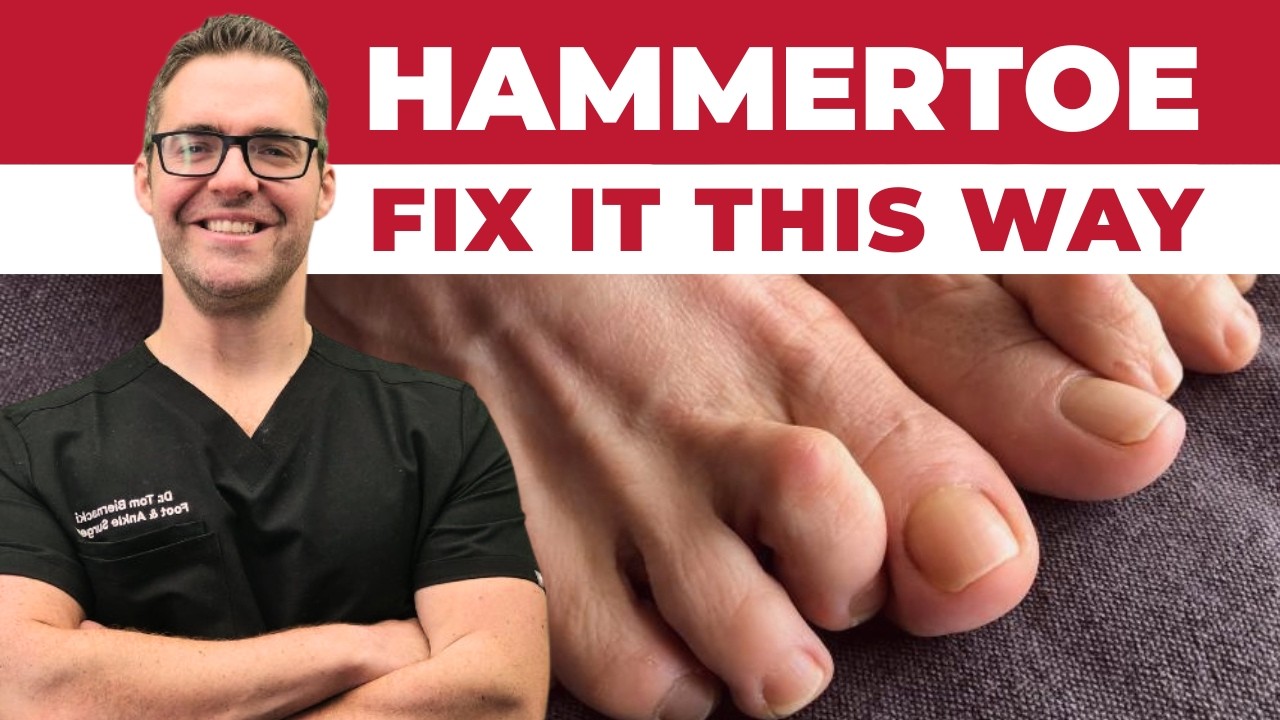
Watch: How to Fix Hammer Toes at Home [Overlapping & Crossover Toes]! — MichiganFootDoctors YouTube
What Is a Hammertoe?
A hammertoe is a deformity in which one of the middle toes — most commonly the second, third, or fourth — bends abnormally at the proximal interphalangeal (PIP) joint, causing a downward curl resembling a hammer. The deformity results from a muscle and tendon imbalance that disrupts the normal biomechanics of the toe. Over time, the bent toe rubs against footwear, causing painful corns, calluses, and skin breakdown at the tip and top of the affected toe.
Causes of Hammertoes
The most common cause is a structural imbalance between the flexor and extensor tendons acting on the toe. Narrow, pointed, or high-heeled footwear forces the toes into a flexed position that — over years — becomes fixed. Bunions that push the big toe toward the second toe frequently cause hammertoe deformity in the second toe. Flat feet, high arches, and neurological conditions affecting foot muscle control also predispose patients to hammertoes. Traumatic injuries that damage the tendons or ligaments can also initiate the deformity.
Flexible vs. Rigid Hammertoe
Hammertoes are classified as flexible or rigid based on whether the deformity can be passively corrected. A flexible hammertoe can be straightened manually and responds to conservative treatment. A rigid hammertoe has fixed contracture — the joint cannot be straightened passively and typically requires surgical correction. Most hammertoes begin as flexible and become rigid over years if not treated.
Conservative Treatment
For flexible hammertoes, conservative treatment is effective. Footwear with a deep, wide toe box removes pressure from the bent joint. Toe splints and buddy-taping straighten flexible hammertoes during the day. Padding over the prominent joint reduces friction against shoes. Stretching exercises for the toe flexors and strengthening of the intrinsic foot muscles address the underlying imbalance. When a bunion is driving the second-toe hammertoe, addressing the bunion is part of the solution. Custom orthotics control the biomechanical factors contributing to deformity progression.
Surgical Correction
Rigid hammertoes that have failed conservative care require surgery. The most common procedure is a proximal interphalangeal (PIP) joint resection arthroplasty — removing a small segment of bone to allow the toe to straighten, sometimes with a pin or implant for temporary stabilization. For more severe deformities, a complete joint fusion (arthrodesis) provides permanent straightening. Flexor-to-extensor tendon transfer procedures address flexible hammertoes with a strong tendon-imbalance component. Recovery from hammertoe surgery involves 2–4 weeks in a surgical shoe, followed by gradual return to regular footwear over 6–8 weeks.
Dr. Tom's Product Recommendations

PediFix Toe Straighteners
⭐ Highly Rated
Soft gel toe straighteners that hold flexible hammertoes in a corrected position during daily activity. Reduce corn and callus formation by eliminating the friction between the bent joint and footwear.
Flexible hammertoe pain relief and corn prevention
Rigid hammertoes — surgical correction is the only effective treatment
Disclosure: We earn a commission at no extra cost to you.

New Balance 928v3 Wide Width Walking Shoe
⭐ Highly Rated
A roomy, deep toe box walking shoe that accommodates hammertoe deformities without rubbing or pressure. Available in 4E extra-wide width. One of Dr. Biernacki’s top footwear recommendations for patients with hammertoes.
Daily wear for hammertoe patients — eliminates friction and prevents progression
Post-surgical hammertoe — specialized surgical shoes are initially required
Disclosure: We earn a commission at no extra cost to you.
✅ Pros / Benefits
- Flexible hammertoes highly responsive to conservative care
- Surgical correction has excellent outcomes for rigid deformities
- Wide-toe-box footwear provides immediate relief
- Addressing underlying bunion prevents recurrence
❌ Cons / Risks
- Rigid hammertoes require surgery
- Post-surgical recovery takes 6–8 weeks
- Deformity progresses without treatment
- Recurrence possible if footwear habits don’t change
Dr. Tom Biernacki’s Recommendation
Hammertoes are like bunions — they don’t get better on their own, and the window for conservative management closes once the deformity becomes rigid. If you catch a hammertoe while it’s still flexible, we can slow or stop the progression with the right shoes and toe exercises. Once it’s rigid, surgery is the only real option.
— Dr. Tom Biernacki, DPM | Board-Certified Podiatric Surgeon | Balance Foot & Ankle
Frequently Asked Questions
Can hammertoes be straightened without surgery?
Flexible hammertoes can be managed with splints, padding, and footwear changes but cannot be permanently straightened without surgery. Rigid hammertoes require surgical correction. Early intervention while the deformity is flexible offers the best non-surgical outcomes.
How painful is hammertoe surgery?
Hammertoe surgery is typically performed under local anesthesia with mild sedation. Post-operative pain is well-managed with oral medications. Most patients are weight-bearing in a surgical shoe on the day of surgery.
What causes a corn on a hammertoe?
The bent joint presses against the top of the shoe with every step, creating repetitive friction that causes the skin to thicken into a corn. Properly fitting footwear and toe cushions reduce corn formation.
How long does hammertoe surgery recovery take?
Patients wear a surgical shoe for 2–4 weeks, then transition to regular supportive footwear over 6–8 weeks. Full swelling resolution and final outcome take 3–6 months.
Michigan Foot Pain? See Dr. Biernacki In Person
4.9★ rated | 1,200+ Reviews | 3,000+ Surgeries
Book online 24/7 · Howell & Bloomfield Township
📞 (810) 206-1402 Book Online →Ready to feel better?
Appointments available in Howell and Bloomfield Township, Michigan.
Book Your VisitIn-Office Treatment at Balance Foot & Ankle
If home treatment isn’t providing relief for your hammertoe causes treatment surgery, our podiatry team at Balance Foot & Ankle can help with expert evaluations and advanced in-office care.
Ready to Get Relief?
Book online 24/7 in Howell & Bloomfield Township, MI
4.9★ | 1,200+ Reviews | 3,000+ Surgeries
Or call: (810) 206-1402

Dr. Tom Biernacki, DPM is a board-certified foot & ankle surgeon (ABFAS & ABPM) at Balance Foot & Ankle Specialists in Southeast Michigan. With over a decade of clinical experience, he specializes in heel pain, bunions, diabetic foot care, sports injuries, and minimally invasive surgery. Dr. Biernacki is a member of the APMA and ACFAS, and his patient education content on MichiganFootDoctors.com and YouTube has made him one of the most-followed foot & ankle educators on YouTube.