
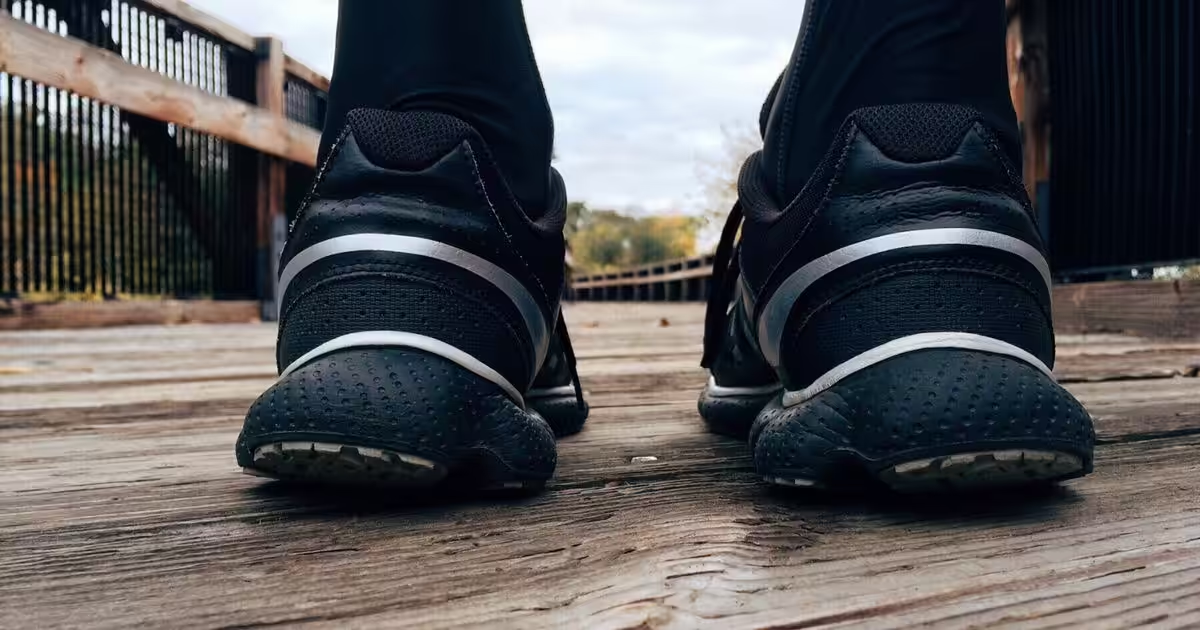
“SR” stands for Slip Resistant — not a sportier Bondi. HOKA built the Bondi SR for nurses, hospital staff, and service workers: a water-resistant leather upper, a slip-resistant rubber outsole rated for wet and oily floors, and the same maximal Bondi cushioning underneath. The Bondi 9 is the everyday walking-and-running version. Neither shoe has a carbon plate. Which one fits your life depends on where you spend your day — details below, or call (810) 206-1402 for a footwear evaluation at our Howell or Bloomfield Township office, or book a footwear evaluation online.
Hoka Bondi vs Bondi SR: Podiatrist Explains the Difference
Reviewed by Dr. Tom Biernacki, DPM, FACFAS
Board-certified podiatric surgeon | Balance Foot & Ankle
Last reviewed: May 2026
Specs and sizing: our sister site Podiatrist Tested keeps a side-by-side breakdown, with every figure labeled by source, in its Bondi 9 against the Bondi SR.
In This Article
- The Key Difference Between Bondi 9 and Bondi SR
- HOKA Bondi 9: Maximum Cushion Daily Trainer
- HOKA Bondi SR: The Slip-Resistant Work Shoe
- Specs Comparison: Bondi 9 vs Bondi SR
- Which for Foot Conditions and Recovery?
- Who Should Buy Each Shoe
- The Most Common Mistake
- FAQ
- The Bottom Line
The Key Difference Between Bondi 9 and Bondi SR
Both shoes carry the Bondi name and HOKA’s signature maximal stack — but they are built for different days. The confusion I see in clinic is patients assuming “SR” means a special sport or racing version of the Bondi. It does not. SR stands for Slip Resistant: it is the occupational version of the Bondi, built for people who spend their shifts on hospital, kitchen, and service-industry floors.
The Bondi 9 is HOKA’s flagship maximum-cushion road trainer: a breathable knit upper over an updated supercritical-foam midsole (officially 43 mm heel / 38 mm forefoot in men’s, 5 mm drop), built for daily walking, easy running, and all-day comfort.
The Bondi SR keeps that maximal cushioning but swaps the build for work: a water-resistant leather upper that wipes clean, and a full-ground-contact slip-resistant rubber outsole made for wet or oily surfaces. It carries the APMA Seal of Acceptance.
One more point of confusion worth clearing up: HOKA does sell carbon-plated racing shoes — but the Bondi is not one of them. No version of the Bondi has a carbon plate.
HOKA Bondi 9: Maximum Cushion Daily Trainer
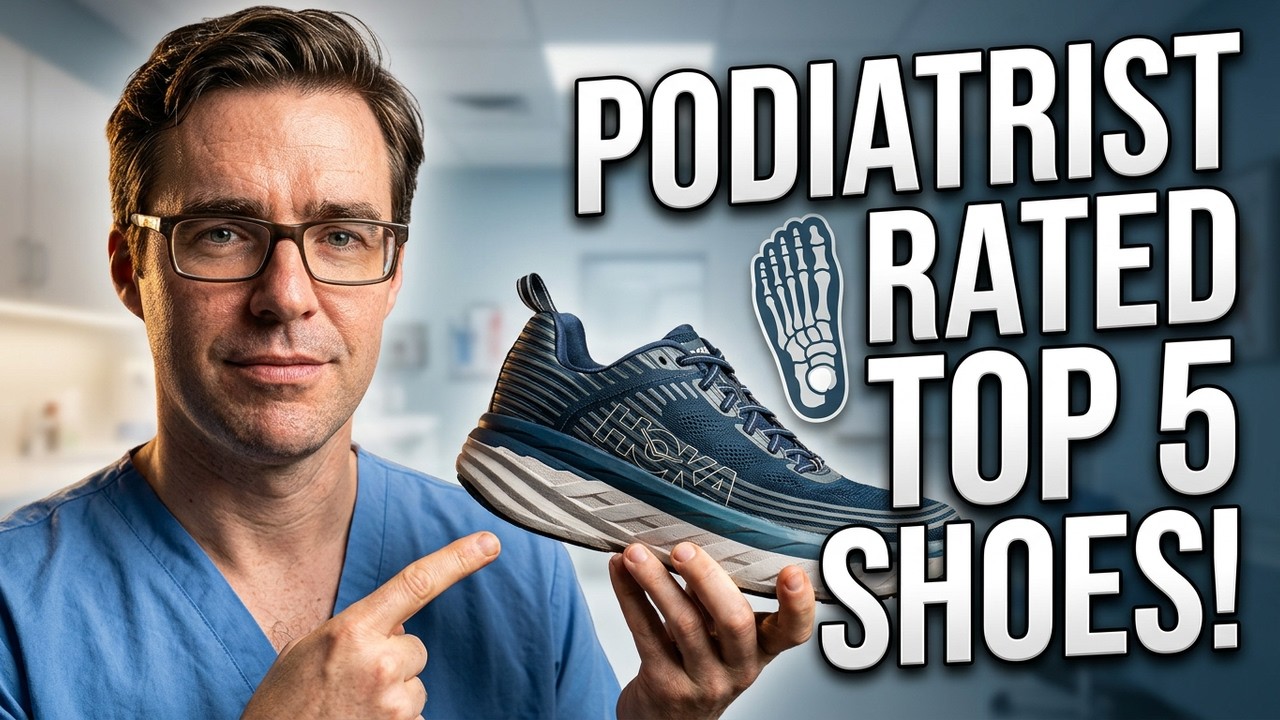
The Bondi 9 is the most cushioned shoe in HOKA’s lineup — designed for high-mileage training, all-day standing, and patients who need impact reduction as a primary therapeutic goal. Its updated supercritical-foam midsole provides consistent, soft, resilient cushioning over many hours of use. The wide base and extended heel counter deliver stability without any medial post. The meta-rocker geometry — a subtle curve from heel to toe — reduces peak pressure at the metatarsal heads and propels the foot through the gait cycle, reducing the energy cost of each step.
For clinical use: the Bondi 9 is frequently recommended by our DPMs for plantar fasciitis (high-arched type), metatarsalgia, fat pad atrophy, heel spur syndrome, post-surgical transitions from walking boots, and all-day standing on hard floors. It’s also our first recommendation for elderly patients who’ve lost the natural fat pad cushioning in their heels and forefeet. It is heavier than a performance trainer, but that weight reflects meaningful foam volume — not wasted material.
HOKA Bondi SR: The Slip-Resistant Work Shoe
The Bondi SR is the Bondi re-engineered for work. The knit upper is replaced with water-resistant leather that wipes clean after spills, and the outsole is a full-ground-contact, slip-resistant rubber designed to grip wet and oily floors. Underneath, you still get the maximal Bondi-class cushioning the shoe is famous for — which is exactly what a 10–12 hour shift on hard hospital or kitchen flooring demands.
This is one of the shoes we recommend most often for nurses, surgical techs, restaurant staff, and warehouse workers on smooth concrete. The removable footbed accepts an over-the-counter or custom orthotic, and the black leather build satisfies most workplace dress codes. It also carries the APMA Seal of Acceptance. The trade-offs are what you would expect from a leather work shoe: it runs a little warmer and heavier than the knit Bondi 9, and it is not built for running mileage.
Key takeaway: The Bondi SR is not a “better” Bondi — it is the Bondi for your job. If your floors see water, soap, or grease, the SR’s slip-resistant outsole and easy-clean upper are the reason it exists.
Specs Comparison: Bondi 9 vs Bondi SR
For every published figure on each shoe, Podiatrist Tested, Dr. Biernacki’s independent shoe-review site, has separate spec analyses of the HOKA Bondi 9 and the HOKA Bondi SR.
- Primary use: Bondi 9 = daily training / walking / therapeutic wear · Bondi SR = work shifts on slick floors
- Upper: Bondi 9 = breathable knit · Bondi SR = water-resistant leather
- Outsole: Bondi 9 = standard road rubber · Bondi SR = slip-resistant, full ground-contact rubber
- Midsole: Bondi 9 = updated supercritical foam · Bondi SR = cushioned EVA
- Stack height (men’s, official): Bondi 9 = 43 mm heel / 38 mm forefoot · Bondi SR = maximal Bondi-class stack
- Drop: Bondi 9 = 5 mm (official) · Bondi SR = comparable
- Carbon plate: Neither — no version of the Bondi has one
- Orthotics compatible: Both (removable footbed)
- Best for: Bondi 9 = walkers, runners, recovery · Bondi SR = nurses, kitchen and service work, spill-prone workplaces
Which for Foot Conditions and Recovery?
For the conditions we treat at Balance Foot & Ankle, both shoes are clinically reasonable — the deciding factor is where you spend your day:
- Plantar fasciitis: Both work. For walking, errands, and exercise, the Bondi 9. For a 10-hour shift on hospital or kitchen floors, the Bondi SR — ideally with an arch-support insole in either shoe.
- Metatarsalgia (ball-of-foot pain): Either — the maximal stack and rocker geometry reduce peak forefoot pressure. Choose by environment.
- Post-surgical transitions (boot to shoe): Bondi 9 — lighter and easier to fit over swelling. Move to the SR only when returning to slip-hazard work.
- Stress-fracture recovery: Bondi 9 — maximum cushioning for a controlled return to activity.
- All-day standing on wet or greasy floors: Bondi SR, full stop. The slip-resistant outsole is a safety feature, not a comfort feature.
- Running: Bondi 9. The SR is a work shoe, not a running shoe.
Who Should Buy Each Shoe
Buy the Bondi 9 if: you walk or run for exercise, stand a lot on ordinary dry floors, want maximum cushioning for everyday or recovery wear, or need a therapeutic daily trainer that accepts your orthotics. It is the version we recommend for most patients.
Buy the Bondi SR if: you are a nurse, hospital worker, cook, server, or anyone whose shift happens on smooth, wet, or oily floors — or your workplace requires a slip-rated black leather shoe. You get the same Bondi-class cushioning in a build that survives spills and mop water.
The Most Common Mistake We See
The most common mistake is buying the Bondi SR as an everyday sneaker because it sounds like an upgraded Bondi. It is not — the leather upper runs warmer and heavier than the knit Bondi 9, and the outsole is tuned for grip on smooth floors, not for running mileage.
The reverse mistake matters more. Wearing the mesh Bondi 9 into a kitchen or onto a hospital ward means a knit upper that soaks up spills and a standard road outsole with no slip rating. On a wet or greasy floor, that is a fall risk — a safety issue, not a style preference.
⚠ Choose the Bondi SR — not the Bondi 9 — if:
- You work on wet, soapy, or oily floors (healthcare, kitchens, service industry)
- Your employer requires slip-resistant or black leather footwear
- You have slipped at work before — outsole grip is a safety feature
- You need a work shoe that wipes clean after spills
VitaMedica Arnica Gel
Natural topical relief I recommend for sore feet: an arnica gel with 15 homeopathic ingredients and soothing aloe. Massage a thin layer into the sore area.
PowerStep Pinnacle Insoles
Medical-grade arch support with a deep heel cradle. The OTC insole I recommend most in our clinic. ($25–35)
In-Office Treatment at Balance Foot & Ankle
When home care and proper footwear aren’t resolving foot pain while running, our team at Balance Foot & Ankle provides hands-on exam plus imaging when needed and treatment in Howell and Bloomfield Township.
Book online 24/7. (810) 206-1402
Learn about our custom orthotics for runners → | Book online →
The Bottom Line
The HOKA Bondi 9 and Bondi SR share a name and the same maximal-cushion DNA, but they are built for different floors. For walking, easy running, recovery, and everyday therapeutic wear — the Bondi 9. For shifts on hospital, kitchen, or service-industry floors — the Bondi SR, with its slip-resistant outsole and wipe-clean leather upper. Neither shoe has a carbon plate, and both accept orthotics. Match the shoe to your day — and if foot pain persists beyond 4–6 weeks in the right footwear, the shoe is not the problem. Book an evaluation.
Sources
- HOKA — Bondi SR: Slip-Resistant Professional Shoes. hoka.com. 2026.
- HOKA — Bondi 9 Product Specifications. hoka.com. 2026.
- Cheung RTH, et al. “Running footwear and plantar fasciitis.” Foot Ankle Int. 2011;32(12):1140-1149.
- APMA Seal of Acceptance program. apma.org.
Related Conditions
Foot Pain Limiting Your Running?
Our sports podiatry team at Balance Foot & Ankle specializes in returning runners to full training. Gait analysis, custom orthotics, and shoe recommendations tailored to your exact foot mechanics — Howell & Bloomfield Township, MI.
4.9★ | 1,200+ Reviews | 3,000+ Surgeries Performed
Or call: (810) 206-1402
★★★★★ 4.9 Stars · 1,200+ Five-Star Reviews
Get Expert Care at Balance Foot & Ankle
Appointments at our Howell and Bloomfield Township offices. Board-certified podiatric surgeons. Most insurance accepted.
Podiatrist’s Top Picks: Dr. Tom Biernacki’s Final Recommendations
After 15+ years treating plantar fasciitis, heel pain, and overuse injuries at Balance Foot & Ankle in Howell and Bloomfield Township, here are the specific products I recommend most often. Every link below is to the exact model on Amazon — same product I’d hand you in clinic.
HOKA — My Picks
HOKA Bondi 9 (Women’s) — My #1 maximum-cushion pick for plantar fasciitis — the 33mm stack drops impact load on the fascia better than anything else in this price range.
HOKA Bondi 9 (Men’s) — Same maximalist cushion in a men’s last — patients with heel pain or ‘standing all day’ jobs report relief within the first week.
HOKA Clifton 10 — The everyday neutral pick when the Bondi is overkill — lighter, still well-cushioned, holds up at ~400 miles before the foam packs out.
HOKA Arahi 7 — If you overpronate but still want HOKA cushion, this is the J-Frame stability shoe I recommend — gentle guidance without the brick-like feel of older motion-control shoes.
Affiliate disclosure: Some links above are Amazon affiliate links. If you buy through them, Balance Foot & Ankle earns a small commission at no extra cost to you. These are the same products we recommend in clinic — the commission does not influence the recommendation.
Appointments in Howell & Bloomfield Township
Three board-certified podiatric surgeons. 1,200+ five-star reviews. Most insurance accepted.
Frequently Asked Questions
What is the difference between the Hoka Bondi and Bondi SR?
The HOKA Bondi 9 is a premium everyday running shoe with maximal cushioning and Meta-Rocker geometry. The Bondi SR (Slip Resistant) is designed for healthcare workers and service professionals who need ASTM-rated slip resistance on wet or oily surfaces. The SR version has a wider, more stable base, a rubber outsole with slip-resistant tread pattern, and a more durable upper — sacrificing some running performance for occupational safety compliance.
Is the Hoka Bondi SR good for nurses on their feet all day?
The Bondi SR is among the most popular podiatrist recommendations for nurses, hospital staff, and restaurant workers. The maximal cushioning (40mm stack height) reduces cumulative impact from 10–12 hour shifts on hard floors. The slip-resistant outsole meets ASTM F2913-11 standards for wet and oily surfaces. The wide base provides lateral stability during quick direction changes. Pair with a custom orthotic or Powerstep insole for maximum arch support.
How long do Hoka Bondi SR shoes last for healthcare workers?
With daily use on hospital or clinic floors, the Bondi SR typically lasts 6–12 months before significant midsole compression. The outsole tread often retains adequate grip longer than the midsole cushioning remains effective. Track how your feet and legs feel at the end of a shift — increased soreness or fatigue suggests the midsole has lost its shock-absorbing capacity. Budget for 1–2 pairs per year with heavy daily use.
Are Hoka shoes good for plantar fasciitis at work?
Yes — Hoka’s maximal cushioning and Meta-Rocker geometry significantly reduce plantar fascial load during prolonged standing. The rocker sole shifts propulsion away from the forefoot and heel, reducing both insertion and mid-body fascial tension. The Bondi SR, Arahi SR, and Clifton SR are all appropriate for plantar fasciitis. For severe plantar fasciitis, add a Powerstep orthotic insole to provide additional arch support beyond what the stock footbed provides.
For a complete clinical overview: Podiatrist-Recommended Shoes Guide — shoe recommendations for every foot condition
What features should I look for in podiatrist-recommended shoes?
Look for a wide, deep toe box, firm heel counter, adequate arch support, and a rocker-bottom sole if indicated. Avoid completely flat shoes or high heels for everyday wear. A podiatrist can recommend specific brands based on your foot type and condition.
How often should I replace my athletic shoes?
Most athletic shoes should be replaced every 300–500 miles or every 6–12 months with regular use. Worn midsoles lose shock absorption before the upper shows visible wear. Signs you need new shoes include increased foot fatigue, shin pain, or visible compression lines in the midsole.
Podiatrist Pairing — Best Insole for This Shoe Category
The HOKA Bondi 9 already has a plush ride, but for plantar fasciitis sufferers we still recommend an arch-support insole inside it. Removable factory insole accommodates aftermarket orthotics. Here are the two insoles I most often prescribe alongside this shoe category:
- PowerStep Pinnacle Insoles — the #1 podiatrist-recommended over-the-counter orthotic. Full-length with built-in arch support and a deep heel cradle. Fits inside most running shoes after removing the stock insole.
- Currex RunPro Insoles — runner-specific insole engineered for shock absorption and dynamic support during gait. Three arch profiles (low / med / high) so it matches your actual foot.
Medical References
- Plantar Fasciitis: Diagnosis and Conservative Management (PubMed)
- Plantar Fasciitis (APMA)
- Diagnosis and Treatment of Plantar Fasciitis (PubMed / AAFP)
- Heel Pain (APMA)
This article has been reviewed for medical accuracy by Dr. Tom Biernacki, DPM. References are provided for informational purposes.
Recommended Products from Dr. Tom
Still in pain after switching to a Bondi?
A maximal cushioned shoe reduces symptoms; it does not treat the cause. If the first few steps out of bed still hurt after several weeks in a new shoe, that is plantar fasciitis behaving normally rather than a wrong shoe choice, and persistent heel pain past the six to eight week mark generally needs treatment beyond footwear. Custom orthotics can be moved between shoes, which is usually a better investment than continuing to buy models.
Balance Foot & Ankle sees patients at two Michigan offices: our Howell podiatry office, serving Livingston County, and our Bloomfield Township podiatry office, serving Bloomfield Hills, Birmingham, Pontiac and the rest of Oakland County. Dr. Tom Biernacki sees patients at both. Call (810) 206-1402 to book an appointment.

Dr. Tom Biernacki, DPM is a board-certified foot & ankle surgeon (ABFAS & ABPM) at Balance Foot & Ankle Specialists in Southeast Michigan. With over a decade of clinical experience, he specializes in heel pain, bunions, diabetic foot care, sports injuries, and minimally invasive surgery. Dr. Biernacki is a member of the APMA and ACFAS, and his patient education content on MichiganFootDoctors.com and YouTube has made him one of the most-followed foot & ankle educators on YouTube.
More questions patients ask
What is the difference between HOKA Bondi and Bondi SR?
The HOKA Bondi SR (Slip Resistant) is specifically designed for healthcare workers and people working on wet or slippery surfaces, featuring a slip-resistant outsole rated ASTM F2913. Both share the same maximally cushioned midsole and rocker geometry. If you need slip resistance for work environments, choose the SR; for running or general use, the standard Bondi suffices.
Is the HOKA Bondi good for plantar fasciitis?
Yes—the HOKA Bondi is one of the most frequently recommended shoes for plantar fasciitis. Its 4mm heel drop, thick EVA midsole, and meta-rocker geometry minimize plantar fascia strain by reducing heel impact and facilitating a smooth toe-off that avoids overstretching the fascia.
Do podiatrists recommend HOKA Bondi for foot pain?
Yes—podiatrists widely recommend the HOKA Bondi for plantar fasciitis, heel pain, metatarsalgia, and post-surgical recovery due to its industry-leading cushioning and rocker sole. It is particularly effective for patients who spend long hours on their feet and need maximum shock absorption.
Is Hoka Bondi SR good for nurses?
Yes — HOKA Bondi SR is one of the top podiatrist-recommended nursing shoes. Slip-resistant outsole (ASTM-certified), maximum cushioning for 12-hour shifts, leather upper (durable, fluid-resistant), removable insole for custom orthotics, and supportive arch. Most nurses find Bondi SR significantly reduces foot/back pain during long shifts.
Are Hoka Bondi shoes good for plantar fasciitis?
Yes — HOKA Bondi 8 is one of the most recommended plantar fasciitis shoes. Maximum cushioning, meta-rocker geometry (reduces forefoot loading), supportive midsole, and roomy toe box. Most patients with plantar fasciitis report significant pain reduction within first wear. Pairs excellently with custom orthotics or Powerstep Pinnacle insoles.
Still have a question about coverage or cost? Book online and we will check your benefits before your visit: Book in Howell · Book in Bloomfield Township. Prefer to talk it through first? Call (810) 206-1402.