
What Causes Pain on the Inside of the Ankle?
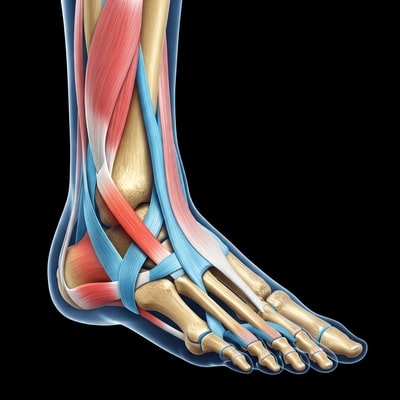
Medial ankle pain — pain on the inner (big-toe side) of the ankle — has several distinct causes with different anatomy, presentations, and treatments. The most important structures on the medial ankle are the posterior tibial tendon (PTT), the deltoid ligament complex, the tibialis posterior tendon sheath, the tarsal tunnel (containing the posterior tibial nerve, flexor hallucis longus, and flexor digitorum longus tendons), and the medial malleolus of the tibia. Accurately identifying which structure is involved is essential because treatment differs substantially depending on the diagnosis.
Posterior Tibial Tendon Dysfunction (PTTD)
The posterior tibial tendon is the primary dynamic support of the medial longitudinal arch. When it degenerates or tears — most commonly in middle-aged women with flatfoot, hyperpronation, or obesity — it causes medial ankle pain just posterior and inferior to the medial malleolus, along the tendon’s course toward its navicular insertion. Classic findings: pain and swelling along the posterior tibial tendon, progressive flatfoot deformity (arch collapse), “too many toes” sign when viewed from behind, and inability to perform a single-leg heel rise. Stage I PTTD involves tendinitis with normal tendon function; Stage II involves significant deformity but flexible hindfoot; Stages III and IV involve rigid deformity and ankle joint involvement.
Treatment depends on staging. Stage I: relative rest, NSAIDs, immobilization in an ankle-foot orthosis (AFO), physical therapy for strengthening. Stage II: AFO or UCBL orthosis for arch support, tendon rehabilitation, and surgical planning if conservative management fails after 3–6 months. Surgical options for Stage II include flexor digitorum longus tendon transfer augmenting the failed PTT, medial calcaneal osteotomy to correct hindfoot valgus, and often a lateral column lengthening. Stages III–IV typically require fusion procedures.
Tarsal Tunnel Syndrome
The tarsal tunnel is a fibro-osseous canal behind and beneath the medial malleolus, through which pass the posterior tibial nerve, posterior tibial artery and vein, flexor digitorum longus tendon, and flexor hallucis longus tendon. Compression of the posterior tibial nerve within this tunnel produces tarsal tunnel syndrome — burning, tingling, and numbness on the plantar foot and into the toes, with a positive Tinel’s sign (tapping over the tarsal tunnel reproduces electric shock sensations into the foot). Causes include space-occupying lesions within the tunnel (ganglion cysts, varicosities, lipoma), post-traumatic scarring, flatfoot deformity stretching the nerve, or systemic conditions such as hypothyroidism causing nerve compression.
Diagnosis is confirmed with electrodiagnostic studies (nerve conduction velocity, EMG). Treatment begins with address of contributing factors: orthotic control of flatfoot reducing nerve tension, anti-inflammatory medication, corticosteroid injection near the nerve, activity modification. Surgical tarsal tunnel release — decompression of the flexor retinaculum and release of any space-occupying lesion — is indicated when conservative management fails after 3–6 months in patients with confirmed electrodiagnostic abnormality.
Deltoid Ligament Injury
The deltoid ligament is a broad, strong triangular ligament connecting the medial malleolus to the talus, calcaneus, and navicular. It is the primary restraint against eversion of the ankle. Isolated deltoid ligament tears are uncommon — they typically occur with eversion ankle sprains, combined with lateral ligament injuries, or in the setting of ankle fractures (where deltoid rupture indicates instability requiring surgical stabilization). Medial ankle swelling and tenderness over the deltoid ligament, reproducing pain with eversion stress, suggest deltoid injury. Medial ankle clear space widening on X-ray (>4 mm) indicates significant deltoid disruption requiring surgical attention.
Isolated grade I–II deltoid sprains without ankle instability are managed conservatively with rest, RICE, ankle brace, and graduated rehabilitation. High-grade deltoid tears associated with instability or syndesmotic injury require surgical repair or reconstruction. Chronic deltoid insufficiency leading to valgus ankle deformity requires osteotomy or reconstruction to prevent progressive joint degeneration.
Frequently Asked Questions
What does posterior tibial tendon pain feel like?
Posterior tibial tendon pain is felt along the inner ankle and lower leg, typically as an aching or burning pain just behind and below the medial malleolus (the inner ankle bone). It often worsens with activity — especially walking on uneven ground, climbing stairs, or prolonged standing — and improves with rest. Many patients notice the inner arch of the foot flattening over time as the tendon weakens. Swelling along the tendon course and difficulty rising on tiptoe on the affected side are hallmark findings. If left untreated, the tendon may progress from inflammation to partial or complete rupture, causing significant flatfoot deformity.
Can tarsal tunnel syndrome resolve on its own?
Mild tarsal tunnel syndrome — particularly when caused by a reversible contributing factor such as flatfoot deformity (correctable with orthotics) or inflammatory swelling — may improve significantly with conservative treatment. Orthotic support, anti-inflammatory medications, and corticosteroid injection resolve symptoms in approximately 40–50% of cases. However, tarsal tunnel syndrome caused by a persistent space-occupying lesion (ganglion cyst, varicosity) or significant nerve compression documented on nerve conduction studies typically does not resolve without addressing the underlying cause. Surgery is highly effective when conservative management fails — tarsal tunnel release achieves good to excellent outcomes in 85–90% of appropriately selected patients. Early intervention before permanent nerve damage improves outcomes.
How do I know if my medial ankle pain is serious?
Signs that medial ankle pain warrants prompt evaluation include: progressive flatfoot deformity (arch visibly dropping over weeks to months), inability to rise on tiptoe on the affected side, numbness or tingling into the bottom of the foot (nerve involvement), pain at rest or at night, significant swelling that doesn’t improve with rest and ice, and medial ankle pain following an injury (which could indicate fracture or ligament tear). Medial ankle pain that persists beyond 2–3 weeks without improvement with rest and anti-inflammatories, or that is severe enough to alter your gait, warrants podiatric evaluation. Posterior tibial tendon dysfunction in particular can progress rapidly from treatable tendinitis to complex flatfoot deformity if not addressed early.
Medical References & Sources
- PubMed Research — Posterior Tibial Tendon Dysfunction Treatment
- PubMed Research — Tarsal Tunnel Syndrome Outcomes
- American Orthopaedic Foot & Ankle Society — Adult Acquired Flatfoot
Dr. Tom Biernacki, DPM is a board-certified podiatric surgeon at Balance Foot & Ankle in Howell and Bloomfield Hills, Michigan. He diagnoses and treats medial ankle pain including posterior tibial tendon dysfunction, tarsal tunnel syndrome, and deltoid ligament injuries with comprehensive conservative and surgical care.
Dr. Tom’s Recommended Products for Ankle Pain & Injuries
📍 Located in Michigan?
Our board-certified podiatrists treat this condition at two convenient locations. Same-day appointments often available.
These are products I personally use and recommend to my patients at Balance Foot & Ankle.
- ASO Ankle Stabilizing Orthosis — Figure-8 straps with bilateral stability columns — the gold standard lace-up ankle brace for return to sport
- McDavid 195 Ankle Brace — Hinged design allows dorsiflexion/plantarflexion while blocking inversion — best for chronic lateral instability
- Doctor Hoy’s Natural Pain Relief Gel 3oz — Menthol-based cryotherapy — penetrates soft tissue to reduce ankle sprain inflammation and acute pain
Affiliate disclosure: As an Amazon Associate, Balance Foot & Ankle earns from qualifying purchases. We only recommend products we trust for our own patients.
Dr. Tom’s Recommended Insoles
PowerStep is the brand I prescribe most — medical-grade OTC support without the custom orthotic price tag.
- PowerStep Pinnacle Insoles — The OTC orthotic I recommend most — medical-grade arch support at a fraction of custom orthotic cost. Works in most shoes.
- PowerStep Maxx Insoles — For severe arch pain or flat feet — maximum correction and support when Pinnacle isn’t enough.
Affiliate disclosure: As an Amazon Associate, Balance Foot & Ankle earns from qualifying purchases. We only recommend products we trust for our own patients.
Dr. Tom’s Recommended: Natural Topical Pain Relief
This is what I actually use in our clinic at Balance Foot & Ankle.
- Doctor Hoy’s Natural Pain Relief Gel — Natural topical pain relief I use in our clinic. Arnica + camphor formula. Apply directly to the painful area 3-4x daily for fast-acting relief without NSAIDs.
📧 Get Dr. Tom’s Free Lab Test Guide
Discover the 5 lab tests every person over 35 should ask their doctor about — explained in plain English by a board-certified physician.
Affiliate disclosure: As an Amazon Associate, Balance Foot & Ankle earns from qualifying purchases. We only recommend products we trust for our own patients.
Join 950,000+ Learning About Foot Health
Dr. Tom shares honest medical advice, supplement reviews, and treatment guides you won’t find anywhere else.
Top-Rated Ankle Braces
- Aircast Air-Stirrup — Gold Standard Ankle Brace
- Zamst A2-DX — Maximum Support for Athletes
- McDavid Lace-Up Ankle Brace — Everyday Stability
Amazon affiliate links — we may earn a small commission at no extra cost to you.

Dr. Tom Biernacki, DPM is a board-qualified podiatrist and foot & ankle surgeon serving Southeast Michigan at Balance Foot & Ankle Specialists. A Michigan native, Dr. Biernacki earned his undergraduate degree from Michigan State University and his Doctor of Podiatric Medicine (DPM) from Kent State University College of Podiatric Medicine. He completed a three-year comprehensive surgical residency in foot and ankle surgery in the Detroit metro area.
Dr. Biernacki specializes in the treatment of heel pain, bunions, hammertoes, diabetic foot care, sports injuries, flatfoot correction, and minimally invasive foot surgery. He is dedicated to providing evidence-based, patient-centered care that helps people of all ages stay active and pain-free.
He sees patients at multiple convenient Metro Detroit locations and is committed to community education through the MichiganFootDoctors.com resource library. Dr. Biernacki is a member of the American Podiatric Medical Association (APMA) and the Michigan Podiatric Medical Association (MPMA).