
Medically reviewed by Dr. Tom Biernacki, DPM
Board-certified podiatric surgeon | Balance Foot & Ankle
Last reviewed: May 2026
 Morton's neuroma diagnosis Michigan podiatrist” class=”wp-image-438661″ width=”1200″ height=”630″ loading=”eager” fetchpriority=”high” decoding=”async” srcset=”https://www.michiganfootdoctors.com/uploads/2026/05/mulders-click-podiatrist-michigan.webp 1200w, https://www.michiganfootdoctors.com/uploads/2026/05/mulders-click-podiatrist-michigan-300×158.webp 300w, https://www.michiganfootdoctors.com/uploads/2026/05/mulders-click-podiatrist-michigan-1024×538.webp 1024w, https://www.michiganfootdoctors.com/uploads/2026/05/mulders-click-podiatrist-michigan-768×403.webp 768w” sizes=”(max-width: 1200px) 100vw, 1200px” />
Quick answer: Mulder’s click is a physical-exam sign that points to a Morton’s neuroma — a pinched nerve between the toes — so the first step is confirming the neuroma and how large it is, because that guides whether padding, an injection, or a procedure fits best. We test for it and, when needed, image it. We evaluate it at our Howell and Bloomfield Hills offices. Call (810) 206-1402.
✅ Medically reviewed by Dr. Tom Biernacki, DPM — Board-Certified Podiatrist · Last updated April 6, 2026
Mulder’s Click Test [Morton’s Neuroma Squeeze Test & BEST TREATMENT]
A Mulder’s Click Test and Sullivan’s Sign are the TOP 2 ways that help confirm Morton’s Neuroma. Make 100% sure you are treating it properly!
https://youtu.be/OmGFFVavU8wMulder’s Click Test [A Morton neuroma squeeze test] Overview:
- A Mulder’s Click Test and Sullivan’s Sign are the TOP 2 ways that help confirm Morton’s Neuroma.
- They are both very useful because anyone can perform them very easily right at home.
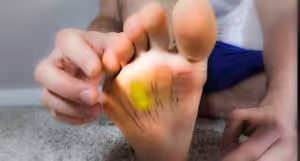
- Mulder’s performed by squeezing the foot with one hand from side to side and trying to press on the site of the presumed neuroma; this should elicit a “clicking” sound.
How to Perform Mulder’s Click Test:
- Squeeze the toes from side to side
- Press from both the top and bottom with the other hand to try to move the neuroma.
- Am for the interspace between the metatarsal heads.
- It doesn’t always click, but if it does- then the neuroma is that much more likely
Sullivan’s Sign:
- Sullivan’s Sign shows a splaying of the 3rd and the 4th toes both on X-ray and when just looking at the foot normally.
- The thinking behind this is that if there is a big ball of tissue in between the toes, that they will look a little bit more spread out; which in some case is true.
- Both Sullivan’s sign test and Mulder’s click or Mulder’s squeeze test are very easily performed at home; while both are not guaranteed tests, if positive they very highly indicate that a Morton’s Neuralgia may be present.

Other Tests to check for Morton Neuralgia
- Sullivan’s Sign.
- Xray to check for splaying.
- MRI.
Morton’s Neuralgia does not always show these tests!
Just because Sullivan’s sign or Mulders sign were not present does not mean that you don’t have a Morton’s Neuroma or neuralgia pain. The best way to diagnose this disorder is still clinical results!
- Do you have numbness, burning or tingling?
- Do you ever hear a clicking sound?
- Do you ever feel like there is a pebble in your foot?
- Does it ever feel like your socks are bunched up?
- Does massaging your foot ever make it feel better?
Conservative Foot Treatment Options in Michigan: From Orthotics to EPAT
Michigan patients with foot and ankle conditions benefit from access to the full range of conservative treatment options at Balance Foot & Ankle. Custom orthotics fabricated from a 3D scan of the patient’s foot provide structural correction for flatfoot, high arch, and biomechanical overload conditions that OTC insoles cannot adequately address. EPAT (extracorporeal pulse activation therapy) provides a non-surgical treatment option for plantar fasciitis, Achilles tendinopathy, and other tendon conditions that resist initial conservative care — clinical evidence shows 70-80% cure rates for chronic plantar fasciitis. Ultrasound-guided injection therapy allows precise corticosteroid, PRP, or local anesthetic delivery to specific anatomical targets including the plantar fascia insertion, retrocalcaneal bursa, Morton’s neuroma interspace, and ankle joint. Physical therapy coordination with specific home exercise prescription addresses strength and flexibility deficits that perpetuate foot and ankle conditions. Michigan patients who want conservative treatment options before considering surgery can call Balance Foot & Ankle at (810) 206-1402 for an evaluation at our Howell or Bloomfield Township office.
Expert Podiatric Care for Michigan Patients: Balance Foot & Ankle
Related Treatment Guides
- Morton’s Neuroma Treatment
- Plantar Fasciitis & Heel Pain Treatment
- Custom 3D Orthotics
- Sports Foot & Ankle Injury Treatment
Michigan patients with any foot or ankle condition — whether a first-time acute problem or a chronic issue that has not responded to self-care — can access expert podiatric evaluation and treatment at Balance Foot & Ankle. Our fellowship-trained podiatric surgeons provide thorough diagnostic evaluation using weight-bearing digital X-rays and musculoskeletal ultrasound, followed by targeted conservative or surgical treatment appropriate to the specific diagnosis. We treat the full spectrum of podiatric conditions: plantar fasciitis, Achilles tendinopathy and rupture, Haglund’s deformity, bunions, hammertoes, neuromas, peripheral neuropathy, diabetic foot complications, toenail fungus, ankle instability, stress fractures, and more. Balance Foot & Ankle accepts Blue Cross Blue Shield of Michigan, Aetna, UnitedHealthcare, Cigna, Medicare, and most Medicare Advantage plans. Same-week new patient appointments are available at our Howell (4330 E Grand River, serving Livingston County) and Bloomfield Township (43494 Woodward Ave #208, serving Oakland County) offices. Call (810) 206-1402 to schedule.
What Is Mulder’s Click?
Mulder’s click is a diagnostic sign for Morton’s neuroma, a painful nerve condition between the toes. Our podiatrists use this and other tests to accurately diagnose and treat intermetatarsal neuromas.
📞 Or call us directly: (810) 206-1402
Clinical References
- Mulder JD. The causative mechanism in Morton’s metatarsalgia. Journal of Bone and Joint Surgery British Volume. 1951;33-B(1):94-95.
- Thomson CE, Gibson JNA, Martin D. Interventions for the treatment of Morton’s neuroma. Cochrane Database of Systematic Reviews. 2004;(3):CD003118.
- Mahadevan D, Venkatesan M, Bhatt R, Bhatia M. Diagnostic accuracy of clinical tests for Morton’s neuroma compared with ultrasonography. Journal of Foot and Ankle Surgery. 2015;54(4):549-553.
More Podiatrist-Recommended Foot Health Essentials
Hoka Clifton 10

Max-cushion everyday shoe — podiatrist favorite for walking and running.

OOFOS Recovery Slide

Impact-absorbing recovery sandal — wear after long days on your feet.
As an Amazon Associate, Balance Foot & Ankle earns from qualifying purchases. Product recommendations are based on clinical experience; prices and availability shown above update live from Amazon.

When to See a Podiatrist
If foot or ankle pain has been bothering you for more than a few weeks, home care alone may not be enough. Balance Foot & Ankle offers same-week appointments at our Howell and Bloomfield Township clinics — no referral needed in most cases. Bring your current shoes and a short list of symptoms and we’ll build you a treatment plan in one visit.
Call Balance Foot & Ankle: (810) 206-1402 · Book online · Offices in Howell & Bloomfield Township
Visit Balance Foot & Ankle — Same-Week Appointments Available
Our podiatry team serves patients throughout Michigan including Howell, Brighton, and Bloomfield Township. If you’re dealing with heel pain, ingrown toenails, or a foot injury, we have same-week appointment availability.
Ready to Get Relief?
Same-week appointments available in Howell & Bloomfield Township, MI
4.9★ | 1,123 Reviews | 3,000+ Surgeries
Or call: (810) 206-1402

Dr. Tom Biernacki, DPM is a board-certified foot & ankle surgeon (ABFAS & ABPM) at Balance Foot & Ankle Specialists in Southeast Michigan. With over a decade of clinical experience, he specializes in heel pain, bunions, diabetic foot care, sports injuries, and minimally invasive surgery. Dr. Biernacki is a member of the APMA and ACFAS, and his patient education content on MichiganFootDoctors.com and YouTube has made him one of the most-followed foot & ankle educators on YouTube.
More questions patients ask
What is Mulder's click test?
Mulder's click is a diagnostic test for Morton's neuroma. The podiatrist squeezes the forefoot while pressing between the metatarsal heads. A palpable click and reproduction of symptoms (pain, numbness between toes) confirms the neuroma diagnosis.
Is Mulder's click always positive with Morton's neuroma?
No. Mulder's click is positive in about 60-70% of Morton's neuroma cases. A negative test doesn't rule out the diagnosis. Ultrasound and MRI provide additional confirmation. Clinical symptoms (burning between toes, pebble-in-shoe feeling) are equally important for diagnosis.
What happens after a positive Mulder's click test?
A positive Mulder's click confirms Morton's neuroma. Treatment begins conservatively with wider shoes, metatarsal pads, and custom orthotics. Corticosteroid injections reduce inflammation. If conservative measures fail after 3-6 months, surgical neurectomy provides definitive relief.
Still have a question about coverage or cost? Book online and we will check your benefits before your visit: Book in Howell · Book in Bloomfield Township. Prefer to talk it through first? Call (810) 206-1402.