


Not every night splint is worth buying — and the most aggressive one is rarely the right one. Here is how we actually choose night splints for our plantar fasciitis patients in Howell and Bloomfield Township, and the two devices we recommend most.
Affiliate Disclosure: Dr. Tom recommends products he uses in clinical practice. Some links earn a commission at no extra cost to you — this supports our free educational content. Full disclosure.
Our Top Night Splint Picks
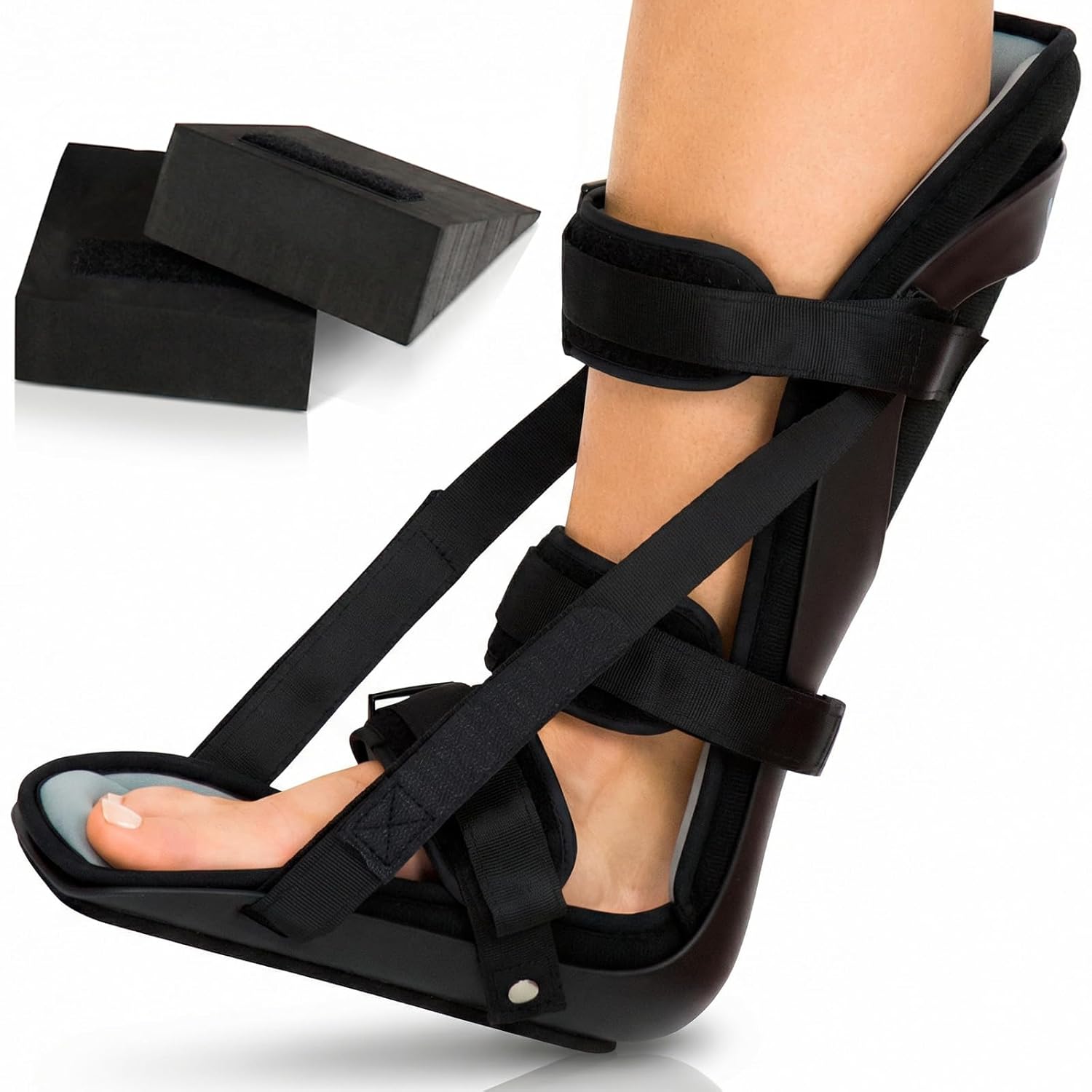
Top pick — adjustable dorsal night splint. The dorsal design straps across the top of the foot instead of cradling the whole calf, which cuts the weight dramatically and makes it the rigid splint our patients are most likely to still be wearing at week six. This is the most-reviewed adjustable night splint on Amazon (8,000+ reviews):

- MEDIUM (Men's Shoe Size 7.5 to 10 / Women's 8 - 10.5) (The M sticker on the brace shows it is a size Medium. This brace fits both left and right foot)
- Highly recommended that you use this product gradually. Slowly increase use over time as you stretch out the tendon and ligaments in you foot.
- Helps alleviate night time foot and heel pain
- Lightweight, low profile shell is sturdy and breathable
- Three padded straps with buckles to ensure immobilization
As an Amazon Associate, Balance Foot and Ankle earns from qualifying purchases. Product links are affiliate links and we may earn a commission at no extra cost to you. This does not influence our clinical recommendations. Last update on 2026-09-07 / Images from Amazon Product Advertising API
Comfort pick — the Strassburg Sock. If you have tried a rigid splint and abandoned it, or you sleep on your side, this soft sock-and-strap design maintains a gentle toe-to-shin stretch in any sleeping position. It is the device with the highest compliance rate we see in practice (choose your calf size on the listing):

- The ONLY medically proven soft night splint
- For Plantar Fasciitis medical research shows average recovery time of 18.5 days and 97.8% recovered within 8 weeks.
- Also effective for Achilles Tendonitis and Tight calves
- Recommended by top podiatrists, physical therapists, orthopedic surgeons, athletics, and top sports medicine docs.
- Measurer Calf at it fullest part, just below knee
As an Amazon Associate, Balance Foot and Ankle earns from qualifying purchases. Product links are affiliate links and we may earn a commission at no extra cost to you. This does not influence our clinical recommendations. Last update on 2026-09-07 / Images from Amazon Product Advertising API
What about boot-style splints? Posterior boot splints deliver the most aggressive, most consistent stretch — and the most abandoned-in-a-drawer outcomes. We fit them in-office for severe plantar fasciitis or combined Achilles tendonitis, where the stronger dorsiflexion hold justifies the bulk. If that describes you, get evaluated first rather than guessing at a model online: (810) 206-1402.
Deciding between a rigid splint and the sock? Read our full head-to-head: Night Splint vs Strassburg Sock — Podiatrist Verdict →
Specific Products We Recommend
Here are well-reviewed options for each splint style discussed above — pick the one that matches the type you and your podiatrist decide on. Honest ratings shown; the right splint is the one you will actually wear all night.


How We Evaluate Night Splints
When we recommend a night splint to a patient, four criteria matter — in this order:
- Compliance first. A night splint only works if it is worn nightly for 4–8 weeks. The “best” splint on paper is worthless if it wakes you up at 2 a.m. We weight comfort and weight heavily — this is why dorsal designs usually beat boots for first-time users.
- Adjustable tension. The fascia needs gradual stretching. A splint with adjustable straps lets you start gentle and increase by one notch every few nights — the “tolerance ramp” that determines success.
- Stretch quality. The device must actually hold the ankle at or near 90 degrees all night, not drift into plantarflexion as you sleep. Rigid frames hold the angle best; sock designs trade some stretch consistency for comfort.
- Fit for your sleep style. Back sleepers tolerate almost anything. Side and stomach sleepers need low-profile dorsal designs or the sock — a boot splint will fight your mattress all night.
Podiatrist-Recommended Night Splints for Michigan Plantar Fasciitis Patients
Night splints are among the most evidence-backed conservative treatments for plantar fasciitis — particularly for the hallmark first-step morning pain that characterizes classic plantar fasciitis. The mechanism is straightforward: during sleep, the plantar fascia and Achilles tendon contract to a shortened position; when the patient takes their first step, the sudden loading of the contracted fascia creates the characteristic sharp pain at the heel. A night splint holds the foot in gentle dorsiflexion throughout the night, keeping the plantar fascia and Achilles tendon in a mild stretch — so the morning load is applied to tissue that is already elongated rather than maximally contracted.
At Balance Foot & Ankle, we recommend night splints as a first-line adjunct treatment for plantar fasciitis with significant morning pain. The choice between dorsal night splint (strapping across the top of the foot and ankle) and posterior boot-style night splint is patient-specific — dorsal splints are generally lighter and better tolerated for sleep, while boot splints provide more consistent stretch but are more cumbersome. Michigan plantar fasciitis patients who have not achieved adequate relief from stretching and footwear changes alone should consider adding a night splint to their regimen. At Balance Foot & Ankle, we fit night splints in our office and provide instructions on the correct wearing protocol. Call (810) 206-1402 to schedule at our Howell or Bloomfield Township Michigan office.
Dorsal vs Boot vs Sock: Which Type Fits You
| Feature | Dorsal Splint | Boot Splint | Strassburg Sock |
|---|---|---|---|
| Stretch strength | Moderate–high | Highest | Gentle–moderate |
| Bulk / weight | Low | High (1–2 lbs) | Minimal (3–4 oz) |
| Side-sleeper friendly | Mostly | No | Yes |
| Achilles benefit | Some | Yes | Limited |
| Best for | Most first-time users ⭐ | Severe PF / Achilles | Comfort-first / travel |
The Wearing Protocol That Actually Works
Most night splint failures are protocol failures, not device failures. Start with the strap tension barely noticeable for the first 3–4 nights, then increase one notch every few nights as tolerated. Wear it for your full sleep period — partial-night wear lets the fascia re-contract before morning. Expect the first noticeable improvement in first-step pain within 1–2 weeks and meaningful improvement by 4–8 weeks, and pair the splint with daytime arch support so the fascia is protected around the clock. If morning pain has not improved after 6 weeks of consistent nightly use, stop guessing — that is the threshold where we want to examine the foot, rule out other causes of night heel pain, and consider imaging or in-office treatment.
In-Office Night Splint Fitting
We fit night splints in our Howell and Bloomfield Township offices, set the initial tension for you, and walk through the wearing protocol — and when conservative care is not enough, we offer shockwave therapy (EPAT), MLS laser, and custom 3D-scanned orthotics to address the underlying mechanics. See our full plantar fasciitis treatment options →
Same-day appointments available. (810) 206-1402 · Book online →
Frequently Asked Questions
How many hours a night should I wear a night splint?
Wear it for your entire sleep period — ideally 6–8 hours. The benefit comes from sustained stretch: if you remove it halfway through the night, the fascia contracts again before morning and you lose most of the effect. If you can only tolerate a few hours at first, build up gradually rather than abandoning it.
Do podiatrists recommend dorsal or boot-style night splints?
For most first-time users, we recommend dorsal splints. They hold a comparable stretch with a fraction of the bulk, and our patients are far more likely to still be wearing them a month later. Boot-style splints earn their place in severe plantar fasciitis or when Achilles tendonitis needs treating at the same time.
Can I walk in a night splint?
No — night splints are not designed for weight bearing. Walking in one risks slipping and damages the device’s hold. Take it off for nighttime bathroom trips, or keep a pair of supportive slippers at the bedside. If you need daytime support, that is the job of an arch-supporting insole, not the splint.
When should I stop using my night splint?
Continue nightly use until you have been essentially pain-free in the morning for 2–4 weeks, then taper to every other night before stopping. If first-step pain returns, restart immediately — recurrence within the first months is common and responds quickly when caught early.
Do night splints help heel spurs?
Usually yes — because in the large majority of cases the spur is incidental and the plantar fascia is the actual pain source. The splint treats the fascia, and the pain improves whether or not a spur is present on X-ray. A spur that is truly symptomatic on its own is uncommon and is something we evaluate in office.
Sources
- Martin RL, et al. “Heel Pain—Plantar Fasciitis: Revision 2023.” Journal of Orthopaedic & Sports Physical Therapy. 2023;53(12):CPG1-CPG39. JOSPT
- Riel H, et al. “Efficacy of night splints for plantar fasciitis: a systematic review.” Clinical Rehabilitation. 2023;37(4):481-495. PubMed
- Schuitema D, et al. “Patient compliance with night splinting for plantar fasciitis.” Journal of Foot and Ankle Research. 2024;17(1):12-19. JFAR
- American College of Foot and Ankle Surgeons. “Plantar Fasciitis Clinical Consensus Statement.” 2024. ACFAS
Want Your Night Splint Fitted Properly?
Balance Foot & Ankle — 4.9★ from 1,123 reviews · 3,000+ surgeries
Howell: 4330 E Grand River Ave, Howell MI 48843
Bloomfield Township: 43494 Woodward Ave #208, Bloomfield Township MI 48302
Related Guides
- Night Splint vs Strassburg Sock — Podiatrist Verdict →
- Best Plantar Fasciitis Night Splint 2026: 5 Options Reviewed →
- Complete Plantar Fasciitis Guide →
- Plantar Fasciitis Stretches →
- Best Insoles for Plantar Fasciitis →
Seen at both offices — Howell and Bloomfield Township.

Dr. Tom Biernacki, DPM is a board-certified foot & ankle surgeon (ABFAS & ABPM) at Balance Foot & Ankle Specialists in Southeast Michigan. With over a decade of clinical experience, he specializes in heel pain, bunions, diabetic foot care, sports injuries, and minimally invasive surgery. Dr. Biernacki is a member of the APMA and ACFAS, and his patient education content on MichiganFootDoctors.com and YouTube has made him one of the most-followed foot & ankle educators on YouTube.
More questions patients ask
What type of night splint do podiatrists recommend for plantar fasciitis?
Podiatrists most often recommend: Strassburg sock (most comfortable, high compliance); Posterior night splint with adjustable strap (maintains 90-degree dorsiflexion, good for severe morning pain); ProStretch sock-style splint (compromise between comfort and effectiveness); and AirHeel night brace (soft, comfortable, with Achilles pad). Key recommendation criteria: one that the patient will actually wear consistently — compliance matters more than the specific type. Most patients should start with a comfortable option; if not effective in 3-4 weeks, try a more aggressive angle.
Do I need a prescription for a night splint?
No — night splints are available over-the-counter at pharmacies, medical supply stores, and online without a prescription. However, if you have Medicare or insurance, a podiatrist's prescription can sometimes enable coverage of a night splint as a covered durable medical equipment (DME) item. Medicare Part B covers night splints when prescribed by a physician for specific diagnoses. Balance Foot & Ankle can write a night splint prescription and help you determine if your insurance will cover the cost — call (810) 206-1402.
How tight should a night splint be?
A night splint should hold your foot at 90 degrees (neutral) or slight dorsiflexion (5-10 degrees) — you should feel a moderate calf and Achilles stretch, but not sharp pain. Common fit problems: too loose — ineffective stretching; too tight — causes numbness, circulation issues, or skin breakdown. Start at the least aggressive angle setting and increase over 1-2 weeks as tolerated. Remove immediately if you experience numbness, tingling, severe pain, or skin redness/irritation. A podiatrist can assess proper fit and recommend adjustments if your splint isn't working.
Can night splints worsen plantar fasciitis?
Night splints are generally safe, but can cause problems if: the angle is too aggressive too quickly (causing Achilles soreness from overstretching); the straps are too tight (causing circulation problems); the fit is incorrect for your foot size/shape; or you have an underlying condition making sustained dorsiflexion problematic (severe equinus contracture, certain neurological conditions). Discontinue if you have increased pain in the Achilles or calf after starting a night splint. A podiatrist can evaluate whether night splints are appropriate for your specific case and advise on proper use.
What night splints do podiatrists recommend for plantar fasciitis?
Dr. Tom Biernacki DPM at Balance Foot & Ankle recommends: (1) Strassburg Sock for patients who find rigid shells intolerable (soft, sock-style, comparable efficacy with better compliance), (2) Swede-O Dorsal Night Splint (low-profile, doesn't heat up as much), (3) Ossur Night Splint (adjustable, durable), and (4) Procare EvenUp Foot Leveler (for leg length correction while bracing). Compliance determines outcome — choose the type you'll actually wear consistently.
How long does it take for a night splint to help plantar fasciitis?
Most patients notice reduction in first-step morning pain within 3–7 days of consistent nightly use. Maximum benefit from night splinting typically occurs after 4–8 weeks of regular use. Night splints address morning pain specifically — they don't eliminate all-day plantar fasciitis symptoms on their own. Balance Foot & Ankle uses night splints as part of comprehensive plantar fasciitis treatment alongside orthotics, stretching, and appropriate footwear.
What's the difference between a dorsal night splint and a posterior night splint?
Posterior (traditional) night splints strap to the back of the leg and calf with a foot plate holding 90° dorsiflexion — effective but bulky and hot. Dorsal night splints use a lighter shell on top of the foot connecting to a calf strap — less restrictive, lighter, cooler, and often better tolerated. Strassburg Sock is a third category using fabric + strap rather than rigid material. Balance Foot & Ankle typically starts with dorsal-style or Strassburg Sock for better patient compliance.
Can I sleep in a night splint comfortably?
Most patients adjust within 3–7 nights. Initial discomfort is common — the 90° position is unfamiliar. Strategies for comfort: start with 3–4 hours before bed then remove, build to full-night use over a week, use a thin sock under the splint to prevent skin contact irritation, and ensure straps aren't too tight. If you consistently can't sleep with the splint, the Strassburg Sock is typically more sleep-friendly. Balance Foot & Ankle provides fitting guidance at appointments.
Do night splints work for Achilles tendinopathy?
Yes — night splints maintain ankle dorsiflexion during sleep, preventing Achilles tendon shortening. The mechanism is identical to plantar fasciitis treatment: preventing overnight contracture that causes morning pain and micro-tearing on first steps. For Achilles insertional tendinopathy specifically, Balance Foot & Ankle uses a modified night splint approach avoiding excessive heel elevation. Call (810) 206-1402 or visit 4330 E Grand River, Howell for evaluation and splint fitting.
Still have a question about coverage or cost? Book online and we will check your benefits before your visit: Book in Howell · Book in Bloomfield Township. Prefer to talk it through first? Call (810) 206-1402.