

Quick answer: Prp Injection Foot Ankle What To Expect is a common foot/ankle topic that affects many patients. Effective treatment starts with a targeted diagnosis, conservative-first treatment, and escalation only when needed. We treat this regularly at our Howell and Bloomfield Township practices. Call (810) 206-1402.
Medically reviewed by Dr. Tom Biernacki, DPM · Board-Certified Podiatric Surgeon · Last reviewed: April 2026 · Editorial Policy
The most important clinical decision with Prp Injection Foot Ankle What To Expect isn’t which treatment to start with — it’s identifying the correct subtype. That changes everything. Call (810) 206-1402.
Quick Answer
PRP Injections for Foot & Ankle Pain: What to Expect an relates to foot pain — typically caused by overuse, footwear, or biomechanics. Most patients improve in 6-12 weeks with conservative care. Same-week appointments in Howell + Bloomfield Township: (810) 206-1402.
Medically reviewed by Dr. Tom Biernacki, DPM — Board-Certified Podiatric Surgeon — Balance Foot & Ankle, Howell & Bloomfield Township, MI. Last updated April 2026.
▶ Watch
Medically Reviewed by Dr. Tom Biernacki, DPM — Board-Certified Podiatrist, Balance Foot & Ankle Specialists, Michigan. Last updated April 2026.
Platelet-rich plasma (PRP) injections have become one of the most discussed — and sometimes most misunderstood — treatments in sports medicine and podiatry. Here is an evidence-based explanation of what PRP actually is, what conditions it works for in the foot and ankle, and what patients should realistically expect from the treatment.
What Is PRP?
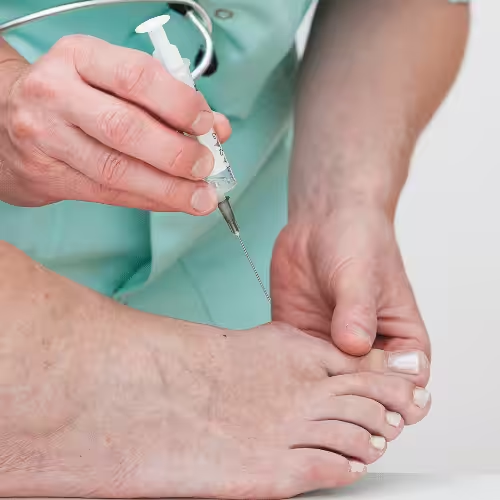
Platelet-rich plasma is a concentrate of your own platelets prepared from a small sample of your blood. The process involves drawing blood (typically 30–60mL), centrifuging it to separate the platelet-rich plasma layer from red blood cells, and then injecting the concentrated PRP into the target tissue.
Platelets are best known for their role in clotting, but they contain hundreds of growth factors and signaling proteins — including platelet-derived growth factor (PDGF), transforming growth factor-beta (TGF-β), vascular endothelial growth factor (VEGF), and insulin-like growth factor (IGF-1) — that directly stimulate tissue repair, collagen synthesis, and new blood vessel formation. PRP harnesses these healing factors and concentrates them at the injury site.
PRP for Plantar Fasciitis
Plantar fasciitis is the most studied indication for PRP in the foot. Multiple randomized controlled trials comparing PRP injection to cortisone injection have found:
- Both PRP and cortisone provide significant short-term pain reduction (4–6 weeks)
- Cortisone provides faster initial relief, with more patients pain-free at 4 weeks
- PRP demonstrates superior durability at 3, 6, and 12 months — with patients maintaining improvement vs. the cortisone group, which often returns to baseline or below
- PRP does not carry the fat pad atrophy risk associated with repeated cortisone injections
PRP is particularly appropriate for chronic plantar fasciitis (3+ months duration) that has failed conservative treatment, cases where cortisone has provided only temporary relief, and patients who want to avoid repeated cortisone injections.
PRP for Achilles Tendinopathy
The evidence for PRP in Achilles tendinopathy is mixed. For mid-substance non-insertional tendinopathy, high-quality randomized trials have not consistently shown PRP to be superior to eccentric exercise protocols and saline injection. However, for insertional Achilles tendinopathy — which responds poorly to eccentric exercise (the tendon is compressed rather than stretched) — PRP may provide additional benefit as part of a multimodal treatment approach.
PRP for Other Foot and Ankle Conditions
PRP is also used with varying levels of evidence for:
- Chronic ankle sprains and ligamentous laxity: Some evidence supports intrarticular PRP reducing synovitis and improving functional outcomes in recurrent instability
- Osteochondral ankle lesions: Intraarticular PRP may support cartilage repair when combined with microfracture surgery
- Peroneal and posterior tibial tendinopathy: Case series support PRP as an adjunct to physical therapy for recalcitrant tendinopathy
- Morton’s neuroma: Some practitioners use perineural PRP injection as an alternative to cortisone or sclerosing therapy, with limited published data
What to Expect After a PRP Injection
PRP injections produce a post-injection flare — worsening pain for 3–7 days after the procedure as the growth factor-triggered inflammatory response initiates the repair cascade. This is normal and expected, and patients should plan for reduced activity during this period. Significant improvement typically begins at 4–6 weeks and continues for 3–6 months as tissue remodeling progresses.
Unlike cortisone injections (which patients can typically resume normal activities after), PRP requires activity modification for 2–4 weeks after injection to allow the repair process to proceed without mechanical disruption of the healing tissue.
PRP Injections for Plantar Fasciitis and Tendinopathy
Dr. Biernacki offers PRP injections for chronic foot and ankle conditions at our Bloomfield Township and Howell offices. Schedule a consultation to see if PRP is right for you.
📞 (810) 206-1402 |
📧 Get Dr. Tom’s Free Lab Test Guide
Discover the 5 lab tests every person over 35 should ask their doctor about — explained in plain English by a board-certified physician.
📍 Located in Michigan?
Our board-certified podiatrists treat this condition at two convenient locations. Same-day appointments often available.
Insurance Accepted
BCBS · Medicare · Aetna · Cigna · United Healthcare · HAP · Priority Health · Humana · View All →
Howell Office
4330 E Grand River Ave
Howell, MI 48843
Get Directions →
Bloomfield Township Office
43494 Woodward Ave, #208
Bloomfield Township, MI 48302
Get Directions →
Your Board-Certified Podiatrists



Ready to Get Back on Your Feet?
Same-week appointments available at both locations.
Book Your AppointmentMore Podiatrist-Recommended Cortisone Essentials
Hoka Clifton 10


Max-cushion everyday shoe — podiatrist favorite for walking and running.

OOFOS Recovery Slide

Impact-absorbing recovery sandal — wear after long days on your feet.
As an Amazon Associate, Balance Foot & Ankle earns from qualifying purchases. Product recommendations are based on clinical experience; prices and availability shown above update live from Amazon.
When to See a Podiatrist
Cortisone injections are most effective when paired with a root-cause fix — orthotic, shoe change, or physical therapy. At Balance Foot & Ankle, we use ultrasound guidance to place every injection exactly in the inflamed space, maximizing relief. And we always discuss the treatment plan that follows, so the pain stays gone.
Call Balance Foot & Ankle: (810) 206-1402 · Book online · Offices in Howell & Bloomfield Township
Pros & Cons of Conservative Care for foot care
Advantages
- ✓ Conservative care first
- ✓ Same-week appointments
- ✓ Multiple insurance accepted
Considerations
- ✗ Self-treatment can mask issues
- ✗ See a podiatrist if pain >2 weeks
Dr. Tom’s Recommended Products for foot care
Affiliate disclosure: As an Amazon Associate, Balance Foot & Ankle earns from qualifying purchases. We only recommend products we use with patients.
Footnanny Heel Cream Dr. Tom’s Pick
Best for: Daily moisturizer for cracked heels
Ready to Get Back on Your Feet?
Same-day appointments in Howell + Bloomfield Township. Most insurance accepted. Dr. Tom Biernacki, DPM & team.
Book Today — Same-Day Appointments Available
Call Now: (810) 206-1402
About Your Care Team at Balance Foot & Ankle
Dr. Tom Biernacki, DPM · Board-Certified Foot & Ankle Surgeon. Specializes in conservative-first care, minimally invasive bunion surgery, and complex reconstruction.
Dr. Carl Jay, DPM · Accepting new patients. Specializes in sports medicine, athletic injuries, and routine podiatric care.
Dr. Daria Gutkin, DPM, AACFAS · Accepting new patients. Specializes in surgical reconstruction and pediatric podiatry.
Locations: 4330 E Grand River Ave, Howell, MI 48843 · 43494 Woodward Ave Suite 208, Bloomfield Township, MI 48302
Hours: Mon–Fri 8:00 AM – 5:00 PM · (810) 206-1402
In-Office Treatment at Balance Foot & Ankle
If home treatment isn’t providing relief for your foot and ankle conditions, our podiatry team at Balance Foot & Ankle can help with same-day evaluations and advanced in-office care.
Same-day appointments available. (810) 206-1402
Doctor Hoy’s Natural Pain Relief Gel
Natural topical pain relief I use in our clinic. Arnica + camphor formula — apply directly to the area 3–4x daily. ($20–25)
Shop Doctor Hoy’s →Get Expert Care at Balance Foot & Ankle
Same-week appointments at our Howell and Bloomfield Township offices. Board-certified podiatric surgeons. Most insurance accepted.
Ready for Expert Care?
Same-day appointments in Howell & Bloomfield Township, MI.
4.9★ | 1,123 Reviews | 3,000+ Surgeries
Or call: (810) 206-1402

Dr. Tom Biernacki, DPM is a board-certified foot & ankle surgeon (ABFAS & ABPM) at Balance Foot & Ankle Specialists in Southeast Michigan. With over a decade of clinical experience, he specializes in heel pain, bunions, diabetic foot care, sports injuries, and minimally invasive surgery. Dr. Biernacki is a member of the APMA and ACFAS, and his patient education content on MichiganFootDoctors.com and YouTube has made him one of the most-followed foot & ankle educators on YouTube.