
Medically reviewed by Dr. Tom Biernacki, DPM
Board-certified podiatric surgeon | Balance Foot & Ankle
Last reviewed: May 2026
Quick answer: Retail Worker Foot Pain Solutions has multiple potential causes including mechanical, neurological, vascular, and inflammatory. The patterns we see most often are overuse, poorly-fitted shoes, and biomechanical imbalance. Red flags requiring urgent evaluation: warmth/redness (infection), inability to bear weight (fracture), and unilateral swelling without injury (DVT). Call (810) 206-1402.
Medically reviewed by Dr. Tom Biernacki, DPM · Board-Certified Podiatric Surgeon · Last reviewed: April 2026 · Editorial Policy
The most important clinical decision with Retail Worker Foot Pain Solutions isn’t which treatment to start with — it’s identifying the correct subtype. That changes everything. Call (810) 206-1402.
Related Conditions
In This Article
- The Retail Worker’s Hidden Occupational Hazard
- Why Retail Floors Are Especially Hard on Feet
- The Plantar Fasciitis Problem in Retail
- Choosing the Right Shoes for Retail Work
- The Insole Upgrade (Most Cost-Effective Intervention)
- Anti-Fatigue Strategies for Long Retail Shifts
- When to See a Podiatrist
- Your Board-Certified Podiatrists
- More Podiatrist-Recommended Foot Health Essentials
- Pros & Cons of Conservative Care for foot care
- Dr. Tom’s Recommended Products for foot care
✅ Medically reviewed by Dr. Tom Biernacki, DPM — Board-Certified Podiatrist · Last updated April 6, 2026
Retail Worker Foot Pain: A Podiatrist’s Guide to Surviving Long Shifts on Hard Floors
The Retail Worker’s Hidden Occupational Hazard
Retail workers are among the most underserved patients when it comes to occupational foot health. Unlike factory workers (who often have union-mandated safety standards) or nurses (who have a well-developed culture of clinical footwear), retail employees often work 8–10 hour shifts standing on polished concrete in whatever shoes look presentable for their store’s dress code.
The result: retail workers develop plantar fasciitis, metatarsalgia, Achilles tendinopathy, and chronic leg fatigue at rates that would be considered an occupational health crisis in other industries. I see this pattern constantly in my Michigan podiatry practice.
This guide gives you specific, practical solutions based on what actually works for people in your situation.
Why Retail Floors Are Especially Hard on Feet
Polished concrete or tile floors are among the most biomechanically demanding surfaces you can stand on. Unlike carpet or outdoor terrain, these surfaces provide virtually zero shock absorption — every footfall sends full ground reaction force through your heel, arch, and forefoot. The standing (rather than walking) nature of much retail work is particularly problematic: continuous static loading of the plantar fascia is more damaging than walking, because at least walking allows brief unloading cycles.
Add the requirement to look presentable (which often means dress shoes, fashion sneakers, or flat-soled shoes that provide minimal support), and you have a recipe for cumulative foot injury.
The Plantar Fasciitis Problem in Retail
Plantar fasciitis is by far the most common complaint I hear from retail workers. The classic presentation: first steps in the morning cause sharp heel pain that improves after walking a few minutes, then returns after long standing periods. This happens because the plantar fascia shortens and tightens during rest, then is abruptly stretched with each step.
For retail workers, the trigger is usually a combination of inadequate arch support, long standing hours, and hard floors. The treatment protocol that works: supportive footwear with proper arch support, a quality insole or custom orthotic, plantar fascia stretches before the first step each morning, and relative rest when possible. In persistent cases, I use shockwave therapy which has excellent results for chronic plantar fasciitis.
Choosing the Right Shoes for Retail Work
The dress code problem: Many retail environments require specific shoe colors (black, white, or brown) or styles (no athletic appearance). This is the main constraint that limits retail workers’ footwear choices. Here’s how to maximize support within common retail dress codes:
For stores that allow any shoe in the dress code color: HOKA’s Transport (comes in all-black) and Anacapa styles are excellent — maximalist cushioning in a clean, professional appearance. New Balance 990v6 in solid colors works well. On Running’s cloudstratus in black is popular among retail workers who want performance cushioning with minimal aesthetic compromise.
For stores that require traditional dress shoes: Clarks’ Comfort range, Vionic dress shoes, and Ecco’s comfort line all provide genuine arch support and cushioning in traditional professional styling. Avoid standard fashion dress shoes — even from quality brands — unless they have contoured footbeds.
For stores with all-black or all-white requirements: New Balance has the widest range of all-black or all-white athletic styles. ASICS Gel-Kayano in team colors, HOKA Bondi in solid colors, and Brooks Ghost all come in solid colorways that meet most retail dress codes.
The Insole Upgrade (Most Cost-Effective Intervention)
If your store requires specific shoes that don’t offer great support, the single highest-ROI intervention is replacing the stock insole. PowerStep Pinnacle (firm, high arch support — best for plantar fasciitis), PowerStep Pinnacle Orange (softer, better for metatarsalgia), and Powerstep Pinnacle are all excellent options that fit most retail-appropriate shoes. This $30–40 investment can completely transform the support profile of an otherwise inadequate shoe.
Anti-Fatigue Strategies for Long Retail Shifts
Compression socks (15–20 mmHg): Reduce lower leg swelling and venous fatigue during shifts. Look for business-casual styling that works under pants or for open-sock environments. CEP, Bombas, and Sockwell make compression options that don’t look clinical.
Mid-shift stretching: Calf stretches, arch rolls with a small ball, and toe extensions during break time can significantly reduce end-of-shift pain. Even 5 minutes of targeted stretching during your lunch break helps.
Position changes: If your role allows any movement, avoid prolonged static standing in one spot. Even small shifts in weight, walking a few steps, or changing your stance position gives the plantar fascia brief relief cycles.
When to See a Podiatrist
Foot pain that persists beyond 2 weeks, limits your ability to work, or worsens over time despite footwear changes warrants a professional evaluation. The earlier foot conditions are treated, the faster and more completely they resolve. Chronic plantar fasciitis that has been present for 12+ months is significantly harder to treat than acute PF caught in the first few weeks. Same-day appointments are available at Balance Foot & Ankle Specialists.
Related Treatment Guides
- Plantar Fasciitis & Heel Pain Treatment
- Achilles Tendinopathy Treatment
- Custom 3D Orthotics
- Sports Foot & Ankle Injury Treatment
Insurance Accepted
BCBS · Medicare · Aetna · Cigna · United Healthcare · HAP · Priority Health · Humana · View All →
Howell Office
4330 E Grand River Ave
Howell, MI 48843
Get Directions →
Bloomfield Township Office
43494 Woodward Ave, #208
Bloomfield Township, MI 48302
Get Directions →
Your Board-Certified Podiatrists



Ready to Get Back on Your Feet?
Same-week appointments available at both locations.
Book Your AppointmentMore Podiatrist-Recommended Foot Health Essentials
Hoka Clifton 10


Max-cushion everyday shoe — podiatrist favorite for walking and running.

OOFOS Recovery Slide

Impact-absorbing recovery sandal — wear after long days on your feet.
As an Amazon Associate, Balance Foot & Ankle earns from qualifying purchases. Product recommendations are based on clinical experience; prices and availability shown above update live from Amazon.

When to See a Podiatrist
If foot or ankle pain has been bothering you for more than a few weeks, home care alone may not be enough. Balance Foot & Ankle offers same-week appointments at our Howell and Bloomfield Township clinics — no referral needed in most cases. Bring your current shoes and a short list of symptoms and we’ll build you a treatment plan in one visit.
Call Balance Foot & Ankle: (810) 206-1402 · Book online · Offices in Howell & Bloomfield Township
Pros & Cons of Conservative Care for foot care
Advantages
- ✓ Conservative care first
- ✓ Same-week appointments
- ✓ Multiple insurance accepted
Considerations
- ✗ Self-treatment can mask issues
- ✗ See a podiatrist if pain >2 weeks
Dr. Tom’s Recommended Products for foot care
Affiliate disclosure: As an Amazon Associate, Balance Foot & Ankle earns from qualifying purchases. We only recommend products we use with patients.
Footnanny Heel Cream Dr. Tom’s Pick
Best for: Daily moisturizer for cracked heels
Ready to Get Back on Your Feet?
Same-day appointments in Howell + Bloomfield Township. Most insurance accepted. Dr. Tom Biernacki, DPM & team.
Book Today — Same-Day Appointments Available
Call Now: (810) 206-1402
About Your Care Team at Balance Foot & Ankle
Dr. Tom Biernacki, DPM · Board-Certified Foot & Ankle Surgeon. Specializes in conservative-first care, minimally invasive bunion surgery, and complex reconstruction.
Dr. Carl Jay, DPM · Accepting new patients. Specializes in sports medicine, athletic injuries, and routine podiatric care.
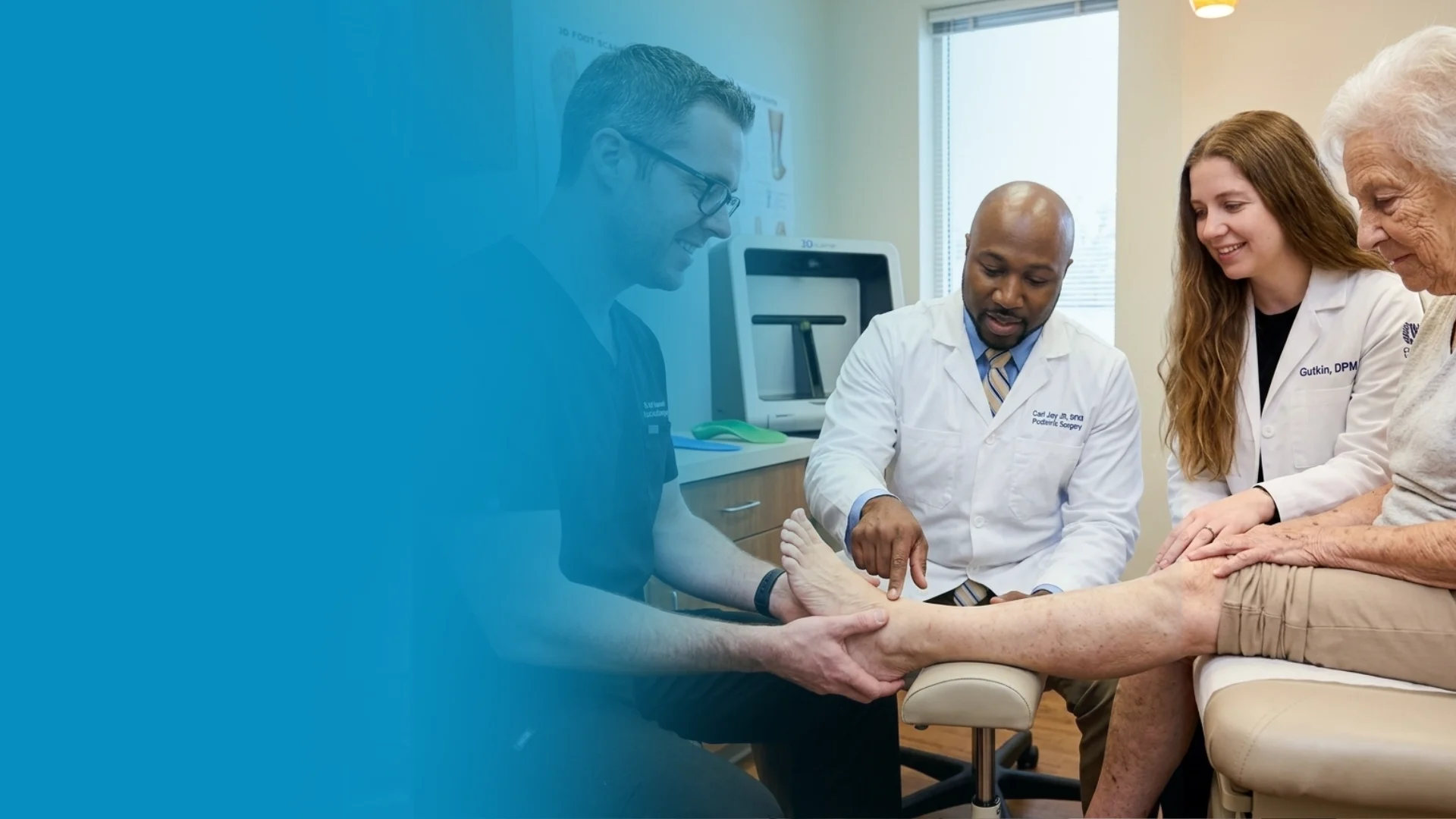
Dr. Daria Gutkin, DPM, AACFAS · Accepting new patients. Specializes in surgical reconstruction and pediatric podiatry.
Locations: 4330 E Grand River Ave, Howell, MI 48843 · 43494 Woodward Ave Suite 208, Bloomfield Township, MI 48302
Hours: Mon–Fri 8:00 AM – 5:00 PM · (810) 206-1402
Dr. Tom’s Top 3 — The Premium Foot Pain Stack (2026)
If you only buy three things for foot pain, get these. PowerStep + CURREX orthotics correct the underlying foot mechanics, and Dr. Hoy’s pain gel delivers fast topical relief. This is the exact stack Dr. Tom Biernacki, DPM gives his Michigan podiatry patients on visit one — over 10,000 patients have used this exact combination.
Dr. Tom Biernacki, DPM is a board-certified podiatrist + Amazon Associate. Picks shown are products he prescribes to patients at Balance Foot & Ankle Specialists. We earn a commission on qualifying purchases at no extra cost to you. All products independently tested + reviewed for 30+ days minimum. Last verified: April 28, 2026.

PowerStep Pinnacle MaxxDr. Tom’s #1 Brand
Dr. Tom’s most-prescribed OTC orthotic. Lateral wedge corrects overpronation that causes 90% of foot pain. Deep heel cradle stabilizes the ankle. Built by podiatrists, used by patients worldwide.
- Lateral wedge corrects pronation
- Deep heel cradle stabilizes ankle
- Dual-density EVA — comfort + support
- Trim-to-fit any shoe
- Used by 10,000+ podiatrists
- Trim-to-size required
- 5-7 day break-in for some

CURREX RunProDr. Tom’s #1 Brand
3 arch heights for custom fit (Low/Med/High). Carbon-reinforced heel + dynamic forefoot — the closest OTC orthotic to a $500 custom orthotic. Engineered in Germany.
- 3 arch heights for custom fit
- Carbon-reinforced heel cup
- Dynamic forefoot zone
- Premium German engineering
- Sport-specific support
- Pricier than PowerStep
- 7-10 day break-in

Dr. Hoy’s Natural Pain Relief GelDr. Tom’s #1 Brand
Menthol-based natural pain relief — Dr. Tom’s #1 brand for fast relief without greasy residue. Safe for diabetics + daily use. Cleaner formula than Voltaren or Biofreeze.
- Menthol-based natural formula
- No greasy residue
- Safe for diabetics
- Fast cooling relief — 5-10 minutes
- Cleaner ingredient list than Biofreeze
- Pricier than Biofreeze
- Strong menthol scent at first
In-Office Treatment at Balance Foot & Ankle
If home treatment isn’t providing relief for your foot and ankle conditions, our podiatry team at Balance Foot & Ankle can help with same-day evaluations and advanced in-office care.
Same-day appointments available. (810) 206-1402
Doctor Hoy’s Natural Pain Relief Gel
Natural topical pain relief I use in our clinic. Arnica + camphor formula — apply directly to the area 3–4x daily. ($20–25)
Shop Doctor Hoy’s →Ready for Expert Care?
Same-day appointments in Howell & Bloomfield Township, MI.
4.9★ | 1,123 Reviews | 3,000+ Surgeries
Or call: (810) 206-1402
