

Quick answer: A sprained top of the foot is a stretch or tear of the midfoot ligaments, usually from a twist, fall, or direct blow. Most mild sprains heal in 2–4 weeks with rest, ice, compression, and supportive shoes; sharp pain with weight-bearing, swelling, or bruising that doesn’t improve needs an X-ray to rule out a fracture or Lisfranc injury.
The most important clinical decision with Sprained Top Foot isn’t which treatment to start with — it’s identifying the correct subtype. That changes everything. Call (810) 206-1402.
Sprained Top of Foot (Dorsal Foot Sprain): Grades, Causes, and Treatment Protocol
A sprain at the top of the foot (dorsal foot sprain) involves the ligaments and joint capsules of the midfoot — most commonly the tarsometatarsal (Lisfranc) region, the midtarsal joints, or the extensor tendon sheath complex. The most important clinical decision is distinguishing a simple dorsal foot sprain from a Lisfranc injury — a disruption of the ligaments holding the midfoot together. Missed Lisfranc injuries are one of the most consequential diagnostic errors in foot and ankle care: 20-40% are missed on initial presentation, and an untreated Lisfranc injury leads to painful midfoot arthritis and permanent deformity.
| Injury Type | Mechanism | Location of Pain | Key Clinical Finding | X-Ray Finding | Treatment | Return to Sport |
|---|---|---|---|---|---|---|
| Simple dorsal midfoot sprain (most common) | Twisting injury; direct blow to the top of the foot; stumbling on stairs; forced plantarflexion; dancer missing a step | Diffuse dorsal midfoot; may be tender over 2nd or 3rd tarsometatarsal joint; no specific point tenderness | Swelling and tenderness dorsal midfoot; weight-bearing painful but possible; squeeze test of the forefoot is negative or mildly positive; no diastasis on stress X-ray | No fracture; no diastasis (separation between metatarsals); metatarsal alignment intact | RICE × 72 hours; supportive boot or stiff-soled shoe × 2-4 weeks; progress to regular shoe as pain allows; physical therapy for restoration of proprioception | 2-4 weeks for grade I; 4-6 weeks for grade II |
| Lisfranc ligament sprain / injury (do not miss) | Low-energy: indirect rotational force with foot planted (falling off a step, stopping suddenly while turning); High-energy: motor vehicle crush injury, industrial crush; the key is ANY mechanism that stresses the tarsometatarsal joints | Point-specific tenderness at the base of the 2nd metatarsal (2nd tarsometatarsal joint — the “keystone” of the Lisfranc joint complex); tenderness at the 1st-2nd interspace; pain with weight-bearing is severe | Piano key test: dorsiflexion/plantarflexion of each metatarsal individually — pain at the 2nd MT is pathognomonic; inability to bear weight on the forefoot; bruising in the plantar arch (midfoot bruising on the BOTTOM is highly specific for Lisfranc injury); stress X-ray: diastasis ≥2mm between 1st and 2nd MT bases | Weight-bearing X-ray (NON-weight-bearing may appear normal): widening between the bases of the 1st and 2nd metatarsals ≥2mm; 2nd MT may be displaced off the medial cuneiform; fleck sign (small avulsion fracture at the base of the 2nd MT) | STABLE (pure ligament, no diastasis): non-weight-bearing cast × 6 weeks, then progressive weight-bearing. UNSTABLE (diastasis ≥2mm) or FRACTURE-DISLOCATION: surgical fixation (ORIF or primary fusion) — critical to restore midfoot alignment before arthritis develops | 3-4 months for stable; 4-6 months post-surgery for unstable |
| Extensor tendon strain / tenosynovitis | Direct blow to the dorsal foot; tight shoe lace; excessive downhill running; forced plantarflexion with toe dorsiflexion resistance | Pain runs along the specific extensor tendon (extensor hallucis longus — runs to the big toe; extensor digitorum longus — runs to the lesser toes); may feel a crepitus (crackling) with ankle movement | Pain follows the tendon track from the ankle toward the toe; resisted dorsiflexion of the specific toe reproduces pain (distinguishes from ligament sprain); visible swelling along the tendon course; crepitus with motion (tenosynovitis) | Usually normal; MRI or ultrasound may show peritendinous fluid (tenosynovitis) or partial tear | Relative rest from aggravating activity; ice; NSAIDs; skip-lacing (avoid lace pressure over the tendon); orthotics; cortisone injection into the tendon sheath (NOT the tendon) for refractory tenosynovitis; very rarely surgical | 2-6 weeks depending on severity |
| Navicular stress fracture | Insidious onset with increased running mileage; sprinting athletes; dancers; military training; GRADUAL onset differentiates from acute sprain | Dorsal midfoot pain; specific point tenderness at the navicular (the N-spot: center of the navicular bone on the dorsal midfoot); single-leg hop test produces sharp pain | N-spot tenderness (pressing the center of the navicular with one finger reproduces exact pain); insidious onset without specific trauma; negative stress X-ray; positive MRI or CT | Normal X-ray (early); CT is the gold standard (shows fracture line in coronal plane through the central third of the navicular); MRI shows edema and fracture | NON-weight-bearing boot or cast × 6-8 weeks (mandatory — navicular stress fractures have high non-union risk with continued weight-bearing); no running until CT confirms healing; surgical fixation for complete fractures or athletes with delayed healing | 3-4 months; full season loss common in high-level athletes |
Dorsal Foot Sprain vs Lisfranc: The 4-Step Exam That Changes the Diagnosis
| Step | Test | Positive = Lisfranc Concern | Negative = Simple Sprain More Likely |
|---|---|---|---|
| 1 | Weight-bearing assessment: Can the patient bear weight on the forefoot (ball of foot) at all? | Unable to bear weight on the forefoot; or weight-bearing causes severe pain at the midfoot specifically — Ottawa Foot Rules apply; X-ray indicated | Can walk with mild-moderate pain; no significant forefoot loading pain |
| 2 | Plantar bruising: Check the arch and sole for bruising (not just the top) | Bruising on the BOTTOM of the midfoot (in the arch) — this is highly specific for Lisfranc ligament disruption; midfoot injury with plantar arch bruising = Lisfranc until proven otherwise | Bruising only on the top (dorsal surface) — less specific for Lisfranc; consistent with simple sprain |
| 3 | Point tenderness at the 2nd tarsometatarsal joint: Press with one finger at the base of the 2nd metatarsal | Exquisite point tenderness at this specific location (not diffuse tenderness) — the 2nd TMT joint is the most commonly injured structure in Lisfranc injuries; “N-point tenderness” at the 2nd MT base | Diffuse tenderness across the dorsal midfoot without this specific point of maximum tenderness |
| 4 | Weight-bearing X-ray: Comparison views with the opposite foot; check the 1st-2nd intermetatarsal space | Diastasis (separation) ≥2mm between the bases of the 1st and 2nd metatarsals; fleck sign (small avulsion fracture at the 2nd MT base); loss of alignment at any TMT joint | No diastasis; metatarsal bases align with their respective cuneiforms as on the uninjured foot |
You twisted your foot and the top hurts. Could be a simple sprain — or a Lisfranc injury that needs surgery. Here’s how to tell.
You’re in the right place. Dr. Tom Biernacki, DPM, FACFAS — board-certified foot & ankle surgeon with 3,000+ surgeries — explains exactly what top of foot sprain means and what works. Call (810) 206-1402 for same-day appointment at Howell or Bloomfield Hills.
Medically reviewed by Dr. Tom Biernacki, DPM
Board-certified podiatric surgeon | Balance Foot & Ankle | Last reviewed: May 2026
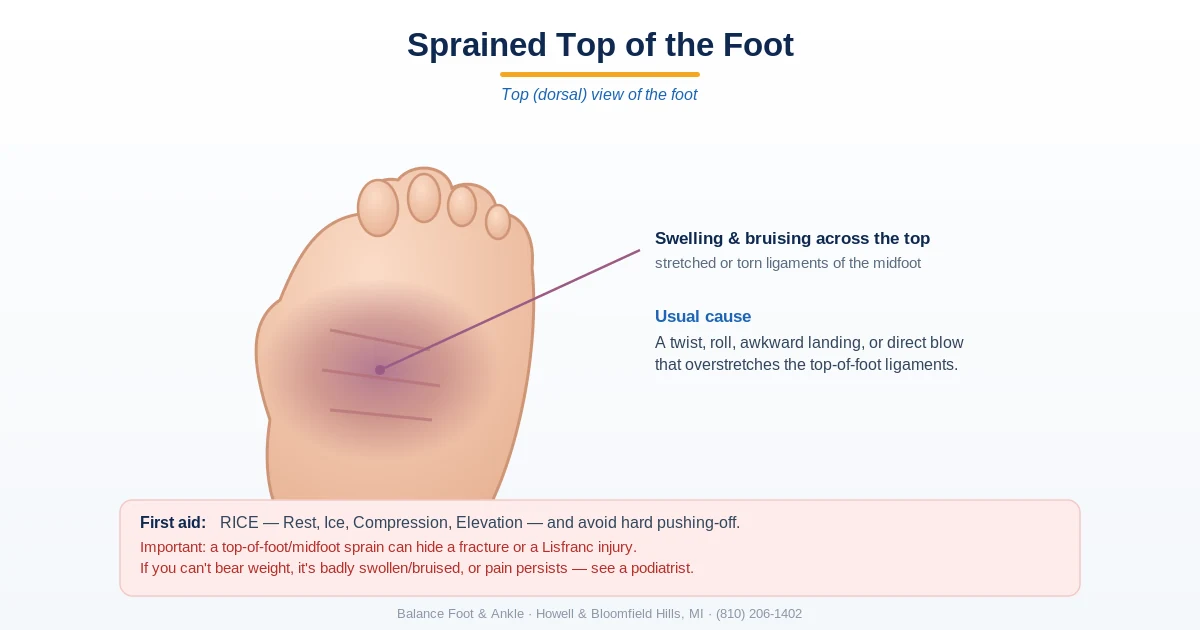
What Does a Sprained Top of Foot Mean?
Pain across the top of the foot after a stumble, awkward step, or sports collision is a scenario we see constantly in our clinic. The top of the foot (dorsum) houses multiple small bones, tendons, and ligaments — any of which can be injured. The term “sprained top of foot” describes ligamentous or soft tissue injury to this region, but an accurate diagnosis matters because fractures, tendon tears, and Lisfranc injuries can mimic a simple sprain and require very different treatment.
Key takeaway: Top-of-foot pain after trauma can range from a mild sprain to a Lisfranc fracture-dislocation. Never assume it’s “just a sprain” — accurate diagnosis changes management significantly.
Common Causes of Top Foot Pain
Extensor tendonitis is the most common cause of non-traumatic top foot pain — inflammation of the tendons running across the top of the foot. It produces a dull ache that worsens with activity, tight laces, or prolonged walking. Stress fractures of the metatarsal shafts produce point tenderness over a specific bone. Lisfranc injuries — sprains or fractures at the tarsometatarsal joint complex — are the most commonly missed serious injury in the foot.
How to Recognize a Lisfranc Injury
A Lisfranc injury involves the ligaments and/or bones at the midfoot junction. Classic signs: midfoot swelling and bruising — particularly on the bottom of the arch (“plantar ecchymosis”), inability to bear weight, and tenderness across the entire midfoot. Even a “sprain-type” Lisfranc injury without fracture requires non-weight-bearing cast immobilization for 6–8 weeks. Missed Lisfranc injuries lead to chronic midfoot arthritis and instability.
Treatment for Top Foot Sprains
For minor sprains (confirmed no fracture or Lisfranc injury), the RICE protocol applies: rest, ice, compression, and elevation. A stiff-soled shoe or removable walking boot provides pain relief. Most mild top-of-foot sprains resolve in 2–4 weeks.
Extensor tendonitis specifically benefits from loosening lace pressure (skip a lace crossing over the tender area) and padding the shoe tongue. We often add a corticosteroid injection for persistent cases that haven’t responded after 6 weeks.
⚠️ See a podiatrist urgently if you have top foot pain with:
- Inability to bear weight after the injury
- Bruising on the bottom of the arch (plantar ecchymosis)
- Visible deformity or abnormal foot shape
- Rapidly spreading swelling
- Point tenderness over a specific bone shaft
Diagnosis: What to Expect
A standard X-ray series is the first step. However, Lisfranc injuries and stress fractures are frequently missed on plain X-rays — MRI or CT scan provides definitive diagnosis. Weight-bearing X-rays are specifically needed for Lisfranc evaluation; supine films can look normal even with significant instability. In our clinic, we have a low threshold for advanced imaging when the clinical exam suggests more than a simple sprain.
PowerStep Pinnacle Arch Support Insoles
⭐ 4.7★ | 50K+ Sold
Reduces stress on the top of the foot during sprained top foot recovery — critical for midfoot and extensor tendon healing.
Medi-Dyne Tuli’s Cheetah Metatarsal Pad
⭐ 4.5★ | 12K+ Sold
Offloads the metatarsal heads and midfoot during sprained top foot healing — reduces painful pressure with every step.
Learn more about how custom orthotics work — our Michigan guide covers casting, materials, activity-specific designs, and what to expect from the fitting process.
MOST COMMON MISTAKE WE SEE
The most dangerous mistake with top-of-foot sprains is dismissing them as “minor” because the patient can still walk. Lisfranc injuries — which can look nearly identical to a simple sprain — require surgical fixation if missed, and delayed diagnosis leads to post-traumatic arthritis. Any dorsal foot injury where the gap between the first and second metatarsal is widened on weight-bearing X-ray must be evaluated by a specialist the same week.
DIFFERENTIAL DIAGNOSIS — CONDITIONS THAT MIMIC A SPRAINED TOP OF FOOT
- Lisfranc ligament injury — often missed as a “sprain”; key finding is widening at the 1st–2nd intermetatarsal space on weight-bearing X-ray; requires surgical consultation
- Midfoot stress fracture — insidious onset, no acute event; bone tenderness over a specific metatarsal; confirmed by MRI or bone scan if X-ray negative
- Extensor tendonitis — no trauma; pain with resisted toe extension; worsened by tight shoe straps; responds well to NSAIDs and shoe modification
- Navicular fracture — dorsal navicular tenderness; common in athletes; easily missed on plain X-ray; CT or MRI needed
- Ganglion cyst — firm, mobile dorsal lump; non-traumatic; pain with shoe pressure; transilluminates on exam
RED FLAGS — SEE A PODIATRIST URGENTLY
- Inability to bear weight immediately after the injury
- Significant swelling or bruising on the bottom of the foot (sole bruising = Lisfranc until proven otherwise)
- A “pop” felt or heard at the time of injury
- Dorsal foot pain that progressively worsens over 48–72 hours despite rest and ice
- Gap or step-off deformity visible on the dorsum of the foot
- Top foot injury in a diabetic patient — delayed diagnosis dramatically worsens outcomes
Call (810) 206-1402 or book online — most urgent presentations seen same or next business day.
Frequently Asked Questions
How long does a sprained top of foot take to heal? A mild sprain heals in 2–4 weeks. Extensor tendonitis may take 4–8 weeks. Lisfranc injuries require 3–6 months even with proper treatment.
Can I walk on a sprained top of foot? If you can bear weight without severe pain, light ambulation is acceptable for mild sprains. If every step causes significant pain, rest and seek evaluation.
Why does my top of foot hurt with no injury? Non-traumatic top foot pain is usually extensor tendonitis from tight shoes, overuse, or flat feet. A podiatrist can identify the cause and address it with orthotics and activity modification.
The Bottom Line
Top-of-foot pain after trauma deserves professional evaluation — what looks like a simple sprain can be a Lisfranc injury or stress fracture. For mild confirmed sprains, RICE and a stiff-soled shoe manage most cases well. If pain persists beyond 2 weeks or you couldn’t bear weight initially, don’t delay getting an X-ray.
Sources
- Nunley JA, Vertullo CJ. “Classification and management of midfoot sprains.” Am J Sports Med. 2002.
- Bica D et al. “Diagnosis and Management of Common Foot Fractures.” Am Fam Physician. 2016.
- Myerson MS et al. “Fracture dislocations of the tarsometatarsal joints.” Foot Ankle. 1986.
Ready to Get Relief?
Same-day appointments available in Howell & Bloomfield Hills, MI
4.9★ | 1,123 Reviews | 3,000+ Surgeries
Or call: (810) 206-1402
Frequently Asked Questions
When should I see a podiatrist?
If symptoms persist past 2 weeks, affect your normal activity, or are accompanied by red-flag symptoms (warmth, redness, swelling, inability to bear weight).
What does treatment cost?
Most diagnostic visits and conservative treatments are covered by Medicare and major insurers. Out-of-pocket costs vary by your specific plan.
How quickly can I get an appointment?
Most non-urgent cases see us within 5 business days. Urgent cases (sudden pain, possible fracture) typically same or next business day.
What is Ankle sprain?
Ankle sprain is a common foot/ankle condition that affects mobility and quality of life. Understanding the underlying cause is the first step in successful treatment. Our podiatrists at Balance Foot & Ankle perform a hands-on biomechanical exam, review your activity history, and use diagnostic imaging when appropriate to identify the root cause—not just treat the symptom. Many patients have been told to “rest and ice” without a deeper diagnostic workup; our approach is different.
Symptoms and warning signs
Common signs of ankle sprain include pain that worsens with activity, morning stiffness, swelling, tenderness when palpated, and difficulty bearing weight. If you experience sudden severe pain, inability to walk, visible deformity, numbness or color change, contact our office the same day or visit urgent care—these can signal a more serious injury such as a fracture, tendon rupture, or vascular compromise. Diabetics with any foot wound should seek same-day care.
Conservative treatment options
Most cases of ankle sprain respond to non-surgical care: structured rest, supportive footwear changes, custom orthotics, targeted stretching and strengthening protocols, anti-inflammatory medications when medically appropriate, and in-office procedures such as ultrasound-guided injections. We also offer advanced therapies including MLS laser therapy, EPAT/shockwave, regenerative injections, and image-guided procedures. Treatment is sequenced from least invasive to most invasive, and we explain the rationale at every step.
When is surgery considered?
Surgery is reserved for cases that fail 3-6 months of well-structured conservative care, when there is structural pathology (severe deformity, complete tear, advanced arthritis), or when imaging shows damage that will not heal without intervention. Our surgeons have performed 3,000+ foot and ankle procedures and prioritize minimally-invasive techniques whenever appropriate. We discuss recovery timelines, return-to-activity milestones, and realistic outcome expectations before any procedure is scheduled.
Recovery timeline and prevention
Recovery from ankle sprain varies based on severity and chosen treatment path. Conservative cases often improve within 4-8 weeks with consistent adherence to the protocol. Post-procedural recovery may range from a few days (in-office procedures) to several months (reconstructive surgery). Long-term prevention involves footwear assessment, activity modification, structured strengthening, and regular check-ins with your podiatrist if you have a history of recurrence. We provide written home-exercise plans and digital follow-up support.
Dr. Tom’s Recommended Products for Top of Foot Sprain
- Doctor Hoy’s Natural Pain Relief Gel — Apply along the dorsum of the foot to the swollen extensor tendon region 3–4x daily. Arnica + camphor for the acute swelling and pain of a Lisfranc sprain.
- Plantar Fasciitis Compression Socks (20-30mmHg) — Graduated compression controls the dorsal foot edema that makes top-of-foot sprains so painful to walk on in the acute phase.
- PowerStep Pinnacle Insoles — Once cleared to walk in regular shoes: proper arch support reduces the midfoot stress that delays recovery from Lisfranc-area sprains.
Top-of-foot sprains with bruising under the arch are Lisfranc injuries until proven otherwise — this is a fracture-equivalent that needs imaging. book a same-day appointment → · (810) 206-1402
Ready to feel better?
Same-week appointments available in Howell and Bloomfield Hills, Michigan.
Book Your VisitIn-Office Treatment at Balance Foot & Ankle
If home treatment isn’t resolving your sprained top of foot, our podiatry team at Balance Foot & Ankle can help. We offer same-day evaluations and advanced in-office treatments to get you back on your feet faster.
Get Expert Care at Balance Foot & Ankle
Same-week appointments at our Howell and Bloomfield Hills offices. Board-certified podiatric surgeons. Most insurance accepted.
Footwear & Orthotics for a Top-of-Foot Sprain
A firm-soled, supportive shoe limits midfoot movement while a top-of-foot sprain heals, and orthotics add stability. See our podiatrist-recommended shoes, and see a podiatrist if you can’t bear weight.

Dr. Tom Biernacki, DPM is a board-certified foot & ankle surgeon (ABFAS & ABPM) at Balance Foot & Ankle Specialists in Southeast Michigan. With over a decade of clinical experience, he specializes in heel pain, bunions, diabetic foot care, sports injuries, and minimally invasive surgery. Dr. Biernacki is a member of the APMA and ACFAS, and his patient education content on MichiganFootDoctors.com and YouTube has made him one of the most-followed foot & ankle educators on YouTube.