
Quick answer: Toenail Removal Michigan 2 is a common nail condition with multiple causes including trauma, fungal infection, biomechanical pressure, and underlying medical conditions. Treatment depends on the cause: trauma resolves as the nail grows out (6-12 months), fungus needs antifungal therapy, and biomechanical issues need shoe and orthotic correction. Call (810) 206-1402.
Medically reviewed by Dr. Tom Biernacki, DPM · Board-Certified Podiatric Surgeon · Last reviewed: April 2026 · Editorial Policy
The most important clinical decision with Toenail Removal Michigan 2 isn’t which treatment to start with — it’s identifying the correct subtype. That changes everything. Call (810) 206-1402.
Quick Answer
Toenail Removal in Michigan Permanent & Temporary Opti relates to toenail conditions — typically caused by fungal infection or trauma. Most patients improve in 6-12 months for nail regrowth with conservative care. Same-week appointments in Howell + Bloomfield Hills: (810) 206-1402.
Medically reviewed by Dr. Tom Biernacki, DPM — Board-Certified Podiatric Surgeon — Balance Foot & Ankle, Howell & Bloomfield Hills, MI. Last updated April 2026.
▶ Watch
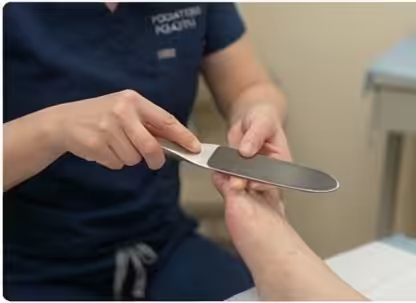
Toenail removal is one of the most common in-office procedures performed in podiatry — and when done correctly, it is highly effective for ending the cycle of recurrent ingrown toenails, painful deformed nails, and severe fungal involvement. At Balance Foot & Ankle in Southeast Michigan, Dr. Tom Biernacki performs toenail removal procedures in-office using local anesthesia, with results that patients consistently describe as significant after years of chronic nail pain.
When Is Toenail Removal Indicated?
Toenail removal is indicated in several situations. Chronic or recurrent ingrown toenails — particularly those that have become infected, developed granulation tissue, or recurred despite conservative treatment — are the most common reason. A nail that has been severely thickened and dystrophic from fungal infection (onychomycosis), trauma, or psoriasis to the point where it causes shoe pain and is no longer cosmetically acceptable may be removed. A sub-ungual hematoma (blood under the nail) that has separated the nail from the nail bed, a nail that is repeatedly injured and avulsed by work or athletic footwear, and nails over active ingrown edges that do not respond to simple edge trimming are all indications for removal.
Partial vs. Total Nail Removal
Partial nail avulsion (PNA) removes only the offending edge or border of the nail — the portion digging into the flesh — while leaving the central nail plate intact. This is the procedure of choice for ingrown toenails when the central nail appears healthy. Total nail avulsion removes the entire nail plate, typically required for severely dystrophic or completely fungal nails. After removal, a new nail will regrow from the nail matrix (growth center) over 6–12 months, though regrowth may produce a similarly problematic nail if the underlying cause is not addressed.
Permanent Nail Removal (Matrixectomy)
When the goal is to prevent the nail from regrowing — either entirely (total matrixectomy) or just the problematic edge (partial matrixectomy) — the nail matrix (growth center) is destroyed after nail removal. Chemical matrixectomy using phenol (phenolization) or sodium hydroxide is the most common technique, applied to the exposed matrix bed for 30 seconds after nail avulsion. This procedure is highly effective, with recurrence rates under 5% for partial phenol-alcohol matrixectomy. The resulting nail ridge is narrower and smooth without the sharp edge that caused the ingrown. The procedure is done under local anesthetic and takes about 15 minutes. A small wound remains at the treated nail fold that heals over 2–4 weeks with daily soaks and antibiotic ointment.
Recovery After Nail Removal
After partial or total nail avulsion, patients wear a bandage and can typically walk immediately in an open-toe sandal or roomy shoe. Wound care involves daily soaks in warm water with Epsom salts and application of antibiotic ointment. Pain is generally mild and well-managed with over-the-counter analgesics. Return to work and most activities is the same day or the following day. Open-toe or sandal-style footwear is helpful for 1–2 weeks. Full healing of the nail fold after phenolization takes 3–6 weeks.
More Podiatrist-Recommended Foot Health Essentials
Hoka Clifton 10


Max-cushion everyday shoe — podiatrist favorite for walking and running.

OOFOS Recovery Slide

Impact-absorbing recovery sandal — wear after long days on your feet.
As an Amazon Associate, Balance Foot & Ankle earns from qualifying purchases. Product recommendations are based on clinical experience; prices and availability shown above update live from Amazon.

When to See a Podiatrist
If foot or ankle pain has been bothering you for more than a few weeks, home care alone may not be enough. Balance Foot & Ankle offers same-week appointments at our Howell and Bloomfield Hills clinics — no referral needed in most cases. Bring your current shoes and a short list of symptoms and we’ll build you a treatment plan in one visit.
Call Balance Foot & Ankle: (810) 206-1402 · Book online · Offices in Howell & Bloomfield Hills
Frequently Asked Questions
Does toenail removal hurt?
The procedure itself is done under local anesthetic (digital block — numbing injections at the base of the toe), so no pain is felt during the removal. The injections themselves sting briefly — usually described as the worst part of the experience. After the anesthetic wears off, mild throbbing discomfort typically resolves within 24–48 hours and is managed with ibuprofen or acetaminophen.
Will my toenail grow back after removal?
After simple avulsion without matrixectomy: yes, the nail will regrow over 6–12 months. After phenol matrixectomy: the treated portion of the nail permanently does not regrow (less than 5% recurrence). A partial phenol matrixectomy leaves a narrower nail that grows from the untreated central matrix — most patients are very happy with the cosmetic result.
Can I go back to work after toenail removal?
Most patients return to desk work the same day or the following day, wearing a sandal or open-toe shoe. People who stand or walk for work typically manage with a roomy shoe and bandage. Heavy labor or athletic activity is usually resumed after 2–3 weeks when the wound has healed sufficiently. Dr. Biernacki will provide specific guidance based on your occupation.
How much does toenail removal cost in Michigan?
Toenail removal (partial or total nail avulsion with or without matrixectomy) is covered by most insurance plans including Medicare, Blue Cross Blue Shield, Aetna, Cigna, and Medicaid when medically indicated. Out-of-pocket costs depend on your deductible and copay. Call Balance Foot & Ankle to verify coverage before your procedure.
End the cycle of ingrown nail pain with a simple, effective in-office procedure. Contact Balance Foot & Ankle to schedule toenail removal with Dr. Biernacki in Southeast Michigan.
Dr. Tom’s Recommended Products for Toenail Problems
📍 Located in Michigan?
Our board-certified podiatrists treat this condition at two convenient locations. Same-day appointments often available.
These are products I personally use and recommend to my patients at Balance Foot & Ankle.
- Nail Tek Intensive Therapy II — Restores brittle, discolored, and damaged nails — base coat that strengthens nail plate after trauma or fungal damage
- Kerasal Fungal Nail Renewal — Visibly improves nail appearance for both fungal and non-fungal discoloration within 8 weeks
- Professional Toenail Clipper — Harperton Nail Nipper — Stainless steel curved jaw cuts thick or ingrown toenails cleanly — prevents nail trauma and subungual hematoma
📧 Get Dr. Tom’s Free Lab Test Guide
Discover the 5 lab tests every person over 35 should ask their doctor about — explained in plain English by a board-certified physician.
Affiliate disclosure: As an Amazon Associate, Balance Foot & Ankle earns from qualifying purchases. We only recommend products we trust for our own patients.
Join 950,000+ Learning About Foot Health
Dr. Tom shares honest medical advice, supplement reviews, and treatment guides you won’t find anywhere else.
Subscribe on YouTube →Medically Reviewed by: Dr. Tom Biernacki, DPM — Board-Certified Podiatrist, Balance Foot & Ankle Specialists

Insurance Accepted
BCBS · Medicare · Aetna · Cigna · United Healthcare · HAP · Priority Health · Humana · View All →
Howell Office
4330 E Grand River Ave
Howell, MI 48843
Get Directions →
Bloomfield Hills Office
43494 Woodward Ave, #208
Bloomfield Hills, MI 48302
Get Directions →
Your Board-Certified Podiatrists



Ready to Get Back on Your Feet?
Same-week appointments available at both locations.
Book Your AppointmentPros & Cons of Conservative Care for toenail conditions
Advantages
- ✓ Most cases resolve at home
- ✓ Same-week appointments available
- ✓ Permanent fix exists
Considerations
- ✗ Recurrence common without prevention
- ✗ Diabetics need professional care
Dr. Tom’s Recommended Products for toenail conditions
Affiliate disclosure: As an Amazon Associate, Balance Foot & Ankle earns from qualifying purchases. We only recommend products we use with patients.
Tolcylen Antifungal Solution Dr. Tom’s Pick
Best for: Most effective topical for fungus
Ready to Get Back on Your Feet?
Same-day appointments in Howell + Bloomfield Hills. Most insurance accepted. Dr. Tom Biernacki, DPM & team.
Book Today — Same-Day Appointments Available
Call Now: (810) 206-1402
About Your Care Team at Balance Foot & Ankle
Dr. Tom Biernacki, DPM · Board-Certified Foot & Ankle Surgeon. Specializes in conservative-first care, minimally invasive bunion surgery, and complex reconstruction.
Dr. Carl Jay, DPM · Accepting new patients. Specializes in sports medicine, athletic injuries, and routine podiatric care.
Dr. Daria Gutkin, DPM, AACFAS · Accepting new patients. Specializes in surgical reconstruction and pediatric podiatry.
Locations: 4330 E Grand River Ave, Howell, MI 48843 · 43494 Woodward Ave Suite 208, Bloomfield Hills, MI 48302
Hours: Mon–Fri 8:00 AM – 5:00 PM · (810) 206-1402
What is Foot pain?
Foot pain is a common foot/ankle condition that affects mobility and quality of life. Understanding the underlying cause is the first step in successful treatment. Our podiatrists at Balance Foot & Ankle perform a hands-on biomechanical exam, review your activity history, and use diagnostic imaging when appropriate to identify the root cause—not just treat the symptom. Many patients have been told to “rest and ice” without a deeper diagnostic workup; our approach is different.
Symptoms and warning signs
Common signs of foot pain include pain that worsens with activity, morning stiffness, swelling, tenderness when palpated, and difficulty bearing weight. If you experience sudden severe pain, inability to walk, visible deformity, numbness or color change, contact our office the same day or visit urgent care—these can signal a more serious injury such as a fracture, tendon rupture, or vascular compromise. Diabetics with any foot wound should seek same-day care.
Conservative treatment options
Most cases of foot pain respond to non-surgical care: structured rest, supportive footwear changes, custom orthotics, targeted stretching and strengthening protocols, anti-inflammatory medications when medically appropriate, and in-office procedures such as ultrasound-guided injections. We also offer advanced therapies including MLS laser therapy, EPAT/shockwave, regenerative injections, and image-guided procedures. Treatment is sequenced from least invasive to most invasive, and we explain the rationale at every step.
When is surgery considered?
Surgery is reserved for cases that fail 3-6 months of well-structured conservative care, when there is structural pathology (severe deformity, complete tear, advanced arthritis), or when imaging shows damage that will not heal without intervention. Our surgeons have performed 3,000+ foot and ankle procedures and prioritize minimally-invasive techniques whenever appropriate. We discuss recovery timelines, return-to-activity milestones, and realistic outcome expectations before any procedure is scheduled.
Recovery timeline and prevention
Recovery from foot pain varies based on severity and chosen treatment path. Conservative cases often improve within 4-8 weeks with consistent adherence to the protocol. Post-procedural recovery may range from a few days (in-office procedures) to several months (reconstructive surgery). Long-term prevention involves footwear assessment, activity modification, structured strengthening, and regular check-ins with your podiatrist if you have a history of recurrence. We provide written home-exercise plans and digital follow-up support.
Ready to feel better?
Same-week appointments available in Howell and Bloomfield Hills, Michigan.
Book Your VisitVisit Balance Foot & Ankle — Same-Day Appointments Available
Our podiatry team serves patients throughout Michigan including Howell, Brighton, and Bloomfield Hills. If you’re dealing with heel pain, ingrown toenails, or a foot injury, we have same-day appointment availability.
Same-day appointments available. (810) 206-1402
Doctor Hoy’s Natural Pain Relief Gel
Natural topical pain relief I use in our clinic. Arnica + camphor formula — apply directly to the area 3–4x daily. ($20–25)
Shop Doctor Hoy’s →Our podiatrists treat the underlying cause, not just the symptom. Same-week appointments at our Howell and Bloomfield Hills, Michigan offices.
Ready for Expert Care?
Same-day appointments in Howell & Bloomfield Hills, MI.
4.9★ | 1,123 Reviews | 3,000+ Surgeries
Or call: (810) 206-1402

Dr. Tom Biernacki, DPM is a board-certified foot & ankle surgeon (ABFAS & ABPM) at Balance Foot & Ankle Specialists in Southeast Michigan. With over a decade of clinical experience, he specializes in heel pain, bunions, diabetic foot care, sports injuries, and minimally invasive surgery. Dr. Biernacki is a member of the APMA and ACFAS, and his patient education content on MichiganFootDoctors.com and YouTube has made him one of the most-followed foot & ankle educators on YouTube.