
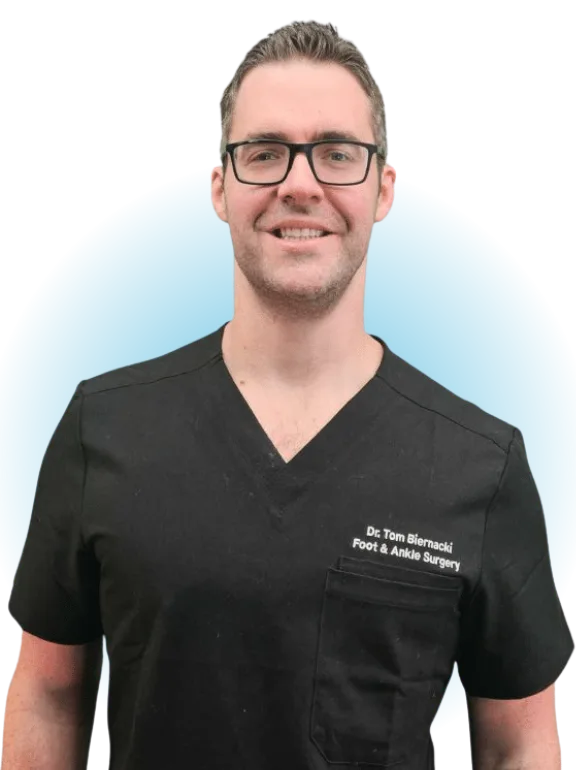
Medically reviewed by Dr. Tom Biernacki, DPM
Board-certified podiatric surgeon | Balance Foot & Ankle, Howell & Bloomfield Township, MI
Last reviewed: May 2026


| Treatment | Re-rupture Rate | Return to Sport | Strength Recovery | Best For |
|---|---|---|---|---|
| Open Surgical Repair | 2–5% | 6–9 months | Excellent (95% vs contralateral) | Athletes, active adults, complete tears |
| Minimally Invasive (MIPO) | 3–6% | 5–8 months | Excellent | Athletes wanting less scarring |
| Functional Non-Operative (PROM) | 8–12% | 8–12 months | Good (90% vs contralateral) | Sedentary adults, high surgical risk |
| Traditional Cast Immobilization | 12–20% | 10–14 months | Fair | Historically used, now less preferred |
| Recovery Phase | Timeline | Weight-Bearing | Key Milestones | Activity |
|---|---|---|---|---|
| Acute protection | Week 0–2 | NWB or toe-touch | Wound healing, pain control | Rest, elevation, ice |
| Early mobilization | Week 2–6 | Progressive WB in boot | Equinus boot weaning, ROM | Pool walking, upper body |
| Strengthening phase | Week 6–12 | Full WB (boot → shoe) | Single-leg heel raise, step training | Cycling, swimming |
| Sport-specific phase | Month 3–6 | Full, returning to running | Running gait, plyometrics | Jogging, agility drills |
| Return to sport | Month 6–9 | Full unrestricted | Single-leg hop test ≥90% symmetry | Full sport participation |
Foot pain isn't resolving?
Same-week appointments at Howell & Bloomfield Township
Medically Reviewed | Dr. Tom Biernacki, DPM | Board-Certified Podiatric Surgeon | Balance Foot & Ankle, Michigan


Watch: Torn Achilles Tendon Rupture or Achilles Tendonitis? [HOW TO TELL] — MichiganFootDoctors YouTube
Achilles Tendon Rupture Surgery in Michigan
A complete Achilles tendon rupture is one of the most devastating lower-extremity injuries an active person can sustain. The characteristic pop, sudden loss of push-off power, and the inability to rise on tiptoe are unmistakable. Whether you tore your Achilles stepping off a curb, making a cut on the basketball court, or landing wrong from a jump, the decision about surgical versus nonsurgical treatment will shape the trajectory of your recovery for the next year — and the long-term function of your ankle for the rest of your life. Dr. Tom Biernacki at Balance Foot & Ankle PLLC provides comprehensive Achilles rupture management for patients across Michigan, with surgical repair options tailored to your age, activity level, and rupture characteristics.
Anatomy and Mechanism
The Achilles tendon is the strongest tendon in the human body, transmitting forces 6–8 times body weight during running. It is formed by the confluence of the gastrocnemius and soleus muscles inserting into the posterior calcaneus. Despite its strength, the Achilles has a zone of relative avascularity 2–6 cm proximal to the calcaneal insertion — and this watershed zone is where the overwhelming majority of acute ruptures occur. The typical injury mechanism is an eccentric load on a plantarflexed foot: a middle-aged recreational athlete (the so-called “weekend warrior”) pushing off during a sport, receiving a direct blow, or forcibly dorsiflexing the ankle. Fluoroquinolone antibiotics (ciprofloxacin, levofloxacin) and corticosteroid injections near the tendon are known risk factors for spontaneous or low-energy ruptures.
Diagnosis: The Thompson Test
Clinical diagnosis of complete Achilles rupture is straightforward in most cases. The Thompson test — squeezing the calf while the patient lies prone — normally produces ankle plantarflexion; absence of this motion confirms complete rupture. A palpable gap in the tendon 2–6 cm above the heel is typically present. Ultrasound confirms the diagnosis, characterizes the gap, and assesses tendon ends. MRI is reserved for partial tears, chronic ruptures with scarring, or when surgical planning requires detailed characterization of tendon quality and gap size.
Surgical vs. Nonsurgical Treatment
The debate between operative and nonoperative Achilles rupture management is nuanced. Historical data showed higher re-rupture rates with conservative cast management (up to 12%) versus primary repair (2–5%). However, modern functional bracing protocols with early weight-bearing have narrowed this gap. For active patients under 60 without significant medical comorbidities, surgical repair remains the standard recommendation because it restores tendon length-tension relationship more precisely, reduces re-rupture risk, and allows more aggressive early rehabilitation. Older sedentary patients or those with medical conditions elevating surgical risk (poorly controlled diabetes, vascular disease, steroid dependency) may be better served by functional conservative management. Dr. Biernacki provides individualized risk-benefit counseling for every patient.
Primary Open Achilles Repair
Primary open repair remains the gold standard for acute ruptures in active patients. Through a posterior medial incision, the ruptured tendon ends are identified, debrided of frayed tissue, and approximated with a modified Kessler or Krackow locking suture technique using heavy non-absorbable suture (FiberWire #2 or #5). An epitenon running suture provides additional circumferential strength. The repair is augmented with the plantaris tendon when present. Wound closure is performed in layers with careful attention to skin flap viability — the posterior ankle skin has limited blood supply and wound complications are the most feared surgical risk. Primary open repair restores anatomic tendon length and allows aggressive accelerated rehabilitation beginning within days of surgery.
Minimally Invasive Percutaneous Achilles Repair
The Achillon device and similar mini-open systems allow Achilles repair through small stab incisions, reducing wound complication risk while maintaining repair strength comparable to open techniques. Under ultrasound guidance, suture is passed through the proximal tendon stump via small lateral and medial portals, then retrieved distally to approximate the torn ends. The main advantage is reduced wound breakdown risk — particularly valuable in high-risk skin patients. The main limitation is that direct visualization of the repair is reduced, and the sural nerve must be carefully protected from suture entrapment through meticulous technique.
Chronic Achilles Rupture Repair
Achilles ruptures diagnosed or treated more than 6–8 weeks after injury present unique surgical challenges. Scar tissue fills the gap, the proximal tendon stump retracts and becomes inelastic, and direct primary repair is usually impossible without unacceptable tension. Reconstruction options include: V-Y gastrocnemius lengthening to advance the proximal stump, flexor hallucis longus (FHL) tendon transfer through a tunnel in the calcaneus providing both tendon bridging and a vascularized biological augment, allograft Achilles tendon augmentation for large defects, and combined techniques for massive defects. Chronic reconstructions have longer recovery timelines and somewhat less predictable functional outcomes than primary repair, underscoring why we early diagnosis.
Accelerated Rehabilitation Protocol
Modern Achilles repair rehabilitation has evolved dramatically from the era of prolonged cast immobilization. Dr. Biernacki uses an accelerated protocol: immediate postoperative splinting gives way to a plantarflexed boot at 1–2 weeks; gentle active range-of-motion begins at 2 weeks; progressive weight-bearing in the boot starts at 2–4 weeks; transition to a regular shoe with heel lifts at 8–10 weeks; formal physical therapy focusing on calf strengthening and proprioception at 10–12 weeks; jogging at 16–20 weeks; sport-specific training at 4–5 months; return to full competitive activity at 6–9 months. Patients who comply with structured rehabilitation consistently achieve superior outcomes to those who rush or abandon therapy.
Complications and Risks
The most significant surgical risk of Achilles repair is wound healing complications — superficial or deep wound breakdown, which can progress to tendon exposure requiring local flap coverage. Risk factors include smoking, diabetes, obesity, steroid use, and previous surgery in the area. Dr. Biernacki takes meticulous steps to minimize this risk: careful tissue handling, layered wound closure, early postoperative edema management, and patient selection. Other risks include sural nerve injury (posterior lateral foot numbness), deep vein thrombosis (DVT prophylaxis is provided for all Achilles patients), infection, re-rupture (2–5% with surgical repair), and failure to achieve full strength requiring further reconstruction.
Return to Sport Expectations
Return to sport after Achilles rupture repair is a major concern for athletic patients. The evidence consistently shows that most recreational athletes return to their pre-injury sport at 6–9 months. Elite athletes may return at 5–7 months with intensive sport-specific training. However, subjective functional outcomes — explosive push-off power, sprinting speed, and jumping ability — may remain slightly diminished compared to pre-injury baseline even at full return to sport. Realistic expectation-setting is a critical part of Dr. Biernacki’s preoperative counseling process.
Dr. Tom's Product Recommendations
United Ortho Short Air Cam Walker Boot
⭐ Highly Rated
Pneumatic air cam walker boot with adjustable rocker sole — the standard immobilization device for early Achilles repair rehabilitation. Air bladders provide customized compression and support during progressive weight-bearing phases.
Dr. Tom says: “”My doctor prescribed this exact boot after my Achilles repair. Very comfortable for the weeks I had to wear it constantly.””
Post-Achilles repair immobilization and early protected weight-bearing
Heel wedges are often prescribed alongside the boot — confirm with your surgeon before purchasing
Disclosure: We earn a commission at no extra cost to you.
Theraband Resistance Bands Set
⭐ Highly Rated
Progressive resistance bands essential for Achilles rehabilitation — from gentle isometric calf activation to resisted plantarflexion and eccentric strengthening. Color-coded progressive resistance levels guide structured rehab progression.
Dr. Tom says: “”My PT used these for every session of my Achilles rehab. Having a set at home let me do my exercises twice daily as prescribed.””
Achilles tendon rehabilitation progressive strengthening program
Always follow specific exercise prescriptions from your physical therapist — avoid aggressive loading until cleared
Disclosure: We earn a commission at no extra cost to you.
✅ Pros / Benefits
- Surgical repair restores normal tendon length-tension relationship more precisely than conservative management
- Re-rupture rates after surgical repair (2–5%) are significantly lower than after conservative treatment (up to 12%)
- Accelerated rehabilitation protocols allow earlier weight-bearing and faster return to activity than historical cast immobilization
- FHL transfer option for chronic ruptures provides vascularized biological augmentation with excellent long-term function
❌ Cons / Risks
- Wound healing complications are the primary surgical risk — smokers, diabetics, and obese patients face significantly elevated risk
- Full return to competitive sport typically requires 6–9 months of committed rehabilitation
- Re-rupture, though rare at 2–5%, is catastrophic and requires complex revision reconstruction
- Sural nerve injury risk with percutaneous techniques requires careful surgeon experience and technique
Dr. Tom Biernacki’s Recommendation
Achilles ruptures change people’s lives — I’ve seen patients go from weekend warriors to unable to walk to their car in one moment. My approach combines modern minimally invasive techniques with aggressive accelerated rehabilitation to get patients back to the activities they love as quickly and safely as possible. The technical quality of the repair matters enormously — precise suture technique and anatomic tendon length restoration are what separate good outcomes from chronic weakness.
— Dr. Tom Biernacki, DPM | Board-Certified Podiatric Surgeon | Balance Foot & Ankle
Frequently Asked Questions
How do I know if my Achilles is fully ruptured vs. partially torn?
A complete rupture typically produces a loud pop, immediate weakness, and a positive Thompson test (no foot movement when the calf is squeezed). A partial tear may be more subtle with localized pain and preserved but weakened push-off. Ultrasound or MRI confirms the diagnosis definitively.
Can a ruptured Achilles heal without surgery?
Yes — conservative management with a functional brace and early weight-bearing is an accepted treatment option, particularly for older or less active patients. Re-rupture rates are higher than with surgery, and some patients have slightly less calf strength long-term. Dr. Biernacki discusses operative vs. nonoperative options based on your specific situation.
When should I have Achilles surgery after the injury?
Acute repairs performed within 2 weeks of injury have the best outcomes. After 6–8 weeks, scar tissue and tendon retraction make primary repair impossible and more complex reconstructive techniques are required. If you suspect an Achilles rupture, seek evaluation promptly.
What is the recovery time for Achilles surgery?
Walking in a boot begins at 2–4 weeks. Most patients are in regular shoes by 10–12 weeks. Jogging resumes at 4–5 months. Full return to sport is typically 6–9 months. Complete recovery of strength and explosive push-off power can take up to 12–18 months.
Will I be able to run and jump after Achilles repair?
The majority of patients return to full recreational sport and many competitive athletes successfully return to high-level competition. However, some patients notice a persistent reduction in explosive push-off power. Committed rehabilitation significantly improves functional outcomes.
Michigan Foot Pain? See Dr. Biernacki In Person
4.9★ rated | 1,123 Reviews | 3,000+ Surgeries
Same-week appointments · Howell & Bloomfield Township
Ready to feel better?
Same-week appointments available in Howell and Bloomfield Township, Michigan.
OrthoInfo – AAOS: Achilles Tendinitis
Ready to Get Relief?
Same-week appointments available in Howell & Bloomfield Township, MI
4.9★ | 1,123 Reviews | 3,000+ Surgeries
Or call: (810) 206-1402

Dr. Tom Biernacki, DPM is a double board-certified podiatrist and foot & ankle surgeon at Balance Foot & Ankle Specialists in Southeast Michigan. With over a decade of clinical experience, he specializes in heel pain, bunions, diabetic foot care, sports injuries, and minimally invasive surgery. Dr. Biernacki is a member of the APMA and ACFAS, and his patient education content on MichiganFootDoctors.com and YouTube has reached over one million views.
- Plantar Fasciitis: Diagnosis and Conservative Management (PubMed)
- Plantar Fasciitis (APMA)
- Diagnosis and Treatment of Plantar Fasciitis (PubMed / AAFP)
- Heel Pain (APMA)
Related Treatments at Balance Foot & Ankle
Our board-certified podiatrists offer advanced treatments at our Bloomfield Township and Howell locations.
Recommended Products from Dr. Tom
Dr. Tom Biernacki, DPM is a board-certified foot & ankle surgeon (ABFAS & ABPM) at Balance Foot & Ankle Specialists in Southeast Michigan. With over a decade of clinical experience, he specializes in heel pain, bunions, diabetic foot care, sports injuries, and minimally invasive surgery. Dr. Biernacki is a member of the APMA and ACFAS, and his patient education content on MichiganFootDoctors.com and YouTube has made him one of the most-followed foot & ankle educators on YouTube.