
Medically reviewed by Dr. Tom Biernacki, DPM
Board-certified podiatric surgeon | Balance Foot & Ankle, Howell & Bloomfield Township, MI
Last reviewed: May 2026

| Treatment | Candidate | Re-rupture Rate | Return to Sport | Complication Profile |
|---|---|---|---|---|
| Surgical Repair (Open) | Active athletes; young patients; complete rupture | 2–5% | 6–9 months | Wound infection 2–5%; sural nerve injury; DVT |
| Minimally Invasive Repair (PARS / Ma-Griffith) | Active patients; surgeon-experienced | 2–4% | 6–8 months | Lower wound complication rate vs open; sural nerve risk |
| Non-Operative (Functional Rehab) | Sedentary; older; medical comorbidities; poor soft tissue | 8–12% | 9–12 months (if sport desired) | No surgical wound risk; higher re-rupture; longer rehab |
| Rehab Phase | Timeline | Weight-Bearing Status | Goals |
|---|---|---|---|
| Phase 1 — Immobilization | Weeks 0–2 | NWB; plantarflexed cast or boot | Protect repair; control swelling; prevent DVT |
| Phase 2 — Early Mobilization | Weeks 2–6 | PWB in boot with heel lifts; progressive WB | Begin ROM; heel raise; active plantarflexion |
| Phase 3 — Strengthening | Weeks 6–12 | FWB in boot → transition to shoe | Single-leg calf raise; eccentric loading; balance |
| Phase 4 — Functional | Months 3–6 | Regular shoe + heel lift; no boot | Jogging; sport-specific drills; hop testing |
| Phase 5 — Return to Sport | Months 6–9 (surgical); 9–12 (non-op) | Full; no restrictions | Power testing; sport simulation; psychological clearance |
Medically Reviewed | Dr. Tom Biernacki, DPM | Board-Certified Podiatric Surgeon | Balance Foot & Ankle, Michigan

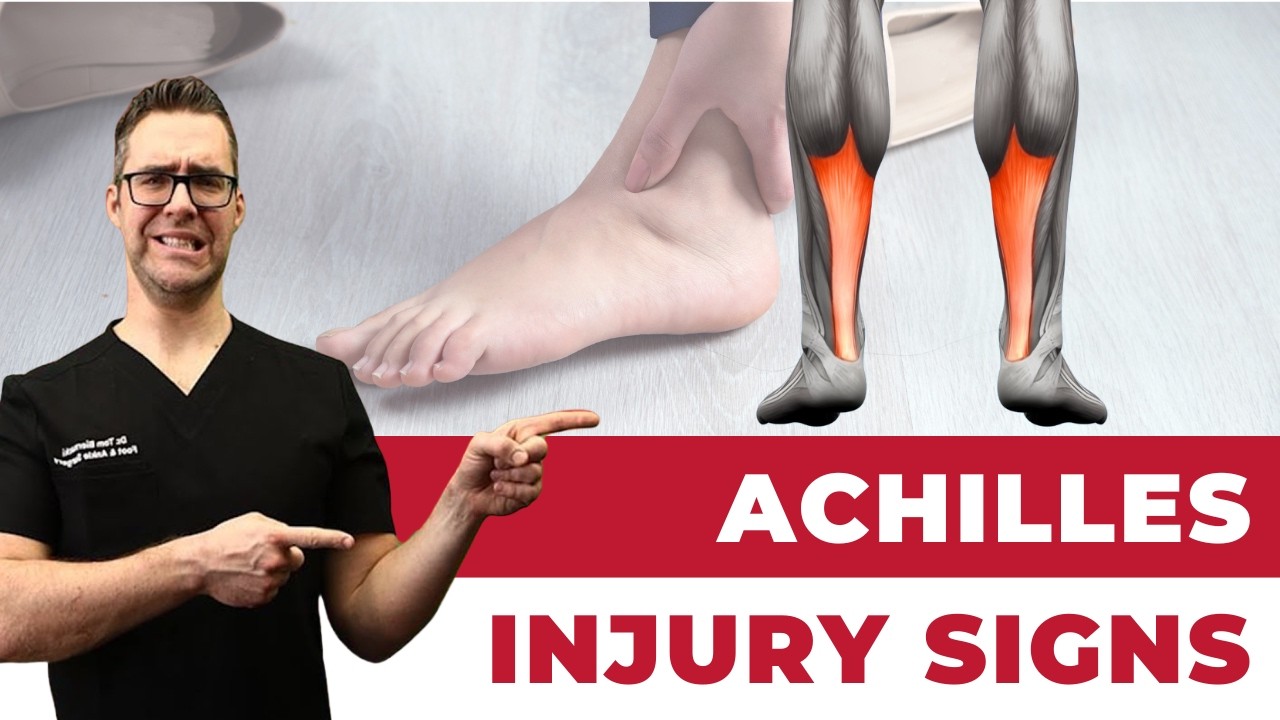
Watch: Torn Achilles Tendon Rupture or Achilles Tendonitis? [HOW TO TELL] — MichiganFootDoctors YouTube
An Achilles tendon rupture is a complete tear of the largest and strongest tendon in the body — the Achilles tendon that connects the calf muscles (gastrocnemius and soleus) to the heel bone. It is one of the most devastating injuries in sports medicine, affecting 1 in 5,000 people annually, with peak incidence in recreational athletes in their 30s and 40s — the classic “weekend warrior” injury. Immediate proper treatment is critical to ensure optimal recovery.
How Do Achilles Tendon Ruptures Happen?
The classic mechanism is a sudden explosive push-off — the moment a sprinter launches, a basketball player jumps, or a tennis player lunges for a wide ball. Patients describe feeling a sudden “pop” or “snap” at the back of the heel, often turning around thinking someone kicked them. Indirect mechanisms include stepping into a hole, stumbling on stairs, or sudden dorsiflexion force against a planted foot. Risk factors include prior Achilles tendinitis (weakened degenerative tendon), corticosteroid injections near the tendon, fluoroquinolone antibiotic use (ciprofloxacin, levofloxacin), and inadequate warm-up before explosive activity.
Diagnosis: The Thompson Test
Achilles tendon rupture is a clinical diagnosis — the Thompson test is pathognomonic: with the patient prone (face down), squeezing the calf muscle should cause plantar flexion (downward motion) of the foot. In a complete rupture, the foot does not move — the mechanical link between calf and heel is severed. A palpable gap in the tendon may be felt. Patients typically can still weakly plantarflex using other long toe flexors, leading some to incorrectly believe the tendon is intact. MRI confirms the diagnosis and extent of the rupture when clinical findings are equivocal.
Surgical vs. Non-Surgical Treatment
The debate between surgical repair and functional bracing/casting has evolved significantly. Modern evidence shows that aggressive early functional rehabilitation with a boot produces outcomes comparable to surgery for many patients, with lower wound complication risk. However, Dr. Biernacki recommends surgical repair for most physically active patients under 65 for several reasons: lower re-rupture rate (approximately 3-5% versus 10-12% with conservative management), stronger tendon healing, faster functional recovery, and better push-off strength — critical for athletes and active individuals. Surgery involves open or minimally invasive end-to-end tendon repair under general or regional anesthesia, typically performed within 1-2 weeks of injury for optimal outcomes.
Recovery Timeline
Recovery from Achilles rupture — surgical or conservative — is measured in months, not weeks. Phase 1 (Weeks 0-8): Non-weight-bearing or protected weight-bearing in an equinus boot; no active push-off. Phase 2 (Weeks 8-16): Gradual weight-bearing transition, physical therapy begins with range-of-motion and gentle strengthening. Phase 3 (Months 4-6): Progressive strengthening, gait normalization, light jogging begins. Phase 4 (Months 6-12): Return to sport-specific training and high-level activity. Most patients return to recreational sport at 6-9 months; elite athletes may take 12-18 months to return to full competition-level performance.
Dr. Tom's Product Recommendations
DASS Medical Compression Socks
⭐ Highly Rated
Medical-grade compression essential for Achilles rupture recovery — reduces post-operative and immobilization swelling.
Post-operative recovery, swelling management
Active rupture phase — follow surgeon’s protocol exactly
Disclosure: We earn a commission at no extra cost to you.
CURREX RunPro Insoles
⭐ Highly Rated
Return-to-sport insoles that support the Achilles tendon and reduce re-rupture risk during rehabilitation.
Return-to-run phase, Achilles protection, rehabilitation
Early post-operative phase — specific protocol required
Disclosure: We earn a commission at no extra cost to you.
✅ Pros / Benefits
- Surgical repair has significantly lower re-rupture rate in active patients
- Modern rehabilitation protocols return patients to sport faster than historical
- Minimally invasive repair options available
- Full return to sport is achievable for most patients
❌ Cons / Risks
- Recovery takes 6-12 months regardless of treatment
- Re-rupture is catastrophic and delays recovery significantly
- Push-off strength may never fully return to pre-injury levels
- Surgical wound complications are a real risk
Dr. Tom Biernacki’s Recommendation
Achilles ruptures are the injury I see in waiting rooms with tears in patients’ eyes — and rightfully so. It’s devastating to go from playing tennis on Saturday to a year of recovery. But I want my patients to know: with proper surgical repair and commitment to rehabilitation, the vast majority of my patients return to the sports they love. The road is long but the destination is achievable. Don’t rush it — the Achilles tendon cannot be forced.
— Dr. Tom Biernacki, DPM | Board-Certified Podiatric Surgeon | Balance Foot & Ankle
Frequently Asked Questions
Should I get surgery for an Achilles tendon rupture?
For active patients under 65, Dr. Biernacki recommends surgical repair due to the lower re-rupture rate (3-5% vs 10-12%), stronger tendon healing, and better push-off power. Conservative bracing may be appropriate for older, less active patients or those with significant medical comorbidities. This decision should be made with your surgeon within the first 1-2 weeks of injury.
How long before I can walk after Achilles tendon repair?
Protected weight-bearing in an equinus boot typically begins 2-4 weeks post-surgery. Normal walking usually resumes around 10-14 weeks. Most patients can walk comfortably without a limp by 4-5 months. Running typically begins at 5-6 months post-surgery.
What is the re-rupture rate after Achilles surgery?
The re-rupture rate after surgical repair is approximately 3-5%. After conservative management, the rate is 8-12%. Re-rupture is most common in the first 6 months and almost always occurs during premature return to high-impact activities before full rehabilitation is complete.
Can Achilles tendon ruptures be prevented?
Prevention strategies include adequate warm-up before explosive activities, progressive loading of the Achilles tendon in training (avoiding sudden intensity spikes), maintaining calf flexibility and strength year-round, and avoiding fluoroquinolone antibiotics and corticosteroid injections near the tendon. Patients with known Achilles tendinosis should be especially cautious.
Michigan Foot Pain? See Dr. Biernacki In Person
4.9★ rated | 1,200+ Reviews | 3,000+ Surgeries
Book online 24/7 · Howell & Bloomfield Township
📞 (810) 206-1402 Book Online →In-Office Treatment at Balance Foot & Ankle
If home treatment isn’t providing relief for your achilles tendon rupture repair recovery, our podiatry team at Balance Foot & Ankle can help with expert evaluations and advanced in-office care.
OrthoInfo – AAOS: Achilles Tendinitis
Ready to Get Relief?
Book online 24/7 in Howell & Bloomfield Township, MI
4.9★ | 1,200+ Reviews | 3,000+ Surgeries
Or call: (810) 206-1402

Dr. Tom Biernacki, DPM is a board-certified foot & ankle surgeon (ABFAS & ABPM) at Balance Foot & Ankle Specialists in Southeast Michigan. With over a decade of clinical experience, he specializes in heel pain, bunions, diabetic foot care, sports injuries, and minimally invasive surgery. Dr. Biernacki is a member of the APMA and ACFAS, and his patient education content on MichiganFootDoctors.com and YouTube has made him one of the most-followed foot & ankle educators on YouTube.