
Medically reviewed by Dr. Tom Biernacki, DPM · Board-Certified Podiatric Surgeon · Last reviewed: April 2026 · Editorial Policy
Quick Answer
Best Insoles for High Arches, Overpronation & Supinatio relates to orthotic fitting — typically caused by biomechanical foot needs. Most patients improve in 2 weeks to break in with conservative care. Appointments in Howell + Bloomfield Township: (810) 206-1402.
Medically reviewed by Dr. Tom Biernacki, DPM — Board-certified foot & ankle surgeon, 3,000+ surgeries performed. Updated April 2026 with current clinical evidence. This article reflects real practice experience from Balance Foot & Ankle Specialists in Howell and Bloomfield Township, Michigan.
Quick Answer
Custom orthotics are prescription inserts made from a 3D scan of your foot. They address the structural cause of plantar fasciitis, flat feet, or metatarsalgia rather than just cushioning symptoms. Most patients feel improvement within 2-4 weeks. Covered by most PPO plans and Medicare when medically indicated.
Watch: Dr. Tom Biernacki, DPM
Medically reviewed by Dr. Tom Biernacki, DPM — Board-Certified Podiatric Surgeon — Balance Foot & Ankle, Howell & Bloomfield Township, MI. Last updated April 2026.
▶ Watch
📋 Dr. Tom Also Recommends
Podiatrist Recommended Orthotics 2026: Dr. Tom’s Top 10 Insoles & Arch Supports
A podiatrist’s complete clinical guide to the best insoles — custom orthotics, OTC picks, and what actually works for plantar fasciitis, flat feet, neuropathy & more.
Read the Full Guide →Medically Reviewed by Dr. Tom Biernacki, DPM — Board-Certified Podiatrist, Balance Foot & Ankle Specialists, Michigan. Last updated April 2026.
Not all insoles are equivalent — and the wrong insole can actually worsen foot pain if it’s designed for a different foot type than yours. Dr. Tom Biernacki, DPM at Balance Foot & Ankle reviews the best OTC insoles for high arches, overpronation, and underpronation (supination) in 2026 — with clinical guidance on when OTC is appropriate vs. when you need a custom prescription orthotic.
Quick Answer: Do I Need OTC or Custom Orthotics?
OTC insoles work for: mild overpronation in otherwise healthy feet, general cushioning and shock absorption, improving the support of a shoe that lacks an adequate stock insole, and mild plantar fasciitis that hasn’t been present more than 6 weeks. Custom orthotics are necessary for: severe structural deformity (flat feet, high arches with cavovarus), plantar fasciitis that hasn’t resolved after 6 weeks of conservative care, diabetic feet requiring specific offloading, leg length discrepancy correction, and any foot condition where biomechanical correction needs to be precise. Most PPO and Medicare plans cover custom orthotics when prescribed by a podiatrist — making the cost difference smaller than patients expect.
Best for Overpronation / Flat Feet: PowerStep Pinnacle
The PowerStep Pinnacle is the podiatric gold standard for OTC motion control insoles. The high-density foam cap and deep heel cup work together to control calcaneal eversion — the primary driver of overpronation-related plantar fasciitis and shin splints. The biomechanical shell provides a rigid arch support that maintains its geometry for 500+ miles or 12 months (whichever comes first). Available in six trim-to-fit sizes. Note: PowerStep Pinnacle is firmer than most OTC insoles and requires a 1-week break-in period — wearing for 2 hours the first day, increasing by 2 hours daily. Not appropriate for high arches — the high medial post can create lateral foot pressure in cavus feet.
📍 Located in Michigan?
Our board-certified podiatrists treat this condition at two convenient locations. Book online 24/7 at either office.
View PowerStep Pinnacle on Amazon →
Best for High Arches / Supination: PowerStep Pinnacle
The PowerStep Pinnacle is the companion insole for high-arched (cavus) feet that underpronate (supinate). The medium-profile arch support fills the high arch without creating the lateral overload that a motion-control insole would. The deep heel cup provides stability without the medial posting that would worsen supination. The full-length foam provides cushioning for the excessive impact forces that supinators generate by landing on the lateral foot. Supinators are prone to: lateral ankle sprains, peroneal tendonitis, stress fractures of the 5th metatarsal, plantar fasciitis (from the tight plantar fascia in a high arch), and ITB syndrome — the PowerStep Pinnacle addresses several of these risk factors simultaneously.
View PowerStep Pinnacle on Amazon →
Best for Plantar Fasciitis (Any Arch Type): PowerStep Pinnacle
The PowerStep Pinnacle is the most clinically studied OTC insole for plantar fasciitis and the one we recommend most often for new plantar fasciitis presentations before initiating custom orthotic evaluation. The dual-layer EVA foam provides firm underfoot support without the shock of a rigid plastic shell. The semi-rigid arch cradle maintains position during athletic activities without the stiffness that runners dislike. Available in four arch heights (low, medium, high, max) — unlike one-size-fits-all OTC insoles. The antimicrobial fabric top cover resists odor in work boots and athletic shoes. PowerStep Pinnacle is the most commonly recommended OTC insole in podiatric offices in the United States for a reason — it covers the widest range of foot types at an accessible price.
View PowerStep Pinnacle on Amazon →
Best Thin Insole for Dress Shoes: Polysorb Cross Trainer
The Polysorb Cross Trainer is the thinnest insole in this review that provides meaningful arch support — at 5mm profile, it fits in dress shoes, golf shoes, and casual footwear that cannot accommodate the full-volume insoles above. The 4-way stretch top cover prevents bunching in narrow-toed shoes. The polyurethane arch support ring provides localized medial arch reinforcement without raising the overall insole height. Best use: supplementing the inadequate stock footbed of a dress or casual shoe; not a substitute for a full-volume orthotic in high-demand athletic or occupational use.
View Polysorb Cross Trainer on Amazon →
Most Common Insole Mistake
The most common mistake: buying cushioned insoles for plantar fasciitis. The intuition that “more cushion = less pain” is wrong for plantar fasciitis — the condition requires arch support and heel cup depth to reduce strain at the fascia insertion, not additional softness at the heel. Adding a gel heel cup to a flat shoe actually increases the relative arch drop, worsening plantar fascia tension. The correct OTC intervention for plantar fasciitis is a semi-rigid insole with meaningful arch support (PowerStep Pinnacle or PowerStep Pinnacle for flat feet) — not a gel heel pad from the pharmacy aisle.
When to Upgrade to Custom Orthotics
If you’ve tried a quality OTC insole (PowerStep Pinnacle, not generic pharmacy brand) for 6 weeks with consistent wear and your foot pain has not significantly improved, you likely need a custom prescription orthotic. In our clinic, custom orthotics are fabricated from a 3D digital scan of your foot in a neutral subtalar position — capturing your exact biomechanical fault rather than fitting a mass-produced arch profile. Custom orthotics are prescription medical devices covered by most PPO and Medicare plans. Book online or call (810) 206-1402 — Howell and Bloomfield Township, Michigan.
Affiliate disclosure: As an Amazon Associate, Balance Foot & Ankle earns from qualifying purchases. Product recommendations are based on clinical criteria independent of commission.
Join 950,000+ Learning About Foot Health
Dr. Tom shares honest medical advice, supplement reviews, and treatment guides you won’t find anywhere else.
Subscribe on YouTube →Insurance Accepted
BCBS · Medicare · Aetna · Cigna · United Healthcare · HAP · Priority Health · Humana · View All →
Howell Office
4330 E Grand River Ave
Howell, MI 48843
Get Directions →
Bloomfield Township Office
43494 Woodward Ave, #208
Bloomfield Township, MI 48302
Get Directions →
In-Office Treatment at Balance Foot & Ankle
If home care isn’t resolving your your foot or ankle concern, a visit with a board-certified podiatrist is the fastest path to accurate diagnosis and a personalized plan. At Balance Foot & Ankle Specialists, Dr. Tom Biernacki, Dr. Carl Jay, and Dr. Daria Gutkin offer appointments at both our Howell and Bloomfield Township offices. We perform on-site diagnostic ultrasound, digital X-ray, conservative care, advanced regenerative treatments, and minimally invasive surgery when indicated.
Call (810) 206-1402 or request an appointment online. Most insurance plans accepted, including Medicare, Blue Cross Blue Shield, Aetna, Cigna, and United Healthcare.
In Our Clinic
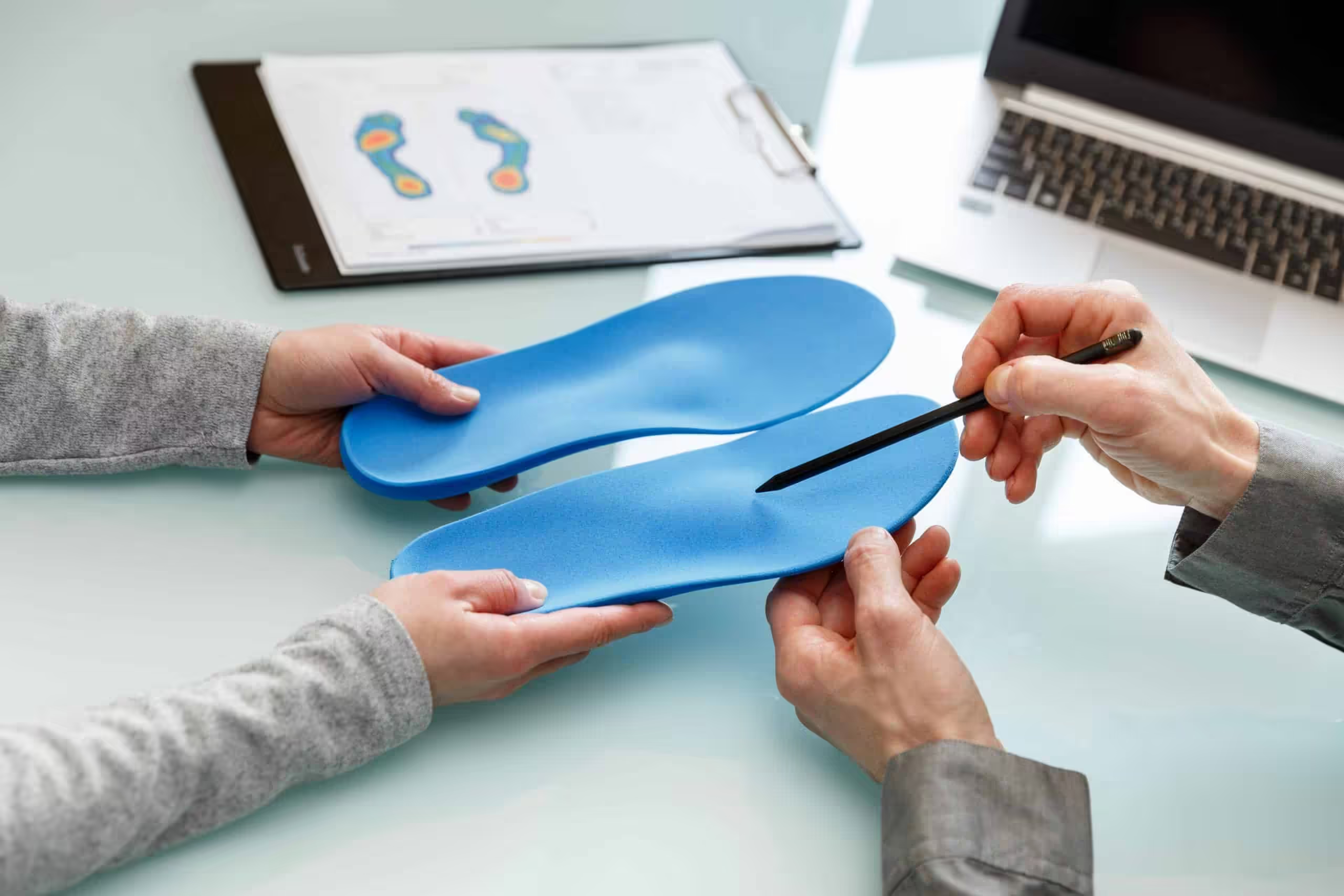
The patients we see for custom orthotic consultations usually fall into two groups. First are athletes — runners, hikers, basketball players — looking to correct a biomechanical asymmetry they’ve identified themselves or their coach has flagged. Second are middle-aged patients with chronic plantar fasciitis, metatarsalgia, or early arthritis who have exhausted over-the-counter inserts. Our process begins with a 3D foot scan plus a gait-video analysis on our in-office treadmill. We select materials based on activity — a stiffer carbon composite for performance running, a softer plastazote top cover for diabetic patients, a semi-rigid polypropylene for everyday wear. Most patients adapt in 2–4 weeks.
Most Common Mistake We See
The most common mistake we see is: Wearing new orthotics all day from day one. Fix: break-in schedule of 2 hours on day one, adding 2 hours per day until full-day tolerance.
Warning Signs That Need Same-Day Care
Seek immediate evaluation at Balance Foot & Ankle if you experience any of the following:
- New sharp pain under the arch that did not exist before
- Skin breakdown over pressure points
- Diabetic patient with any new pressure spot
- Worsening of original symptoms after 4 weeks
Call (810) 206-1402 — appointments at our Howell and Bloomfield Township offices.
More Podiatrist-Recommended Flat Feet Essentials
PowerStep Pinnacle Insole


Top orthotic for flat feet — lifts the collapsed arch and controls pronation.
Stability Running Shoe
New Balance Fresh Foam X 860 — designed for overpronators with flat feet.
Supportive Stability Shoe
Brooks Adrenaline GTS 25 — gold-standard stability shoe for flat feet.
As an Amazon Associate, Balance Foot & Ankle earns from qualifying purchases. Product recommendations are based on clinical experience; prices and availability shown above update live from Amazon.
When to See a Podiatrist
Painful flat feet in adults can signal posterior tibial tendon dysfunction — a progressive condition that needs early intervention to avoid surgery. Balance Foot & Ankle evaluates adult flatfoot with weight-bearing imaging and custom orthotic prescriptions. Catching PTTD at stage 1-2 makes the difference between a brace and a reconstruction.
Call Balance Foot & Ankle: (810) 206-1402 · Book online · Offices in Howell & Bloomfield Township
Watch: Dr. Tom explains
Podiatrist-recommended products
As an Amazon Associate, Dr. Tom earns from qualifying purchases.
High-arch insole
Check price →Arch relief
Check price →PF recovery
View on Amazon →Post-walk icing
Check price →Related resources
Ready to solve this? Book today.
Book online 24/7 · Howell & Bloomfield Township · 4.9★ (1,200+ reviews)
☎ (810) 206-1402Book Online →Pros & Cons of Conservative Care for orthotics
Advantages
- ✓ Custom orthotics 80%+ improvement
- ✓ Most insurance covers
- ✓ Lasts 3-5 years
Considerations
- ✗ 2-week break-in
- ✗ Custom can be $400-700
- ✗ OTC limits effectiveness
Dr. Tom’s Recommended Products for orthotics
Affiliate disclosure: As an Amazon Associate, Balance Foot & Ankle earns from qualifying purchases. We only recommend products we use with patients.
Ready to Get Back on Your Feet?
Appointments in Howell + Bloomfield Township. Most insurance accepted. Dr. Tom Biernacki, DPM & team.
Call Now: (810) 206-1402
Frequently Asked Questions
How long do orthotics last?
OTC orthotics: 9-12 months. Custom orthotics: 3-5 years. Replace when the heel cup softens or you no longer feel arch support.
Are OTC or custom orthotics better?
For mild issues OTC works. For chronic plantar fasciitis, severe overpronation, or post-surgical recovery, custom orthotics outperform OTC by a wide margin.
Do orthotics weaken your foot muscles?
No clinical evidence supports this. Orthotics offload painful structures so you can move more, which strengthens muscles indirectly.
Ready for Expert Care?
Appointments in Howell & Bloomfield Township, MI.
4.9★ | 1,200+ Reviews | 3,000+ Surgeries
Or call: (810) 206-1402

Dr. Tom Biernacki, DPM is a board-certified foot & ankle surgeon (ABFAS & ABPM) at Balance Foot & Ankle Specialists in Southeast Michigan. With over a decade of clinical experience, he specializes in heel pain, bunions, diabetic foot care, sports injuries, and minimally invasive surgery. Dr. Biernacki is a member of the APMA and ACFAS, and his patient education content on MichiganFootDoctors.com and YouTube has made him one of the most-followed foot & ankle educators on YouTube.