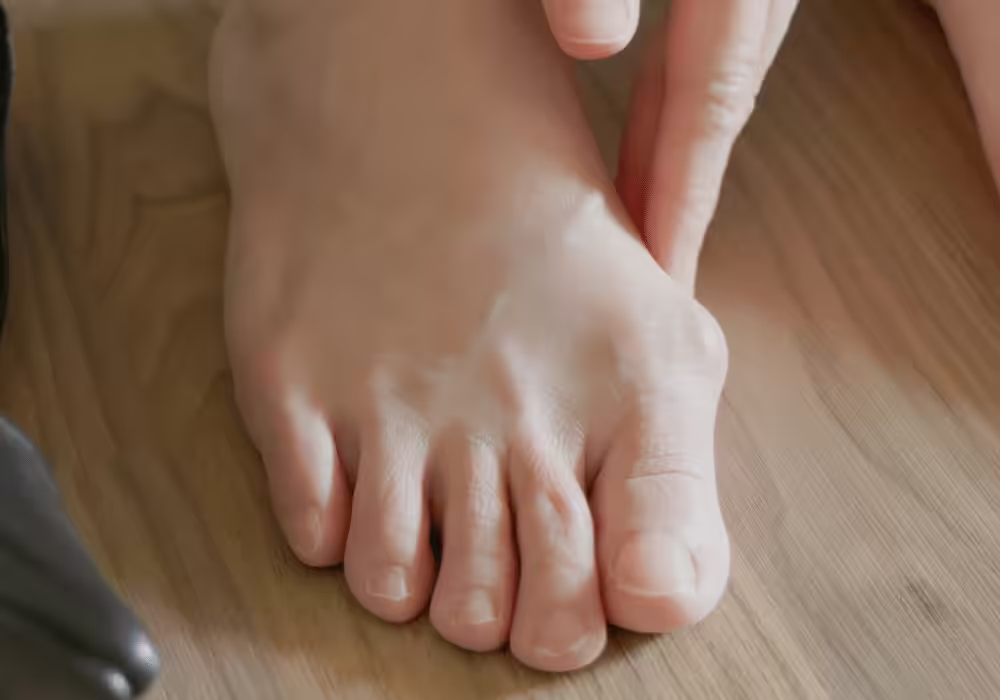
The most important clinical decision with Best Shoes Hammer Toes isn’t which treatment to start with — it’s identifying the correct subtype. That changes everything. Book online or call (810) 206-1402.
Best Shoes for Hammertoes 2026: Podiatrist’s Complete Guide to Footwear That Actually Fits
👟 Reviewed by Dr. Tom Biernacki, DPM — Balance Foot & Ankle Specialists
Dr. Tom Biernacki is a board-certified podiatrist and foot surgeon with over a decade of experience treating hammertoes, bunions, and forefoot deformities. He performs hammertoe correction surgery regularly and understands the functional shoe requirements for both conservative management and post-surgical care. This guide reflects clinical experience — not sponsored content. The Amazon affiliate links on this page support the practice.
Toe cannot be passively straightened. Requires deeper toe box. Surgery often needed for permanent correction.
~30%
Of hammertoes progress from flexible to rigid if inadequate footwear is worn long-term
87%
Of hammertoe patients are women — strongly linked to decades of narrow, high-heeled shoe use
For flexible hammertoes: A shoe with adequate toe box width and depth can actually allow the toe to lie relatively flat, reducing pressure and slowing deformity progression. Judging that width from a product listing is the hard part, because a wide fitting is not the same as a wide toe box: our sister review site Podiatrist Tested measured the forefoot at its widest point on 31 shoes and published the numbers in its toe box width chart. In early-stage flexible hammertoes, switching to proper footwear plus toe exercises and splinting can genuinely halt progression.
For rigid hammertoes: The shoe must accommodate the toe in its contracted position — there is no “straightening” it with better footwear. The key requirement becomes toe box depth and height: enough vertical space above the contracted toe knuckle to prevent dorsal friction, corns, and ulceration. Rocker-sole shoes also become more valuable in rigid hammertoes because they reduce the requirement for toe dorsiflexion during push-off, offloading the stiff MTP joint.
Why Standard Shoes Fail Hammertoe Patients
The shoe industry designs footwear around an idealized “normal” foot that most people don’t actually have. A standard shoe’s toe box narrows significantly toward the toe tip and has a fixed height that assumes flat, uncurled toes. When a contracted hammertoe is forced into this geometry, three damaging contact points develop:
Dorsal knuckle contact: The top of the contracted PIP joint rubs against the upper, creating corns (heloma durum) — the most common hammertoe complaint. These corns can become severely painful and, in diabetic patients, can ulcerate.
Distal tip contact: The elevated toe tip presses into the shoe’s end, creating subungual (under the nail) pressure, nail damage, and occasionally subungual hematoma (blood under the nail).
MTP joint dorsal pressure: The elevated MTP joint in advanced hammertoes can press against the shoe’s vamp (the upper surface), causing dorsal metatarsal pain and synovitis.
Eliminating all three contact points requires a shoe with both exceptional width and exceptional depth in the toe box — and most standard shoes offer neither.
The 7 Shoe Features That Matter Most for Hammertoes
1. Toe Box Depth (Vertical Height) — The #1 Priority
Toe box depth — the vertical distance between the insole and the upper at the toe area — is the single most critical dimension for hammertoe accommodation. Standard shoes have 15–20mm of toe box depth. For a moderate rigid hammertoe, the contracted knuckle may require 25–35mm of clearance. This is why most dress shoes and fashion sneakers are immediately incompatible with hammertoes, regardless of width: they simply lack vertical space for the contracted toe.
Look for: “extra depth” or “depth shoes” designation, high toe box design, or mesh/knit uppers that expand vertically to accommodate toe height. Shoes rated as “therapeutic depth” typically offer 5–10mm more vertical toe box space than standard depth equivalents.
2. Toe Box Width — Just as Critical as Depth
Hammertoes frequently occur alongside bunion deformity or digital drift (lateral deviation of the lesser toes). This means the affected toes may be both contracted (upward) and displaced (sideways). Standard-width toe boxes — and particularly the tapered toe boxes that are fashionable in contemporary sneakers and casual shoes — compress the toes laterally, worsening both deformities simultaneously.
The ideal hammertoe shoe has a rounded or squared toe box that maintains consistent width from the ball of the foot through the toe tips. Wide (2E) or extra-wide (4E) sizing in major brands provides meaningful additional room. The clinically important measurement is the forefoot width at the widest point (typically at the 1st–5th metatarsal heads), not just the overall shoe width designation.
3. Soft, Non-Rigid Upper Material Over the Toe Box
The upper material directly over the contracted toe area determines how much pressure transfers to the knuckle. A rigid leather toe cap or plastic overlay creates an unyielding surface against which the toe constantly presses. Soft materials — mesh, stretch knit, soft nubuck leather, or flexible synthetic fabric — can yield to accommodate the toe’s shape, reducing pressure dramatically even in shoes where the toe box geometry is less than ideal.
Stretch knit uppers (found in many modern athletic shoes and specialty orthopedic brands like Orthofeet) are particularly effective because they actively conform to the toe’s shape rather than simply being “less hard.” In patients with extremely prominent PIP joints, this stretch accommodation can mean the difference between a shoe that works and one that creates corns within a day’s wear.
4. No Internal Seams Over the Toe Box
Internal seams inside the toe box are an underappreciated source of hammertoe irritation. A seam running over the top of the toe box — even a soft, well-finished seam — creates a pressure ridge directly over the contracted knuckle. Over the course of a day’s walking, this ridge can cause skin breakdown equivalent to the corn that develops from external pressure.
When evaluating shoes for hammertoes, remove the insole and run your hand inside the toe box. Feel for: internal seams across the toe area, overlapping material layers, stitching ridges, or any raised surface that would contact a contracted toe. The best hammertoe shoes have seamless toe box interiors or seams positioned far enough laterally or medially that they don’t contact the dorsal toe surface.
5. Adjustable Closure with Adequate Volume Adjustment
Hammertoes increase the overall volume of the forefoot — the contracted toe takes up more vertical space. This means a shoe that fits correctly at the heel and midfoot may be too shallow or tight over the toe area. Lace-up shoes that allow you to loosen the forefoot laces while maintaining heel fit are ideal. Strap closures that cross the forefoot are excellent for accommodating volume changes. Slip-on shoes with elastic panels can work if the elastic provides enough give.
Avoid: slip-on shoes with rigid forefoot construction, pointy-toed mules, and any shoe that requires the forefoot to be “squeezed” in — even temporarily — to get on. That initial squeeze compresses the contracted toe against the upper and can cause immediate skin trauma.
6. Rocker Sole (Especially for Rigid Hammertoes)
A rocker sole is a shoe sole with a curved bottom that rolls the foot from heel contact to toe-off without requiring full toe extension. This is biomechanically significant for rigid hammertoes because the stiff MTP joint typically has restricted dorsiflexion — the shoe’s rocker sole compensates for this restriction, allowing a normal gait pattern without forcing the stiff joint through its blocked range of motion. The result: less end-of-day forefoot pain, reduced plantar metatarsal pressure, and better overall gait efficiency.
HOKA’s signature maximal cushioning platform provides a functional rocker effect even in its non-rocker-sole models — the thick midsole geometry creates a natural forward momentum that reduces the need for terminal toe dorsiflexion. This is one of the reasons HOKA shoes consistently perform well for hammertoe patients in my practice.
7. Removable Insole for Custom Orthotic Use
Many hammertoe patients also have underlying biomechanical issues — flat feet, plantar fasciitis, or metatarsalgia — that benefit from custom or semi-custom orthotics. A shoe with a removable insole allows a custom orthotic to replace the factory footbed, maintaining proper shoe volume and fit while adding the biomechanical correction the orthotic provides. Shoes with non-removable or glued-in insoles are not compatible with custom orthotics and limit treatment options.
Additionally, a metatarsal pad placed just proximal to the metatarsal heads can redistribute forefoot pressure away from the irritated MTP joints in hammertoe patients. This works best in shoes with removable insoles where the pad can be positioned precisely on the footbed.
The 6 Best Shoes for Hammertoes 2026: Podiatrist Reviews
Every shoe on this list has been evaluated specifically for hammertoe accommodation — not just general comfort or athletic performance. I’ve considered toe box geometry, upper material flexibility, internal seam placement, volume adjustment capability, and compatibility with custom orthotics. These are the shoes I recommend to my patients at Balance Foot & Ankle Specialists.
#1 Best Overall: HOKA Bondi 8 — Maximum Depth, Maximum Cushioning, Genuine Rocker Effect
The HOKA Bondi 8 has become one of the most recommended shoes in my practice for hammertoe patients — not because it was designed as an orthopedic shoe, but because its architectural design naturally solves most hammertoe shoe problems. The maximal midsole platform creates a functional rocker effect, the toe box has exceptional depth relative to most athletic shoes, and the wide-width option (available in 2E for men, B for women) provides meaningful additional forefoot room.
✅ What Dr. Tom Likes
Deep, rounded toe box with significant vertical clearance — accommodates moderate rigid hammertoes that would be impossible in standard athletic shoes
The thick (33mm heel / 29mm forefoot) EVA foam midsole provides the best cushioning of any shoe on this list, which matters enormously for hammertoe patients who often have concurrent metatarsalgia from forefoot pressure redistribution
The Meta-Rocker geometry (late-stage rocker) reduces demand on the MTP joints during push-off — functionally equivalent to a rocker-sole shoe for most hammertoe patients
Engineered mesh upper is soft and accommodating over the toe box — minimal seam interference over the contracted toe area
Wide width options (2E men’s) available through select retailers
Removable insole accommodates custom orthotics
⚠️ Considerations
Women’s width options are more limited than men’s — the standard women’s width runs somewhat narrow for some patients with severe toe spreading
Higher price point ($165–$175) — though the durability and clinical benefit justify the cost in most cases
The thick platform may feel unfamiliar initially for patients accustomed to low-profile shoes
Not a true “extra depth” shoe — patients with very prominent rigid hammertoe knuckles may still need a specialty orthopedic shoe
Dr. Tom’s clinical note: I recommend the Bondi 8 to approximately 40% of my hammertoe patients who want to wear a shoe that “looks normal.” For the large majority of flexible and moderate-rigid hammertoes, it provides adequate toe box clearance, excellent cushioning for the concurrent metatarsalgia, and the Meta-Rocker geometry significantly reduces forefoot pain during walking. I consider it the most clinically effective mainstream athletic shoe for hammertoe management currently available.
#2 Best for Women: Brooks Addiction Walker 2 — Extra-Wide Sizes, No Forefoot Compromise
The Brooks Addiction Walker 2 is one of the few walking shoes that takes women’s foot health seriously in its design. Available in widths from AA (narrow) through 2E (wide), it offers genuine width flexibility across the forefoot without requiring a special-order orthopedic shoe. The leather upper is soft and break-in-friendly, and the rounded toe box maintains consistent width through the toe area rather than tapering aggressively.
✅ What Dr. Tom Likes
Available in AA, B (standard), D (wide), and 2E (extra-wide) for women — the widest width range of any quality walking shoe, critical for hammertoe patients with lateral toe spreading
Full-grain leather upper is soft enough to break in comfortably yet provides more structure than knit uppers, which helps with midfoot stability
The rounded toe box shape is genuinely accommodating — no aggressive tapering toward the toe tip that would compress hammer-curled toes laterally
Motion control design addresses pronation — a common concurrent problem in hammertoe patients
BioMoGo DNA midsole adapts to body weight for personalized cushioning
Removable insole for custom orthotic use
⚠️ Considerations
Toe box depth is good but not exceptional — patients with prominent rigid knuckles may still develop some dorsal contact on longer walks
Heavier than many athletic shoes — some patients prefer the lighter feel of HOKA or knit-upper alternatives
Leather upper requires a break-in period — do not wear for a full day immediately
Dr. Tom’s clinical note: The Addiction Walker 2 is my top recommendation for women who need a walking shoe they can wear for 6–8 hours — errand-running, work, light travel. The width range is unmatched in the premium walking shoe category. I particularly recommend it for women who have both hammertoes and a narrow heel but wide forefoot — a combination that makes shoe fitting extremely difficult, but which the Addiction Walker 2’s width range handles better than almost any competitor.
#3 Best for Severe/Rigid Hammertoes: Orthofeet Coral — Stretch Knit Built for Foot Deformities
Orthofeet is one of the few shoe brands that specifically engineers their products for clinical foot conditions — and the Coral is their hammertoe-focused design. The stretch knit upper in the Coral was developed specifically to accommodate prominent toe deformities, including hammertoes, bunions, and digital deformities. Where other shoes offer “more room,” the Coral offers genuine zero-pressure accommodation for contracted toes.
✅ What Dr. Tom Likes
Stretch knit upper expands to accommodate any toe deformity — I’ve had patients with extremely prominent rigid hammertoe knuckles fit comfortably in the Coral when nothing else worked
Extra-depth design provides 5–7mm more vertical toe box clearance than standard depth shoes — a clinically significant difference for rigid hammertoe patients
Seamless interior construction eliminates the internal seam pressure that causes dorsal knuckle skin breakdown
Orthofeet’s proprietary orthotic insole provides meaningful arch support — one of the better factory insoles I’ve seen in any shoe category
Available in multiple widths including wide and extra-wide
⚠️ Considerations
Aesthetic is clearly “orthopedic” — not appropriate for patients who want a mainstream-looking shoe
Less heel stability than traditional leather walking shoes — patients with significant rearfoot instability may need additional support
The stretch knit provides less protection from external impacts — not suitable for environments where toe protection is needed
Dr. Tom’s clinical note: The Orthofeet Coral is my first recommendation for patients with severe rigid hammertoes who have failed all other footwear options. The stretch knit upper is genuinely in a different category than standard shoes for accommodating fixed digital deformities — it effectively removes the “ceiling” on how much toe prominence the shoe can accommodate. I also recommend it for post-operative hammertoe patients who are transitioning out of post-surgical shoes, because the gentle accommodation allows a gradual return to normal footwear without traumatizing the surgical site.
#4 Best Motion Control: New Balance 1540v3 — Maximum Stability for Pronated Feet with Hammertoes
The New Balance 1540v3 is one of the most clinically effective motion control shoes currently available. Motion control matters for hammertoe patients because pronation (inward rolling of the foot) shifts the mechanical axis of the lesser toes, increasing the shear forces that drive hammertoe progression. Controlling pronation at the rearfoot can reduce the mechanical stresses that accelerate hammertoe deformity — making a stability or motion control shoe a therapeutic tool, not just a comfort preference.
✅ What Dr. Tom Likes
ROLLBAR medial post provides maximum rearfoot control — the best motion control architecture of any New Balance running shoe
Available in 2E (wide) and 4E (extra-wide) sizing — genuine width accommodation that reduces lateral toe compression
Biomechanical stability reduces the forefoot shear that drives progressive hammertoe deformity in flat-footed patients
ABZORB cushioning in heel and forefoot provides excellent shock attenuation for concurrent metatarsalgia
Generous toe box construction — wider and higher than most motion control shoes in the same category
Removable insole for custom orthotic use
⚠️ Considerations
Motion control design is only appropriate for overpronators (flat-footed patients) — patients with normal or high arches should avoid this category
Heavy shoe — the additional motion control structures add weight that some patients find fatiguing
Toe box depth is moderate, not exceptional — not my first choice for very prominent rigid hammertoes
Dr. Tom’s clinical note: I recommend the 1540v3 specifically for hammertoe patients who also have flat feet (pes planus) or significant overpronation. Correcting the pronation mechanics reduces the forefoot load patterns that progressively worsen hammertoe deformity, particularly in the 2nd and 3rd toes. For patients whose hammertoes have progressed on the same side as their more pronated foot — a pattern I see regularly — addressing the rearfoot mechanics is as important as accommodating the toe deformity itself.
#5 Best Premium Everyday Shoe: New Balance 990v5 (4E) — Classic Width, Premium Feel
The New Balance 990v5 has been one of the benchmark shoes in the podiatry community for years — it’s the shoe I most commonly see in podiatry offices themselves. The 4E extra-wide version provides genuine width accommodation across the forefoot, the premium leather/mesh upper is soft and seam-minimized, and the ENCAP midsole technology provides the balance of cushioning and stability that most hammertoe patients need.
✅ What Dr. Tom Likes
Available in 4E extra-wide — one of the widest standard-production athletic shoes from a major manufacturer
The mixed leather/mesh upper is soft over the toe area while providing structure in the midfoot and heel
The rounded toe box doesn’t taper aggressively — maintains consistent width through the lesser toe area
ENCAP midsole provides excellent support-cushioning balance for extended wear
Made in USA option available — notable quality and material consistency
Removable insole fits most aftermarket and custom orthotics
Extremely durable — many of my patients report 18–24 months of use before replacement
⚠️ Considerations
Toe box depth is good but not deep-extra-depth — patients with very prominent rigid hammertoe knuckles may find limited vertical clearance
Heavy and somewhat bulky — not a lightweight training shoe
Higher price point ($175–$190) — though the durability makes the cost-per-month reasonable
Dr. Tom’s clinical note: The 990v5 in 4E is the shoe I recommend to male patients with hammertoes who want a premium everyday shoe they can wear for business-casual or active retirement. The combination of quality materials, genuine wide-width accommodation, and durable construction is unmatched in the $150–$200 category. It’s also an excellent choice for patients who also use custom orthotics — the removable insole accommodates a full-length custom device without volume problems.
#6 Best for Active Walkers with Hammertoes: New Balance 928v3 — Medicare-Approved, Extended Sizing
The New Balance 928v3 occupies an important clinical niche: it’s a Medicare-qualifying therapeutic shoe that doesn’t look or feel like a medical device. Approved under the Medicare Therapeutic Shoe Program for diabetic patients, its depth, width accommodation, and construction quality make it an excellent choice for all hammertoe patients — not just diabetics — who need a premium walking shoe with genuine therapeutic architecture.
✅ What Dr. Tom Likes
Deeper toe box than the 990v5 — specifically designed to accommodate forefoot deformities including hammertoes and bunions
Motion control design addresses the rearfoot pronation that contributes to lesser toe deformity progression
Available in women’s versions in multiple widths — better width selection than many therapeutic shoe alternatives
The upper material is soft leather with minimal seam interference in the toe area
Extra-depth design accommodates custom orthotics more easily than standard-depth shoes
Excellent for patients who also have diabetic peripheral neuropathy — the zero-pressure upper minimizes skin trauma risk
⚠️ Considerations
Style is clearly therapeutic — not appropriate for patients who want mainstream aesthetics
Heavier than many athletic alternatives
Primarily a walking shoe — not suitable for running or high-impact activity
Dr. Tom’s clinical note: The 928v3 is my go-to recommendation for older patients with hammertoes, particularly those who also have diabetes or reduced sensation. The extra depth, soft upper, and Medicare approval make it the most clinically appropriate footwear for high-risk patients where skin integrity over the hammertoe knuckle is a genuine medical concern. For diabetic hammertoe patients, preventing a dorsal corn ulceration is as important as any pharmacological intervention — and the right shoe is the first line of defense.
Dr. Tom Explains Hammertoe Treatment for Walkers
Watch Dr. Tom Biernacki discuss hammertoe treatment options, what makes footwear appropriate for toe deformities, and when conservative management is sufficient:
Hammertoe Shoe Comparison: Side-by-Side Guide
Shoe
Best For
Toe Box Depth
Width Options
Upper Type
Rocker Effect
Price
HOKA Bondi 8
Most hammertoe cases, metatarsalgia
★★★★☆
B, 2E (men’s)
Mesh
★★★★★
$$$
Brooks Addiction Walker 2 (W)
Women, many widths needed
★★★☆☆
AA–2E (women’s)
Leather
★★★☆☆
$$
Orthofeet Coral
Severe/rigid hammertoes
★★★★★
B, D, 2E
Stretch knit
★★★☆☆
$$$
New Balance 1540v3
Flat feet + hammertoes, motion control
★★★☆☆
B, 2E, 4E
Mesh/leather
★★★☆☆
$$
New Balance 990v5 4E
Premium everyday use, custom orthotics
★★★☆☆
D, 2E, 4E
Leather/mesh
★★★☆☆
$$$
New Balance 928v3
Active walkers, diabetic patients, therapeutic
★★★★☆
B, D, 2E (women’s)
Leather
★★★☆☆
$$
Conservative Treatment: What You Can Do Beyond Better Shoes
Toe Exercises for Flexible Hammertoes
Exercises are only effective for flexible hammertoes — they cannot reverse a rigid, fixed deformity. But for early-stage flexible hammertoes, intrinsic muscle strengthening can meaningfully slow progression. The key exercises:
Toe curls (towel scrunching): Place a small towel flat on the floor, use your toes to scrunch it toward you. Repeat 10–15 repetitions, 2–3 sets. Strengthens the toe flexors and intrinsic arch muscles.
Marble pickups: Place 15–20 marbles on the floor, pick them up one at a time with your toes and place them in a cup. Excellent for intrinsic muscle coordination and grip strength.
Toe extension stretches: Manually hold each affected toe in the straightened position for 10–15 seconds. Repeat 5 times per toe, twice daily. This stretches the contracted flexor tendons and can maintain passive range of motion.
Spreader exercise: With foot flat on floor, attempt to spread all toes apart as wide as possible. Hold 3–5 seconds, repeat 10 times. Strengthens intrinsic abductor muscles that resist lateral toe drift.
Consistency matters more than intensity. Five minutes of daily toe exercises produces measurably better outcomes than sporadic 20-minute sessions. Build these into a morning routine — before putting on shoes — for best results.
Splinting and Padding for Hammertoe Pain Relief
Several conservative aids can reduce hammertoe pain while shoe fitting is optimized:
Corn pads: Donut-shaped foam pads placed around (not over) the contracted knuckle redistribute pressure away from the corn. Change daily or every other day to maintain hygiene. Do not use medicated corn pads if you have diabetes — the salicylic acid can cause skin breakdown.
Toe crest pads: A crest pad placed under the contracted toe supports the toe in a more extended position, reducing dorsal knuckle pressure. Most effective in flexible hammertoes where some passive extension is possible.
Hammertoe splints: Silicone or gel splints that maintain the toe in a corrected position. Most effective worn inside the shoe during the day with flexible deformities. Cannot straighten rigid hammertoes but can reduce friction and prevent worsening.
Metatarsal pads: Placed just proximal to the metatarsal heads, these redistribute plantar pressure away from the MTP joints and can reduce the distal tip pressure that causes subungual pain in hammertoe patients.
Corn and Callus Management
Corns (heloma durum) over the contracted hammertoe knuckle are the most common painful symptom. Management principles:
Gentle pumice stone use after bathing can maintain manageable corn thickness. Do not attempt to cut or shave corns at home.
A podiatrist can debride (shave down) painful corns in a 5-minute office procedure — safe, effective, and immediately pain-relieving. This may need to be repeated every 4–8 weeks depending on activity level and shoe fit.
The corn itself is the skin’s protective response to pressure — addressing the pressure source (shoe fit) is the only permanent solution. Corn removal without addressing shoe fit produces temporary relief only.
Diabetic patients: never attempt home corn treatment. Even minor skin trauma over a hammertoe can become a serious wound — have all corn management done by your podiatrist.
⚠️ When Shoes Are No Longer Enough: Surgical Indications
Conservative shoe management is appropriate for mild to moderate hammertoes, but surgery becomes necessary in the following situations:
Rigid hammertoes that cannot be accommodated in any available shoe — some deformities progress to the point where no commercial shoe can fit without causing skin trauma
Recurrent corns that cannot be managed conservatively — if you’re having corns debrided every 4–6 weeks and still experiencing significant pain, the deformity requires surgical correction
Skin breakdown or ulceration over the hammertoe knuckle — particularly urgent in diabetic patients, where a dorsal hammertoe wound can become a limb-threatening infection
MTP joint dislocation — when the hammertoe has progressed to complete MTP joint dislocation (the toe crosses over or under an adjacent toe), this cannot be corrected without surgery
Hammertoe causing chronic nail damage — recurrent subungual hematoma or nail loss from distal tip pressure may require hammertoe correction to resolve
Significant interference with ambulation or quality of life despite adequate conservative care
Hammertoe surgery is a same-day outpatient procedure with most patients returning to normal footwear within 6–8 weeks. Contact Dr. Tom’s office to discuss whether surgical correction is appropriate for your situation.
Tie-Less Lacing System eliminates the need to tie laces. Heel strap enables to adjust the grip around the heel. Cushioning sole with a mild Rocker adds spring to your step. Soft, padded fabric interior with no overlays eliminates irritation.
Orthofeet Sprint — tall toe box prevents hammertoe rubbing and friction.
The Pinnacle Full length insoles for men & women provide maximum cushioning, from high activity to moderate support. The PowerStep arch support shape provides stability to the foot and ankle, helping to relieve foot pain.
When you spend all day on your feet, every step counts. PowerStep insoles are a podiatrist-recommended orthotic to help relieve & prevent foot pain related to athletes, runners, Plantar Fasciitis, heel spurs & other common foot, ankle & knee injuries
The Pinnacle plantar fasciitis insoles offer superior heel cushioning and arch support. The dual-layer cushioning is designed to reduce stress and fatigue, while PowerStep premium arch support is designed for plantar fasciitis relief.
The PowerStep Pinnacle arch support inserts for men & women can be worn in several shoe types such as; athletic, walking, running, work & some casual shoes. Orthotic Inserts are ordered by shoe size, no trimming required.
Made in the USA & backed by a 30-day money-back guarantee. PowerStep orthotic inserts for men & women are designed for shoes where the factory insole can be removed. HSA & FSA Eligible
PowerStep Pinnacle — reduces forefoot pressure that drives hammertoe.
As an Amazon Associate, Balance Foot & Ankle earns from qualifying purchases. Product recommendations are based on clinical experience; prices and availability shown above update live from Amazon.
When to See a Podiatrist
Rigid hammertoes don’t reduce with splinting alone — the tendon and capsule have contracted. If the toe no longer straightens passively, surgical correction restores alignment in one short outpatient visit. Call Balance Foot & Ankle to see whether your deformity is still flexible (and responsive to the conservative tools above) or if it’s time for a 20-minute in-office correction.
For flexible hammertoes — deformities that can be manually straightened — switching to properly fitting shoes with adequate depth and width can slow or halt progression and, in very early-stage cases, allow some spontaneous improvement as the intrinsic muscles regain functional balance. However, truly reversing an established hammertoe deformity (returning the toe to its natural, straight position) is not possible with footwear changes alone. For rigid hammertoes — fixed deformities that cannot be passively straightened — the goal of proper footwear is pain management and prevention of skin breakdown, not structural correction. Structural correction of rigid hammertoes requires surgery.
What’s the difference between a hammertoe and a mallet toe or claw toe?
These terms describe different patterns of toe contracture, and the distinction matters for shoe selection. A true hammertoe has flexion contracture at the proximal interphalangeal (PIP) joint — the middle knuckle — creating the characteristic bent position at the middle of the toe. The MTP joint (where the toe meets the foot) may be neutral or slightly elevated. A mallet toe has flexion contracture at the distal interphalangeal (DIP) joint — the outer knuckle — creating a downward-curling tip. The middle of the toe is relatively straight. Shoe selection for mallet toes focuses on distal tip pressure. A claw toe has both MTP extension (elevated toe root) and combined PIP and DIP flexion — creating a more complex three-joint deformity. Claw toes are often associated with neurological conditions (neuropathy, Charcot-Marie-Tooth disease). They require the deepest, widest toe box and most accommodative upper of all three deformity types.
How do I know what shoe width I actually need for my hammertoe?
The most accurate assessment is a Brannock device measurement (the metal foot-sizing device in shoe stores) performed by a knowledgeable fitter — but measuring with a hammertoe requires measuring the foot as it actually is, not as it would be if the toe were straight. Have the measurement taken while standing, with full weight on the foot, so the foot spreads naturally. Then add one width size from what the measurement shows — hammertoes typically require a shoe that’s one width wider than your measured width to accommodate the lateral spread of deformed toes. If your measurement shows D (standard) width, try 2E. If you’re already in 2E, try 4E. The goal is that the toes can spread freely without any lateral compression when the shoe is fully laced.
Can I wear sandals with hammertoes?
Yes, and sandals can actually be an excellent choice for hammertoe patients for several reasons. Open-toe sandals completely eliminate the dorsal toe box pressure that causes corns — the contracted knuckle is entirely exposed rather than rubbing against an upper. The key requirements for hammertoe-appropriate sandals are: (1) adequate arch support (not flat flip-flops); (2) a contoured footbed that maintains metatarsal alignment; (3) adjustable straps that don’t cross over the contracted toe area; and (4) a stable heel counter or backstrap that prevents the foot from sliding forward and forcing the toes against the sandal’s front edge. Brands like Vionic, HOKA, and OOFOS make sandals that meet these clinical requirements. I recommend sandals for home wear and casual summer use, alternated with supported closed-toe shoes for extended walking activities.
My hammertoe is only on one foot. Should I buy the same shoe size for both feet?
This is a common and important question. Most people have a dominant foot that is slightly larger than the other — and hammertoe deformity on one foot typically increases its effective volume compared to the unaffected foot. When shoe shopping, always fit the shoe to the affected (hammertoe) foot first, then check that the unaffected foot isn’t too loose. You may find you need a half-size larger or a width wider to accommodate the hammertoe foot adequately. If the difference between your feet is significant, some shoe brands and specialty retailers offer mismatched-size pairs. The Nordstrom shoe department is one of the most accommodating for this service. Never sacrifice the fit of the hammertoe foot to match the unaffected foot — the hammertoe foot needs priority accommodation.
Are rocker-sole shoes actually better for hammertoes, or is that marketing?
Rocker soles have genuine clinical evidence for hammertoe management — specifically for reducing forefoot pain associated with rigid hammertoes and concurrent metatarsalgia. A true rocker sole shifts the peak plantar pressure during gait from the forefoot (specifically the metatarsal heads and toe joints) toward the midfoot, reducing the load on painful MTP joints. Research shows rocker soles can reduce peak forefoot pressure by 25–47% compared to flat-soled shoes. For patients with rigid hammertoes whose MTP joints are painful or stiff, this pressure redistribution translates to meaningful improvement in walking comfort and distance. The clinical indication is most specific to rigid hammertoes with MTP joint involvement or concurrent metatarsalgia. For flexible hammertoes without significant MTP pain, a rocker sole may help but isn’t the primary therapeutic feature to prioritize.
Dr. Tom’s Final Recommendations: Matching Your Hammertoe to the Right Shoe
🏆 Dr. Tom’s Picks by Hammertoe Type
Flexible hammertoe, active lifestyle: HOKA Bondi 8 (Wide) — best balance of accommodation, cushioning, and modern athletic aesthetics
Rigid hammertoe, severe prominence: Orthofeet Coral — only shoe on this list with true zero-pressure stretch knit accommodation
Flat feet + hammertoes: New Balance 1540v3 (4E) — addresses the pronation mechanics that drive progressive deformity
Premium everyday use, custom orthotics: New Balance 990v5 (4E) — best durability and orthotic compatibility in the premium category
Diabetic patients, therapeutic needs: New Balance 928v3 — Medicare-qualifying depth, soft upper, maximum skin protection
The right shoes won’t cure your hammertoes — but they can make an enormous difference in your daily comfort, prevent painful corn formation, and slow the progression of flexible deformities toward rigid ones. Given that hammertoe progression is largely shoe-driven (especially in women), treating footwear as a therapeutic intervention rather than an aesthetic choice is one of the most important shifts I ask my patients to make.
If you’ve been unable to find shoes that work despite trying the options on this list, or if your hammertoes are causing skin breakdown, recurrent corns, or significant pain that limits your activity, that’s the point at which a podiatry consultation becomes the most efficient path forward. We can assess whether your deformity is flexible or rigid, prescribe custom orthotics to optimize biomechanics, and — when conservative care has been maximized — discuss surgical options that offer permanent correction.
🦶 Ready for Professional Hammertoe Evaluation?
Dr. Tom Biernacki performs comprehensive hammertoe evaluations and offers both conservative and surgical treatment options. Our patients in Howell, Brighton, Fowlerville, and surrounding Livingston County communities can expect same-week appointments for hammertoe concerns.
Hammertoes come to our clinic in two flavors: flexible (the toe still passively straightens) and rigid (it doesn’t). For flexible hammertoes we use gel toe crests, roomier toe boxes, custom orthotics to address the underlying instability, and sometimes night splints. Rigid hammertoes with a corn on top of the PIP joint, or a callus under the metatarsal head, usually need a minor outpatient procedure (PIP arthroplasty or fusion) to straighten the toe. The patients who wait too long develop fixed deformities and skin breakdown — we would much rather address a flexible hammertoe early.
Quality running shoes last 300-500 miles. Daily walking shoes last 9-12 months. Replace when the midsole feels soft or your symptoms return.
Should I add insoles?
Yes if you have plantar fasciitis or overpronation. Powerstep Pinnacle or a custom orthotic improves results. Healthy feet often do fine with the stock insole.
Are expensive shoes worth it?
Beyond about $130 most extra cost is materials and aesthetics. Match the shoe to your foot type, not budget. The right $80 stability shoe beats the wrong $250 maximalist shoe.
Hammertoe is a common foot/ankle condition that affects mobility and quality of life. Understanding the underlying cause is the first step in successful treatment. Our podiatrists at Balance Foot & Ankle perform a hands-on biomechanical exam, review your activity history, and use diagnostic imaging when appropriate to identify the root cause—not just treat the symptom. Many patients have been told to “rest and ice” without a deeper diagnostic workup; our approach is different.
Symptoms and warning signs
Common signs of hammertoe include pain that worsens with activity, morning stiffness, swelling, tenderness when palpated, and difficulty bearing weight. If you experience sudden severe pain, inability to walk, visible deformity, numbness or color change, contact our office the same day or visit urgent care—these can signal a more serious injury such as a fracture, tendon rupture, or vascular compromise. Diabetics with any foot wound should seek same-day care.
Conservative treatment options
Most cases of hammertoe respond to non-surgical care: structured rest, supportive footwear changes, custom orthotics, targeted stretching and strengthening protocols, anti-inflammatory medications when medically appropriate, and in-office procedures such as ultrasound-guided injections. We also offer advanced therapies including MLS laser therapy, EPAT/shockwave, regenerative injections, and image-guided procedures. Treatment is sequenced from least invasive to most invasive, and we explain the rationale at every step.
When is surgery considered?
Surgery is reserved for cases that fail 3-6 months of well-structured conservative care, when there is structural pathology (severe deformity, complete tear, advanced arthritis), or when imaging shows damage that will not heal without intervention. Our surgeons have performed 3,000+ foot and ankle procedures and prioritize minimally-invasive techniques whenever appropriate. We discuss recovery timelines, return-to-activity milestones, and realistic outcome expectations before any procedure is scheduled.
Recovery timeline and prevention
Recovery from hammertoe varies based on severity and chosen treatment path. Conservative cases often improve within 4-8 weeks with consistent adherence to the protocol. Post-procedural recovery may range from a few days (in-office procedures) to several months (reconstructive surgery). Long-term prevention involves footwear assessment, activity modification, structured strengthening, and regular check-ins with your podiatrist if you have a history of recurrence. We provide written home-exercise plans and digital follow-up support.
Reviewed by Dr. Tom Biernacki, DPM — Board-certified podiatrist, Balance Foot & Ankle, Howell & Bloomfield Township, MI. 4.9-star rating across 1,123+ patient reviews. Schedule an evaluation | (810) 206-1402
Ready to feel better?
Same-week appointments available in Howell and Bloomfield Township, Michigan.
If home treatment isn’t providing relief for your hammertoes, our podiatry team at Balance Foot & Ankle can help with same-day evaluations and advanced in-office care.
Dr. Tom Biernacki, DPM is a double board-certified podiatrist and foot & ankle surgeon at Balance Foot & Ankle Specialists in Southeast Michigan. With over a decade of clinical experience, he specializes in heel pain, bunions, diabetic foot care, sports injuries, and minimally invasive surgery. Dr. Biernacki is a member of the APMA and ACFAS, and his patient education content on MichiganFootDoctors.com and YouTube has reached over one million views.
This article has been reviewed for medical accuracy by Dr. Tom Biernacki, DPM. References are provided for informational purposes.
When one toe is drifting rather than all of them. A single lesser toe lifting or crossing over, with pain under that joint, points at the plantar plate rather than a general hammertoe pattern, and the footwear brief is different: the shoe must not bend under the ball of the foot. See best shoes for a plantar plate tear.
Dr. Tom Biernacki, DPM is a board-certified foot & ankle surgeon (ABFAS & ABPM) at Balance Foot & Ankle Specialists in Southeast Michigan. With over a decade of clinical experience, he specializes in heel pain, bunions, diabetic foot care, sports injuries, and minimally invasive surgery. Dr. Biernacki is a member of the APMA and ACFAS, and his patient education content on MichiganFootDoctors.com and YouTube has made him one of the most-followed foot & ankle educators on YouTube.
Balance Foot & Ankle surgeons are affiliated with Trinity Health Michigan, Corewell Health, and Henry Ford Health — three of Michigan’s largest health systems.


![Een Vrolijk Lentelied [LegacyTitleID: 121233401]](https://m.media-amazon.com/images/I/01RmK+J4pJL.gif._SL160_.jpg)