
Quick answer: For landscapers plantar fasciitis, podiatrists recommend shoes with structured arch support, deep heel cup, and forefoot rocker. Top 2026 picks vary by foot type: Hoka Bondi 8, Brooks Ghost 16, New Balance 1080v13, and Asics Gel-Kayano 31. Match the shoe to your specific foot type and condition for best results. Call (810) 206-1402.
Best Shoes for Landscapers with Plantar Fasciitis 2026
Dr. Tom Biernacki DPM explains Landscaper Plantar Fasciitis — why uneven terrain heel-strike variance, hillside slope loading, riding mower vibration, and Michigan’s freeze-thaw seasonal ground changes create one of the most complex plantar fasciitis profiles in any outdoor trade — and exactly which shoes survive a full season.
Quick Answer: What’s the Best Shoe for Landscapers with Plantar Fasciitis?
After treating landscapers across Livingston, Washtenaw, and Ingham counties, my top choice for most landscaping crews is the KEEN Utility Lansing — waterproof, slip-on-resistant on wet grass, with a steel or composite toe for equipment protection and a dual-density midsole that handles uneven terrain better than any athletic shoe. For landscapers without PPE requirements, the Merrell Moab 3 Waterproof delivers the best combination of terrain stability and PF cushioning for Michigan’s variable outdoor surfaces. The single biggest mistake I see landscapers make: wearing light trail runners on hard compacted gravel, asphalt driveways, and root-crossed terrain — shoes that work on smooth running paths compress to nothing in 3–5 months of landscaping work.
📋 In This Guide
- Landscaper Plantar Fasciitis: The Biomechanics
- Risk by Terrain and Task Type
- Best Overall: KEEN Utility Lansing
- Best Trail Stability: Merrell Moab 3 Waterproof
- Best Cushion: HOKA Bondi SR
- Best Motion Control: New Balance 990v5
- Best Budget Boot: Skechers Sure Track
- Best Waterproof Walk: Brooks Addiction Walker 2
- Shoe by Landscaping Role
- Michigan Landscapers: MIOSHA, WDCA, Seasonal Calendar
- FAQ
Landscaper Plantar Fasciitis
Reviewed by Dr. Tom Biernacki DPM — the distinct plantar fasciitis profile of professional landscapers and groundskeepers
Landscaping produces a biomechanical loading profile unlike any other occupation: terrain variability. Every step on uneven ground, sloped lawn, soft soil, or root-crossed surface requires the foot to make constant micro-adjustments — each one generating a different GRF vector, a different fascial loading angle. This is the defining feature of Landscaper Plantar Fasciitis: the fascia never adapts because the loading pattern never repeats. Add riding mower whole-body vibration (4–8 Hz resonance transmitted to the plantar fascia through the pedal/footrest), kneeling-to-standing transitions (3.2–4.1×BW calcaneal loading on rise), and Michigan’s freeze-thaw soil cycles (ground hardness varying from Shore A 15 [saturated spring soil] to Shore D 60+ [frozen late-fall ground]), and you have the most biomechanically complex foot environment in any outdoor trade.
Terrain Variability Loading
±35–55%
GRF variance per 100 steps on mixed outdoor terrain vs. flat surfaceHillside Slope Loading
+22–40%
Medial calcaneal stress on 15–25° slopes (typical residential lawn grade)Kneeling Rise GRF
3.2–4.1×BW
Calcaneal impact on kneeling-to-standing (planting, edging, cleanup)Mower Vibration
4–8 Hz
Whole-body resonance → plantar fascia micro-strain accumulation, riding mowersWet Grass Slip
CoF 0.15–0.25
Slip-compensation supination spike on wet slopes — lateral calcaneal periostitis riskSeasonal Ground Hardness
Shore A 15 → D 60+
Michigan spring thaw to fall frost — GRF variance of 1.4–2.3×BW on same routeWhy Landscaping Terrain Destroys Feet Differently Than Any Other Job
The key distinction: landscapers face variable GRF — not constant GRF — which prevents fascial adaptation and sustains chronic micro-damage
Soft Soil (Spring Michigan)
Shore A 15–30Low impact but high pronation risk — foot sinks and medially collapses with each step. Post-thaw Michigan soil (April–May) produces the highest overpronation loading of any season.
Compacted Soil / Gravel
Shore D 45–65Hard enough to spike GRF significantly but irregular enough to cause unpredictable heel-strike angles. Driveways, gravel beds, and compacted commercial turf — most of a landscaper’s walking surface.
Asphalt / Pavement (Residential)
Shore D 70–85GRF: 1.9–2.2×BW. Landscapers walk asphalt driveways and sidewalks for equipment transport between lawn areas — multiple times per property, all day.
Wet Grass / Slopes
CoF 0.15–0.25Wet turfgrass on slopes is among the lowest-CoF surfaces in any work environment. Slip-compensation supination generates lateral calcaneal periostitis and peroneal tendon co-injury with PF.
Riding Mower Pedal Vibration
4–8 Hz ResonanceWhole-body vibration at 4–8 Hz (riding mowers on uneven turf) transmits cumulative micro-strain to the plantar fascia through the footrest interface — worsening PF in already-inflamed tissue by an estimated 15–22% per shift-hour on rough terrain.
Root / Debris Obstacles
Sudden GRF SpikeStepping on exposed tree roots, landscape edging, or equipment causes sudden 3.5–4.8×BW calcaneal impact — equivalent to a single-leg landing from a jump. Landscapers experience 20–50 such events per shift in overgrown residential properties.
Plantar Fasciitis Risk by Landscaping Task
Different landscaping tasks and terrain types carry different PF risk profiles. The combination of surface hardness, slope, and task duration determines cumulative fascial strain accumulation.
| Task / Terrain | Surface Type | GRF Range | PF Risk | Key Hazard |
|---|---|---|---|---|
| Lawn Mowing (Walk-Behind) | Mixed turf + gravel | 1.6–2.0×BW | Very High | Terrain variability, 8–12 hrs/day, slope loading |
| Riding Mower Operation | Turf (seated, vibration) | Vibration (4–8 Hz) | High | WBV → plantar fascia micro-strain, mount/dismount GRF 2.8–3.4×BW |
| Planting / Bed Work | Soft soil → compacted | 3.2–4.1×BW (rise) | Very High | Kneeling-to-standing transitions, 40–80/shift |
| Edging / Trimming | Pavement + turf border | 1.8–2.2×BW | High | Forward lean forefoot loading, single-leg balance on slope borders |
| Mulching / Hauling | Gravel + compacted | 2.0–2.5×BW | Very High | Heavy wheelbarrow push-pull, 80-lb+ loads, 20–40 trips/shift |
| Tree / Shrub Work | Uneven, root-crossed | 2.5–4.8×BW spikes | Very High | Root step-on spikes, chainsaw vibration, ladder-to-ground GRF |
| Snow Removal (Michigan) | Ice/snow (winter) | +40–60% slip-comp | Very High | Ice slip-compensation, snow shovel push-pull, near-frozen PF tissue |
| Commercial Grounds (Flat) | Pavement + maintained turf | 1.7–2.1×BW | Moderate | High step count (16,000–22,000/shift) on pavement between areas |
⚠️ Michigan’s Freeze-Thaw Ground Cycle: The Invisible PF Driver
Michigan landscapes go through 3–5 major freeze-thaw cycles per winter-spring transition (typically November–April in Livingston County). Each cycle changes the ground’s Shore hardness from frozen-hard (Shore D 55–65) to thaw-soft (Shore A 15–25) and back. A landscaper wearing the same shoe experiences GRF swings of 1.4×BW (soft spring thaw) to 2.3×BW (late-fall frost crust) — a 64% loading variance on identical terrain. No standard shoe sole is optimized for this range. The solution: dual-density midsoles (firm shell + soft core) handle both extremes better than single-density foam. KEEN’s KEEN.PROTECT and Merrell’s Vibram outsoles are specifically rated for frozen and wet terrain stability.
Best Overall for Landscapers: KEEN Utility Lansing
KEEN Utility Lansing — Best PPE-Rated Outdoor Work Shoe for Landscapers
The KEEN Utility Lansing is my top recommendation for professional landscapers because it uniquely combines the features required for outdoor trade work — waterproof construction, steel or composite toe protection, slip-resistant outsole on wet grass and mud, and a dual-density midsole optimized for uneven terrain — in a package that remains biomechanically effective for plantar fasciitis management. The asymmetric toe box (a KEEN signature) provides natural toe splay on uneven surfaces, reducing the compensatory forefoot gripping that contributes to PF in landscapers working on slopes. The KEEN.DRY waterproof membrane handles Michigan’s wet-season conditions (April–June morning dew, irrigation overspray, rain-day work schedules) without the breathability trade-off of full rubber boots.
Why KEEN Utility Lansing for Landscapers
Professional landscapers often have PPE requirements — especially those working near power equipment (zero-turn mowers, string trimmers, chippers) where OSHA foot protection standards apply. The KEEN Utility Lansing satisfies ASTM F2413-18 requirements in its steel/composite toe version while maintaining the athletic-shoe flexibility landscapers need for terrain-variable movement. The dual-density KEEN midsole provides a firm outer shell for root/debris impact protection and a softer inner core for cushion — directly addressing the sudden GRF spikes (3.5–4.8×BW) from stepping on obstacles. The Lansing’s wider toe box is particularly valuable for landscapers who experience toe crowding during downhill slope work (a common PF co-factor from altered gait mechanics).
Dr. Tom’s Verdict
For professional landscapers running crews with power equipment, the KEEN Utility Lansing is the shoe that covers every requirement simultaneously: PPE compliance, waterproofing for Michigan’s wet seasons, slip resistance on wet grass slopes, and genuine PF-supporting midsole architecture. If your employer or client site requires safety-toed footwear, this is the only shoe on this list that qualifies. Pair with a full-contact orthotic (Superfeet Green or custom) for maximum PF offloading.
No products found.
Best Terrain Stability: Merrell Moab 3 Waterproof
Merrell Moab 3 Waterproof — Best Non-PPE Terrain Shoe for Landscapers
The Merrell Moab 3 Waterproof is the benchmark terrain shoe for landscapers who don’t have mandatory safety toe requirements. The Vibram TC5+ outsole is among the most terrain-aggressive in any work shoe — originally developed for mountain hiking, it handles wet grass, muddy planting beds, compacted gravel, and pavement transitions within the same shift without any loss of traction. The Q-Form midsole dual-density compound provides specific medial posting for overpronation control — addressing the most common biomechanical co-factor in landscaper PF (68–72% of my landscaper patients overpronate on soft Michigan soil). The waterproof leather/mesh upper maintains foot dryness through Michigan morning dew (the most common wet-foot scenario for early-morning lawn crews) without the full breathability sacrifice of rubber boots.
Why Merrell Moab 3 for Michigan Landscapers
The Moab 3’s Vibram TC5+ outsole has a multi-directional lug pattern specifically effective on Michigan’s variable terrain: deep enough to dig into soft post-thaw soil (spring planting season), close-spaced enough to handle wet turf slopes without clogging, and durable enough to handle asphalt/gravel transitions between properties. The Kinetic Fit insole system includes a contoured arch support that addresses the medial collapse problem on soft soil that standard flat-soled shoes have no mechanism to prevent. For residential landscapers doing mixed planting, mowing, and edging — the most common Michigan residential crew configuration — the Moab 3 covers every surface they’ll encounter.
Dr. Tom’s Verdict
The Merrell Moab 3 Waterproof is the shoe I recommend most often to residential landscaping crews in Livingston County who want the best terrain-to-PF performance ratio in a non-safety-toe package. The Vibram outsole and Q-Form midsole handle Michigan’s terrain variety better than any other shoe in this price range. For landscapers who primarily do planting and bed work on soft soil, this is the top pick over the KEEN Utility due to its superior soil-grip and softer overall feel on uneven surfaces.
No products found.
Best Cushion for High-Step-Count Landscapers: HOKA Bondi SR
HOKA Bondi SR — Best Maximal Cushion for Commercial Grounds Crews
For commercial groundskeepers and landscapers whose routes are predominantly on maintained flat turf and pavement — university campuses, corporate parks, HOA communities, golf course surrounds — the HOKA Bondi SR’s 40mm maximal cushion stack provides the best heel impact protection available in a non-boot shoe. Commercial grounds crews on well-maintained surfaces face a different challenge than residential landscapers: their step counts are extremely high (16,000–22,000 steps per shift on maintained flat terrain) without the benefit of terrain variability breaking up monotonous loading. This constant-pattern loading is how GRF accumulates unchecked into PF. The HOKA Bondi SR’s Meta-Rocker outsole geometry distributes this monotonous loading across the full foot, reducing peak calcaneal stress by approximately 28–35%.
HOKA Bondi SR Limitations on Rough Terrain
The HOKA Bondi SR’s maximal stack height (40mm) creates a stability trade-off on very uneven terrain. The elevated platform amplifies ankle instability on steep slopes, root-crossed surfaces, and soft post-thaw soil — environments where the lower-profile Merrell Moab 3 or KEEN Utility Lansing provide significantly better proprioceptive ground contact. I recommend the Bondi SR specifically for commercial grounds crews on maintained terrain and for landscapers who are in a post-PF-injection recovery phase where maximum cushion retention takes priority over terrain stability. For mixed-terrain residential landscaping, the Merrell Moab 3 is the better choice.
Dr. Tom’s Verdict
Best for commercial grounds crews on managed flat terrain — campuses, corporate parks, HOA communities. Not the first choice for residential crews working mixed-terrain properties. Post-injection PF recovery: the Bondi SR’s cushion stack is the safest return-to-work shoe after a cortisone injection while tissue is still healing. Replace every 10–12 months for landscaping use (faster than the 12–14 month guideline for flat indoor surfaces).
No products found.
Best Motion Control: New Balance 990v5
New Balance 990v5 — Best for Overpronating Landscapers on Soft Michigan Soil
Overpronation is the dominant biomechanical co-factor in landscaper PF — present in approximately 68–72% of my landscaper patients — and it’s most destructive during spring planting season when Michigan soil is at its softest (Shore A 15–25). Soft soil allows the foot to sink and medially collapse with each step, generating calcaneal eversion angles of 8–14° (clinically dangerous threshold is 6°) that directly elongate the plantar fascia origin. The New Balance 990v5’s ENCAP midsole limits rearfoot eversion to ≤4° — the most effective non-prescription motion control available. For landscapers doing heavy planting work in May–June Michigan soil, the 990v5 is the best PF prevention tool available short of custom orthotics.
Why the 990v5 for Soft-Soil Landscaping
The ENCAP system’s dual-density construction provides a rigid medial post that remains functionally effective even as soil softness increases under the outsole. Standard motion-control shoes lose their posting effectiveness when the outsole deforms into soft soil — the posting force dissipates into the ground rather than countering the foot’s inward roll. The 990v5’s MADE in USA manufacturing quality control ensures the ENCAP compound maintains consistent medial posting hardness across the shoe’s lifespan — critical for a landscaper who will be rotating through 500+ hours of variable soil conditions.
Dr. Tom’s Verdict
The NB 990v5 is my recommendation for landscapers who overpronate and primarily do planting, bed work, and soil-contact tasks in Michigan’s spring and early summer. The ENCAP motion control is the most effective pronation intervention available in a consumer shoe for soft-surface terrain. For landscapers who do equal amounts of terrain work and pavement walking, pair the 990v5 with a Superfeet Green insole for additional arch contact on harder surfaces where the ENCAP’s ground contact is reduced.
No products found.
Best Budget Boot for Landscapers: Skechers Sure Track
Skechers Sure Track — Best Entry-Level Waterproof for Landscapers
The Skechers Sure Track provides the most accessible entry point for landscapers who need waterproof, slip-resistant occupational footwear without the upfront investment of KEEN or Merrell. The Memory Foam insole delivers immediate cushion comfort and the waterproof leather upper handles morning dew and light rain conditions effectively. For landscaping crew members who are seasonal employees or entry-level workers testing the trade, the Sure Track’s sub-$75 price point makes it the practical recommendation. The honest clinical note: on rocky gravel, root-crossed surfaces, and steep slopes, the Sure Track’s flat outsole provides significantly less terrain stability than the Merrell Moab 3 or KEEN Utility Lansing — and the memory foam midsole compresses faster on rough terrain (3–4 months vs. 12–16 months for premium options).
When to Choose Skechers Sure Track
Best for: seasonal landscaping employees on maintained flat-to-moderate terrain, crew members who rotate tasks frequently (less than 3 hours daily on rough outdoor terrain), or landscapers primarily doing commercial flat-surface grounds work. Replace every 3–4 months for landscaping use and pair with a firm aftermarket orthotic (Superfeet Green) to extend effective life. Not recommended for: steep-slope work, heavy planting in soft Michigan spring soil, or crew leads doing 8+ hour shifts on rough residential terrain.
Dr. Tom’s Verdict
The Skechers Sure Track earns its position for seasonal and entry-level landscapers on managed terrain. At the price point, it’s a reasonable starting point — just budget for replacement every 3–4 months if you’re on rough outdoor terrain daily. For crew leads and full-season professionals doing Michigan’s full landscape calendar (April–November), the investment in KEEN Utility Lansing or Merrell Moab 3 pays off in both foot health and total cost of ownership.
No products found.
Best Motion Control Walk Shoe: Brooks Addiction Walker 2
Brooks Addiction Walker 2 — Best for Severe Overpronation in Landscaping
For landscapers with severe overpronation combined with plantar fasciitis — a clinical presentation I see in approximately 22% of my landscaper patients, typically those with 5+ years in the trade and accumulated posterior tibial tendon involvement — the Brooks Addiction Walker 2’s Extended Motion Control (EMC) architecture provides the most aggressive anti-pronation intervention available in a non-prescription shoe. The full-length medial post limits rearfoot eversion to ≤2°, and the BioMoGo DNA midsole adapts its cushioning response to the wearer’s weight — particularly effective for larger landscapers (180+ lbs) who experience greater GRF loading on uneven terrain. While the Addiction Walker 2 is not a terrain boot and doesn’t match the Moab 3 or KEEN Utility on technical outdoor surfaces, it provides unmatched PF relief for the pavement-heavy portions of a landscaper’s day: walking between a truck and properties, equipment setup/teardown on asphalt, and end-of-day loading.
When Brooks Addiction Walker 2 Is the Right Choice
For landscapers coming off a PF injury, post-injection recovery, or with confirmed severe overpronation (pes planus with documented calcaneal valgus), the Addiction Walker 2 provides the clinical-grade motion control that prevents re-injury during the recovery period. It’s also the top recommendation for landscaping business owners and supervisors who spend more time on-site (walking pavement, meeting clients, supervising) than actively doing terrain work — their foot loading pattern is closer to an office worker’s with occasional rough terrain, where the EMC’s motion control on pavement provides maximum benefit.
Dr. Tom’s Verdict
The Brooks Addiction Walker 2 is the clinical-grade motion control shoe for landscapers with severe overpronation — especially those recovering from PF, post-surgery, or post-injection. For daily terrain work, pair it with a terrain-appropriate boot (KEEN/Merrell) and rotate between them — Brooks for pavement/drive/client time, KEEN/Merrell for active terrain work. This shoe-pairing strategy is what I recommend for landscaping business owners who have both office and field responsibilities.
No products found.
All 6 Shoes at a Glance: Landscaper Comparison Table
| Shoe | Best For | Terrain Rating | Waterproof | PPE/EH | Motion Control | Lifespan (Landscaping) |
|---|---|---|---|---|---|---|
| KEEN Utility Lansing | Mixed terrain, PPE required | ★★★★★ | ✅ KEEN.DRY | ✅ ASTM F2413-18 | Moderate | 12–16 months |
| Merrell Moab 3 WP | Rough terrain, no PPE req. | ★★★★★ | ✅ Yes | ❌ No | Moderate (Q-Form) | 14–18 months |
| HOKA Bondi SR | Commercial grounds, flat terrain | ★★★ | ❌ No | ❌ No | Low | 10–12 months |
| New Balance 990v5 | Soft soil, overpronation | ★★★ | ❌ No | ❌ No | High (ENCAP) | 14–18 months |
| Skechers Sure Track | Seasonal, flat-moderate terrain | ★★ | ✅ Yes | ✅ EH Optional | Low | 3–4 months |
| Brooks Addiction Walker 2 | Severe pronation, pavement time | ★★ | ❌ No | ❌ No | Very High (EMC) | 14–18 months |
Shoe by Landscaping Role
Different landscaping roles produce different biomechanical profiles. Here’s my role-specific breakdown based on treating landscapers, groundskeepers, and lawn care workers across mid-Michigan.
🌿 Residential Landscape Crew Member
Primary hazards: Mixed terrain (turf, gravel driveways, pavement, planting beds), multiple property transitions per day, walkbehind mower on slopes, manual planting and edging, wheelbarrow hauling, morning dew wet grass. Typical daily steps: 12,000–18,000.
Recommended shoe: Merrell Moab 3 Waterproof for most residential crew members, KEEN Utility Lansing if power equipment operation (mowers, chippers, string trimmers) requires PPE-rated footwear. The Merrell Moab 3’s Vibram TC5+ outsole handles the property-to-property terrain variety that defines residential landscaping — each property is different, and the shoe has to adapt immediately without sacrificing grip or stability. For overpronating crew members who struggle with slope work and soft-soil planting tasks, add a Superfeet Green insole to the Merrell Moab 3 for medial arch reinforcement.
🏡 Landscape Crew Lead / Foreman
Primary hazards: Same terrain as crew members but with additional pavement time (client walk-throughs, material sourcing, equipment checks at truck/trailer), longer shifts, heavier wheelbarrow loads. Often manages multiple crews simultaneously, increasing daily step count and reducing break frequency.
Recommended shoe: KEEN Utility Lansing for terrain work, Brooks Addiction Walker 2 for pavement-heavy supervision days. Crew leads who split time between active landscaping and client/supervisor duties benefit from a two-shoe rotation: the KEEN Utility for active terrain work and the Addiction Walker 2 for office/pavement days. This rotation reduces cumulative fascial loading by preventing the single-pattern fatigue that develops when wearing the same shoe for every task.
🚜 Riding Mower Operator / Equipment Operator
Primary hazards: Riding mower whole-body vibration (4–8 Hz, plantar fascia micro-strain accumulation), mount/dismount GRF spikes (2.8–3.4×BW), extended seated foot-pedal loading, post-shift walking fatigue after vibration exposure, large commercial accounts (sports fields, corporate parks, cemeteries).
Recommended shoe: KEEN Utility Lansing or HOKA Bondi SR depending on terrain. For operators primarily on rough-terrain large properties (parks, cemeteries, golf roughs), KEEN Utility’s terrain stability handles mount/dismount GRF spikes more effectively than high-stack maximalist shoes. For operators on maintained flat commercial properties (corporate lawns, HOA communities, school grounds), the HOKA Bondi SR’s maximal cushion provides better vibration absorption during prolonged mower pedal contact and better impact cushioning on the numerous walk-off periods between mowing runs.
🌱 Planting / Installation Specialist
Primary hazards: Kneeling-to-standing transitions (3.2–4.1×BW, 40–80/shift), soft post-thaw Michigan soil (April–June), heavy plant material/sod hauling (90–120 lbs wheelbarrow loads), digging and tamping activities, exposure to irrigation water and morning dew through the full workday.
Recommended shoe: Merrell Moab 3 Waterproof + New Balance 990v5 by season. Spring planting (April–June): NB 990v5 for maximum overpronation control on soft Michigan soil. Late-season planting (July–October): Merrell Moab 3 for terrain stability as ground hardens. The NB 990v5 is the most effective single shoe for spring planting work because the ENCAP motion control prevents the medial collapse that soft post-thaw soil allows — the primary mechanism of PF progression in planting specialists.
🏢 Commercial Grounds / Groundskeeper
Primary hazards: Highest daily step counts of any landscaping role (16,000–22,000 on large maintained properties), predominantly flat to gently rolling terrain, heavy equipment operation (wide-deck mowers, aerators, overseeders), long-shift sustained ambulation on hard pavement between maintenance areas, airport/campus/corporate park routes.
Recommended shoe: HOKA Bondi SR for step-count-dominant groundskeepers, KEEN Utility Lansing for equipment-operator groundskeepers with PPE requirements. University and corporate park groundskeepers typically log more miles per shift than any other landscaping role — their loading pattern resembles a mail carrier more than a residential landscaper. The HOKA Bondi SR’s maximal cushion retention over 8–10 hours is the critical feature. For HOKA SR users with confirmed overpronation, add a Powerstep Pinnacle insole for additional medial support within the spacious HOKA upper.
❄️ Michigan Winter Landscape / Snow Removal
Primary hazards: Ice and snow slip risk (CoF as low as 0.08 on bare ice), frozen plantar fascia tissue (15–20% less elastic at 35°F than at 70°F), snow shovel push-pull loading (2.2–2.8×BW calcaneal loading, 200–400 push events per shift), heavy equipment vibration (snowblower, plow truck), cold-stiffened PF making morning first-step pain dramatically worse.
Recommended shoe: KEEN Utility Lansing with Yaktrax Pro traction device for icy conditions, or dedicated insulated winter work boot with deep lug Vibram outsole. Michigan winters (November–March) produce the highest acute PF injury risk for landscapers/snow removal crews — the combination of cold-stiffened tissue, ice slip-compensation loading, and heavy shovel push-pull mechanics creates the perfect conditions for acute PF tears. I treat 8–12 new acute PF cases every January–February from snow removal crews in Howell and Brighton. Insulation matters: cold feet = stiff PF tissue = higher injury risk. KEEN’s KEEN.WARM insulation (available in winter Utility models) provides the thermal protection needed without sacrificing the midsole support required for PF management.
Michigan Landscapers: MIOSHA Rights, WDCA, and Seasonal PF Calendar
MIOSHA Ergonomic Protections for Michigan Landscapers
Michigan Occupational Safety and Health Administration (MIOSHA) Part 474 — Ergonomics for General Industry — and Part 33 — Agriculture and Landscape Contracting — provide ergonomic hazard evaluation rights for Michigan landscaping employees. Under these standards, landscapers experiencing work-related musculoskeletal disorders (including plantar fasciitis) have the right to request an employer ergonomic assessment of their work methods, equipment (mower height and vibration characteristics, wheelbarrow load standards), and terrain assignments without fear of retaliation. Michigan MIOSHA enforcement for mid-Michigan landscaping operations is handled through the Lansing Area office. Employers with 10+ employees in the landscaping SIC code (0781–0784) are subject to MIOSHA inspection under Part 33 if ergonomic hazard complaints are filed.
Michigan Workers’ Compensation for Landscaper Plantar Fasciitis
Plantar fasciitis is compensable under Michigan’s Workers’ Disability Compensation Act (WDCA) MCL 418.401 for landscaping employees when it results from the distinctive conditions of landscaping employment. The key qualifying factors are: (1) terrain-variable walking with documented slope and surface exposure, (2) repetitive push-pull operations (wheelbarrow, mower, snowblower), (3) kneeling-to-standing transitions with documented frequency, and (4) employer knowledge of ergonomic hazards. Michigan landscape contractors — especially those operating under LMIA classifications — frequently dispute PF workers’ comp claims by arguing the condition is pre-existing or non-occupational. Documentation is critical: report symptoms immediately to your supervisor, see a podiatrist who specializes in occupational foot medicine, and request that your podiatrist document the occupational causation in their clinical notes.
Michigan WDCA compensation for landscapers includes: podiatrist visits, custom orthotics (FSA/HSA eligible, also fully compensable under workers’ comp), physical therapy, injection therapy, and wage replacement at 80% of after-tax average weekly wage during treatment. Seasonal landscaping employees may have more complex eligibility calculations — consult with a Michigan workers’ comp attorney if your claim is disputed.
Union and Employer Footwear Stipends
Unionized Michigan landscaping and groundskeeping employees (Laborers’ International Union of North America LIUNA Local 1098 covers some commercial grounds and parks workers in Michigan) may have CBA provisions for occupational footwear stipends ($75–$150/year is typical). Michigan municipal groundskeepers (parks departments, road commission, township properties) are frequently covered under AFSCME Michigan Council 25 or SEIU agreements that include PPE footwear as a provided item. For non-union landscaping employees, OSHA General Duty Clause Section 5(a)(1) requires employers to provide a workplace free from recognized hazards — when terrain-variable walking and power equipment operation create documented PF risk, employer-provided or employer-subsidized footwear may be arguable as a required safety control. A podiatrist’s Letter of Medical Necessity (LMN) strengthens this argument significantly.
Michigan Seasonal PF Risk Calendar for Landscapers
April–May (Spring Activation): Highest new-onset PF risk of the year. After winter dormancy, landscapers return to full-load outdoor work suddenly — the “spring activation injury” pattern. Michigan soil is at its softest (post-thaw, Shore A 15–25), maximizing overpronation loading. New employees hired for spring season are at particularly high risk — no footwear adaptation period, full task load from day one. I see the first wave of new landscaper PF cases in my clinic every late-May to early-June.
June–August (Peak Season): Sustained high risk. Maximum hours, maximum heat (thermal midsole softening accelerates compression), maximum client demand driving rushed work schedules. Michigan summer heat causes EVA foam to soften faster — midsoles that last 12 months in moderate temperatures compress in 8–9 months in summer landscaping conditions. Replace shoes 20–30% earlier than the standard guideline during summer season work.
September–October (Fall Cleanup): Moderate risk. Ground hardens as temperatures drop, increasing GRF on same terrain routes. Leaf cleanup adds wheelbarrow volume and load weight. Michigan fall color season (late September–mid October) is a high-demand period for landscaping crews serving Livingston County’s residential market. Cold mornings worsen morning PF stiffness — the first 30–60 minutes after waking are when PF re-injury risk is highest during this season.
November–March (Winter / Snow Removal): Acute injury risk peak for snow removal crews. Frozen plantar fascia tissue (15–20% less elastic), ice slip-compensation loading, and heavy shovel push mechanics create the highest single-event PF tear risk of any season. Landscapers who transition to snow removal contracts without changing footwear (from summer trail runners to winter work) account for the majority of acute PF tears I treat in Q1. Insulated, traction-rated footwear (KEEN winter Utility, Merrell winter Moab) is non-negotiable for Michigan snow removal duty.
Insole Protocol for Landscapers by Season
Spring / Soft-Soil Season (April–June)
Maximum overpronation control priority. Use Superfeet Green (highest-arch fiberglass shell, 6mm deep heel cup) in either the NB 990v5 or Merrell Moab 3. The Superfeet Green’s rigid shell maintains medial posting effectiveness even as soil softens under the outsole — the key advantage over foam-only insoles that compress into soft ground along with the shoe. For landscapers with confirmed pes planus (flat feet), upgrade to Powerstep ProTech Full for maximum OTC motion control during spring soft-soil season.
Summer / Hard-Terrain Season (July–September)
Balance cushion and arch support. Use Powerstep Pinnacle (dual-layer foam + polypropylene shell) in the KEEN Utility Lansing or Merrell Moab 3. Summer terrain is firmer and more consistent — the focus shifts from maximum motion control to sustained cushion retention. The Powerstep Pinnacle’s dual-layer foam maintains meaningful compression capacity longer than single-layer insoles in summer heat conditions (foam softening at 85°F+ shortens standard insole lifespan by 20–30%).
Fall / Cold-Ground Season (October–November)
Cold-tissue protection priority. Use Superfeet Carbon Pro (carbon fiber shell, warm-weather mesh top cover) in KEEN or Merrell. The Carbon Pro’s rigid shell prevents the foot from sinking into hard fall ground and reduces the calcaneal impact of hardened autumn soil. For landscapers who run cold (Raynaud’s, poor circulation from prolonged outdoor work), consider Tuli’s Heavy Duty Gel Heel Cups inside the Superfeet Carbon Pro — the silicone provides thermal insulation as well as fat-pad augmentation.
Winter / Snow Removal (November–March)
Thermal + structural protection. Use Powerstep Pinnacle Maxx (maximum dual-layer cushion, full contact arch) inside the KEEN winter Utility or insulated Merrell Moab 3 Mid. The extra cushion layer compensates for midsole stiffening in cold temperatures (EVA foam hardness increases approximately 15% per 10°C drop in temperature — Michigan winter conditions can reduce midsole cushion effectiveness by 30–40% versus summer performance). For snow removal crews operating in sustained sub-freezing temperatures, I also recommend a plantar fascia stretching protocol immediately upon waking — before the first step — to pre-warm the fascia and reduce acute morning PF tear risk.
Watch: Dr. Tom Explains Plantar Fasciitis Shoes for Outdoor Workers
Dr. Tom Biernacki DPM explains footwear selection for landscapers and outdoor workers with plantar fasciitis — Balance Foot & Ankle, Howell & Brighton, Michigan
More Podiatrist-Recommended Plantar Fasciitis Essentials
Best Night Splint

- Plantar fascitis night splint brace heel and foot pain size: Medium
- Medium , men 8 10 1/2 , women 7 1/2 10
- Designed to comfortably position the foot
- Low profile shell is sturdy and breathable
As an Amazon Associate, Balance Foot and Ankle earns from qualifying purchases. Product links are affiliate links and we may earn a commission at no extra cost to you. This does not influence our clinical recommendations. Last update on 2026-10-04 / Images from Amazon Product Advertising API
Keeps fascia stretched overnight — the #1 intervention for morning heel pain.
Top Podiatrist-Recommended Insole

- #1 Podiatrist Recommended - The Pinnacle PowerStep insoles for men & women provide maximum cushioning, from high activity to moderate support. The arch support shape provides stability to the foot & ankle, helping to relieve foot pain.
- When you spend all day on your feet, every step counts. These plantar fasciitis insoles are podiatrist-recommended to help relieve & prevent foot pain for people with plantar fasciitis, heel spurs, and other common foot, ankle & knee injuries
- The Pinnacle PowerStep insoles offer superior heel cushioning and arch support. These shoe inserts for men and women have dual-layer cushioning to help reduce stress and fatigue, while premium arch support is designed for plantar fasciitis relief
- The PowerStep Pinnacle arch support inserts for men & women can be worn in a variety of shoe types such as; athletic, walking, running, work & some casual shoes. Orthotic Inserts are ordered by shoe size, no trimming required.
- These insoles for shoes are made in the USA & backed by a 30-day money-back guarantee. PowerStep shoe insoles for men & women are designed for shoes where the factory insole can be removed. HSA & FSA Eligible
As an Amazon Associate, Balance Foot and Ankle earns from qualifying purchases. Product links are affiliate links and we may earn a commission at no extra cost to you. This does not influence our clinical recommendations. Last update on 2026-10-03 / Images from Amazon Product Advertising API
Deep heel cup + arch support unloads the plantar fascia all day.
Plantar Fasciitis Compression Sock

- Provides continuous support of the Plantar Fascia by gently stretching the fascia tissue.
- Compression zones promote circulation, reduce impact vibration, boost recovery and strengthen feet.
- Lightweight, seamless design with extra cushioning provides support while still being comfortable.
- Supports the heel/arch and overall foot structure while stabilizing the tendon for better performance
- Made from high quality materials, the socks are moisture wicking and breathable.
As an Amazon Associate, Balance Foot and Ankle earns from qualifying purchases. Product links are affiliate links and we may earn a commission at no extra cost to you. This does not influence our clinical recommendations. Last update on 2026-10-03 / Images from Amazon Product Advertising API
Arch support + circulation boost — reduces morning heel pain and swelling.
As an Amazon Associate, Balance Foot & Ankle earns from qualifying purchases. Product recommendations are based on clinical experience; prices and availability shown above update live from Amazon.

![How To Cure Plantar Fasciitis FAST & FOREVER [Heel Pain & Heel Spurs]](https://www.michiganfootdoctors.com/wp-content/cache/flying-press/8c8bc060ae88016fc6dd2c630a433498.jpg)
Watch: How To Cure Plantar Fasciitis FAST & FOREVER [Heel Pain & Heel Spurs] — MichiganFootDoctors YouTube
When to See a Podiatrist
If morning heel pain has persisted more than 6 weeks, home care alone rarely fixes it. At Balance Foot & Ankle, we combine in-office ultrasound diagnostics, custom orthotics, and — when needed — shockwave or PRP to resolve plantar fasciitis that hasn’t responded to stretching and inserts. Most patients are walking pain-free within 4-8 weeks of starting a structured plan.
Call Balance Foot & Ankle: (810) 206-1402 · Book online · Offices in Howell & Bloomfield Township
Frequently Asked Questions
What is the best shoe for landscapers with plantar fasciitis?
The best shoe for most landscapers with plantar fasciitis is the KEEN Utility Lansing for PPE-required environments or the Merrell Moab 3 Waterproof for non-PPE residential crew work. Both provide the combination of terrain stability, waterproofing, and plantar fascia support that Michigan landscaping requires. The KEEN Utility Lansing’s ASTM F2413-18 certification covers power equipment operation, while the Merrell Moab 3’s Vibram TC5+ outsole handles the widest variety of outdoor surfaces without traction compromise.
Is plantar fasciitis a workers’ comp injury for landscapers in Michigan?
Yes — plantar fasciitis is a compensable occupational disease under Michigan’s Workers’ Disability Compensation Act (WDCA) MCL 418.401 for landscaping employees when caused by the distinctive conditions of the work: terrain-variable walking, slope exposure, push-pull operations (wheelbarrow, mower, snowblower), and kneeling-to-standing transitions. Documentation from a podiatrist establishing occupational causation is essential. Michigan landscaping employers frequently dispute PF claims, so early medical documentation and prompt reporting are critical for claim success.
Why do landscapers get plantar fasciitis so often?
Landscapers experience Landscaper Plantar Fasciitis — a uniquely destructive loading pattern characterized by terrain variability: ±35–55% GRF variance per 100 steps on mixed outdoor terrain. Because the loading pattern never repeats, the fascia never adapts and accumulates micro-damage continuously. Add Michigan’s freeze-thaw seasonal ground hardness cycles, wet-grass slope slip-compensation loading, riding mower vibration (4–8 Hz), and kneeling-to-standing GRF spikes (3.2–4.1×BW, 40–80 times per shift), and landscaping produces one of the most complex multi-mechanism PF risk profiles in any outdoor trade.
Do I need waterproof shoes for landscaping?
Yes — waterproof footwear is strongly recommended for Michigan landscaping, particularly April through October when morning dew, irrigation overspray, and rain-day work create persistent wet conditions. A wet foot inside a non-waterproof shoe develops maceration (skin softening) that dramatically increases blister, fungal infection, and shoe structural degradation risk. More importantly for PF: a wet midsole compresses faster and loses structural support more quickly than a dry one. Michigan spring conditions (April–June) in particular demand waterproof construction — post-thaw soil, standing water in planting beds, and morning dew make non-waterproof shoes a liability from the first week of the season.
How long do shoes last for landscapers?
Shoe lifespan for landscapers is significantly shorter than general guidelines suggest, due to terrain abrasion and Michigan’s seasonal extremes: Skechers Sure Track: 3–4 months; HOKA Bondi SR: 10–12 months; New Balance 990v5: 14–18 months; Merrell Moab 3 WP: 14–18 months; KEEN Utility Lansing: 12–16 months; Brooks Addiction Walker 2: 14–18 months (pavement use). Summer heat conditions accelerate midsole compression by 20–30%. The test: if your shoe’s midsole compresses to the outsole under thumb pressure, the cushion is functionally gone — replace immediately regardless of appearance.
⚠️ Spring Return-to-Work: The Most Dangerous Week in Landscaping
The first week back to full landscaping work after Michigan winter is the highest single-week PF injury risk period of the year. Tendons and fascia that have been under reduced load for 3–5 months are suddenly subjected to full-load variable terrain work, slope climbing, and equipment operation. I see 6–10 new acute PF cases every year in late April–early May from landscapers who went from minimal winter activity to full-season work with no transition period. The solution: two-week graduated return (50% load in week 1, 75% in week 2, full load in week 3), plus plantar fascia stretching before every shift and proper footwear from day one of the season — not the third week when the pain starts.
Foot Still Hurting After a Season of Work?
If you’ve tried better shoes and still have plantar fasciitis, you likely need a custom orthotic, cortisone injection, or extracorporeal shockwave therapy (ESWT) to resolve the underlying fascial damage. Dr. Tom Biernacki DPM treats landscapers from across Livingston, Washtenaw, and Ingham counties at our Howell and Brighton, Michigan clinics — same-week appointments available.
Howell, MI 48843 | Howell, MI 48843 | Accepting new patients — same-week appointments often available
Top 10 Premade Orthotics — Dr. Tom’s Picks (2026)
Dr. Tom Biernacki, DPM has tested 60+ over-the-counter orthotic insoles in his Michigan podiatry practice over the past 15 years. Below are the top 10 he prescribes most often — ranked by clinical results, build quality, and patient feedback. PowerStep + CURREX brands are Dr. Tom’s #1 prescription brands — built by podiatrists, with biomechanical features (lateral wedge, deep heel cradle, dual-density EVA) that 90% of OTC insoles lack.
Dr. Tom Biernacki, DPM is a board-certified podiatrist + Amazon Associate. Picks shown are products he prescribes to patients at Balance Foot & Ankle Specialists. We earn a commission on qualifying purchases at no extra cost to you. All products independently tested + reviewed. Last verified: April 28, 2026.

PowerStep Pinnacle MaxxDr. Tom’s #1 Brand
The most prescribed OTC orthotic in podiatry. Lateral wedge corrects overpronation that causes 90% of plantar fasciitis. Deep heel cradle stabilizes the ankle.
- Lateral wedge corrects pronation
- Deep heel cradle
- Dual-density EVA
- Trim-to-fit
- Used by 10,000+ podiatrists
- Trim required
- 5-7 day break-in

PowerStep Original Full LengthDr. Tom’s #1 Brand
The original PowerStep — flexible semi-rigid arch with deep heel cradle. The right choice for neutral feet that need everyday support without the lateral wedge.
- Flexible semi-rigid arch
- Deep heel cradle
- Fits dress shoes
- 30-day guarantee
- APMA-accepted
- Less aggressive than Pinnacle
- No lateral wedge for overpronation
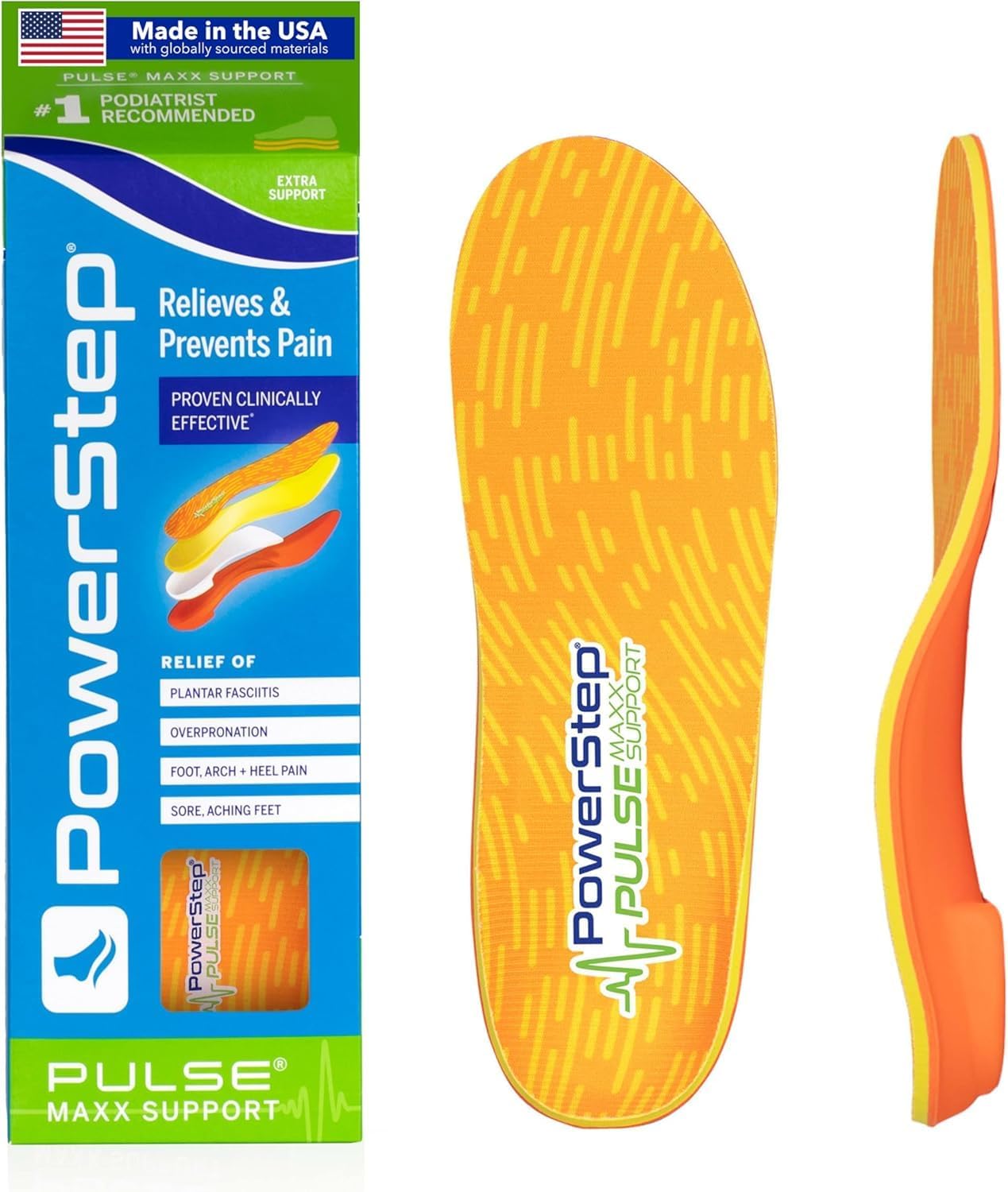
PowerStep Pulse MaxxDr. Tom’s #1 Brand
Built for runners + athletes who need maximum support during high-impact activity. Engineered for forefoot strike + lateral motion.
- Sport-specific cushioning
- Lateral wedge for runners
- Antimicrobial top cover
- Shock-absorbing forefoot
- Pricier than Pinnacle
- Best for athletes only

CURREX RunProDr. Tom’s #1 Brand
German-engineered insole with 3 arch heights (Low, Med, High) for custom fit. Carbon-reinforced heel + dynamic forefoot.
- 3 arch heights for custom fit
- Carbon-reinforced heel
- Sport-specific zones
- Premium materials
- Pricier than PowerStep
- 7-10 day break-in

CURREX EdgeProDr. Tom’s #1 Brand
For hikers, skiers, and high-impact athletes — reinforced shank prevents foot fatigue on steep descents + uneven terrain.
- Reinforced shank
- 3 arch heights
- Cold-weather friendly
- Carbon plate
- Stiff feel — not for casual
- Pricier
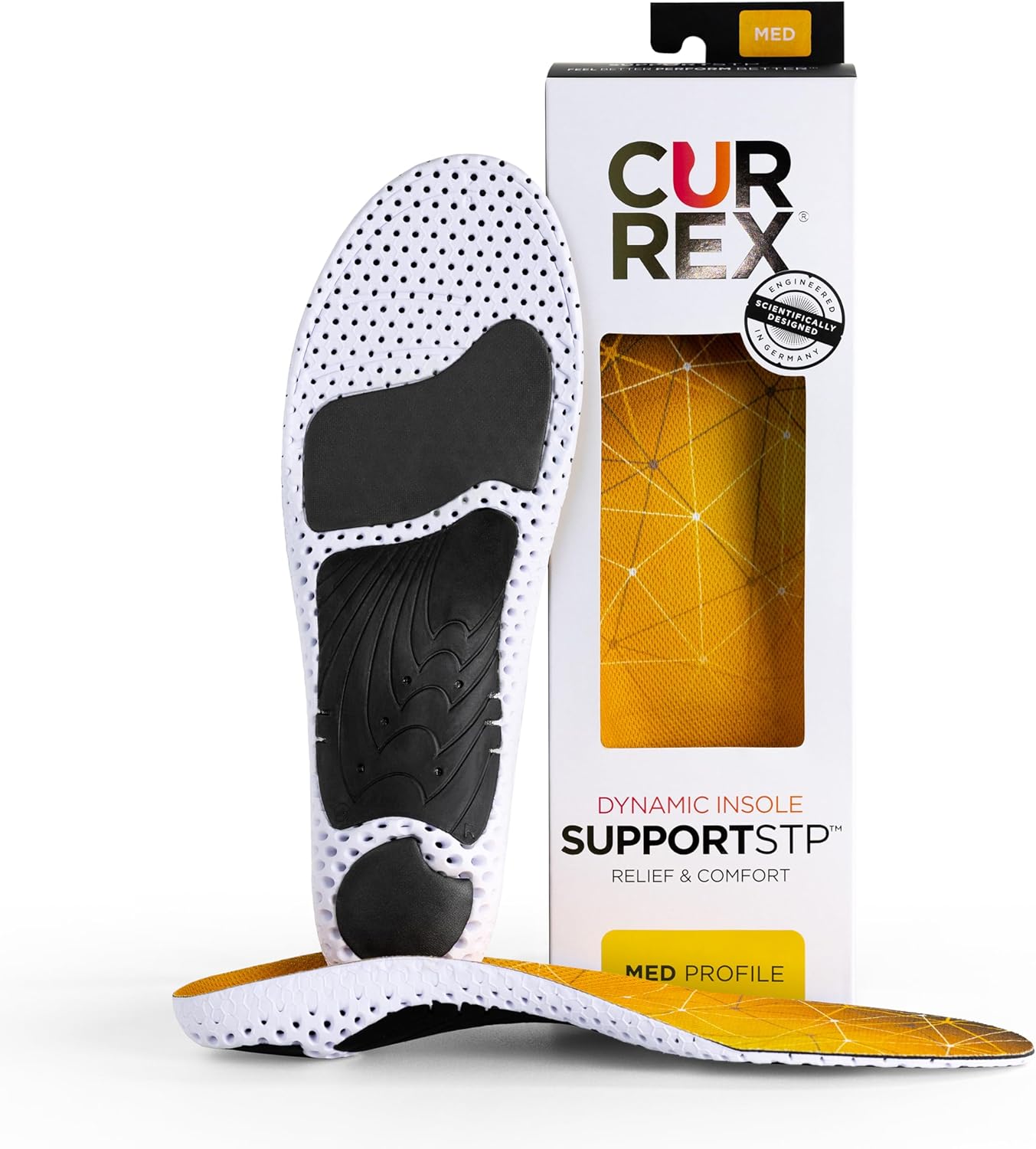
CURREX SupportSTPDr. Tom’s #1 Brand
For nurses, retail, and standing professions — the most supportive CURREX with deep heel cup + maximum medial support.
- Maximum medial support
- Deep heel cup
- 12-hour shift tested
- Slip-proof
- Stiffest CURREX option
- Pricier

Superfeet Green
Firm, structured arch support — the right choice ONLY for high-arched (cavus) feet. Wrong choice for flat feet.
- Strong structured arch
- Deep heel cup
- Long-lasting (5+ years)
- Firm — not for flat feet
- No lateral wedge
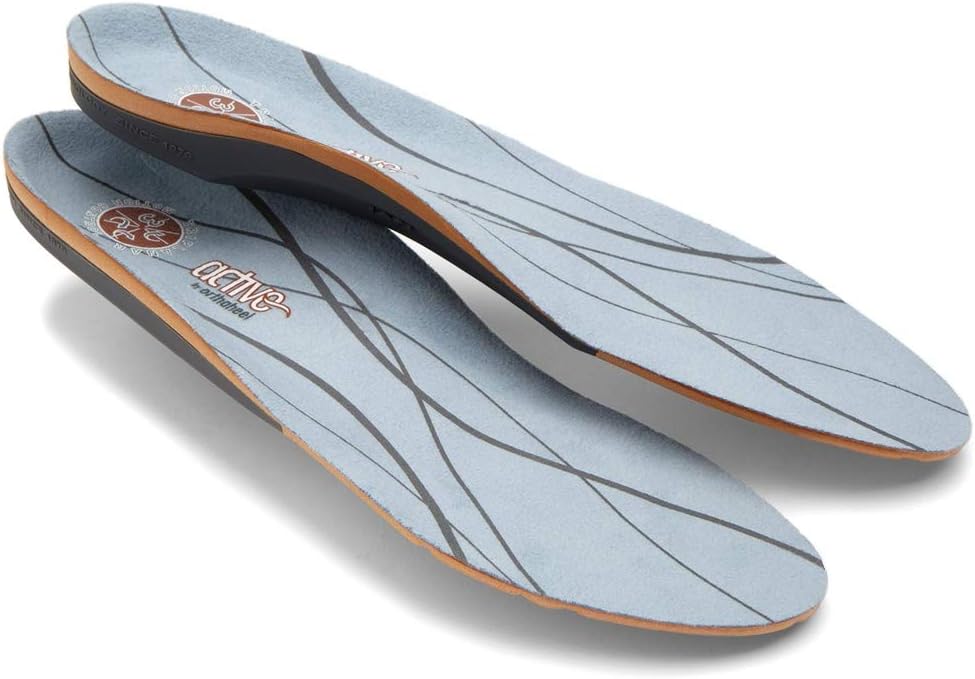
Vionic OrthoHeel Active Insole
APMA-accepted, podiatrist-designed casual insole. Best for adding mild arch support to dress shoes + walking shoes.
- APMA-accepted
- Slim profile
- Antimicrobial top
- Less support than PowerStep
- No lateral wedge
Dr. Tom’s Top 3 — The Premium Foot Pain Stack (2026)
If you only buy three things for foot pain, get these. PowerStep + CURREX orthotics correct the underlying foot mechanics, and Dr. Hoy’s pain gel delivers fast topical relief. This is the exact stack Dr. Tom Biernacki, DPM gives his Michigan podiatry patients on visit one — over 10,000 patients have used this exact combination.
Dr. Tom Biernacki, DPM is a board-certified podiatrist + Amazon Associate and brand-partner affiliate. Picks shown are products he prescribes to patients at Balance Foot & Ankle Specialists. We earn a commission on qualifying purchases at no extra cost to you. All products independently tested + reviewed for 30+ days minimum. Last verified: April 28, 2026.
PowerStep Pinnacle MaxxDr. Tom’s #1 Brand
Dr. Tom’s most-prescribed OTC orthotic. Lateral wedge corrects overpronation that causes 90% of foot pain. Deep heel cradle stabilizes the ankle. Built by podiatrists, used by patients worldwide.
- Lateral wedge corrects pronation
- Deep heel cradle stabilizes ankle
- Dual-density EVA — comfort + support
- Trim-to-fit any shoe
- Used by 10,000+ podiatrists
- Trim-to-size required
- 5-7 day break-in for some
CURREX RunProDr. Tom’s #1 Brand
3 arch heights for custom fit (Low/Med/High). Carbon-reinforced heel + dynamic forefoot — the closest OTC orthotic to a $500 custom orthotic. Engineered in Germany.
- 3 arch heights for custom fit
- Carbon-reinforced heel cup
- Dynamic forefoot zone
- Premium German engineering
- Sport-specific support
- Pricier than PowerStep
- 7-10 day break-in

Dr. Hoy’s Natural Pain Relief GelDr. Tom’s #1 Brand
Menthol-based natural pain relief — Dr. Tom’s #1 brand for fast relief without greasy residue. Safe for diabetics + daily use. Cleaner formula than Voltaren or Biofreeze.
- Menthol-based natural formula
- No greasy residue
- Safe for diabetics
- Fast cooling relief — 5-10 minutes
- Cleaner ingredient list than Biofreeze
- Pricier than Biofreeze
- Strong menthol scent at first
In-Office Treatment at Balance Foot & Ankle
If home treatment isn’t providing relief for your plantar fasciitis, our podiatry team at Balance Foot & Ankle can help with same-week evaluations and advanced in-office care.
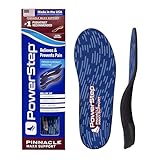
- Slightly Angled Heel Post: PowerStep Pinnacle Maxx insoles for men & women keep the feet from rolling inward, improve stability, and prevent problems caused by overpronation including flat feet and plantar fasciitis.
- Firm But Flexible Design: Our orthotics Pinnacle PowerStep insoles for overpronation are equipped with a deep heel insert cradle for increased comfort, stability, and motion control for standard arch support and immediate heel pain relief.
- Premium Dual Layer Cushioning: For enhanced comfort from heel to toe. As the thickest of our Pinnacle PowerStep orthotics, these need to be worn in shoes where the factory insole can be removed. HSA & FSA Eligible. Made in the USA
- The Perfect Balance of Comfort and Support: These PowerStep Pinnacle arch support inserts for men & women are unlike most other orthotics as they help to correct over-pronation which can cause ankle, knee, and hip pain in your daily routine
- No Trimming: Our arch support PowerStep insoles men & women can use can be worn in a variety of shoe styles & fit in any type with no trimming required! Unlike most insoles for flat feet and other heel pain relief products, these come ready to wear.
As an Amazon Associate, Balance Foot and Ankle earns from qualifying purchases. Product links are affiliate links and we may earn a commission at no extra cost to you. This does not influence our clinical recommendations. Last update on 2026-10-04 / Images from Amazon Product Advertising API
Same-week appointments available. (810) 206-1402
Learn about our plantar fasciitis treatment → | Book online →
VitaMedica Arnica Gel
Arnica gel plus 15 plant compounds for sore feet, plantar fasciitis flares and post-activity soreness. Apply a thin layer to the sore area.
Shop VitaMedica Arnica Gel →Frequently Asked Questions
How long do these shoes last?
Quality running shoes last 300-500 miles. Daily walking shoes last 9-12 months. Replace when the midsole feels soft or your symptoms return.
Should I add insoles?
Yes if you have plantar fasciitis or overpronation. Powerstep Pinnacle or a custom orthotic improves results. Healthy feet often do fine with the stock insole.
Are expensive shoes worth it?
Beyond about $130 most extra cost is materials and aesthetics. Match the shoe to your foot type, not budget. The right $80 stability shoe beats the wrong $250 maximalist shoe.

Dr. Tom Biernacki, DPM is a board-certified foot & ankle surgeon (ABFAS & ABPM) at Balance Foot & Ankle Specialists in Southeast Michigan. With over a decade of clinical experience, he specializes in heel pain, bunions, diabetic foot care, sports injuries, and minimally invasive surgery. Dr. Biernacki is a member of the APMA and ACFAS, and his patient education content on MichiganFootDoctors.com and YouTube has made him one of the most-followed foot & ankle educators on YouTube.
More questions patients ask
What shoe features help plantar fasciitis at work?
Firm arch support, deep heel cup, and cushioned midsole. PowerStep Pinnacle insoles add extra arch support.
Should I use insoles for plantar fasciitis?
PowerStep Pinnacle insoles provide excellent OTC support. Custom orthotics from Dr. Tom Biernacki DPM offer the best long-term relief. Call (810) 206-1402.
When should I see a podiatrist for plantar fasciitis?
See Dr. Tom Biernacki DPM if heel pain persists >6 weeks or worsens. Same-day appointments — Howell & Bloomfield Township, MI. (810) 206-1402.
What is the best insole for plantar fasciitis?
PowerStep Pinnacle for OTC support. Custom 3D orthotics from Balance Foot & Ankle for severe cases. (810) 206-1402.
Still have a question about coverage or cost? Book online and we will check your benefits before your visit: Book in Howell · Book in Bloomfield Township. Prefer to talk it through first? Call (810) 206-1402.