

Quick answer: Chronic Exertional Compartment Syndrome Shin Splints Michigan is a clinical condition that responds to evidence-based treatment when caught early. Symptoms include pain, swelling, and altered function. Diagnosis requires clinical exam, often imaging. Treatment ladder: conservative care first (4-6 weeks), then targeted interventions if needed. Book online, or call (810) 206-1402.
Medically reviewed by Dr. Tom Biernacki, DPM · Board-Certified Podiatric Surgeon · Last reviewed: April 2026 · Editorial Policy
Quick Answer
Chronic exertional compartment syndrome causes exercise-induced leg pain and tightness that resolves with rest. Activity modification helps some patients, but fasciotomy is frequently needed to return to full activity. Appointments in Howell + Bloomfield Township: (810) 206-1402.
Medically reviewed by Dr. Tom Biernacki, DPM — Board-Certified Podiatric Surgeon — Balance Foot & Ankle, Howell & Bloomfield Township, MI. Last updated April 2026.
▶ Watch
Medically Reviewed by Dr. Tom Biernacki, DPM — Board-Certified Podiatrist, Balance Foot & Ankle Specialists, Michigan. Last updated April 2026.
Chronic exertional compartment syndrome (CECS) is one of the most commonly misdiagnosed conditions in sports medicine — and one of the most frustrating for athletes because it presents with exercise-related lower leg pain that is repeatedly treated as shin splints or stress fracture without resolution. The distinction matters enormously: shin splints (medial tibial stress syndrome) and tibial stress fractures are treated with relative rest and load management; CECS is treated with fasciotomy surgery or botulinum toxin injection. Weeks or months of rest that resolves shin splints has no lasting benefit on CECS — symptoms return immediately when running is resumed. At Balance Foot & Ankle in Howell and Bloomfield Township, MI, Dr. Tom Biernacki, DPM evaluates and manages CECS with accurate diagnosis and evidence-based treatment options.
What Is Chronic Exertional Compartment Syndrome?
The lower leg contains four fascial compartments — anterior, lateral, deep posterior, and superficial posterior — each bounded by inelastic fascia that limits expansion. During exercise, muscle volume increases by 20% or more as blood flow surges, producing increased intracompartmental pressure. In healthy individuals, the fascia accommodates this expansion adequately. In CECS, the fascia is abnormally stiff or the muscle hypertrophies beyond the fascia’s accommodative capacity, causing intracompartmental pressure to rise to levels that reduce perfusion pressure (the pressure gradient driving blood through the muscle capillaries). The result is a predictable cycle: exercise begins → compartment pressure rises → perfusion decreases → ischemic pain develops → athlete slows or stops → pressure normalizes → pain resolves rapidly. This pattern — onset after a predictable duration of exercise, resolution within minutes of stopping, complete absence of pain at rest — is virtually diagnostic of CECS and distinguishes it clearly from shin splints (which can persist for hours or days after activity).
Symptoms — The CECS Pattern
The characteristic CECS symptom pattern: lower leg pain, pressure, or tightness developing predictably after a consistent duration of exercise — typically 10–20 minutes of running at moderate pace. The pain is described as aching, cramping, or “bursting” pressure in the affected compartment — most commonly the anterior compartment (outside of the shin) or deep posterior compartment (inside of the shin above the ankle). Neurological symptoms — numbness or tingling in the foot in the distribution of the anterior compartment nerve (foot dorsum and first web space) or deep posterior compartment nerve (plantar foot) — frequently accompany the pain. The athlete must stop or significantly reduce intensity to obtain relief; walking on level ground for 5–10 minutes typically resolves symptoms completely. The complete absence of symptoms the next morning is the most distinctive CECS feature — shin splints and stress fractures are characteristically painful with the first morning steps and during daily walking.
Diagnosis — Compartment Pressure Testing
The gold standard for CECS diagnosis is compartment pressure measurement before and after exercise. The patient exercises to the point of symptom reproduction, then undergoes pressure measurement immediately and at 5 minutes post-exercise. The diagnostic criteria most widely used are: resting pressure ≥15 mmHg; 1-minute post-exercise pressure ≥30 mmHg; 5-minute post-exercise pressure ≥20 mmHg. Pressures meeting any of these thresholds in a symptomatic compartment confirm CECS. The procedure requires a pressure monitoring system (Stryker or equivalent) and needle placement in the affected compartment — an in-office procedure that takes approximately 30 minutes including the exercise protocol. MRI with an exercise component (running on a treadmill prior to imaging) shows muscle edema in the affected compartment and is an emerging non-invasive diagnostic alternative, though not yet as widely available or validated as pressure testing.
Non-Surgical Management — Limited But Worth Attempting
Conservative management options for CECS have limited and mixed evidence, but are appropriate to attempt before surgery in motivated patients. Gait retraining — converting from a heel-strike running pattern to a forefoot or midfoot strike pattern — significantly reduces anterior compartment pressures during running by reducing the eccentric loading demands on the tibialis anterior. Published studies show gait retraining provides clinically meaningful symptom reduction in approximately 40–70% of anterior CECS patients. The training requires 4–8 weeks of supervised retraining with a gait analysis system and physical therapist familiar with the protocol. Botulinum toxin (Botox) injection into the symptomatic compartment reduces muscle contraction force and thereby reduces compartment pressure elevation during exercise — an emerging conservative procedure with promising results, particularly for lateral compartment CECS. Stretching, orthotics, and anti-inflammatory medications do not meaningfully reduce compartment pressure and provide no benefit beyond general comfort.
Surgical Treatment — Fasciotomy
Fasciotomy — surgical release of the inelastic fascia confining the affected compartment — is the definitive treatment for CECS and has a success rate of 80–90% for anterior and lateral compartment release. The procedure divides the fascial sheath longitudinally, allowing the muscle to expand without pressure restriction during exercise. Minimally invasive endoscopic fasciotomy, performed through 1–2 small incisions, has replaced open fasciotomy at experienced centers due to reduced wound complications and faster return to activity. Recovery involves 2 weeks of protected weight-bearing followed by progressive return to running over 4–6 weeks, with full competitive return at approximately 6–8 weeks for anterior compartment release. Deep posterior compartment fasciotomy has a higher technical complexity and complication rate than anterior release and is typically reserved for confirmed cases that have failed anterior fasciotomy when the symptoms are posterior, or when a complete four-compartment release is indicated.
CECS vs Shin Splints — Key Differentiating Features
The clinical distinction that most reliably separates CECS from medial tibial stress syndrome (shin splints): in CECS, pain is completely absent at rest and in the morning and develops predictably during exercise; in shin splints, pain is present with walking and first morning steps and is aggravated but not exclusively triggered by exercise. In CECS, pain resolves within 5–10 minutes of stopping activity; in shin splints, pain persists for hours after activity. In CECS, the affected leg may feel normal or slightly firm on palpation; in shin splints, there is linear tenderness along the posteromedial tibial border over several centimeters that is detailedly tender to palpation even at rest. When a runner describes pain that “turns on” predictably during a run and “turns off” predictably when stopping, CECS should be the leading diagnosis until proven otherwise.
Red Flags — When to Seek Immediate Evaluation
Seek emergency evaluation for lower leg pain if: pain develops suddenly during a single bout of intense exercise and does not resolve with rest (possible acute compartment syndrome — surgical emergency requiring emergency fasciotomy within 6 hours); there is progressive numbness and weakness of the foot or ankle during rest (neurovascular compromise from elevated compartment pressure); the leg is visibly tense, pale, and painful with passive stretch (classic signs of acute compartment syndrome). Chronic exertional compartment syndrome does not progress to acute compartment syndrome during normal exercise — but missed acute compartment syndrome from trauma or fracture has catastrophic consequences.
Treatment at Balance Foot & Ankle — Michigan
Dr. Tom Biernacki, DPM evaluates exercise-related lower leg pain with a structured history, physical examination, and intracompartmental pressure testing for suspected CECS. Conservative management including gait retraining referral and botulinum toxin injection, and surgical fasciotomy for confirmed CECS that has failed conservative care, are available. Appointments at our Howell office (4330 E Grand River Ave) and Bloomfield Township office (43494 Woodward Ave #208). Call (810) 206-1402 or book online.
Join 950,000+ Learning About Foot Health
Dr. Tom shares honest medical advice, supplement reviews, and treatment guides you won’t find anywhere else.
Subscribe on YouTube →📍 Located in Michigan?
Our board-certified podiatrists treat this condition at two convenient locations. Book online 24/7 at either office.
Insurance Accepted
BCBS · Medicare · Aetna · Cigna · United Healthcare · HAP · Priority Health · Humana · View All →
Howell Office
4330 E Grand River Ave
Howell, MI 48843
Get Directions →
Bloomfield Township Office
43494 Woodward Ave, #208
Bloomfield Township, MI 48302
Get Directions →
More Podiatrist-Recommended Foot Health Essentials
Hoka Clifton 10


Max-cushion everyday shoe — podiatrist favorite for walking and running.

OOFOS Recovery Slide

Impact-absorbing recovery sandal — wear after long days on your feet.
As an Amazon Associate, Balance Foot & Ankle earns from qualifying purchases. Product recommendations are based on clinical experience; prices and availability shown above update live from Amazon.
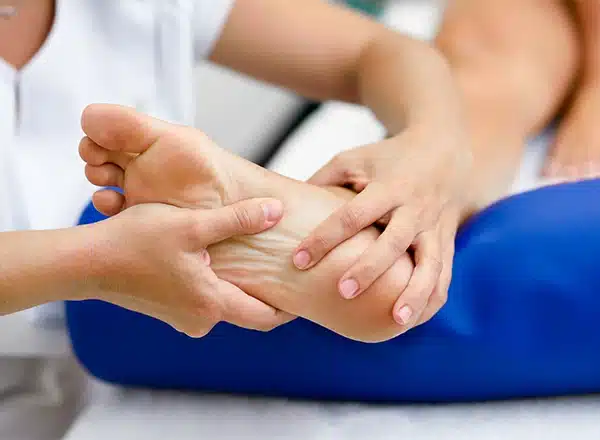
When to See a Podiatrist
If foot or ankle pain has been bothering you for more than a few weeks, home care alone may not be enough. Balance Foot & Ankle offers online booking 24/7 at our Howell and Bloomfield Township clinics — no referral needed in most cases. Bring your current shoes and a short list of symptoms and we’ll build you a treatment plan in one visit.
Call Balance Foot & Ankle: (810) 206-1402 · Book online · Offices in Howell & Bloomfield Township
Differential Diagnosis: What Else Could It Be?
Not every case of shin splints (medial tibial stress syndrome) is straightforward. In our clinic we routinely rule out three look-alike conditions before confirming the diagnosis. If your symptoms don’t match the classic presentation, one of these may explain the pain — which is why physical exam matters more than self-diagnosis.
| Condition | How It Differs |
|---|---|
| Tibial stress fracture | Point tenderness on a single spot of the tibia, worse with impact, often night pain — URGENT. |
| Chronic exertional compartment syndrome | Pain starts predictably after 15–20 min of running, subsides after stopping, may include numbness. |
| Popliteal entrapment syndrome | Pain in the back of the calf with running, often bilateral, may include loss of pulse with plantarflexion. |
Red Flags — When to See a Podiatrist Now
Seek expert evaluation at Balance Foot & Ankle if you notice any of the following:
- Point tenderness on a single spot (possible stress fracture)
- Night pain at rest
- Pain that continues AFTER stopping activity
- Numbness or cold foot during running (compartment syndrome)
Call (810) 206-1402 or request an appointment. For an urgent foot or ankle problem, call (810) 206-1402 and we’ll find the soonest opening.
In Our Clinic: What We See
Clinical perspective from Dr. Tom Biernacki, DPM — Balance Foot & Ankle, Howell & Bloomfield Township, MI:
In our Balance Foot & Ankle clinic, the typical shin splints patient is a runner or military/first-responder recruit in their 20s or 30s who has recently ramped up mileage too quickly. The pain is classically along the medial two-thirds of the tibia, diffuse rather than pinpoint, and worse with each running session. On exam we’re specifically looking for ONE location of point tenderness — that’s the red flag that separates shin splints from a stress fracture. When proper activity modification and structured calf/tibial posterior loading begins early, most shin splints resolve within 4–6 weeks without imaging.
Watch: Dr. Tom explains
Podiatrist-recommended products
As an Amazon Associate, Dr. Tom earns from qualifying purchases.
Reduce eccentric tibial loading that drives CECS.
Check price →Ice the shins after each run during the evaluation phase.
Check price →Topical menthol for post-exercise shin soreness.
View on Amazon →Rule out tibial stress fracture with temporary immobilization.
Check price →Related resources
Ready to solve this? Book today.
Book online 24/7 · Howell & Bloomfield Township · 4.9★ (1,200+ reviews)
☎ (810) 206-1402Book Online →Pros & Cons of Conservative Care for foot care
Advantages
- ✓ Conservative care first
- ✓ Book online 24/7
- ✓ Multiple insurance accepted
Considerations
- ✗ Self-treatment can mask issues
- ✗ See a podiatrist if pain >2 weeks
Dr. Tom’s Recommended Products for foot care
Affiliate disclosure: As an Amazon Associate, Balance Foot & Ankle earns from qualifying purchases. We only recommend products we use with patients.
Footnanny Heel Cream Dr. Tom’s Pick
Best for: Daily moisturizer for cracked heels
Ready to Get Back on Your Feet?
Appointments in Howell + Bloomfield Township. Most insurance accepted. Dr. Tom Biernacki, DPM & team.
Call Now: (810) 206-1402
Visit Balance Foot & Ankle — Online Booking 24/7
Our podiatry team serves patients throughout Michigan including Howell, Brighton, and Bloomfield Township. If you’re dealing with heel pain, ingrown toenails, or a foot injury, you can book online 24/7.
Book online 24/7. (810) 206-1402
Frequently Asked Questions
What causes this condition?
Causes include mechanical stress, biomechanical imbalance, age-related changes, and sometimes systemic disease. Our clinical exam plus imaging identifies the specific driver.
Can it go away on its own?
Mild cases sometimes resolve with rest and supportive footwear. Persistent symptoms past 4-6 weeks rarely resolve without active treatment.
Is surgery required?
Most patients resolve with non-surgical care. Surgery is reserved for refractory cases or structural deformity.
Our podiatrists treat the underlying cause, not just the symptom. Appointments at our Howell and Bloomfield Township, Michigan offices.
Ready for Expert Care?
Appointments in Howell & Bloomfield Township, MI.
4.9★ | 1,200+ Reviews | 3,000+ Surgeries
Or call: (810) 206-1402

Dr. Tom Biernacki, DPM is a board-certified foot & ankle surgeon (ABFAS & ABPM) at Balance Foot & Ankle Specialists in Southeast Michigan. With over a decade of clinical experience, he specializes in heel pain, bunions, diabetic foot care, sports injuries, and minimally invasive surgery. Dr. Biernacki is a member of the APMA and ACFAS, and his patient education content on MichiganFootDoctors.com and YouTube has made him one of the most-followed foot & ankle educators on YouTube.