
Quick answer: Treatment for shin splints medial tibial stress syndrome runners treatment michigan follows a stepwise approach: 1) conservative care first (rest, ice, supportive footwear, OTC anti-inflammatories), 2) physical therapy and targeted exercises, 3) in-office treatments (injections, custom orthotics) if conservative fails at 4-6 weeks, 4) surgery for refractory cases. Most patients resolve at step 1 or 2. Call (810) 206-1402.
Medically reviewed by Dr. Tom Biernacki, DPM · Board-Certified Podiatric Surgeon · Last reviewed: April 2026 · Editorial Policy
The most important clinical decision with Shin Splints Medial Tibial Stress Syndrome Runners Treatment Michigan isn’t which treatment to start with — it’s identifying the correct subtype. That changes everything. Call (810) 206-1402.
Quick Answer
Shin Splints (MTSS) — Medial Tibial Stress Syndrome Tr relates to foot pain — typically caused by overuse, footwear, or biomechanics. Most patients improve in 6-12 weeks with conservative care. Same-week appointments in Howell + Bloomfield Hills: (810) 206-1402.
Medically reviewed by Dr. Tom Biernacki, DPM — Board-Certified Podiatric Surgeon — Balance Foot & Ankle, Howell & Bloomfield Hills, MI. Last updated April 2026.
▶ Watch
Medically Reviewed by Dr. Tom Biernacki, DPM — Board-Certified Podiatrist, Balance Foot & Ankle Specialists, Michigan. Last updated April 2026.
Shin Splints vs. Tibial Stress Fracture — The Critical Distinction
Medial tibial stress syndrome (MTSS — “shin splints”) and tibial stress fracture are both running-related tibial pain conditions, and distinguishing them is the most important clinical decision in their management. MTSS involves periosteal inflammation along a broad stretch of the posteromedial tibial cortex — the pain is diffuse, covering 5 cm or more of the tibial shaft, and tender along the medial tibial border. Tibial stress fracture involves focal cortical bone disruption — the pain is point-specific (tender at exactly one location, approximately 1–2 cm wide), and responds to the tuning fork test (vibration increases pain at the fracture site). The management difference: MTSS is treated with activity modification and continues to heal with appropriate running load management; tibial stress fracture — particularly anterior cortex — requires non-weight-bearing and potentially surgery. Every patient presenting with lower leg pain should have point tenderness assessed before a diagnosis of MTSS is made. At Balance Foot & Ankle in Howell and Bloomfield Hills, Michigan, Dr. Tom Biernacki, DPM provides accurate diagnosis and treatment. Call (810) 206-1402.
The Cause of MTSS — Traction Periostitis and Bone Remodeling Overload
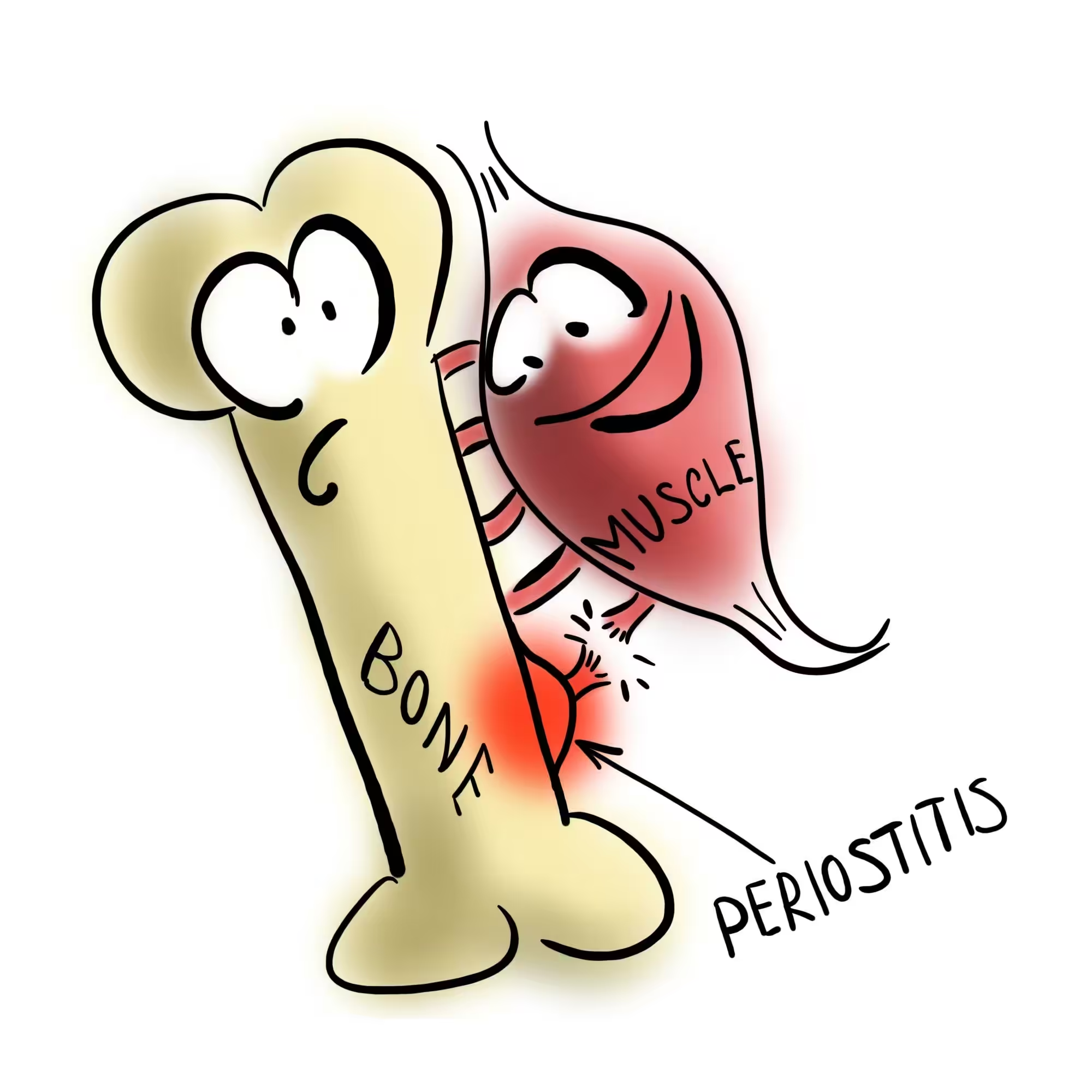
MTSS is caused by two mechanisms that coexist: traction periostitis from the soleus and posterior tibialis muscles at their origin on the posteromedial tibia — the repeated contraction of these muscles during running exerts tensile force on the periosteum, causing inflammation; and bone remodeling overload — the tibial cortex normally undergoes continuous remodeling in response to load; when load increases faster than remodeling capacity, osteoclastic resorption temporarily exceeds osteoblastic deposition, creating a mechanically weakened cortex that is painful under continued loading. Risk factors: training mileage increase greater than 10% per week; transition from soft to hard running surfaces; overpronation (increases tibialis posterior traction on the medial tibia); worn shoe midsoles; and low bone mineral density (particularly in female athletes with the Female Athlete Triad).
Conservative Management — Load Management and Biomechanical Correction
MTSS treatment requires simultaneous load reduction and biomechanical correction: activity modification — reduce weekly mileage by 40–50% and substitute low-impact cross-training (swimming, cycling) during the reduction period; progressive mileage return — increase by no more than 10% per week once pain-free at the modified load; biomechanical correction — custom orthotics with medial arch support and rearfoot control reduce the traction force on the posteromedial tibia by controlling the overpronation that increases tibialis posterior pull; new running shoes — worn midsoles increase tibial shock transmission; MLS laser therapy — accelerates periosteal healing and reduces inflammation, allowing faster return to full training; and calf and tibialis posterior strengthening — reduces the tensile load on the periosteum during running. MTSS resolves in 6–12 weeks with this approach in the majority of athletes.
When MTSS Does Not Resolve — Compartment Syndrome and Stress Fracture
MTSS that fails to improve with 8–12 weeks of appropriate management requires re-evaluation: repeat X-ray and MRI to identify a stress fracture that may have been present initially but was not visible on the original imaging; compartment pressure measurement for exertional compartment syndrome — which presents similarly but worsens rapidly during exercise and resolves quickly with rest (unlike MTSS, which persists after exercise stops); and nerve entrapment evaluation — the superficial peroneal nerve can be compressed in its fascial compartment, producing lower leg pain that mimics MTSS.
Shin Splints Treatment in Howell & Bloomfield Hills Michigan
Dr. Tom Biernacki, DPM distinguishes MTSS from tibial stress fracture with clinical examination and tuning fork testing, coordinates MRI when stress fracture cannot be excluded, provides custom orthotics for biomechanical correction, and MLS laser therapy for accelerated periosteal healing at Balance Foot & Ankle. Same-day evaluation for runners with acute lower leg pain. Serving Howell, Brighton, Hartland, Bloomfield Hills, and all Southeast Michigan. Book your evaluation or call (810) 206-1402.
Dr. Tom’s Recommended Products for Shin Splints
📍 Located in Michigan?
Our board-certified podiatrists treat this condition at two convenient locations. Same-day appointments often available.
These are products I personally use and recommend to my patients at Balance Foot & Ankle.
- Shock Doctor Compression Shin Splint Sleeve — Targeted compression over medial tibia reduces periosteal stress and venous pooling during activity
- Brooks Adrenaline GTS 24 — Overpronation control reduces medial tibial stress — 80% of shin splints are biomechanical in origin
- PowerStep Pinnacle Insoles — Biomechanical control reduces tibial torsion forces — addressing the root cause of medial tibial stress syndrome
Affiliate disclosure: As an Amazon Associate, Balance Foot & Ankle earns from qualifying purchases. We only recommend products we trust for our own patients.
Dr. Tom’s Pick: Performance Running Insoles
CURREX RunPro insoles are what I recommend to serious runners — available in 3 arch profiles tuned for your specific gait pattern.
- CURREX RunPro Insoles — Dynamic arch system with 3 profiles (low/medium/high). Reduces repetitive stress injuries and improves energy return. Choose your arch type at checkout.
Affiliate disclosure: As an Amazon Associate, Balance Foot & Ankle earns from qualifying purchases.
💊 Dr. Tom’s Pick: Doctor Hoy’s Natural Pain Relief
A topical pain relief gel I recommend to patients: arnica, camphor, and natural anti-inflammatories. No prescription needed. Apply directly to the painful area for fast-acting relief. Great for sore feet, heel pain, and joint discomfort.
View Doctor Hoy’s on Amazon →
Affiliate disclosure: As an Amazon Associate, Balance Foot & Ankle earns from qualifying purchases.
👣 Dr. Tom’s Pick: PowerStep Pinnacle Insoles
The #1 OTC orthotic I prescribe most often. PowerStep Pinnacle provides clinical-grade arch support, cushioning, and heel stability — the same biomechanical correction as a custom orthotic at a fraction of the cost. Fits most shoe types.
View PowerStep Pinnacle on Amazon →
Affiliate disclosure: As an Amazon Associate, Balance Foot & Ankle earns from qualifying purchases.
Join 950,000+ Learning About Foot Health
Dr. Tom shares honest medical advice, supplement reviews, and treatment guides you won’t find anywhere else.
📧 Get Dr. Tom’s Free Lab Test Guide
Discover the 5 lab tests every person over 35 should ask their doctor about — explained in plain English by a board-certified physician.
🔗 Related Care & Resources
Treated by Dr. Tom Biernacki DPM — Board-certified podiatric surgeon at Balance Foot & Ankle in Howell & Bloomfield Hills, MI.
Schedule an Appointment →
or call (810) 206-1402
Insurance Accepted
BCBS · Medicare · Aetna · Cigna · United Healthcare · HAP · Priority Health · Humana · View All →
Howell Office
4330 E Grand River Ave
Howell, MI 48843
Get Directions →
Bloomfield Hills Office
43494 Woodward Ave, #208
Bloomfield Hills, MI 48302
Get Directions →
Your Board-Certified Podiatrists



Ready to Get Back on Your Feet?
Same-week appointments available at both locations.
Book Your AppointmentMore Podiatrist-Recommended Foot Health Essentials
Hoka Clifton 10


Max-cushion everyday shoe — podiatrist favorite for walking and running.

OOFOS Recovery Slide

Impact-absorbing recovery sandal — wear after long days on your feet.
As an Amazon Associate, Balance Foot & Ankle earns from qualifying purchases. Product recommendations are based on clinical experience; prices and availability shown above update live from Amazon.
When to See a Podiatrist
If foot or ankle pain has been bothering you for more than a few weeks, home care alone may not be enough. Balance Foot & Ankle offers same-week appointments at our Howell and Bloomfield Hills clinics — no referral needed in most cases. Bring your current shoes and a short list of symptoms and we’ll build you a treatment plan in one visit.
Call Balance Foot & Ankle: (810) 206-1402 · Book online · Offices in Howell & Bloomfield Hills
Differential Diagnosis: What Else Could It Be?
Not every case of shin splints (medial tibial stress syndrome) is straightforward. In our clinic we routinely rule out three look-alike conditions before confirming the diagnosis. If your symptoms don’t match the classic presentation, one of these may explain the pain — which is why physical exam matters more than self-diagnosis.
| Condition | How It Differs |
|---|---|
| Tibial stress fracture | Point tenderness on a single spot of the tibia, worse with impact, often night pain — URGENT. |
| Chronic exertional compartment syndrome | Pain starts predictably after 15–20 min of running, subsides after stopping, may include numbness. |
| Popliteal entrapment syndrome | Pain in the back of the calf with running, often bilateral, may include loss of pulse with plantarflexion. |
Red Flags — When to See a Podiatrist Now
Seek same-day evaluation at Balance Foot & Ankle if you notice any of the following:
- Point tenderness on a single spot (possible stress fracture)
- Night pain at rest
- Pain that continues AFTER stopping activity
- Numbness or cold foot during running (compartment syndrome)
Call (810) 206-1402 or request an appointment. Our Howell and Bloomfield Hills offices reserve same-day slots for urgent foot and ankle issues.
In Our Clinic: What We See
Clinical perspective from Dr. Tom Biernacki, DPM — Balance Foot & Ankle, Howell & Bloomfield Hills, MI:
In our Balance Foot & Ankle clinic, the typical shin splints patient is a runner or military/first-responder recruit in their 20s or 30s who has recently ramped up mileage too quickly. The pain is classically along the medial two-thirds of the tibia, diffuse rather than pinpoint, and worse with each running session. On exam we’re specifically looking for ONE location of point tenderness — that’s the red flag that separates shin splints from a stress fracture. When proper activity modification and structured calf/tibial posterior loading begins early, most shin splints resolve within 4–6 weeks without imaging.
Watch: Dr. Tom explains
Podiatrist-recommended products
As an Amazon Associate, Dr. Tom earns from qualifying purchases.
Reduces tibial stress by controlling overpronation during running.
View on Amazon →Cryotherapy protocol: 15 minutes post-run on painful tibial region.
View on Amazon →Topical anti-inflammatory for shin region pain between training sessions.
View on Amazon →Supplemental cushioning for runners transitioning back to full mileage.
View on Amazon →Related resources
Ready to solve this? Book today.
Same-week appointments · Howell & Bloomfield Hills · 4.9★ (1,123+ reviews)
☎ (810) 206-1402Book Online →Pros & Cons of Conservative Care for foot care
Advantages
- ✓ Conservative care first
- ✓ Same-week appointments
- ✓ Multiple insurance accepted
Considerations
- ✗ Self-treatment can mask issues
- ✗ See a podiatrist if pain >2 weeks
Dr. Tom’s Recommended Products for foot care
Affiliate disclosure: As an Amazon Associate, Balance Foot & Ankle earns from qualifying purchases. We only recommend products we use with patients.
Footnanny Heel Cream Dr. Tom’s Pick
Best for: Daily moisturizer for cracked heels
Ready to Get Back on Your Feet?
Same-day appointments in Howell + Bloomfield Hills. Most insurance accepted. Dr. Tom Biernacki, DPM & team.
Book Today — Same-Day Appointments Available
Call Now: (810) 206-1402
About Your Care Team at Balance Foot & Ankle
Dr. Tom Biernacki, DPM · Board-Certified Foot & Ankle Surgeon. Specializes in conservative-first care, minimally invasive bunion surgery, and complex reconstruction.
Dr. Carl Jay, DPM · Accepting new patients. Specializes in sports medicine, athletic injuries, and routine podiatric care.
Dr. Daria Gutkin, DPM, AACFAS · Accepting new patients. Specializes in surgical reconstruction and pediatric podiatry.
Locations: 4330 E Grand River Ave, Howell, MI 48843 · 43494 Woodward Ave Suite 208, Bloomfield Hills, MI 48302
Hours: Mon–Fri 8:00 AM – 5:00 PM · (810) 206-1402
Visit Balance Foot & Ankle — Same-Day Appointments Available
Our podiatry team serves patients throughout Michigan including Howell, Brighton, and Bloomfield Hills. If you’re dealing with heel pain, ingrown toenails, or a foot injury, we have same-day appointment availability.
Same-day appointments available. (810) 206-1402
Frequently Asked Questions
How long does treatment take to work?
Most patients see improvement in 4-8 weeks with consistent conservative care. Persistent symptoms after 8 weeks need imaging and escalation.
When is surgery needed?
Surgery is reserved for cases that fail 3-6 months of conservative care, structural deformities, or fractures requiring stabilization.
Is this covered by insurance?
Most diagnostic visits and conservative treatments are covered by Medicare and major insurers. Custom orthotics often require diabetic or post-surgical justification.
Our podiatrists treat the underlying cause, not just the symptom. Same-week appointments at our Howell and Bloomfield Hills, Michigan offices.
Ready for Expert Care?
Same-day appointments in Howell & Bloomfield Hills, MI.
4.9★ | 1,123 Reviews | 3,000+ Surgeries
Or call: (810) 206-1402

Dr. Tom Biernacki, DPM is a board-certified foot & ankle surgeon (ABFAS & ABPM) at Balance Foot & Ankle Specialists in Southeast Michigan. With over a decade of clinical experience, he specializes in heel pain, bunions, diabetic foot care, sports injuries, and minimally invasive surgery. Dr. Biernacki is a member of the APMA and ACFAS, and his patient education content on MichiganFootDoctors.com and YouTube has made him one of the most-followed foot & ankle educators on YouTube.