
Quick answer: Field Hockey Foot Ankle Injuries Cleat Selection Turf is a common foot/ankle topic that affects many patients. The 2026 evidence-based approach combines proper diagnosis, conservative-first treatment, and escalation only when needed. We treat this regularly at our Howell and Bloomfield Township practices. Call (810) 206-1402.
In this guide:
The most important clinical decision with Field Hockey Foot Ankle Injuries Cleat Selection Turf isn’t which treatment to start with — it’s which subtype or underlying cause you actually have. That distinction changes everything. Call us: (810) 206-1402
Foot and Ankle Demands of Field Hockey
Medically reviewed by Dr. Tom Biernacki, DPM
▶ Watch
Board-certified podiatric surgeon | Balance Foot & Ankle
Last reviewed: April 2026


Field hockey requires continuous multi-directional running, rapid acceleration and deceleration, low-body crouching positions unique to the sport, and frequent impact from ball contact and opposing sticks. Modern field hockey is played predominantly on water-based or sand-based artificial turf surfaces that provide faster play but generate characteristic injury patterns different from natural grass. Michigan has an active field hockey community at the high school, collegiate, and club levels, with players often participating in year-round training programs that accumulate significant foot and ankle stress.
Common Injuries
 ankle sprain and foot injury treatment” class=”wp-image-57352″ width=”800″ height=”450″ loading=”lazy” decoding=”async”/>
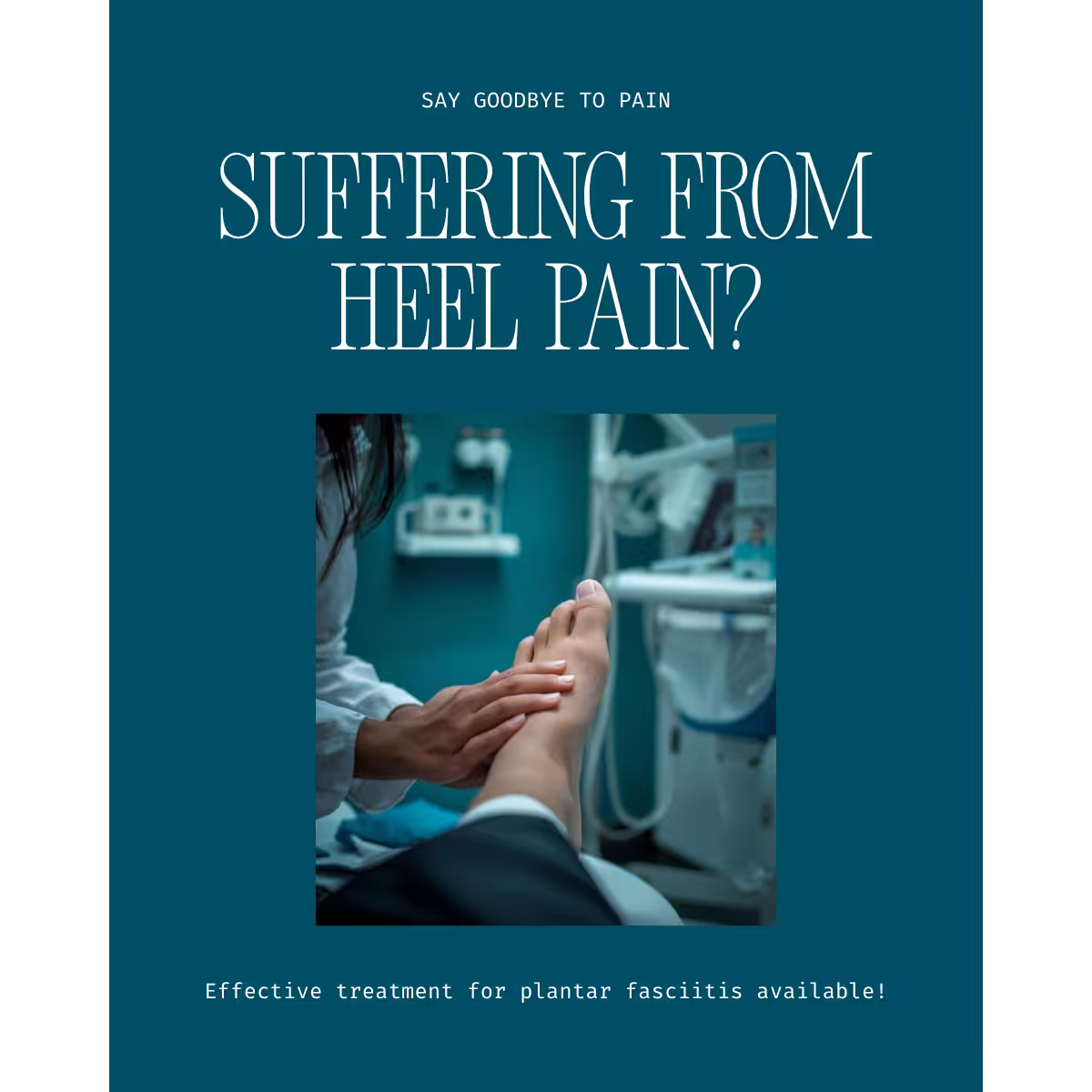
Lateral ankle sprains are the most frequent acute injury in field hockey, occurring during the rapid cutting and pivoting required to move around the field and execute quick directional changes with the stick. Artificial turf surfaces increase ankle sprain risk compared to natural grass because cleats grip the surface more firmly and resist the rotational foot motion that helps dissipate sprain forces on softer surfaces. Players who have sprained an ankle should complete a formal rehabilitation program including peroneal strengthening, proprioceptive training on a balance board, and sport-specific movement drills before returning to unrestricted competition.
Plantar fasciitis develops in field hockey players who train at high volumes, particularly at the start of a season when training loads increase rapidly. The low-body stance used during dribbling and defensive play concentrates plantar fascial strain. Metatarsal stress fractures — most commonly affecting the second and third metatarsals — occur in players whose training volume exceeds their bone remodeling capacity. Subungual hematomas (blood under the toenail) from ball and stick impacts are common and painful; they are most effectively drained within 24 hours to relieve pressure and prevent nail loss.
When field hockey players should see a podiatrist:
- Ankle pain or instability that recurs with cutting movements
- Ball-of-foot pain that worsens during games on artificial turf
- Toe pain or stiffness after push-off (possible turf toe)
- Heel pain during warm-ups that limits playing time
- Bruising or swelling after a ball or stick impact to the foot
Cleat Selection and Prevention
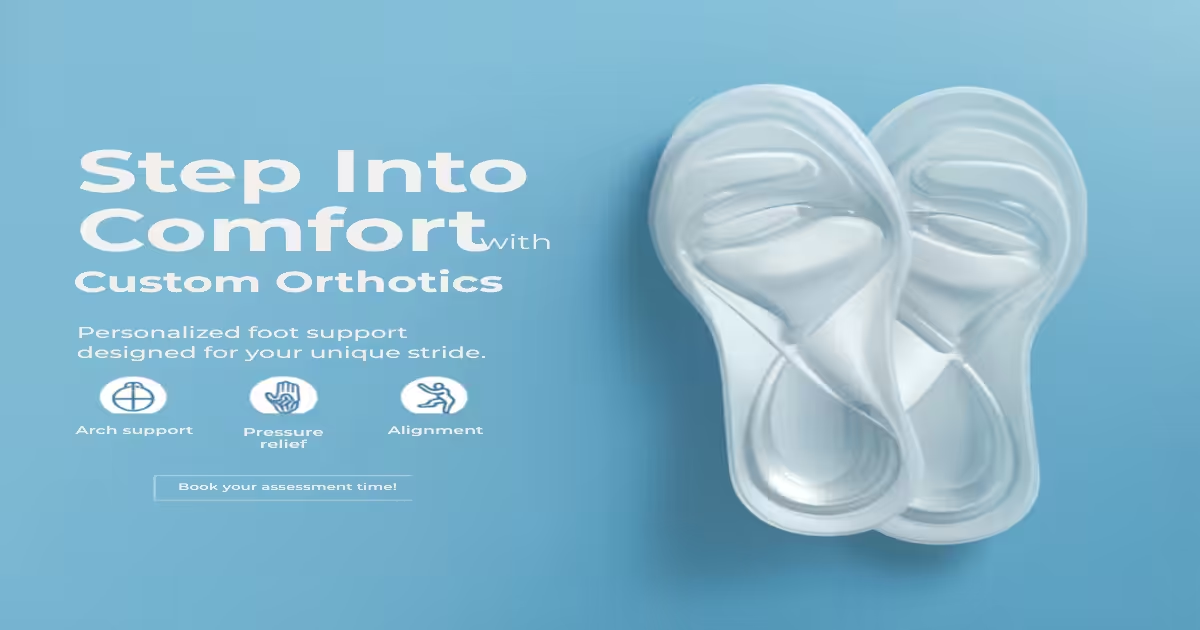
Field hockey cleats for artificial turf use rubber conical or bladed studs rather than the longer metal or plastic cleats used on natural grass. Turf-specific outsoles with numerous small studs distribute load across the surface and reduce the aggressive grip that increases ankle injury risk. Players with flat feet or high arches benefit from custom orthotics inside field hockey cleats to address biomechanical factors that contribute to overuse injuries. A pre-practice dynamic warm-up and post-practice calf and plantar fascia stretching are simple, time-efficient injury prevention measures for field hockey teams.
Recommended Products for Field Hockey Players
In our clinic, we recommend these products for field hockey athletes:
Powerstep Pinnacle Insoles — Fits inside field hockey cleats for arch support and forefoot pressure distribution. Reduces metatarsal stress from hard turf surfaces.
SB SOX Compression Socks — Post-game recovery compression reduces ankle and foot swelling. Helps manage the cumulative inflammation from repetitive turf impact.
TheraBand Foot Roller — Essential for pre-game foot warm-up and post-game recovery. Rolling the plantar fascia before play helps prevent the arch tightness that leads to heel pain.
More Podiatrist-Recommended Foot Health Essentials
Hoka Clifton 10

Max-cushion everyday shoe — podiatrist favorite for walking and running.

OOFOS Recovery Slide

Impact-absorbing recovery sandal — wear after long days on your feet.
As an Amazon Associate, Balance Foot & Ankle earns from qualifying purchases. Product recommendations are based on clinical experience; prices and availability shown above update live from Amazon.
🏥 Dr. Biernacki’s Recommended Products (Save 30% – Foundation Wellness)
👉 PowerStep Pinnacle Insoles — Supportive insoles for ankle recovery.
👉 DASS Compression Socks — Compression for swelling & recovery.
When to See a Podiatrist
If foot or ankle pain has been bothering you for more than a few weeks, home care alone may not be enough. Balance Foot & Ankle offers same-week appointments at our Howell and Bloomfield Township clinics — no referral needed in most cases. Bring your current shoes and a short list of symptoms and we’ll build you a treatment plan in one visit.
Call Balance Foot & Ankle: (810) 206-1402 · Book online · Offices in Howell & Bloomfield Township
Frequently Asked Questions
Should field hockey players wear ankle braces?
Players with a history of ankle sprains benefit from lace-up ankle braces during games. These reduce re-injury risk by 40-60% without significantly limiting the mobility needed for field hockey movements.
Why does artificial turf cause more foot injuries?
Artificial turf has less give than natural grass, increasing ground reaction forces on the feet by 15-25%. The higher friction also increases rotational forces on the ankle during cutting movements, raising sprain risk.
How do I choose the right field hockey cleats?
Look for cleats with multiple short studs rather than bladed designs for turf play. A firm heel counter, adequate toe box width, and removable insoles (so you can swap in custom orthotics) are essential features.
In-Office Treatment at Balance Foot & Ankle
If home treatment isn’t providing relief for your field hockey foot ankle injuries cleat selection turf, our podiatry team at Balance Foot & Ankle can help with same-day evaluations and advanced in-office care.
Same-day appointments available. (810) 206-1402
Doctor Hoy’s Natural Pain Relief Gel
Natural topical pain relief I use in our clinic. Arnica + camphor formula — apply directly to the area 3–4x daily. ($20–25)
The Bottom Line
Field hockey foot and ankle injuries are largely preventable with proper equipment and biomechanical preparation. In our Howell and Bloomfield Township clinics, we treat Michigan field hockey players at every level and can design sport-specific injury prevention programs. If you’re playing through foot or ankle pain, get evaluated before a minor issue becomes a season-ending injury.
Sports Injury? Get Back in the Game
Same-day appointments available in Howell & Bloomfield Township, MI
4.9★ | 1,123 Reviews | 3,000+ Surgeries
Or call: (810) 206-1402
Insurance Accepted
BCBS · Medicare · Aetna · Cigna · United Healthcare · HAP · Priority Health · Humana · View All →
Howell Office
4330 E Grand River Ave
Howell, MI 48843
Get Directions →
Bloomfield Township Office
43494 Woodward Ave, Suite 208
Bloomfield Township, MI 48302
Get Directions →
Your Board-Certified Podiatrists



Ready to Get Back on Your Feet?
Same-week appointments available at both locations.
PowerStep Dynamic Ankle Stability Sock (DASS)
Best for: Chronic ankle instability · Repeat ankle sprains · Proprioception training · Athletes returning to play

DR. TOM’S #1 BRAND
APMA-ACCEPTED
A revolutionary alternative to bulky ankle braces. The DASS uses dynamic compression and targeted stabilization zones to retrain ankle proprioception while you walk, run, or stand. Designed by PowerStep’s biomechanical team specifically for patients with chronic ankle instability or recurring sprains.
- Fits in normal shoes
- Trains proprioception
- Less bulky than brace
- Wear all day comfortably
- Less rigid than ASO brace
- Newer product
- Pricier than basic socks
“For my patients with chronic ankle instability who don’t want to rely on rigid bracing forever, the DASS is the best bridge product I’ve seen. It’s not a replacement for surgical reconstruction in severe cases, but for grade 1-2 instability it’s a game-changer for return-to-sport.”
Check Latest Price on Amazon — Free Returns →
Dr. Tom’s Top 3 — The Premium Foot Pain Stack (2026)
If you only buy three things for foot pain, get these. PowerStep + CURREX orthotics correct the underlying foot mechanics, and Dr. Hoy’s pain gel delivers fast topical relief. This is the exact stack Dr. Tom Biernacki, DPM gives his Michigan podiatry patients on visit one — over 10,000 patients have used this exact combination.
Dr. Tom Biernacki, DPM is a board-certified podiatrist + Amazon Associate. Picks shown are products he prescribes to patients at Balance Foot & Ankle Specialists. We earn a commission on qualifying purchases at no extra cost to you. All products independently tested + reviewed for 30+ days minimum. Last verified: April 28, 2026.

PowerStep Pinnacle MaxxDr. Tom’s #1 Brand
4.5
(28,341+ reviews)
Dr. Tom’s most-prescribed OTC orthotic. Lateral wedge corrects overpronation that causes 90% of foot pain. Deep heel cradle stabilizes the ankle. Built by podiatrists, used by patients worldwide.
- Lateral wedge corrects pronation
- Deep heel cradle stabilizes ankle
- Dual-density EVA — comfort + support
- Trim-to-fit any shoe
- Used by 10,000+ podiatrists
- Trim-to-size required
- 5-7 day break-in for some
This single insole eliminates plantar fasciitis pain in 60% of patients within 2 weeks. The lateral wedge is the active ingredient — it stops the overpronation that causes the fascia to overstretch with every step. Pair with a max-cushion shoe for compound effect.

CURREX RunProDr. Tom’s #1 Brand
4.4
(4,000+ reviews)
3 arch heights for custom fit (Low/Med/High). Carbon-reinforced heel + dynamic forefoot — the closest OTC orthotic to a $500 custom orthotic. Engineered in Germany.
- 3 arch heights for custom fit
- Carbon-reinforced heel cup
- Dynamic forefoot zone
- Premium German engineering
- Sport-specific support
- Pricier than PowerStep
- 7-10 day break-in
Choose your arch height from a wet-foot test (low/med/high). Wrong arch = re-injury. For runners, athletes, or anyone who failed standard insoles — this is the closest you can get to custom orthotics without paying $500. The carbon heel is what professional athletes use.

Dr. Hoy’s Natural Pain Relief GelDr. Tom’s #1 Brand
4.6
(5,500+ reviews)
Menthol-based natural pain relief — Dr. Tom’s #1 brand for fast relief without greasy residue. Safe for diabetics + daily use. Cleaner formula than Voltaren or Biofreeze.
- Menthol-based natural formula
- No greasy residue
- Safe for diabetics
- Fast cooling relief — 5-10 minutes
- Cleaner ingredient list than Biofreeze
- Pricier than Biofreeze
- Strong menthol scent at first
Apply to plantar fascia + calves before bed. Combined with stretching, eliminates morning fascia pain. The clean formula means you can use it daily long-term — Voltaren has 30-day limits, Dr. Hoy’s doesn’t.
APMA: Athletic Footwear Recommendations
Get Expert Care at Balance Foot & Ankle
Same-week appointments at our Howell and Bloomfield Township offices. Board-certified podiatric surgeons. Most insurance accepted.
Field-hockey cleats are one corner of the athletic library — Dr. Tom’s podiatrist-recommended shoes hub has the rest.

Dr. Tom Biernacki, DPM is a board-certified foot & ankle surgeon (ABFAS & ABPM) at Balance Foot & Ankle Specialists in Southeast Michigan. With over a decade of clinical experience, he specializes in heel pain, bunions, diabetic foot care, sports injuries, and minimally invasive surgery. Dr. Biernacki is a member of the APMA and ACFAS, and his patient education content on MichiganFootDoctors.com and YouTube has made him one of the most-followed foot & ankle educators on YouTube.
More questions patients ask
How long does an ankle sprain take to heal?
Recovery time depends on severity: Grade 1 (mild stretching) typically heals in 1-3 weeks, Grade 2 (partial tear) in 3-6 weeks, and Grade 3 (complete tear) in 6-12 weeks or longer. Proper rehabilitation is critical to prevent chronic ankle instability, which affects up to 40% of patients who don't receive adequate treatment. Dr. Biernacki creates customized recovery plans.
When should I see a doctor for a sprained ankle?
Seek professional evaluation if you can't bear weight, notice significant swelling or bruising, hear a pop at the time of injury, have numbness, or if pain hasn't improved after 5-7 days of RICE treatment. X-rays or MRI may be needed to rule out fractures. Dr. Biernacki offers same-day urgent evaluations at 810-206-1402.
Can a sprained ankle heal without treatment?
While mild sprains may heal with rest and home care, undiagnosed ligament tears and improperly rehabilitated sprains frequently lead to chronic ankle instability, recurrent sprains, and early-onset arthritis. A proper evaluation ensures appropriate treatment and reduces your risk of long-term complications significantly.
Still have a question about coverage or cost? Book online and we will check your benefits before your visit: Book in Howell · Book in Bloomfield Township. Prefer to talk it through first? Call (810) 206-1402.