
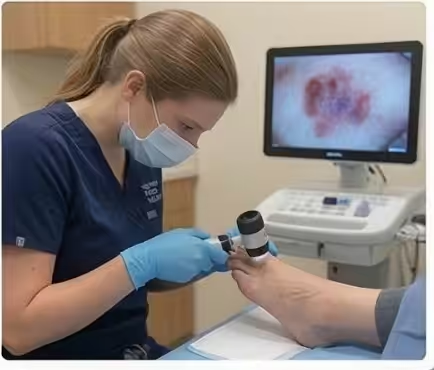
Quick answer: Foot Skin Conditions Eczema Psoriasis Contact Dermatitis is a clinical condition that responds to evidence-based treatment when caught early. Symptoms include pain, swelling, and altered function. Diagnosis requires clinical exam, often imaging. Treatment ladder: conservative care first (4-6 weeks), then targeted interventions if needed. Call (810) 206-1402.
Medically Reviewed by Dr. Tom Biernacki, DPM — Board-Certified Podiatrist, Balance Foot & Ankle Specialists, Michigan. Last updated April 2026.
▶ Watch
The Skin of the Foot: Unique Challenges
The skin of the foot is subject to unique stresses that create a distinctive environment for dermatological conditions. The foot endures continuous mechanical pressure and friction, is enclosed in occlusive footwear that raises temperature and humidity, is exposed to rubber and chemical allergens in shoes and socks, and has the weight of the entire body transmitted through it with every step. These factors make the foot vulnerable to a range of skin conditions that are either unique to or disproportionately common in the feet compared to other body regions.
Many foot skin conditions are misidentified as athlete’s foot (tinea pedis) — a fungal infection — when they are actually inflammatory dermatoses that worsen with antifungal treatment. Accurate diagnosis is essential before initiating treatment, as fungal infections, eczema, psoriasis, and contact dermatitis have overlapping appearances but entirely different management approaches.
Dyshidrotic Eczema (Pompholyx)
Dyshidrotic eczema is one of the most common foot skin conditions seen in podiatric practice. It presents as small, intensely itchy vesicles (fluid-filled blisters) along the soles, sides of the feet, and toes that progress to scaling, cracking, and thickening. Episodes tend to be cyclical — vesicles appear, rupture, crust, and scale over 3–4 weeks, followed by relative quiescence before the next flare. Triggers include stress, heat, sweating, nickel exposure (from jewelry or metal in shoes), and reactions to certain foods or chemicals. Treatment includes topical corticosteroids during active flares, emollient moisturizers to prevent cracking, and avoidance of identified triggers. Severe cases may require short courses of oral corticosteroids or phototherapy.
Psoriasis of the Feet
Psoriasis affecting the feet — particularly the soles — can present as well-demarcated plaques of thickened, silvery-scaled skin (classic plaque psoriasis), or as palmoplantar pustulosis, characterized by yellowish-brown sterile pustules on the weight-bearing surfaces of the sole, which can be extremely painful and disabling. Psoriasis affecting the nails (nail psoriasis) produces pitting, oil spots (yellow-brown discoloration), onycholysis (nail separation), and subungual hyperkeratosis — changes that can be virtually indistinguishable from onychomycosis clinically, making nail culture or biopsy important for differentiation.
Psoriatic arthritis can affect the joints of the feet and ankles, causing inflammatory joint pain and swelling that may be the presenting manifestation of psoriasis in some patients. Podiatric evaluation can identify joint involvement and support referral to rheumatology for systemic management. Foot-specific psoriasis management includes potent topical corticosteroids, vitamin D analogues, tar preparations, and systemic biologics for severe or widespread disease in coordination with dermatology.
Contact Dermatitis
Contact dermatitis of the foot is an inflammatory skin reaction caused by exposure to an irritant or allergen — most commonly components of footwear. Rubber accelerators (chemicals used in shoe rubber manufacturing) and chromate (used in leather tanning) are the most frequent footwear allergens. The distribution of contact dermatitis mirrors the contact pattern of the offending material: dorsal foot and toe box (dorsum of the toes) for rubber or leather contact, or circumferential patterns matching sock elastic bands. Patch testing — the gold standard for identifying contact allergens — identifies the responsible substance and allows avoidance counseling. Treatment with topical corticosteroids and complete avoidance of the identified allergen typically resolves the condition.
Tinea Pedis (Athlete’s Foot) vs Inflammatory Dermatoses
The moccasin-type tinea pedis (diffuse, scaly involvement of the entire sole and lateral border of the foot) most closely resembles eczema and psoriasis. Clues favoring tinea include one-foot dominant involvement (tinea often affects one foot more than the other initially), concurrent nail fungus, and skin scrapings positive for fungal elements on KOH preparation. Eczema and psoriasis are typically bilateral and symmetric. When the diagnosis is uncertain, skin scraping for KOH microscopy and/or fungal culture provides definitive differentiation. Applying potent topical steroids to tinea pedis — a common error when tinea is misidentified as eczema — produces tinea incognito: a suppressed but spreading, modified fungal infection that can become extensive.
When to See a Podiatrist for Foot Skin Problems
Any persistent foot skin condition that doesn’t respond to over-the-counter antifungal treatments within 2–3 weeks should be professionally evaluated. Conditions causing significant pain, skin cracking, or secondary infection require podiatric assessment. Diabetic patients should see a podiatrist for any skin change on the foot — even mild inflammation or scaling can become a portal of entry for infection in the immunocompromised or neuropathic patient. A podiatrist can perform KOH scraping for immediate in-office fungal diagnosis, coordinate dermatology referral for complex inflammatory dermatoses, and manage the biomechanical and footwear factors that perpetuate foot skin conditions.
Foot or Ankle Pain? We Can Help.
Balance Foot & Ankle — Howell & Bloomfield Township, MI
📅 Book Online
📞 (810) 206-1402
Insurance Accepted
BCBS · Medicare · Aetna · Cigna · United Healthcare · HAP · Priority Health · Humana · View All →
Howell Office
4330 E Grand River Ave
Howell, MI 48843
Get Directions →
Bloomfield Township Office
43494 Woodward Ave, Suite 208
Bloomfield Township, MI 48302
Get Directions →
Your Board-Certified Podiatrists



Ready to Get Back on Your Feet?
Same-week appointments available at both locations.
Book Your AppointmentMore Podiatrist-Recommended Foot Health Essentials
Hoka Clifton 10

Max-cushion everyday shoe — podiatrist favorite for walking and running.

OOFOS Recovery Slide

Impact-absorbing recovery sandal — wear after long days on your feet.
As an Amazon Associate, Balance Foot & Ankle earns from qualifying purchases. Product recommendations are based on clinical experience; prices and availability shown above update live from Amazon.
When to See a Podiatrist
If foot or ankle pain has been bothering you for more than a few weeks, home care alone may not be enough. Balance Foot & Ankle offers same-week appointments at our Howell and Bloomfield Township clinics — no referral needed in most cases. Bring your current shoes and a short list of symptoms and we’ll build you a treatment plan in one visit.
Call Balance Foot & Ankle: (810) 206-1402 · Book online · Offices in Howell & Bloomfield Township
In-Office Treatment at Balance Foot & Ankle
If home treatment isn’t providing relief for your foot and ankle conditions, our podiatry team at Balance Foot & Ankle can help with same-day evaluations and advanced in-office care.
Doctor Hoy’s Natural Pain Relief Gel
Natural topical pain relief I use in our clinic. Arnica + camphor formula — apply directly to the area 3–4x daily. ($20–25)
Shop Doctor Hoy’s →Frequently Asked Questions
What causes this condition?
Causes include mechanical stress, biomechanical imbalance, age-related changes, and sometimes systemic disease. Our clinical exam plus imaging identifies the specific driver.
Can it go away on its own?
Mild cases sometimes resolve with rest and supportive footwear. Persistent symptoms past 4-6 weeks rarely resolve without active treatment.
Is surgery required?
Most patients resolve with non-surgical care. Surgery is reserved for refractory cases or structural deformity.

Dr. Tom Biernacki, DPM is a board-certified foot & ankle surgeon (ABFAS & ABPM) at Balance Foot & Ankle Specialists in Southeast Michigan. With over a decade of clinical experience, he specializes in heel pain, bunions, diabetic foot care, sports injuries, and minimally invasive surgery. Dr. Biernacki is a member of the APMA and ACFAS, and his patient education content on MichiganFootDoctors.com and YouTube has made him one of the most-followed foot & ankle educators on YouTube.