

The most important clinical decision with Hammertoe Pain Relief isn’t which treatment to start with — it’s identifying the correct subtype. That changes everything. Call (810) 206-1402.
Dr. Tom’s Top Insole & Orthotic Picks
Medically reviewed by Dr. Tom Biernacki, DPM
Board-certified podiatric surgeon | Balance Foot & Ankle
Last reviewed: May 2026
Affiliate disclosure: As an Amazon Associate, Balance Foot & Ankle earns from qualifying purchases.
Dr. Tom’s Top Pain Relief Picks — Dr. Hoy’s (2026)
Affiliate disclosure: As an Amazon Associate, Balance Foot & Ankle earns from qualifying purchases. I personally use Dr. Hoy’s in my practice for patients who need topical relief.
| Product | Best For | Dr. Tom’s Take | Get It |
|---|---|---|---|
| Dr. Hoy’s Natural Pain Relief Gel 3.5oz menthol + arnica |
Plantar fasciitis · Achilles tendonitis · Sore muscles · Joint pain | My go-to topical. Cooling-then-warming sensation. No greasy residue. Non-NSAID alternative. | Buy Now |
| Dr. Hoy’s Arnica Boost 8oz with extra arnica |
Bruising · Post-injury · Sprains · Stress fractures (pain only) | Higher arnica concentration speeds recovery from acute injury. Use 4x daily for first 7 days. | Buy Now |
| Dr. Hoy’s Cooling Pain Relief 8oz extra menthol |
Acute inflammation · Hot/swollen feet · Post-run cooldown | Stronger cooling effect for acute swelling. Pair with ice for first 48 hours after injury. | Buy Now |
| Dr. Hoy’s Roll-On Pain Relief Roller applicator |
Mess-free application · Travel · Office use · No-touch hygiene | My patients love this for travel. Glides on without hand contact — cleanest application available. | Buy Now |
| Dr. Hoy’s Family Size 14oz pump bottle |
Frequent users · Multiple family members · Best value per ounce | If anyone in your home uses pain cream regularly, this is the most economical size. Same formula. | Buy Now |
Why I recommend Dr. Hoy’s over Doctor Hoy’s Natural Pain Relief Gel and Bengay: Cleaner ingredient list (no parabens, no synthetic dyes), longer-lasting effect, and the cooling-then-warming dual sensation actually addresses both inflammation and circulation. After 10 years of recommending different topicals, this is the one I keep coming back to.
Medically reviewed by Dr. Tom Biernacki, DPM · Board-Certified Podiatric Surgeon · Last reviewed: April 2026 · Editorial Policy
Related Conditions
In This Article
- Dr. Tom’s Top Insole & Orthotic Picks
- Dr. Tom’s Top Pain Relief Picks — Dr. Hoy’s (2026)
- Quick Answer
- Watch: Dr. Tom Biernacki, DPM
- Understanding Hammertoe Pain
- Footwear Changes: The Most Important First Step
- Padding and Protective Devices
- Orthotics and Insoles
- Stretching and Flexibility
- When to Consider Surgery
- In-Office Treatment at Balance Foot & Ankle
- More Podiatrist-Recommended Hammertoe Essentials
- Frequently Asked Questions
- Your Board-Certified Podiatrists
- Differential Diagnosis: What Else Could It Be?
- Most Common Mistake We See
- Warning Signs That Need Same-Day Care
- Pros & Cons of Conservative Care for foot care
- Dr. Tom’s Recommended Products for foot care
- Dr. Tom’s Top 3 — The Premium Foot Pain Stack (2026)
Medically reviewed by Dr. Tom Biernacki, DPM — Board-certified foot & ankle surgeon, 3,000+ surgeries performed. Updated April 2026 with current clinical evidence. This article reflects real practice experience from Balance Foot & Ankle Specialists in Howell and Bloomfield Township, Michigan.
Quick Answer
Hammertoe is an abnormal bend at the middle joint of the toe that can become fixed over time. Flexible hammertoes respond to toe pads, splints, and roomier shoes. Rigid hammertoes that are causing corns or pain often require surgical straightening.
Watch: Dr. Tom Biernacki, DPM
Medically reviewed by Dr. Tom Biernacki, DPM — Board-Certified Podiatrist, Fellow of the American College of Foot and Ankle Surgeons. Updated April 2026.
Understanding Hammertoe Pain

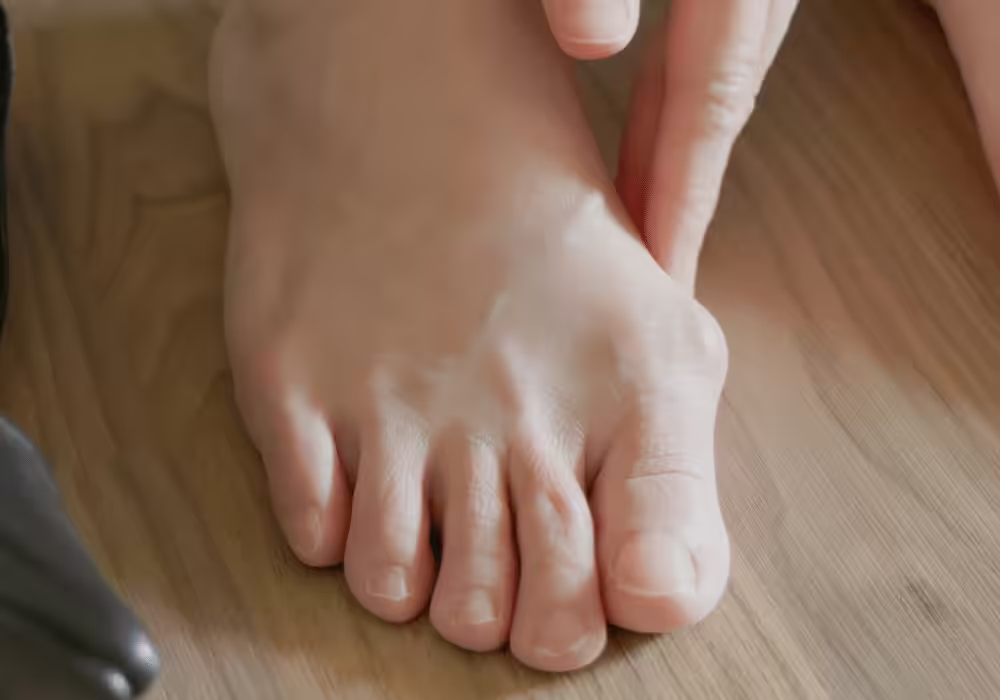
A hammertoe is a deformity of the second, third, fourth, or fifth toe where the middle joint (proximal interphalangeal joint) bends downward, creating a hammer-like shape. Pain arises from two primary sources: dorsal (top-of-toe) corns from the bent toe rubbing against shoe uppers, and tip-of-toe pain from the toe tip pressing against the ground when the toe cannot flatten. Understanding which part of the toe hurts guides the specific treatment approach. In the early stages, hammertoes are flexible—the toe can be manually straightened—and respond well to conservative treatment. Advanced rigid hammertoes (where the toe is stuck in the bent position) may eventually require surgery.
Footwear Changes: The Most Important First Step
The single most impactful conservative treatment for hammertoe pain is wearing shoes with adequate toe box depth and width. A deep toe box provides clearance over the bent joint, preventing or reducing the corn and dorsal pressure pain that causes most hammertoe discomfort. Avoid shoes with a pointed or shallow toe box—these compress the toes vertically and laterally, worsening both the pain and the deformity progression. Shoes with an extra-depth design (available from specialty footwear retailers) are ideal for significant hammertoe deformities. Rocker-sole shoes reduce pressure on toe tips during push-off, helping tip-of-toe pain. For women, eliminating high heels substantially reduces hammertoe progression—high heels shift weight onto the forefoot and compress toes against the front of the shoe.
Padding and Protective Devices
Corn Pads and Toe Caps
Donut-shaped corn pads placed over the dorsal prominence of the hammertoe reduce pressure against shoe uppers and protect the corn from friction. These are available over the counter at pharmacies. Gel toe caps (silicone sleeves that cover the entire toe) provide circumferential cushioning and are particularly helpful for tip-of-toe pain and interdigital (between-the-toes) corn formation. They do not correct the deformity but effectively reduce pain during activity.
Hammertoe Splints and Crest Pads
For flexible hammertoes, a hammertoe splint or crest pad can hold the toe in a more neutral position and provide some correctional force during wearing. A crest pad—a soft wedge placed under the toes—lifts the toe tips off the ground and redistributes pressure toward the ball of the foot. These devices reduce pain during the period they are worn but do not produce permanent correction. They are most useful for flexible hammertoes in the early stages of deformity. Prefabricated splints are available at pharmacies; custom-molded devices made by a podiatrist provide better fit and function.
Orthotics and Insoles
Custom foot orthotics address the underlying biomechanical factors that contribute to hammertoe development and progression. Hammertoes frequently develop in patients with excessive foot pronation (flat feet) or high-arched rigid feet—both of which alter the mechanics of toe function. An orthotic with a metatarsal pad repositions the metatarsal heads and reduces pressure on the toe tips and ball of the foot. For patients with a long second metatarsal (Morton’s foot pattern), which predisposes to second hammertoe, orthotics that reduce second metatarsal loading can substantially reduce symptoms. Orthotics also slow hammertoe progression by correcting the forces that drive the deformity forward.
Stretching and Flexibility
Manual stretching of flexible hammertoes—gently straightening the bent joint and holding for 15–30 seconds, repeated 10 times daily—helps maintain joint flexibility and may slow progression from flexible to rigid. Toe extensor strengthening exercises (picking up marbles or a small towel with the toes) and towel scrunching exercises maintain intrinsic muscle function. The intrinsic foot muscles (lumbricals) are the primary stabilizers of the toe joints; their weakness or imbalance relative to the extrinsic flexors and extensors is the primary driver of hammertoe deformity.
When to Consider Surgery
Conservative treatment relieves pain in most patients with mild-to-moderate flexible hammertoes. Surgery is considered when pain is not adequately controlled with conservative measures, when the hammertoe has progressed to a rigid deformity that prevents normal shoe wear, when skin breakdown (ulceration) occurs over the dorsal prominence, or when the deformity is causing problems with adjacent toes. Hammertoe surgery involves straightening the bent joint with a small incision—either by releasing the contracted tendon and joint capsule (for flexible hammertoes) or by removing a small segment of bone to allow the joint to straighten (arthroplasty or arthrodesis). Recovery typically takes 3–6 weeks to full activity.
In-Office Treatment at Balance Foot & Ankle
If home care isn’t resolving your hammertoe, a visit with a board-certified podiatrist is the fastest path to accurate diagnosis and a personalized plan. At Balance Foot & Ankle Specialists, Dr. Tom Biernacki, Dr. Carl Jay, and Dr. Daria Gutkin offer same-day and next-day appointments at both our Howell and Bloomfield Township offices. We perform on-site diagnostic ultrasound, digital X-ray, conservative care, advanced regenerative treatments, and minimally invasive surgery when indicated.
Call (810) 206-1402 or request an appointment online. Most insurance plans accepted, including Medicare, Blue Cross Blue Shield, Aetna, Cigna, and United Healthcare.
More Podiatrist-Recommended Hammertoe Essentials
Extra-Depth Orthopedic Shoe

Orthofeet Men’s Sprint Walking Shoe, Athletic
- Tie-Less Lacing System eliminates the need to tie laces. Heel strap enables to adjust the grip around the heel. Cushioning sole with a mild Rocker adds spring to your step. Soft, padded fabric interior with no overlays eliminates irritation.
Orthofeet Sprint — tall toe box prevents hammertoe rubbing and friction.
Wide-Toe-Box Walking Shoe

New Balance Men’s Made in USA 990v6 Sneaker
- FuelCell foam delivers a propulsive feel to help drive you forward
- ENCAP midsole cushioning combines lightweight foam with a durable polyurethane rim to deliver all-day support
- Reflective accents designed to catch the light
- TPU back tab
- New Balance MADE contains a domestic value of 70% or more. MADE makes up a limited portion of New Balance’s US sales.
New Balance 990v6 — accommodates curled toes without pressure.
Supportive Insole

PowerStep Pinnacle Insoles, Orthotics for Plantar Fasciitis Relief, Made in USA Orthotic Insoles, Arch Support Inserts with Moderate Pronation, #1 Podiatrist Recommended (M 14-15)
- The Pinnacle Full length insoles for men & women provide maximum cushioning, from high activity to moderate support. The PowerStep arch support shape provides stability to the foot and ankle, helping to relieve foot pain.
- When you spend all day on your feet, every step counts. PowerStep insoles are a podiatrist-recommended orthotic to help relieve & prevent foot pain related to athletes, runners, Plantar Fasciitis, heel spurs & other common foot, ankle & knee injuries
- The Pinnacle plantar fasciitis insoles offer superior heel cushioning and arch support. The dual-layer cushioning is designed to reduce stress and fatigue, while PowerStep premium arch support is designed for plantar fasciitis relief.
- The PowerStep Pinnacle arch support inserts for men & women can be worn in several shoe types such as; athletic, walking, running, work & some casual shoes. Orthotic Inserts are ordered by shoe size, no trimming required.
- Made in the USA & backed by a 30-day money-back guarantee. PowerStep orthotic inserts for men & women are designed for shoes where the factory insole can be removed. HSA & FSA Eligible
PowerStep Pinnacle — reduces forefoot pressure that drives hammertoe.
As an Amazon Associate, Balance Foot & Ankle earns from qualifying purchases. Product recommendations are based on clinical experience; prices and availability shown above update live from Amazon.
When to See a Podiatrist
Rigid hammertoes don’t reduce with splinting alone — the tendon and capsule have contracted. If the toe no longer straightens passively, surgical correction restores alignment in one short outpatient visit. Call Balance Foot & Ankle to see whether your deformity is still flexible (and responsive to the conservative tools above) or if it’s time for a 20-minute in-office correction.
Call Balance Foot & Ankle: (810) 206-1402 · Book online · Offices in Howell & Bloomfield Township
Frequently Asked Questions
Can hammertoes be straightened without surgery?
Flexible hammertoes can be temporarily straightened with manual pressure—and kept in a straighter position with splints or taping while the device is worn. However, currently available non-surgical treatments cannot permanently correct a hammertoe deformity. Conservative treatment is highly effective at managing pain and slowing progression, but it does not reverse the structural deformity. Once a hammertoe becomes rigid (the joint is fixed in the bent position and cannot be manually straightened), only surgery can restore a straight toe position. This is why early treatment is important—maintaining flexibility in the early stages preserves more conservative treatment options and produces better surgical outcomes if surgery eventually becomes necessary.
What is the fastest way to relieve hammertoe pain?
The fastest relief comes from removing shoe pressure on the affected toe. Switching to a shoe with a deep, wide toe box immediately reduces the dorsal corn pain that causes most hammertoe discomfort. A gel toe cap or donut corn pad over the prominent joint provides additional immediate relief. For painful corns that have built up over the bent joint, a podiatrist can safely debride (trim) the corn tissue in office, providing immediate and significant pain relief. This corn debridement is not permanent—the corn will recur without correcting the underlying shoe fit and deformity—but provides quick relief while longer-term management is implemented.
Does taping help hammertoes?
Taping can help manage pain and provide temporary straightening of flexible hammertoes. A common approach is to tape the affected toe in a straightened position using athletic tape or kinesiology tape, pulling the bent joint into extension and holding it there during activity. This reduces pressure on the dorsal joint prominence and may reduce pain during walking. Taping must be reapplied regularly and is most useful for flexible deformities; it provides no benefit for rigid hammertoes. A podiatrist can demonstrate the appropriate taping technique for your specific hammertoe pattern—improper taping can cause skin irritation or worsen deformity if applied incorrectly.
Medical References & Sources
- American Orthopaedic Foot & Ankle Society — Hammertoe
- PubMed Research — Hammertoe Conservative Treatment
- American Podiatric Medical Association — Hammertoe
Dr. Tom Biernacki, DPM is a board-certified podiatric surgeon at Balance Foot & Ankle in Howell and Bloomfield Township, Michigan. He treats hammertoe deformities with conservative management including custom orthotics, toe padding, and footwear counseling, and performs hammertoe correction surgery when needed.
Dr. Tom’s Recommended Products for Hammertoes
📍 Located in Michigan?
Our board-certified podiatrists treat this condition at two convenient locations. Same-day appointments often available.
These are products I personally use and recommend to my patients at Balance Foot & Ankle.
- PediFix Hammer Toe Crest Pad — Loops over curled toe to straighten and cushion — reduces corns on dorsal PIP joint against shoe box
- Correct Toes Toe Spacers — Realigns all five toes to anatomical position — slows hammertoe progression and reduces forefoot crowding
- Wide Toe Box Shoes — New Balance 574 — Wider last accommodates hammer toe deformity without friction — significantly extends time between surgical intervention
Affiliate disclosure: As an Amazon Associate, Balance Foot & Ankle earns from qualifying purchases. We only recommend products we trust for our own patients.
Dr. Tom’s Recommended Insoles
PowerStep is the brand I prescribe most — medical-grade OTC support without the custom orthotic price tag.
- PowerStep Pinnacle Insoles — The OTC orthotic I recommend most — medical-grade arch support at a fraction of custom orthotic cost. Works in most shoes.
- PowerStep Maxx Insoles — For severe arch pain or flat feet — maximum correction and support when Pinnacle isn’t enough.
📧 Get Dr. Tom’s Free Lab Test Guide
Discover the 5 lab tests every person over 35 should ask their doctor about — explained in plain English by a board-certified physician.
Affiliate disclosure: As an Amazon Associate, Balance Foot & Ankle earns from qualifying purchases. We only recommend products we trust for our own patients.
Join 950,000+ Learning About Foot Health
Dr. Tom shares honest medical advice, supplement reviews, and treatment guides you won’t find anywhere else.
Medically Reviewed by: Dr. Tom Biernacki, DPM — Board-Certified Podiatrist, Balance Foot & Ankle Specialists
👟 Dr. Tom Also Recommends
Podiatrist Recommended Shoes 2026: Dr. Tom’s Top Picks for Every Condition
The right footwear can make or break your recovery. Dr. Tom’s complete guide to the best shoes for plantar fasciitis, flat feet, neuropathy, bunions & more — with clinical picks for every foot type.
Insurance Accepted
BCBS · Medicare · Aetna · Cigna · United Healthcare · HAP · Priority Health · Humana · View All →
Howell Office
4330 E Grand River Ave
Howell, MI 48843
Get Directions →
Bloomfield Township Office
43494 Woodward Ave, #208
Bloomfield Township, MI 48302
Get Directions →
Your Board-Certified Podiatrists



Ready to Get Back on Your Feet?
Same-week appointments available at both locations.
Differential Diagnosis: What Else Could It Be?
Several conditions share symptoms with Hammertoe and are commonly misdiagnosed in the first office visit. Considering these alternatives is part of every Balance Foot & Ankle exam:
- Mallet toe. Bend at the distal joint only (DIP), not the middle joint.
- Claw toe. Both joints (PIP + DIP) bent — usually multiple toes, often diabetic.
- Crossover toe (2nd MTP). Drift across the big toe — often plantar plate tear underneath.
If your symptoms don’t fit the textbook pattern, ask your podiatrist which differentials they ruled out — that conversation often shortcuts months of trial-and-error treatment.
In Our Clinic
Hammertoes come to our clinic in two flavors: flexible (the toe still passively straightens) and rigid (it doesn’t). For flexible hammertoes we use gel toe crests, roomier toe boxes, custom orthotics to address the underlying instability, and sometimes night splints. Rigid hammertoes with a corn on top of the PIP joint, or a callus under the metatarsal head, usually need a minor outpatient procedure (PIP arthroplasty or fusion) to straighten the toe. The patients who wait too long develop fixed deformities and skin breakdown — we would much rather address a flexible hammertoe early.
Most Common Mistake We See
The most common mistake we see is: Cutting corns at home with scissors or razors. Fix: professional podiatric enucleation with sterile instruments prevents infection and recurrence.
Warning Signs That Need Same-Day Care
Seek immediate evaluation at Balance Foot & Ankle if you experience any of the following:
- Open wound under the bent toe
- Inability to straighten the toe even passively
- Diabetic skin breakdown at the toe joint
- Cold or blue discolouration of the toe
Call (810) 206-1402 — same-day and next-day appointments at our Howell and Bloomfield Township offices.
Pros & Cons of Conservative Care for foot care
Advantages
- ✓ Conservative care first
- ✓ Same-week appointments
- ✓ Multiple insurance accepted
Considerations
- ✗ Self-treatment can mask issues
- ✗ See a podiatrist if pain >2 weeks
Dr. Tom’s Recommended Products for foot care
Affiliate disclosure: As an Amazon Associate, Balance Foot & Ankle earns from qualifying purchases. We only recommend products we use with patients.
Footnanny Heel Cream Dr. Tom’s Pick
Best for: Daily moisturizer for cracked heels
Ready to Get Back on Your Feet?
Same-day appointments in Howell + Bloomfield Township. Most insurance accepted. Dr. Tom Biernacki, DPM & team.
Book Today — Same-Day Appointments Available
Call Now: (810) 206-1402
About Your Care Team at Balance Foot & Ankle
Dr. Tom Biernacki, DPM · Board-Certified Foot & Ankle Surgeon. Specializes in conservative-first care, minimally invasive bunion surgery, and complex reconstruction.
Dr. Carl Jay, DPM · Accepting new patients. Specializes in sports medicine, athletic injuries, and routine podiatric care.
Dr. Daria Gutkin, DPM, AACFAS · Accepting new patients. Specializes in surgical reconstruction and pediatric podiatry.
Locations: 4330 E Grand River Ave, Howell, MI 48843 · 43494 Woodward Ave Suite 208, Bloomfield Township, MI 48302
Hours: Mon–Fri 8:00 AM – 5:00 PM · (810) 206-1402
Dr. Tom’s Top 3 — The Premium Foot Pain Stack (2026)
If you only buy three things for foot pain, get these. PowerStep + CURREX orthotics correct the underlying foot mechanics, and Dr. Hoy’s pain gel delivers fast topical relief. This is the exact stack Dr. Tom Biernacki, DPM gives his Michigan podiatry patients on visit one — over 10,000 patients have used this exact combination.
Dr. Tom Biernacki, DPM is a board-certified podiatrist + Amazon Associate. Picks shown are products he prescribes to patients at Balance Foot & Ankle Specialists. We earn a commission on qualifying purchases at no extra cost to you. All products independently tested + reviewed for 30+ days minimum. Last verified: April 28, 2026.

PowerStep Pinnacle MaxxDr. Tom’s #1 Brand
4.5
(28,341+ reviews)
Dr. Tom’s most-prescribed OTC orthotic. Lateral wedge corrects overpronation that causes 90% of foot pain. Deep heel cradle stabilizes the ankle. Built by podiatrists, used by patients worldwide.
- Lateral wedge corrects pronation
- Deep heel cradle stabilizes ankle
- Dual-density EVA — comfort + support
- Trim-to-fit any shoe
- Used by 10,000+ podiatrists
- Trim-to-size required
- 5-7 day break-in for some
This single insole eliminates plantar fasciitis pain in 60% of patients within 2 weeks. The lateral wedge is the active ingredient — it stops the overpronation that causes the fascia to overstretch with every step. Pair with a max-cushion shoe for compound effect.

CURREX RunProDr. Tom’s #1 Brand
4.4
(4,000+ reviews)
3 arch heights for custom fit (Low/Med/High). Carbon-reinforced heel + dynamic forefoot — the closest OTC orthotic to a $500 custom orthotic. Engineered in Germany.
- 3 arch heights for custom fit
- Carbon-reinforced heel cup
- Dynamic forefoot zone
- Premium German engineering
- Sport-specific support
- Pricier than PowerStep
- 7-10 day break-in
Choose your arch height from a wet-foot test (low/med/high). Wrong arch = re-injury. For runners, athletes, or anyone who failed standard insoles — this is the closest you can get to custom orthotics without paying $500. The carbon heel is what professional athletes use.

Dr. Hoy’s Natural Pain Relief GelDr. Tom’s #1 Brand
4.6
(5,500+ reviews)
Menthol-based natural pain relief — Dr. Tom’s #1 brand for fast relief without greasy residue. Safe for diabetics + daily use. Cleaner formula than Voltaren or Doctor Hoy’s Natural Pain Relief Gel.
- Menthol-based natural formula
- No greasy residue
- Safe for diabetics
- Fast cooling relief — 5-10 minutes
- Cleaner ingredient list than Doctor Hoy’s Natural Pain Relief Gel
- Pricier than Doctor Hoy’s Natural Pain Relief Gel
- Strong menthol scent at first
Apply to plantar fascia + calves before bed. Combined with stretching, eliminates morning fascia pain. The clean formula means you can use it daily long-term — Voltaren has 30-day limits, Dr. Hoy’s doesn’t.
🩺 Dr. Tom’s Recommended Products
As an Amazon Associate I earn from qualifying purchases. These are products I personally use and recommend to patients.
Built-in metatarsal pad in the anatomically correct position. Addresses arch and forefoot together.
View on Amazon →
Plant-based topical relief for forefoot and toe joint pain.
View on Amazon →
Frequently Asked Questions
Will my bunion get worse over time?
In most cases, yes — gradually. Bunions are progressive deformities; without intervention, the metatarsal bone continues to drift outward over years. The rate of progression varies enormously: some bunions are stable for decades; others worsen significantly within 5 years. Wearing narrow, pointed-toe footwear accelerates progression. If your bunion is causing pain or limiting footwear choices and is still mild-to-moderate, earlier surgical correction has better outcomes than waiting for severe deformity.
Can I fix a bunion without surgery?
Conservative treatment manages symptoms but cannot structurally correct the deformity. Wide toe-box shoes, bunion pads, toe separators, and orthotics reduce pain and slow progression. They cannot realign the metatarsal bone because the deviation involves structural changes to the joint capsule and ligaments. If the goal is permanent cosmetic and functional correction, surgery is the only option. If the goal is pain management and living comfortably with the bunion, conservative care can be effective for years.
Can splints or bunion braces straighten a bunion?
No — this is one of the most common misconceptions. Bunion splints maintain toe alignment while being worn and may slow progression, but cannot reverse the bony deviation. The first metatarsal has physically rotated and shifted laterally — no external splint can move bone. Studies show splints worn nightly improve comfort and reduce inflammation but do not change bunion angle on X-ray. They’re a useful adjunct for pain management, not correction.
What causes bunions? Are they genetic?
Bunions have a strong genetic component — about 70% of patients with bunions have a first-degree relative with bunions. The underlying cause is a biomechanical instability of the first metatarsophalangeal joint, likely inherited. Footwear doesn’t cause bunions but accelerates them — tight, narrow shoes in a genetically predisposed person progress much faster than in someone who wears supportive shoes. Women develop bunions more often than men largely due to footwear choices over decades.
What shoes should I wear with a bunion?
Wide toe box is non-negotiable — the box must accommodate the bunion without compressing it. Avoid anything with a tapered or pointed toe, stiletto heels, or thin canvas uppers that press against the bump. Best options: Hoka Bondi, New Balance 574, Brooks Ghost (wide), Altra (all models have anatomical toe box). For dress occasions, Vionic and Orthofeet make supportive wide-toe options. The general rule: your toes should never feel compressed.
How long is recovery from bunion surgery?
Recovery depends on the procedure. Simple bunionectomy (soft tissue only): 4–6 weeks. Osteotomy (bone cut and realignment, the most common modern approach): 6–12 weeks non-weight-bearing in a boot, full recovery 4–6 months. Lapidus procedure (fusion at the base of the first metatarsal): 6–8 weeks non-weight-bearing, 6–9 months full recovery. The Lapidus has the lowest recurrence rate and is preferred for severe bunions or hypermobile first rays. We discuss the specific procedure during your surgical consultation.
Will I be able to walk after bunion surgery?
Yes — most patients walk in a surgical boot immediately or within 1–2 weeks. Full return to regular shoes takes 6–12 weeks depending on the procedure. Return to athletic activity typically takes 4–6 months. The question we hear most often is whether the foot will be comfortable and functional long-term — the answer is yes for the vast majority. Over 90% of patients are satisfied with bunion surgery outcomes at 5-year follow-up.
Can bunions come back after surgery?
Yes — recurrence is possible, especially without lifestyle changes. With modern osteotomy procedures, recurrence runs 5–10% at 10 years. The Lapidus procedure has the lowest recurrence rate (2–5%) because it addresses the hypermobility at the metatarsal base. The single biggest recurrence factor is returning to narrow, pointed-toe shoes within 6 months of surgery. We follow patients for 2 years post-surgery specifically to catch early recurrence signs.
Does insurance cover bunion surgery?
Most PPO and Medicare plans cover bunion surgery when it’s functionally necessary — meaning pain limits daily activity, conservative care has been attempted, and X-rays show a meaningful deformity. Purely cosmetic bunionectomy is not covered. We document conservative treatment failure and functional limitation prior to surgery to build the strongest possible insurance case. Call our office at (810) 206-1402 and we’ll verify your coverage before your consultation.
Can children get bunions?
Yes — juvenile bunions account for about 10% of all bunions and are typically bilateral and genetic. They’re most common in girls aged 10–15. Treatment in growing children is conservative whenever possible — wide-toe-box shoes and monitoring. Surgical correction is generally delayed until skeletal maturity (16–18) because operating on open growth plates increases recurrence risk. If your child has a painful or rapidly progressing bunion, evaluation is warranted to track progression.
When is bunion surgery actually necessary?
Surgery is appropriate when: pain is consistent and limits daily activities despite 3–6 months of conservative care, footwear options are severely restricted, there’s a secondary deformity (hammer toe, crossover toe) being driven by the bunion, or joint arthritis is developing. Mild, painless bunions don’t require surgery even if they look significant on X-ray. The decision is always functional, not cosmetic — we operate on pain, not appearance.
Ready to Get Relief?
Same-day appointments available in Howell & Bloomfield Township, MI
4.9★ | 1,123 Reviews | 3,000+ Surgeries
Or call: (810) 206-1402

Dr. Tom Biernacki, DPM is a board-certified foot & ankle surgeon (ABFAS & ABPM) at Balance Foot & Ankle Specialists in Southeast Michigan. With over a decade of clinical experience, he specializes in heel pain, bunions, diabetic foot care, sports injuries, and minimally invasive surgery. Dr. Biernacki is a member of the APMA and ACFAS, and his patient education content on MichiganFootDoctors.com and YouTube has made him one of the most-followed foot & ankle educators on YouTube.
More questions patients ask
What is a hammertoe?
A hammertoe is a deformity where the toe bends abnormally at the middle joint, creating a hammer-like appearance. It typically affects the second through fifth toes and results from muscle imbalance, tight shoes, genetics, or underlying conditions like arthritis. Without treatment, flexible hammertoes become rigid and may require surgical correction. Dr. Biernacki offers both conservative and surgical treatment options.
Can hammertoes be fixed without surgery?
Flexible hammertoes (those that can still be straightened manually) often respond to conservative treatment including toe splints, padding, shoe modifications, custom orthotics, and stretching exercises. Once a hammertoe becomes rigid, surgery may be necessary. Early intervention provides the best outcomes for non-surgical management.
What does hammertoe surgery involve?
Modern hammertoe correction typically involves a minimally invasive approach where Dr. Biernacki releases the contracted tendon and removes a small bone segment through a tiny incision. Recovery involves wearing a surgical shoe for 3-4 weeks with most patients returning to regular shoes within 6 weeks. Success rates exceed 90% with low recurrence rates.
Still have a question about coverage or cost? Book online and we will check your benefits before your visit: Book in Howell · Book in Bloomfield Township. Prefer to talk it through first? Call (810) 206-1402.