

Medically reviewed by Dr. Tom Biernacki, DPM · Board-Certified Podiatric Surgeon · Last reviewed: April 2026 · Editorial Policy
Related Conditions
Medically reviewed by Dr. Tom Biernacki, DPM
Board-certified podiatric surgeon | Balance Foot & Ankle
Last reviewed: May 2026
In This Article
- What Are Maximalist and Minimalist Shoes?
- The Science: What Research Actually Shows
- The Podiatrist’s Clinical Verdict by Condition
- Who Should NEVER Wear Minimalist Shoes
- Who CAN Benefit from Minimalist Shoes
- The Bottom Line: It’s Not a War — It’s a Tool
- More Podiatrist-Recommended Shoes Essentials
- Related Articles
- Pros & Cons of Conservative Care for footwear
- Dr. Tom’s Recommended Products for footwear
- Visit Balance Foot & Ankle — Online Booking 24/7
✅ Medically reviewed by Dr. Tom Biernacki, DPM — Board-Certified Podiatrist · Last updated April 6, 2026
Maximalist vs Minimalist Shoes: Podiatrist’s Evidence-Based Guide
This is one of the most contentious debates in running and podiatry. Maximalist vs minimalist shoes — thick-soled, highly cushioned trainers vs thin, flexible, ground-feel footwear — each side has passionate advocates and genuine clinical evidence. As a podiatrist who’s treated foot injuries from both camps, here’s my honest, evidence-based take.
What Are Maximalist and Minimalist Shoes?
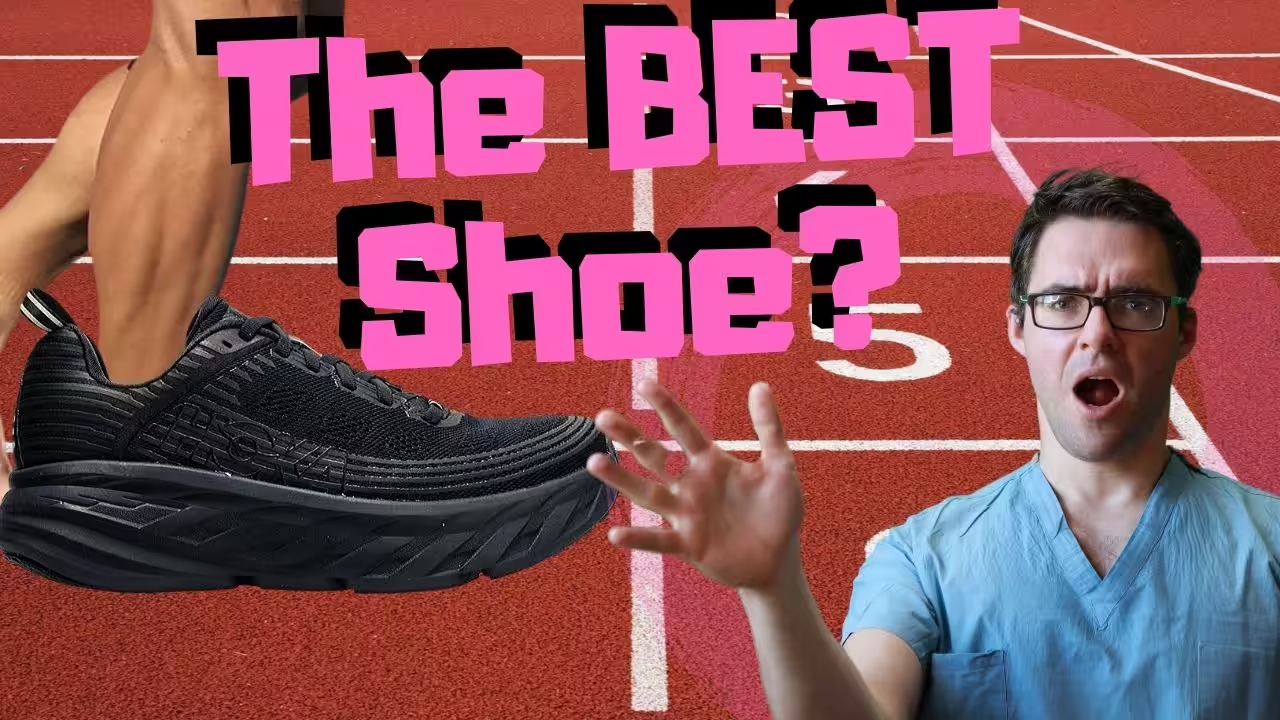
Maximalist shoes feature stack heights of 30mm or more at the heel (often 35-45mm), thick cushioned midsoles, and sometimes rocker geometry. Hoka One One popularized the category in 2010; today Brooks, ASICS, New Balance, and Saucony all offer maximalist options. The theory: more foam = more impact absorption = less injury.
Minimalist shoes — including barefoot shoes, Vibram FiveFingers, Xero Shoes, and “natural” footwear — feature minimal cushioning (0-8mm stack height), zero or near-zero drop, and flexible, foot-shaped lasts. The theory: let the foot’s natural mechanics work without interference; strengthen intrinsic muscles; reduce injury through proprioception.
The Science: What Research Actually Shows
The data is nuanced and often misrepresented by both sides. Let me give you the honest picture:
Maximalist Shoes: What the Evidence Shows
- Rocker geometry reduces metatarsal head pressure by 20-30% — well-documented in clinical literature (Sobel et al., Michaud et al.)
- Higher stack reduces peak impact forces at heel strike — beneficial for heel pain, stress fractures, and plantar fasciitis
- Rocker-bottom designs reduce forefoot loading — prescribed clinically for metatarsalgia, sesamoiditis, diabetic offloading
- Potential downside: reduced proprioception — thicker midsoles decrease sensory feedback, which may affect balance (notably in older adults)
- Some evidence of increased ankle injuries in certain rocker designs due to altered gait mechanics
Minimalist Shoes: What the Evidence Shows
- Strengthens foot intrinsic muscles — consistent finding across multiple studies; barefoot walking increases foot muscle cross-sectional area
- Improves proprioception and sensory feedback — beneficial for balance and fall prevention in certain populations
- High injury rate during transition — up to 40% of runners transitioning too quickly develop stress fractures or tendinopathies
- Metatarsal stress fractures are significantly more common in minimalist footwear — this is one of the most consistent findings in the research
- May worsen pre-existing flat feet — without arch support, overpronators often experience increased medial loading
The Podiatrist’s Clinical Verdict by Condition
| Condition | Maximalist | Minimalist | Verdict |
|---|---|---|---|
| Plantar Fasciitis | ✅ Strong benefit | ⚠️ May worsen | Maximalist wins |
| Metatarsalgia | ✅ Rocker offloads mets | ❌ Increases met pressure | Maximalist wins |
| Metatarsal Stress Fractures | ✅ Cushioning reduces risk | ❌ Significantly increases risk | Maximalist wins |
| Achilles Tendinopathy | ✅ Higher drop reduces tension | ⚠️ Zero drop may worsen | Maximalist wins |
| Diabetic Foot | ✅ Cushioning, offloading | ❌ No protection | Maximalist wins |
| Weak Foot Muscles | ⚠️ Less strengthening | ✅ Strengthens intrinsics | Minimalist wins (carefully) |
| Balance/Proprioception | ⚠️ Reduces feedback | ✅ Improves sensory input | Minimalist wins (carefully) |
| Bunions | Neutral (depends on toe box) | ✅ Wide toe box helps | Depends on brand |
| Morton’s Neuroma | ✅ Wide toe box + cushion | ✅ Wide toe box (but harder sole) | Draw (prioritize toe width) |
Who Should NEVER Wear Minimalist Shoes
As a podiatrist, I have a definite list of patients I actively counsel away from minimalist footwear:
- Diabetic patients — no protective sensation + thin sole = catastrophic injury risk
- Osteoporosis patients — stress fracture risk is unacceptably high
- Severe flat feet / adult-acquired flatfoot — no arch support accelerates deformity progression
- Active plantar fasciitis — minimal cushioning increases fascial load at every step
- Patients with metatarsal pathology (stress fractures, metatarsalgia, neuromas)
- Older adults (65+) — increased fall risk from reduced proprioceptive benefit when muscles aren’t conditioned
Who CAN Benefit from Minimalist Shoes
- Young, healthy runners with neutral mechanics who transition gradually (10% volume per week rule)
- Patients specifically working on intrinsic foot muscle strengthening — but walking distances only, not running
- Athletes with strong, well-conditioned feet seeking performance feel
- Short-distance, low-impact activities on soft surfaces
The Bottom Line: It’s Not a War — It’s a Tool
The maximalist vs minimalist debate creates a false binary. The real question is: what does your foot need right now? An injured foot with plantar fasciitis needs protection, cushioning, and offloading — that’s maximalist territory. A healthy foot doing rehabilitation exercises benefits from proprioceptive feedback — that’s where minimalist elements have value. I have patients who wear Hokas all day and do foot-strengthening exercises barefoot at night. That’s not a contradiction; that’s smart footwear strategy.
More Podiatrist-Recommended Shoes Essentials
Hoka Clifton 10

Max-cushion neutral runner — podiatrist favorite for all-day comfort.
Brooks Adrenaline GTS 25
Stability runner for overpronators — great for flat feet and bunions.
New Balance 990v6
Premium walking shoe with wide toe box — bunion and flat-foot friendly.
As an Amazon Associate, Balance Foot & Ankle earns from qualifying purchases. Product recommendations are based on clinical experience; prices and availability shown above update live from Amazon.
When to See a Podiatrist
The right shoe shape, last, and stability category is more important than brand. Balance Foot & Ankle evaluates your foot type (neutral, pronator, supinator, high-arched) and recommends specific shoe models that match. Bringing in your current pair lets us spot wear patterns that reveal gait issues — a free 5-minute assessment that can prevent years of foot pain.
Call Balance Foot & Ankle: (810) 206-1402 · Book online · Offices in Howell & Bloomfield Township
Are maximalist shoes bad for your feet long-term?
Not inherently. There’s no strong evidence that maximalist shoes weaken healthy feet over time in a clinically meaningful way. The concern that “cushioned shoes make foot muscles lazy” has not been consistently proven in research. For patients with foot pathology, the benefit of cushioning and rocker geometry far outweighs any theoretical muscle-atrophy concern. Healthy people can supplement with barefoot walking exercises if they want to maintain foot muscle strength.
Can minimalist shoes fix flat feet?
No — and they may make flat feet worse. While minimalist shoes strengthen foot muscles over time, flat feet (pes planus) with significant pronation create mechanical overload at the medial arch. Without adequate support, this can accelerate posterior tibial tendon dysfunction and adult-acquired flatfoot. For flat feet, I recommend stability or motion-control shoes, with custom orthotics for severe cases.
Do podiatrists recommend minimalist shoes?
Some do, selectively. Most podiatrists recommend minimalist footwear only for specific purposes — foot muscle strengthening exercises, young healthy runners with careful transition protocols, or patients with specific conditions (like Morton’s neuroma) where a wider, flatter toe box is beneficial. Very few podiatrists recommend minimalist shoes as primary footwear for patients with existing foot pathology.
Related Articles
📌 Zero-Drop vs Traditional Drop Shoes: Complete Guide
📌 Best Shoes for Plantar Fasciitis: Podiatrist-Approved List
📌 Rocker Sole vs Flat Sole: When Does Geometry Matter?
📌 Stability vs Neutral Shoes: How to Know Which You Need
Not Sure Which Shoe Category Is Right for Your Feet?
Maximalist, minimalist, stability, neutral — the right answer depends on your foot structure, gait, and any existing conditions. A 15-minute podiatric evaluation gives you a definitive answer.
📋 Dr. Tom Also Recommends
Podiatrist Recommended Orthotics 2026: Dr. Tom’s Top 10 Insoles & Arch Supports
A podiatrist’s complete clinical guide to the best insoles — custom orthotics, OTC picks, and what actually works for plantar fasciitis, flat feet, neuropathy & more.
Reviewed by Dr. Tom Biernacki, DPM — Board-Certified Podiatrist, Michigan Foot & Ankle Specialists. Dr. Biernacki has treated foot injuries from maximalist and minimalist footwear transitions for over 15 years.
Related Treatment Guides
- Sports Foot & Ankle Injury Treatment
- Plantar Fasciitis & Heel Pain Treatment
- Custom 3D Orthotics
- Bunion Treatment
Michigan patients experiencing foot or ankle problems can schedule an appointment at Balance Foot & Ankle — with locations in Howell (4330 E Grand River) and Bloomfield Township (43494 Woodward Ave #208). Book online or call (810) 206-1402.
Insurance Accepted
BCBS · Medicare · Aetna · Cigna · United Healthcare · HAP · Priority Health · Humana · View All →
Howell Office
4330 E Grand River Ave
Howell, MI 48843
Get Directions →
Bloomfield Township Office
43494 Woodward Ave, #208
Bloomfield Township, MI 48302
Get Directions →
Ready to Get Back on Your Feet?
Book online 24/7 at either office.
Pros & Cons of Conservative Care for footwear
Advantages
- ✓ Right shoe = pain reduction
- ✓ Multiple price points
- ✓ Fast adjustment
Considerations
- ✗ Trial-and-error
- ✗ Replace every 400 miles
- ✗ Custom orthotics often needed
Dr. Tom’s Recommended Products for footwear
Affiliate disclosure: As an Amazon Associate, Balance Foot & Ankle earns from qualifying purchases. We only recommend products we use with patients.
Brooks Ghost 17 Dr. Tom’s Pick
Best for: Neutral runner
Check Price on Amazon
Brooks Adrenaline GTS 23 Dr. Tom’s Pick
Best for: Stability for flat feet
Check Price on Amazon
Altra Torin 8 Dr. Tom’s Pick
Best for: Zero-drop wide toe box
Check Price on Amazon
Ready to Get Back on Your Feet?
Appointments in Howell + Bloomfield Township. Most insurance accepted. Dr. Tom Biernacki, DPM & team.
Call Now: (810) 206-1402
Visit Balance Foot & Ankle — Online Booking 24/7
Our podiatry team serves patients throughout Michigan including Howell, Brighton, and Bloomfield Township. If you’re dealing with heel pain, ingrown toenails, or a foot injury, you can book online 24/7.
Book online 24/7. (810) 206-1402
VitaMedica Arnica Gel
Arnica gel plus 15 plant compounds for sore feet, plantar fasciitis flares and post-activity soreness. Apply a thin layer to the sore area.
Related Care at Balance Foot & Ankle
Clinical foot and ankle services at our Howell and Bloomfield Township offices.
Get Expert Care at Balance Foot & Ankle
Appointments at our Howell and Bloomfield Township offices. Board-certified podiatric surgeons. Most insurance accepted.
Appointments in Howell & Bloomfield Township
Three board-certified podiatric surgeons. 1,200+ five-star reviews. Most insurance accepted.
Ready for Expert Care?
Appointments in Howell & Bloomfield Township, MI.
4.9★ | 1,200+ Reviews | 3,000+ Surgeries
Or call: (810) 206-1402

Dr. Tom Biernacki, DPM is a board-certified foot & ankle surgeon (ABFAS & ABPM) at Balance Foot & Ankle Specialists in Southeast Michigan. With over a decade of clinical experience, he specializes in heel pain, bunions, diabetic foot care, sports injuries, and minimally invasive surgery. Dr. Biernacki is a member of the APMA and ACFAS, and his patient education content on MichiganFootDoctors.com and YouTube has made him one of the most-followed foot & ankle educators on YouTube.
More questions patients ask
Which is better — maximalist or minimalist shoes?
Podiatrists take a nuanced view: neither is universally better. Maximalist shoes (HOKA, Brooks Glycerin, New Balance 1080) — thick midsoles absorb more impact; reduce ground reaction forces; appropriate for most recreational runners, plantar fasciitis patients, and those with high-impact concerns. Minimalist shoes (Vibram FiveFingers, Altra Escalante, zero-drop shoes) — promote natural foot mechanics in adapted feet; strengthen intrinsic foot muscles with proper transition; increase stress fracture and plantar fasciitis risk in non-adapted feet. For the average adult, maximalist or moderate cushioning is safer. Minimalist shoes require a 6-12 month transition.
What does the research say about maximalist vs. minimalist running?
Research on the maximalist-minimalist debate: a landmark 2016 New England Journal study found that 'motion control' benefits of traditional shoes may be overestimated; barefoot/minimalist runners have fewer knee injuries but more foot/ankle injuries. A 2019 meta-analysis found maximalist shoes reduce peak impact forces by 10-15% vs. minimalist; minimalist shoes increase tibialis anterior activity (foot muscle strengthening). Bottom line: both can work for runners; injury history, foot structure, training volume, and transition approach matter more than the shoe category alone.
Are minimalist shoes bad for your feet?
Minimalist shoes are not inherently bad, but they're inappropriate for many patients: people with plantar fasciitis (lack of cushioning worsens heel pain); flat feet or significant overpronation (no structural support); Achilles tendinopathy (zero-drop strains the tendon); osteoarthritis (thin sole increases joint impact); diabetes (thin sole increases wound risk); and sedentary adults transitioning without proper build-up (stress fractures). Minimalist shoes require a minimum 3-6 month transition for daily wear and 6-12 months before running. Consult a podiatrist before transitioning if you have any foot history.
What is the best heel drop for foot health?
Heel drop (height difference between heel and forefoot): 0mm (zero-drop) — encourages forefoot/midfoot landing; increases Achilles and calf load; not appropriate for Achilles tendinopathy patients or those accustomed to high-drop shoes. 4-8mm (low drop) — compromise between natural gait and some Achilles protection; good for neutral runners. 8-12mm (moderate drop) — most common in athletic shoes; reduces Achilles strain; appropriate for heel strikers and plantar fasciitis. 12mm+ (high drop) — maximizes heel cushioning; reduces Achilles load; sometimes prescribed for Achilles tendinopathy. Most podiatrists recommend 8-10mm as a good starting point.
What do podiatrists think about maximalist vs. minimalist shoes?
Podiatrists generally take a middle-ground approach. Maximalist shoes (Hoka, Brooks Glycerin) provide excellent cushioning and injury prevention for most patients. Minimalist shoes (Vivobarefoot, Merrell Trail Glove) benefit healthy runners with strong feet and good mechanics. Neither extreme suits all patients.
Are minimalist shoes good for plantar fasciitis?
Minimalist shoes increase plantar fascia loading and Achilles/calf demand. For most plantar fasciitis patients, minimalist shoes worsen symptoms. Gradual barefoot strengthening exercises may be part of a long-term program, but not in the acute phase. Consult Balance Foot & Ankle before trying minimalist shoes.
Are maximalist shoes good for runners?
Maximally cushioned shoes like Hoka reduce impact forces and are associated with lower risk of certain injuries (stress fractures, metatarsalgia). They're appropriate for most recreational runners, especially those with heel pain or running on hard surfaces. Balance Foot & Ankle frequently recommends Hoka for plantar fasciitis.
Can I wear custom orthotics in minimalist shoes?
Most minimalist shoes lack the volume to accommodate standard custom orthotics. Their design philosophy also runs counter to orthotic use. Patients needing orthotics are not typically appropriate candidates for minimalist footwear. Balance Foot & Ankle can advise on compatible footwear.
What is the safest shoe for someone returning to running after a foot injury?
A moderately cushioned stability or neutral training shoe (8–10mm drop) with a gradual return-to-run protocol is safest post-injury. Custom orthotics prescribed by Balance Foot & Ankle reduce recurrence risk. Call (810) 206-1402 for a return-to-running evaluation.
Still have a question about coverage or cost? Book online and we will check your benefits before your visit: Book in Howell · Book in Bloomfield Township. Prefer to talk it through first? Call (810) 206-1402.