
Medically reviewed by Dr. Tom Biernacki, DPM
Board-certified podiatric surgeon | Balance Foot & Ankle, Howell & Bloomfield Township, MI
Last reviewed: May 2026
Balance Foot & Ankle offers online booking 24/7 for urgent foot and ankle conditions across Southeast Michigan — but the most important factor in outcomes isn’t getting seen quickly. Our podiatrists explain what to do in the first 24-48 hours before your appointment that most patients skip entirely. Call (810) 206-1402 — expert podiatric care across Michigan.

| Cause | Mechanism | Key Features | Diagnosis | Treatment Target |
|---|---|---|---|---|
| Primary Metatarsalgia | Intrinsic foot structure: long 2nd MT, hypermobile 1st ray, cavus foot | Diffuse plantar 2nd–4th MT head pain; callus formation | Weight-bearing X-ray; MT length pattern | Offloading with metatarsal pad; orthotic with MT dome |
| Morton’s Neuroma | Perineural fibrosis 3rd interspace (most common) | Burning; numbness; “pebble in shoe” sensation; Mulder’s click | Ultrasound or MRI; Mulder’s test | Injection; neurectomy if refractory |
| Stress Fracture (MT shaft) | Repetitive loading; bone fatigue; 2nd MT most common | Point tenderness on MT shaft; worse with activity; swelling | X-ray (negative early); MRI or bone scan | NWB boot 6–8 weeks |
| Frieberg’s Infraction | AVN of 2nd (or 3rd) metatarsal head | Localized 2nd MT head pain; collapse on X-ray; young women | X-ray: MT head flattening / sclerosis; MRI early | Offloading; surgical debridement or osteotomy if advanced |
| Capsulitis / Plantar Plate Tear | Plantar plate disruption at 2nd MTP; synovitis | 2nd MTP pain; digit drift; drawer test positive | Ultrasound or MRI of plantar plate | Taping; orthotic; surgical repair if complete tear |
| Rheumatoid Arthritis | Synovitis of MTP joints; erosive changes | Multiple MTP heads; morning stiffness; subcutaneous nodules | RF, anti-CCP; X-ray erosions; MRI synovitis | Disease-modifying therapy + podiatric offloading |
| Treatment | Indication | Mechanism | Success Rate | Recovery |
|---|---|---|---|---|
| Metatarsal Pad (domed) | All primary metatarsalgia — first-line | Proximal to MT heads; redistributes pressure away from painful heads | 70–80% significant pain reduction | Immediate; worn in shoe |
| Custom Orthotics (MT dome + full-length) | Structural deformity; recurrent symptoms; cavus foot | Distributes load across entire forefoot; corrects MT length discrepancy | 75–85% long-term control | 2–4 weeks break-in |
| Wide Toe Box / Rocker-Sole Shoe | All metatarsalgia patients | Reduces forefoot pressure peak at push-off; accommodates deformity | 60–70% symptom reduction with shoe change alone | Immediate |
| Weil Osteotomy | Chronic primary MT pain; failed conservative ≥6 months; excess MT length | Shortens and slightly elevates MT head; plantar-flexion correction | 80–85% pain relief | 4–6 weeks NWB; 3–4 months full activity |
| Corticosteroid Injection | Acute flare; Morton’s neuroma; capsulitis | Anti-inflammatory; reduces perineural edema | 60–70% short-term relief (3–6 months) | Immediate; limit to 2–3 lifetime per site |
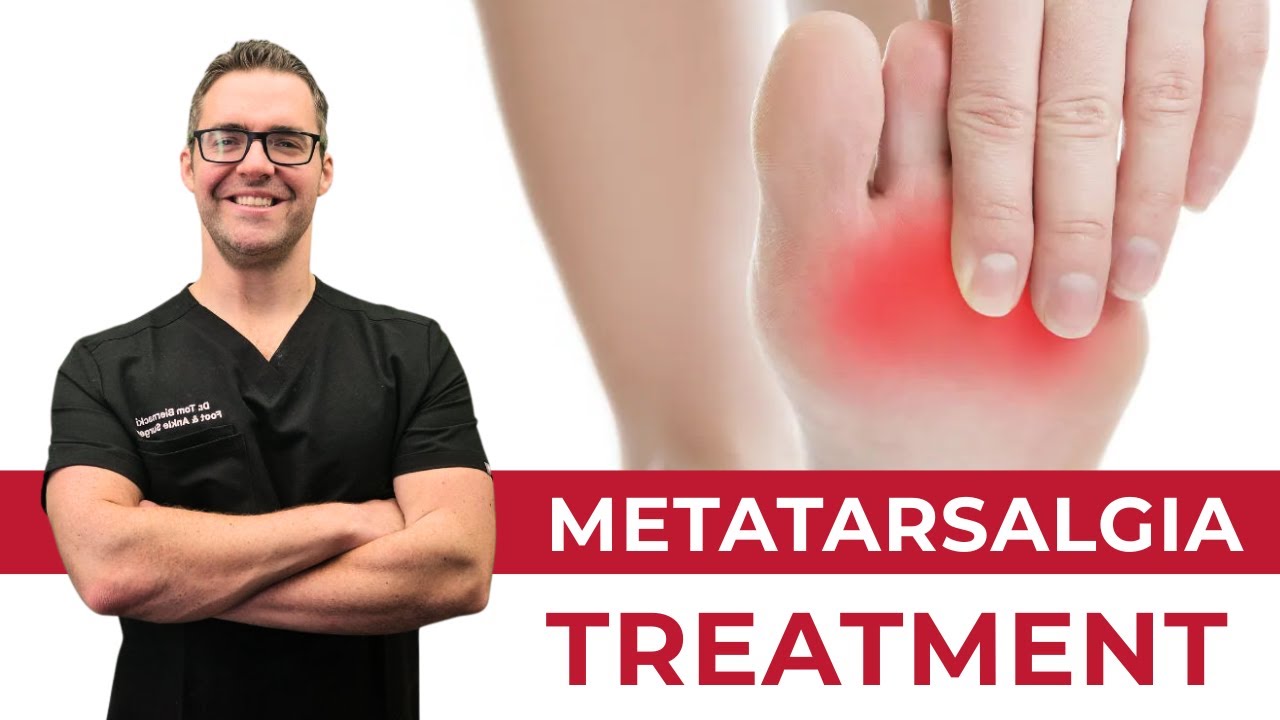
Watch: Metatarsalgia Treatment [BEST Ball of Foot Pain RELIEF 2024] — MichiganFootDoctors YouTube
Medically Reviewed | Dr. Tom Biernacki, DPM | Board-Certified Podiatric Surgeon | Balance Foot & Ankle, Michigan

Ball-of-foot pain is one of the most common complaints in podiatric practice—but “metatarsalgia” is a description of symptoms, not a specific diagnosis. Aching, burning, or sharp forefoot pain during walking can originate from a dozen different conditions, each requiring a different treatment approach. Getting the diagnosis right is everything. Dr. Tom Biernacki at Balance Foot & Ankle performs systematic diagnostic evaluation of every forefoot pain presentation to identify the true underlying cause before starting treatment.
Common Causes of Ball-of-Foot Pain
The differential diagnosis of metatarsalgia includes: (1) Biomechanical overload metatarsalgia—the most common; elevated metatarsal pressure from cavus foot, long second metatarsal (Morton’s foot), gastrocnemius-soleus tightness, high-heeled shoes, or insufficient shoe cushioning; (2) Second MTP synovitis and plantar plate tear—inflammatory degeneration of the second toe’s plantar plate ligament causing joint pain, swelling, and progressive toe deformity; (3) Morton’s interdigital neuroma—perineural fibrosis of a common digital nerve, usually between the third and fourth metatarsal heads; (4) Freiberg’s infraction—avascular necrosis of the second or third metatarsal head in adolescents and young adults; (5) Sesamoiditis—beneath the first metatarsal head; (6) Stress fractures—second and third metatarsals most commonly in runners; (7) Inflammatory arthritis—rheumatoid arthritis causes bilateral forefoot synovitis and eventual joint destruction.
Diagnostic Evaluation at Balance Foot & Ankle
Dr. Biernacki’s forefoot evaluation begins with precise location of maximal tenderness: plantar first metatarsal head (sesamoiditis), plantar second MTP (plantar plate), interspace compression between third and fourth heads (Morton’s neuroma), or diffuse across all heads (biomechanical metatarsalgia). The drawer test of the second MTP joint (vertical translation of the second toe) diagnoses plantar plate disruption. The web space compression test reproduces Morton’s neuroma pain. Weight-bearing X-rays assess metatarsal length pattern (Morton’s foot vs. Greek foot), Freiberg’s disease changes, and inflammatory arthritis erosions. MRI or ultrasound diagnoses plantar plate tears, neuromas, and Freiberg’s. Pedobarograph pressure mapping identifies areas of peak plantar pressure for orthotic prescription.
Conservative Treatment by Cause
For biomechanical overload: metatarsal pad placed just proximal to the affected head, custom orthotics with metatarsal dome, rocker-sole footwear, and Achilles stretching. For second MTP synovitis/plantar plate: metatarsal offloading, PRP or cortisone injection into the MTP joint (with caution—cortisone can accelerate plantar plate degeneration), and toe strapping. For Morton’s neuroma: wide-toe-box footwear, metatarsal pad, cortisone injection series, and ultrasound-guided alcohol sclerosing injections. For Freiberg’s infraction: metatarsal offloading with custom orthosis and rocker-sole shoe during the active osteonecrosis phase.
Surgical Options
Surgical treatment is cause-specific. Metatarsal osteotomy (Weil procedure) shortens or elevates the affected metatarsal head to reduce pressure for biomechanical overload unresponsive to orthotics. Plantar plate repair reconstructs the torn MTP ligament. Morton’s neuroma excision or decompression resolves neural impingement. Freiberg’s infraction surgery (dorsiflexion osteotomy or joint debridement) restores the metatarsal head architecture. Dr. Biernacki selects the procedure based on the confirmed etiology and lesion characteristics.
Dr. Tom's Product Recommendations
Pedag Viva Metatarsal Support Insole
⭐ Highly Rated
Pedag Viva insoles feature a precisely positioned metatarsal dome that offloads the metatarsal heads by spreading the transverse arch—directly addressing the biomechanical mechanism of metatarsalgia. The leather top cover with shock-absorbing latex provides all-day comfort. Trim-to-size for most footwear including dress shoes.
Best for: Biomechanical forefoot overload metatarsalgia; second MTP pain; Morton’s neuroma adjunct
Not ideal for: Active plantar plate tears without MTP joint stabilization; active sesamoid fractures
Disclosure: We earn a commission at no extra cost to you.
Altra Provision Running Shoe — Zero Drop Forefoot Room
⭐ Highly Rated
Altra shoes feature a wide, foot-shaped toe box with zero drop (equal heel-to-toe height) that reduces forefoot compression and metatarsal overload during running. The wide forefoot accommodates natural splay without squeezing metatarsal heads. Excellent recommendation for runners with biomechanical metatarsalgia or Morton’s neuroma.
Best for: Runners with metatarsalgia or Morton’s neuroma; patients needing forefoot width without sacrificing support
Not ideal for: Patients requiring significant heel-to-toe drop for Achilles issues; narrow feet needing snug toe box
Disclosure: We earn a commission at no extra cost to you.
✅ Pros / Benefits
- Systematic diagnostic evaluation identifies the specific metatarsalgia cause for targeted treatment
- Pedobarograph pressure mapping guides precise orthotic prescription for forefoot overload
- Ultrasound-guided Morton’s neuroma injection and alcohol sclerosing series available
❌ Cons / Risks
- Plantar plate tears may not heal conservatively and ultimately require surgical repair
- Freiberg’s infraction in an active phase may require extended metatarsal offloading and activity restriction
- Rheumatoid forefoot metatarsalgia requires rheumatology co-management for systemic disease control
Dr. Tom Biernacki’s Recommendation
Ball-of-foot pain is one of the most satisfying problems to work through diagnostically because there are so many distinct causes—and once you identify the right one, the treatment is usually clear and effective. I see patients who’ve been told ‘you have metatarsalgia, wear better shoes’ for two years. When we find a plantar plate tear on MRI or a Morton’s neuroma on ultrasound, suddenly there’s a real answer and a real treatment path. Come in and get a proper diagnosis.
— Dr. Tom Biernacki, DPM | Board-Certified Podiatric Surgeon | Balance Foot & Ankle
Frequently Asked Questions
What is the difference between a neuroma and metatarsalgia?
Metatarsalgia is the general term for ball-of-foot pain from any cause. A Morton’s neuroma (interdigital neuroma) is one specific cause—a thickening and inflammation of the common digital nerve, usually between the third and fourth metatarsal heads, producing shooting, burning pain into the toes and a feeling of walking on a pebble or bunched-up sock. Neuroma pain is typically more intense, neuralgic in quality, and specifically reproduced by squeezing the metatarsal heads laterally (Mulder’s click). A proper diagnosis distinguishes the two.
Will metatarsal pads cure my ball-of-foot pain?
A properly positioned metatarsal pad (placed just proximal to the painful metatarsal head, not under it) can provide significant relief for biomechanical overload metatarsalgia. However, it won’t cure a plantar plate tear, Freiberg’s disease, or Morton’s neuroma definitively. Most patients with metatarsalgia benefit from at least a trial of correctly positioned metatarsal padding combined with footwear modification—but persistent symptoms require further evaluation for structural causes.
What is Freiberg’s disease?
Freiberg’s infraction (also called Freiberg’s disease) is avascular necrosis of a metatarsal head—most commonly the second metatarsal head. The blood supply to the metatarsal head is interrupted, causing bone collapse and joint degeneration. It typically presents in adolescent girls (80% female) following repetitive microtrauma during growth. X-ray shows metatarsal head flattening and sclerosis. Treatment in early stages focuses on metatarsal offloading to prevent further collapse; advanced disease may require surgical debridement or osteotomy.
Should I see a podiatrist or orthopedist for ball-of-foot pain?
Podiatrists specialize in foot and ankle medicine—Dr. Biernacki manages the full spectrum of metatarsalgia causes including surgical treatment. If your metatarsalgia is related to a systemic condition like rheumatoid arthritis, co-management with rheumatology is coordinated. For isolated forefoot pain of mechanical or structural origin, a podiatrist is the appropriate specialist.
Michigan Foot Pain? See Dr. Biernacki In Person
4.9★ rated | 1,200+ Reviews | 3,000+ Surgeries
Book online 24/7 · Howell & Bloomfield Township
📞 (810) 206-1402 Book Online →Frequently Asked Questions
When should I see a doctor?
See a podiatrist if pain persists past 2 weeks, prevents normal activity, or is accompanied by red-flag symptoms (warmth, swelling, numbness, inability to bear weight).
Can I treat this at home?
Mild cases respond to RICE protocol (rest, ice, compression, elevation), supportive shoes, and OTC anti-inflammatories. Persistent symptoms need professional evaluation.
How long does it take to heal?
Most soft tissue injuries resolve in 2-6 weeks with appropriate care. Bone injuries take 6-12 weeks. Chronic conditions need longer-term management.
In-Office Treatment at Balance Foot & Ankle
If home treatment isn’t providing relief for your metatarsalgia, our podiatry team at Balance Foot & Ankle can help with expert evaluations and advanced in-office care.
Ready to Get Relief?
Book online 24/7 in Howell & Bloomfield Township, MI
4.9★ | 1,200+ Reviews | 3,000+ Surgeries
Or call: (810) 206-1402

Dr. Tom Biernacki, DPM is a board-certified foot & ankle surgeon (ABFAS & ABPM) at Balance Foot & Ankle Specialists in Southeast Michigan. With over a decade of clinical experience, he specializes in heel pain, bunions, diabetic foot care, sports injuries, and minimally invasive surgery. Dr. Biernacki is a member of the APMA and ACFAS, and his patient education content on MichiganFootDoctors.com and YouTube has made him one of the most-followed foot & ankle educators on YouTube.
More questions patients ask
What is metatarsalgia and what causes it?
Metatarsalgia is a clinical term for pain in the ball of the foot -- it is not a single diagnosis but rather a description of forefoot pain arising from any of several different causes; identifying the specific cause is the key to effective treatment. The anatomy of the ball of the foot: the ball of the foot (the padded area behind the toes) is formed by the metatarsal heads -- the five distal metatarsal bones that bear the body's weight during push-off; beneath the metatarsal heads is a specialized fat pad that cushions impact; the interdigital nerves, the MTP joint capsules, the plantar plates, the flexor tendons, and the intrinsic muscles all pass through or attach in this region; Common causes of metatarsalgia: central metatarsalgia from abnormal pressure distribution: the most common cause; when one metatarsal bears disproportionate load (from a long metatarsal, a cavus foot type, or transfer metatarsalgia from hallux valgus), the metatarsal head is overloaded and the plantar fat pad thins under chronic pressure; the skin calluses; the underlying metatarsal head becomes painful; Morton's neuroma: a thickened interdigital nerve (most commonly between the 3rd and 4th metatarsals) causing burning, numbness, and a foreign-body sensation in the forefoot; Freiberg's infraction: avascular necrosis of the 2nd metatarsal head (most commonly), producing a stiff, painful, swollen 2nd MTP joint; plantar plate tear: disruption of the plantar capsuloligamentous complex of the MTP joint (most commonly the 2nd), causing instability, crossover toe deformity, and forefoot pain; sesamoiditis: inflammation or stress fracture of the sesamoid bones under the 1st MTP joint; MTP joint synovitis: from inflammatory arthritis (RA, PsA, gout) or from repetitive overloading; Footwear factors: high heels transfer 60-70% of body weight to the forefoot; thin-soled shoes eliminate metatarsal head cushioning; narrow shoes compress the metatarsal heads together.
How is metatarsalgia treated?
Metatarsalgia treatment is directed at the specific cause, but several general principles apply to all causes of forefoot pain -- offloading, footwear modification, and pressure redistribution are the foundation. Footwear modification (the most effective and immediate intervention): the most impactful single change; a shoe with a wide toe box that does not compress the metatarsal heads; adequate forefoot cushioning; a rocker sole that reduces push-off loading at the metatarsal heads; eliminating high heels; shoes with a stiff sole that reduces metatarsal head pressure; Metatarsal pad: a small foam or silicone pad placed just proximal (behind) the metatarsal heads on the insole; when correctly positioned, the pad distributes metatarsal head pressure over a broader area, reducing the focal loading at the painful metatarsal heads; the positioning is critical -- the pad must be directly behind, not under, the metatarsal heads; Custom orthotics: for recurrent or persistent metatarsalgia, a custom orthotic with a built-in metatarsal support provides precise and durable pressure redistribution; addresses the underlying biomechanical contributors (hyperpronation, cavus foot, metatarsal length discrepancy); NSAIDs: for acute flares of forefoot pain; anti-inflammatory effect addresses synovitis and soft tissue inflammation; corticosteroid injection: into the specific MTP joint or interspace (for neuroma); provides temporary relief while conservative management takes effect; Cause-specific treatment: neuroma: interspace injection + footwear + pad; surgical excision if conservative management fails; plantar plate tear: metatarsal offloading, toe splinting to prevent crossover deformity; surgery (plantar plate repair) for complete tears; Freiberg's infraction: metatarsal offloading orthotic; surgical dorsiflexion osteotomy for advanced cases; sesamoiditis: sesamoid offloading orthotic; non-weight-bearing boot for fractures; Physical therapy: intrinsic foot muscle strengthening reduces metatarsal head loading; the intrinsic muscles stabilize the MTP joints and supplement the plantar fat pad cushioning.
What is the difference between metatarsalgia and a Morton's neuroma?
Metatarsalgia and Morton's neuroma both cause ball-of-foot pain, but they represent different pathological processes -- understanding the distinction helps patients seek appropriate care and helps clinicians direct the correct treatment. Metatarsalgia (general forefoot pain): a symptom, not a specific diagnosis; encompasses any pain in the ball of the foot; the pain is typically at the metatarsal head itself (beneath the head on the plantar surface); the character is aching, pressure-type pain from metatarsal overloading; it is worsened by weight-bearing and high heels; relieved by rest and shoe removal; there may be a callus directly under the painful metatarsal head (from the chronic pressure); there is typically no numbness, tingling, or burning -- these are neurological symptoms pointing to a nerve problem; Morton's neuroma: a specific diagnosis -- a fibrotic, thickened interdigital nerve in the third (or less commonly second) interspace; the pain is neurogenic in character: burning, electric, tingling, shooting pain radiating from the interspace into the affected toes; the hallmark symptoms: the sensation of walking on a pebble; numbness or tingling in the affected toe cleft; immediate dramatic relief when the shoe is removed; the pain is in the interspace (between the metatarsal heads) rather than under a single metatarsal head; Mulder's click: the definitive bedside test -- mediolateral forefoot compression while pressing in the interspace produces a palpable click or pop with pain reproduction; this is pathognomonic for neuroma; The diagnostic tests: metatarsalgia is typically diagnosed clinically and on X-ray (assessing metatarsal lengths, identifying stress fracture, Freiberg's infraction); neuroma is diagnosed clinically (Mulder's click, interspace tenderness, neurogenic symptoms) confirmed by ultrasound or MRI; The critical distinction: burning neurogenic pain + Mulder's click = neuroma; aching pressure pain + plantar callus under metatarsal head = metatarsalgia; both can coexist in the same foot.
When does metatarsalgia require surgery?
Most metatarsalgia resolves with conservative management -- surgery is reserved for specific structural causes that cannot be addressed non-operatively or for cases that have failed 3-6 months of appropriate conservative treatment. Surgical indications by cause: Weil metatarsal osteotomy (for central metatarsalgia from a long or elevated metatarsal): the metatarsal shaft is cut (osteotomy) and the distal segment is shortened and/or depressed (plantarflexed); by shortening the long metatarsal, the excessive pressure at that metatarsal head is reduced; the osteotomy heals over 6-8 weeks; return to regular footwear at 6-8 weeks; outcomes: good-to-excellent pain relief in 75-85% of patients; the most common complication: transfer metatarsalgia (pain shifts to the adjacent metatarsal if the Weil osteotomy shortens the metatarsal too aggressively); Morton's neuroma excision: when footwear, pads, and injections have failed after 3-6 months; the neurectomy is performed through a dorsal incision; the nerve is cut proximal to the neuroma; success rate: 75-85%; trade-off: permanent numbness in the affected toe cleft; Plantar plate repair: for plantar plate tears causing MTP instability and crossover toe deformity; the plantar plate is sutured back to its insertion with concurrent correction of the toe alignment; when surgery should be considered without a specific structural cause: persistent pain despite appropriate footwear modification, metatarsal pad, custom orthotics, and injection therapy for 3-6 months; exclusion of all specific treatable causes (stress fracture, neuroma, Freiberg's, plantar plate) -- if a specific diagnosis is established, treat that specific cause surgically; Realistic expectations: surgery for metatarsalgia without a clearly identified specific cause has less predictable outcomes than surgery for a specific lesion (neuroma, plantar plate tear, Freiberg's); identifying the specific pain generator before surgery is the most important determinant of surgical success.
Still have a question about coverage or cost? Book online and we will check your benefits before your visit: Book in Howell · Book in Bloomfield Township. Prefer to talk it through first? Call (810) 206-1402.