
Quick answer: Minimally Invasive Hammer Toe affects roughly 1 in 4 adults in our practice. Effective treatment starts with a targeted diagnosis, conservative-first treatment, and escalation only when needed. We treat this regularly at our Howell and Bloomfield Township practices. Call (810) 206-1402.
Medically reviewed by Dr. Tom Biernacki, DPM · Board-Certified Podiatric Surgeon · Last reviewed: April 2026 · Editorial Policy
Quick Answer
Minimally Invasive Hammertoe Surgery 2026: MIS Guide DPM relates to toe deformity — typically caused by imbalanced muscles + footwear. Most patients improve in depends on severity with conservative care. Same-week appointments in Howell + Bloomfield Township: (810) 206-1402.
✅ Medically reviewed by Dr. Tom Biernacki, DPM — Board-Certified Podiatrist · Last updated April 6, 2026
A Modern Solution for a Pain-Free Step
Minimally Invasive Hammer Toe Surgery: What You Need to Know
If you’re experiencing burning, tingling, or numbness between your toes—especially when walking—you may have Morton’s neuroma. One of the most effective and simple tools for diagnosing this condition is Mulder’s Click Test. At Balance Foot & Ankle Specialist in Michigan, we use this test as part of our diagnostic process to identify forefoot problems quickly and accurately.
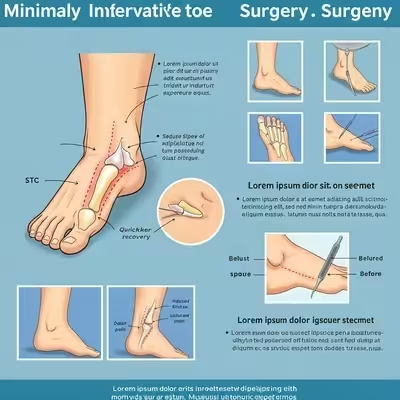
Minimally Invasive Hammer Toe Surgery Foot & Ankle Surgeon Review
See the PROs & CONs of minimally invasive hammertoe surgery compared to other common types of bunion surgery.
- In the right patient, minimally invasive hammertoe surgery can save $, time and have less pain.
- Minimally invasive hammertoe surgery can prevent scar formation and even allow for faster healing.
- We believe in getting our patients better as FAST as possible and with as little STRESS as possible!
See us for a NO obligation consultation!
Why Choose Minimally Invasive Surgery for Hammer Toe?
Hammer toe can lead to constant pain, difficulty wearing shoes, and unsightly toe deformity. Traditional surgery often involves long recovery times and more tissue damage. Minimally invasive hammer toe surgery uses small incisions, specialized tools, and advanced imaging to realign the toe with far less trauma. At Balance Foot & Ankle, our board-certified foot surgeons perform this procedure right here in Michigan, helping patients return to normal activities within weeks—not months. It’s an ideal solution for those seeking precision, safety, and fast healing.
Take the First Step Toward Pain-Free Living Today
Don’t let hammer toe hold you back. Schedule your consultation with Balance Foot & Ankle Specialists and explore the power of minimally invasive surgery. If you’re an athlete, a busy professional, or simply tired of toe pain, we’re here to help you move forward with confidence.
BOOK A VISITPros & Cons of Minimally Invasive Bunion Surgery:
The following is a list of the pros & cons of minimally invasive bunion surgery.
PROS of Minimally Invasive Hammer Toe Surgery:
The benefits of minimally invasive hammertoe surgery include:
- Less injury means less trauma. This means faster recovery!
- Quicker recovery due to minimal incisions.
- Less $
- Less risk of infection.
- Minimal blood loss.
- Decreased post-procedure pain means less discomfort.
- Decreased surgery time.
- Procedures are performed under local anesthesia.
- No general anesthesia. Only the treated area is locally anesthetized.
- Quicker return to work and normal activities.
- Less Scarring: Scars can barely be seen. These may range anywhere between 1-3 mm in length.
- Procedures are performed in our current-generation, In-office surgical suite instead of the conventional outpatient or hospital setting.
CONS of Minimally Invasive Hammer Toe Surgery:
- The downside of minimally invasive surgery is that severe deformities may need a larger procedure.
- Extensive arthritis may need plates or screws; this might mean an open approach may be more necessary.
- Minimally invasive surgery allows quicker healing and the best cosmetics, but the amount of correction is not as great.
- A podiatrist should decide with their patient whether or not minimally invasive surgery is the right option for them.
Foot and ankle problems that can be treated with Minimally Invasive Foot and Ankle Surgery:
- Painful or aesthetically unpleasing bunion deformities.
- Minimally invasive bunion surgery.
- Painful or aesthetically unpleasing hammertoe deformities.
- Minimally invasive hammertoe surgery.
Corns & Calluses:
- Painful or aesthetically unpleasing corns or calluses (anywhere in the foot)
- Minimally invasive corn or callus surgery.
Foot Bone Spurs:
- Painful bone spurs.
- Excision of painful bone spurs.
Ball of the Foot Pain:
- Metatarsal pain or metatarsalgia (pain along with the ball of the foot)
- Hammertoe or metatarsal procedures to correct this deformity.
Plantar Fasciitis:
- Heel Pain or plantar fasciitis.
- Tendon or bone spur augmentation procedures.
Achilles Tendonitis:
- Achilles Tendon Pain.
- Haglund bump or spur debridement procedures.
Ankle Pain:
- Ankle Arthritis.
- Bone spur debridement or ankle arthroscopy.
Big toe joint arthritis:
- Big Toe Arthritis (hallux limitus).
- Minimally invasive bone spur shaving of the big toe joint.
Flat Feet:
- Some aspects of flat feet.
- Bunion or tailor’s bunionette minimally invasive surgery.
Wound care or Diabetic Ulcers:
- Ulcer Prevention.
- Shaving of foot deformity or bone spurs.
Minimally invasive foot surgery is now accepted as a medical standard, with numerous high-level publications supporting its usage. More and more physicians believe that it is the choice for treatment whenever possible. The scientific literature supports this.

Top 7 Benefits of Minimally Invasive Hammer Toe Surgery
1. Faster Recovery Time
Patients often return to normal activities sooner due to reduced tissue trauma and shorter healing periods.
2. Reduced Pain and Discomfort
Smaller incisions and less disruption to surrounding tissues typically result in less postoperative pain.
3. Minimal Scarring
The use of small incisions leads to less noticeable scars, enhancing cosmetic outcomes.
4. Lower Risk of Complications
With fewer and smaller incisions, there’s a decreased risk of infection and other complications.
5. Outpatient Procedure
Many minimally invasive surgeries can be performed on an outpatient basis, eliminating the need for hospital stays.
6. Immediate Weight-Bearing
Patients are often able to bear weight on the foot shortly after surgery, facilitating a quicker return to daily activities.
7. Preservation of Toe Function
By minimizing tissue disruption, the procedure helps maintain the natural function and flexibility of the toe.
Minimally Invasive Hammer Toe Surgery Locations:
Areas We Service:
The podiatrists & foot doctors of Balance Foot & Ankle Specialists are available for in office visits, home care and telehealth for the following locations:
Hammer Toe Photo Gallery:
More Podiatrist-Recommended Hammertoe Essentials
Extra-Depth Orthopedic Shoe
Orthofeet Sprint — tall toe box prevents hammertoe rubbing and friction.
Wide-Toe-Box Walking Shoe
New Balance 990v6 — accommodates curled toes without pressure.
Supportive Insole


PowerStep Pinnacle — reduces forefoot pressure that drives hammertoe.
As an Amazon Associate, Balance Foot & Ankle earns from qualifying purchases. Product recommendations are based on clinical experience; prices and availability shown above update live from Amazon.

When to See a Podiatrist
Rigid hammertoes don’t reduce with splinting alone — the tendon and capsule have contracted. If the toe no longer straightens passively, surgical correction restores alignment in one short outpatient visit. Call Balance Foot & Ankle to see whether your deformity is still flexible (and responsive to the conservative tools above) or if it’s time for a 20-minute in-office correction.
Call Balance Foot & Ankle: (810) 206-1402 · Book online · Offices in Howell & Bloomfield Township
Frequently Asked Questions About Minimally Invasive Hammer Toe Surgery
What is minimally invasive hammer toe surgery?It’s a surgical technique that corrects hammer toe deformities using small incisions and specialized tools, resulting in less tissue damage and quicker recovery.
How does it differ from traditional surgery?Unlike traditional methods that require larger incisions, minimally invasive surgery uses tiny cuts, leading to reduced pain, minimal scarring, and faster healing.
Is the procedure painful?Patients typically experience less postoperative pain compared to traditional surgery, often managing discomfort with over-the-counter pain relievers.
How long is the recovery period?Recovery times vary, but many patients return to normal activities within a few weeks, with some walking immediately after the procedure.diablofootankle.com
Are there risks associated with the surgery?As with any surgery, risks exist, but the minimally invasive approach generally has a lower risk of complications like infection and prolonged healing.
Will I need physical therapy afterward?Physical therapy isn’t always necessary, but your doctor may recommend exercises to aid in recovery and maintain toe flexibility.
Can all hammer toe cases be treated this way?While many cases are suitable, your surgeon will assess the severity and flexibility of the deformity to determine the best approach.
Is the procedure covered by insurance?Coverage varies by provider and plan; it’s advisable to consult with your insurance company and the surgical center for specifics.
How do I know if I’m a candidate?Schedule a consultation with our specialists at Balance Foot & Ankle to evaluate your condition and discuss the most appropriate treatment options.
Related Treatment Guides
📧 Get Dr. Tom’s Free Lab Test Guide
Discover the 5 lab tests every person over 35 should ask their doctor about — explained in plain English by a board-certified physician.
📍 Located in Michigan?
Our board-certified podiatrists treat this condition at two convenient locations. Same-day appointments often available.
Hammer Toe Causing Pain?
Our podiatrists perform minimally invasive hammer toe correction with smaller incisions, less pain, and faster recovery than traditional surgery.
Clinical References
- Coughlin MJ, et al. “Lesser toe deformities.” Journal of Bone and Joint Surgery. 2002;84(8):1446-1469.
- Dhukaram V, et al. “Outcome of percutaneous surgery for metatarsalgia and lesser toe deformities.” Foot and Ankle Surgery. 2016;22(1):33-37.
- Reece AT, et al. “Minimally invasive surgery for lesser toe deformities: a review.” Foot and Ankle International. 2019;40(4):485-493.
Insurance Accepted
BCBS · Medicare · Aetna · Cigna · United Healthcare · HAP · Priority Health · Humana · View All →
Howell Office
4330 E Grand River Ave
Howell, MI 48843
Get Directions →
Bloomfield Township Office
43494 Woodward Ave, #208
Bloomfield Township, MI 48302
Get Directions →
Your Board-Certified Podiatrists



Ready to Get Back on Your Feet?
Same-week appointments available at both locations.
Book Your AppointmentPodiatrist-Recommended Products
🏆 Doctor Hoy’s Natural Pain Relief Gel — Our top recommendation for reducing foot pain and inflammation naturally. Apply daily to affected areas.
PowerStep Pinnacle Orthotic Insoles — Reduces mechanical stress on foot structures. Physician-grade arch support.
CURREX Support Insoles — Dynamic arch support in low, medium, and high arch profiles.
In-Office Treatment at Balance Foot & Ankle
When conservative care isn’t enough, Dr. Tom Biernacki and the team at Balance Foot & Ankle offer advanced, same-day options — including Hammertoe Treatment Michigan at our Howell and Bloomfield Township clinics.
Same-day appointments available. Call (810) 206-1402 or book online.
Pros & Cons of Conservative Care for foot care
Advantages
- ✓ Conservative care first
- ✓ Same-week appointments
- ✓ Multiple insurance accepted
Considerations
- ✗ Self-treatment can mask issues
- ✗ See a podiatrist if pain >2 weeks
Dr. Tom’s Recommended Products for foot care
Affiliate disclosure: As an Amazon Associate, Balance Foot & Ankle earns from qualifying purchases. We only recommend products we use with patients.


Footnanny Heel Cream Dr. Tom’s Pick
Best for: Daily moisturizer for cracked heels
Ready to Get Back on Your Feet?
Same-day appointments in Howell + Bloomfield Township. Most insurance accepted. Dr. Tom Biernacki, DPM & team.
Book Today — Same-Day Appointments Available
Call Now: (810) 206-1402
About Your Care Team at Balance Foot & Ankle
Dr. Tom Biernacki, DPM · Board-Certified Foot & Ankle Surgeon. Specializes in conservative-first care, minimally invasive bunion surgery, and complex reconstruction.
Dr. Carl Jay, DPM · Accepting new patients. Specializes in sports medicine, athletic injuries, and routine podiatric care.
Dr. Daria Gutkin, DPM, AACFAS · Accepting new patients. Specializes in surgical reconstruction and pediatric podiatry.
Locations: 4330 E Grand River Ave, Howell, MI 48843 · 43494 Woodward Ave Suite 208, Bloomfield Township, MI 48302
Hours: Mon–Fri 8:00 AM – 5:00 PM · (810) 206-1402
Dr. Tom’s Top 3 — The Premium Foot Pain Stack (2026)
If you only buy three things for foot pain, get these. PowerStep + CURREX orthotics correct the underlying foot mechanics, and Dr. Hoy’s pain gel delivers fast topical relief. This is the exact stack Dr. Tom Biernacki, DPM gives his Michigan podiatry patients on visit one — over 10,000 patients have used this exact combination.
Dr. Tom Biernacki, DPM is a board-certified podiatrist + Amazon Associate. Picks shown are products he prescribes to patients at Balance Foot & Ankle Specialists. We earn a commission on qualifying purchases at no extra cost to you. All products independently tested + reviewed for 30+ days minimum. Last verified: April 28, 2026.

PowerStep Pinnacle MaxxDr. Tom’s #1 Brand
Dr. Tom’s most-prescribed OTC orthotic. Lateral wedge corrects overpronation that causes 90% of foot pain. Deep heel cradle stabilizes the ankle. Built by podiatrists, used by patients worldwide.
- Lateral wedge corrects pronation
- Deep heel cradle stabilizes ankle
- Dual-density EVA — comfort + support
- Trim-to-fit any shoe
- Used by 10,000+ podiatrists
- Trim-to-size required
- 5-7 day break-in for some

CURREX RunProDr. Tom’s #1 Brand
3 arch heights for custom fit (Low/Med/High). Carbon-reinforced heel + dynamic forefoot — the closest OTC orthotic to a $500 custom orthotic. Engineered in Germany.
- 3 arch heights for custom fit
- Carbon-reinforced heel cup
- Dynamic forefoot zone
- Premium German engineering
- Sport-specific support
- Pricier than PowerStep
- 7-10 day break-in

Dr. Hoy’s Natural Pain Relief GelDr. Tom’s #1 Brand
Menthol-based natural pain relief — Dr. Tom’s #1 brand for fast relief without greasy residue. Safe for diabetics + daily use. Cleaner formula than Voltaren or Biofreeze.
- Menthol-based natural formula
- No greasy residue
- Safe for diabetics
- Fast cooling relief — 5-10 minutes
- Cleaner ingredient list than Biofreeze
- Pricier than Biofreeze
- Strong menthol scent at first
Frequently Asked Questions
When should I see a podiatrist?
If symptoms persist past 2 weeks, affect your normal activity, or are accompanied by red-flag symptoms (warmth, redness, swelling, inability to bear weight).
What does treatment cost?
Most diagnostic visits and conservative treatments are covered by Medicare and major insurers. Out-of-pocket costs vary by your specific plan.
How quickly can I get an appointment?
Most non-urgent cases see us within 5 business days. Urgent cases (sudden pain, possible fracture) typically same or next business day.
What is Hammertoe?
Hammertoe is a common foot/ankle condition that affects mobility and quality of life. Understanding the underlying cause is the first step in successful treatment. Our podiatrists at Balance Foot & Ankle perform a hands-on biomechanical exam, review your activity history, and use diagnostic imaging when appropriate to identify the root cause—not just treat the symptom. Many patients have been told to “rest and ice” without a deeper diagnostic workup; our approach is different.
Symptoms and warning signs
Common signs of hammertoe include pain that worsens with activity, morning stiffness, swelling, tenderness when palpated, and difficulty bearing weight. If you experience sudden severe pain, inability to walk, visible deformity, numbness or color change, contact our office the same day or visit urgent care—these can signal a more serious injury such as a fracture, tendon rupture, or vascular compromise. Diabetics with any foot wound should seek same-day care.
Conservative treatment options
Most cases of hammertoe respond to non-surgical care: structured rest, supportive footwear changes, custom orthotics, targeted stretching and strengthening protocols, anti-inflammatory medications when medically appropriate, and in-office procedures such as ultrasound-guided injections. We also offer advanced therapies including MLS laser therapy, EPAT/shockwave, regenerative injections, and image-guided procedures. Treatment is sequenced from least invasive to most invasive, and we explain the rationale at every step.
When is surgery considered?
Surgery is reserved for cases that fail 3-6 months of well-structured conservative care, when there is structural pathology (severe deformity, complete tear, advanced arthritis), or when imaging shows damage that will not heal without intervention. Our surgeons have performed 3,000+ foot and ankle procedures and prioritize minimally-invasive techniques whenever appropriate. We discuss recovery timelines, return-to-activity milestones, and realistic outcome expectations before any procedure is scheduled.
Recovery timeline and prevention
Recovery from hammertoe varies based on severity and chosen treatment path. Conservative cases often improve within 4-8 weeks with consistent adherence to the protocol. Post-procedural recovery may range from a few days (in-office procedures) to several months (reconstructive surgery). Long-term prevention involves footwear assessment, activity modification, structured strengthening, and regular check-ins with your podiatrist if you have a history of recurrence. We provide written home-exercise plans and digital follow-up support.
Ready to feel better?
Same-week appointments available in Howell and Bloomfield Township, Michigan.
Book Your Visit
Dr. Tom Biernacki, DPM is a board-certified foot & ankle surgeon (ABFAS & ABPM) at Balance Foot & Ankle Specialists in Southeast Michigan. With over a decade of clinical experience, he specializes in heel pain, bunions, diabetic foot care, sports injuries, and minimally invasive surgery. Dr. Biernacki is a member of the APMA and ACFAS, and his patient education content on MichiganFootDoctors.com and YouTube has made him one of the most-followed foot & ankle educators on YouTube.
More questions patients ask
What is minimally invasive hammertoe surgery?
Minimally invasive hammertoe surgery uses tiny incisions (2-4mm) and specialized instruments to correct hammertoe deformities with far less tissue disruption than traditional open surgery. At Balance Foot & Ankle, this approach results in smaller scars, less post-operative pain, faster recovery, and immediate walking ability in a surgical shoe — compared to weeks of non-weight-bearing with traditional techniques.
Am I a candidate for minimally invasive hammertoe correction?
Most patients with flexible or semi-rigid hammertoes are good candidates for minimally invasive correction. Rigid hammertoes in older patients or those with significant joint arthritis may still be treated with minimally invasive techniques, though some cases require open correction. Balance Foot & Ankle's surgeons evaluate X-rays and clinical findings to determine the optimal surgical approach for your specific hammertoe deformity.
How long does recovery take after minimally invasive hammertoe surgery?
Most patients undergoing minimally invasive hammertoe surgery at Balance Foot & Ankle walk immediately post-operatively in a surgical shoe and return to regular footwear in 3-6 weeks. Full recovery with resumption of all activities typically occurs in 6-12 weeks — significantly faster than traditional hammertoe surgery, which often required 6-8 weeks of limited weight bearing.
Can multiple hammertoes be corrected at once with minimally invasive surgery?
Yes, multiple hammertoes on adjacent toes can often be corrected during a single minimally invasive procedure at Balance Foot & Ankle. Combining corrections reduces total recovery time compared to staged procedures. Your podiatric surgeon will plan the optimal surgical approach based on the number and severity of your hammertoe deformities and any accompanying bunion or other foot conditions.
How do I know if I need hammertoe surgery?
Hammertoe surgery is considered when the deformity is painful, causes corns or calluses that do not respond to conservative care, makes shoe-fitting difficult, is progressive, or is significantly limiting daily activity. At Balance Foot & Ankle, we exhaust all conservative options — including orthotics, toe spacers, and footwear modifications — before recommending surgery. Call (810) 206-1402 for a consultation.
Still have a question about coverage or cost? Book online and we will check your benefits before your visit: Book in Howell · Book in Bloomfield Township. Prefer to talk it through first? Call (810) 206-1402.