


Peroneus longus tendon rupture causes lateral arch pain and weakness — and unlike most tendon injuries, the diagnosis is often delayed until function is significantly compromised. Imaging clarifies it.
You’ve come to the right podiatry team. Dr. Tom Biernacki, DPM, FACFAS — board-certified foot & ankle surgeon with 3,000+ surgeries — explains exactly what peroneus longus tendon rupture means and what works. Call (810) 206-1402 for same-day appointment at Howell or Bloomfield Township.
Quick answer: Peroneus Longus Tendon Rupture Lateral Arch Pain Guide has multiple potential causes including mechanical, neurological, vascular, and inflammatory. The patterns we see most often are overuse, poorly-fitted shoes, and biomechanical imbalance. Red flags requiring urgent evaluation: warmth/redness (infection), inability to bear weight (fracture), and unilateral swelling without injury (DVT). Call (810) 206-1402.
Medically reviewed by Dr. Tom Biernacki, DPM · Board-Certified Podiatric Surgeon · Last reviewed: April 2026 · Editorial Policy
The most important clinical decision with peroneus longus tendon rupture isn’t which treatment to start with — it’s identifying the correct subtype. That changes everything. Call (810) 206-1402.
Quick Answer
Peroneus longus rupture causes lateral foot pain and can destabilise the arch. It is easily mistaken for a chronic ankle sprain, and imaging helps confirm the tendon rather than the ligaments is the problem. Same-week appointments in Howell + Bloomfield Township: (810) 206-1402.

Medically reviewed by Dr. Tom Biernacki, DPM — Board-Certified Podiatric Surgeon — Balance Foot & Ankle, Howell & Bloomfield Township, MI. Last updated April 2026.
▶ Watch
Medically Reviewed by Dr. Tom Biernacki, DPM — Board-Certified Podiatrist, Balance Foot & Ankle Specialists, Michigan. Last updated April 2026.
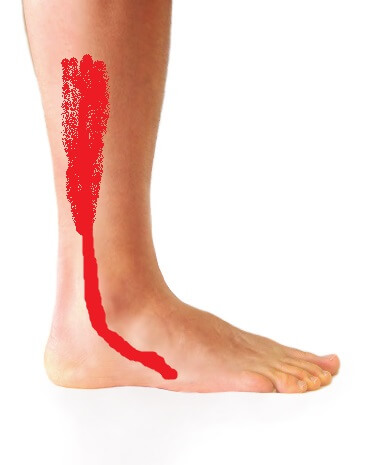
The peroneus longus tendon travels from the fibula to the plantar surface of the first metatarsal base, coursing around the lateral ankle and under the cuboid through the peroneal groove. Unlike the better-known peroneus brevis tears, peroneus longus rupture is underdiagnosed — producing lateral midfoot and plantar arch pain rather than the posterior ankle pain clinicians often associate with peroneal pathology.
Anatomy and Function of the Peroneus Longus
The peroneus longus and peroneus brevis are the primary evertors of the ankle and secondary plantar flexors. However, their functional roles differ importantly: the peroneus brevis primarily everts and prevents ankle inversion; the peroneus longus plantarflexes the first metatarsal, maintaining the medial column of the foot’s weight-bearing position and supporting the transverse arch.
The peroneus longus has three sites of potential pathology: the retromalleolar groove behind the fibula (shared with the peroneus brevis, the site of most peroneal pathology), the peroneal tubercle on the lateral calcaneus, and the peroneal groove of the cuboid (the os peroneum, a sesamoid bone within the PLT at the cuboid, is present in 10–26% of people and is vulnerable to fracture with PLT tears).
Mechanism and Risk Factors
Peroneus longus rupture typically occurs at the cuboid groove — a sharp, anatomically fixed angle that concentrates mechanical stress. Mechanisms include acute inversion ankle sprain with plantarflexion (particularly in obese patients), repetitive loading in cavus foot (increased PLT tension from the high first ray), and os peroneum fracture (the sesamoid fractures with avulsion force, propagating into the tendon). Rupture at the retromalleolar groove or musculotendinous junction is less common.
The cavovarus foot is specifically associated with PLT pathology — the plantarflexed first ray chronically overloads the PLT, leading to progressive tendinopathy, partial tearing, and ultimately complete rupture.
Clinical Presentation
PLT rupture produces lateral midfoot pain — sometimes confused with cuboid syndrome, lateral plantar fasciitis, or fifth metatarsal stress fracture. Chronic PLT insufficiency allows the first ray to dorsiflex (rise), destabilizing the medial column and producing a new-onset flatfoot deformity in a patient who previously had a normal or high arch. This pattern — a cavus foot patient developing progressive arch collapse — should strongly suggest PLT rupture.
Tenderness at the cuboid groove (plantar-lateral foot), pain with resisted plantarflexion of the first ray, and weakness of ankle eversion are clinical clues. X-ray of the foot may show fracture or fragmentation of the os peroneum at the cuboid. MRI is diagnostic, showing PLT signal abnormality, discontinuity, or complete rupture with retraction.
Treatment: Surgical Repair and Reconstruction
Acute PLT ruptures diagnosed within 6 weeks of injury may be primarily repaired through an incision over the lateral foot at the cuboid. Chronic ruptures with tendon retraction require reconstruction using a graft (most commonly flexor hallucis longus transfer) to restore first ray plantarflexion stability. Os peroneum fractures are excised if they prevent tendon repair. Concomitant lateral ankle ligament reconstruction addresses any underlying instability. Postoperative non-weight-bearing for 6 weeks, then progressive loading in a boot over 4–6 weeks, with return to full activity at 4–6 months.
At Balance Foot & Ankle, Dr. Biernacki evaluates lateral midfoot and peroneal tendon pain with ultrasound and MRI at both Bloomfield Township and Howell offices. Early diagnosis of PLT rupture before arch collapse develops significantly improves outcomes. Call (810) 206-1402 for a lateral foot pain evaluation.
Schedule Your Appointment at Balance Foot & Ankle
Board-certified podiatric physician and surgeon serving Southeast Michigan from Bloomfield Township and Howell.
📞 (810) 206-1402 |
📧 Get Dr. Tom’s Free Lab Test Guide
Discover the 5 lab tests every person over 35 should ask their doctor about — explained in plain English by a board-certified physician.
📍 Located in Michigan?
Our board-certified podiatrists treat this condition at two convenient locations. Same-day appointments often available.

Insurance Accepted
BCBS · Medicare · Aetna · Cigna · United Healthcare · HAP · Priority Health · Humana · View All →
Howell Office
4330 E Grand River Ave
Howell, MI 48843
Get Directions →
Bloomfield Township Office
43494 Woodward Ave, #208
Bloomfield Township, MI 48302
Get Directions →
Your Board-Certified Podiatrists



Ready to Get Back on Your Feet?
Same-week appointments available at both locations.
Book Your AppointmentMore Podiatrist-Recommended Plantar Fasciitis Essentials
Best Night Splint


Keeps fascia stretched overnight — the #1 intervention for morning heel pain.
Top Podiatrist-Recommended Insole

Deep heel cup + arch support unloads the plantar fascia all day.
Plantar Fasciitis Compression Sock

Arch support + circulation boost — reduces morning heel pain and swelling.
As an Amazon Associate, Balance Foot & Ankle earns from qualifying purchases. Product recommendations are based on clinical experience; prices and availability shown above update live from Amazon.
When to See a Podiatrist
If morning heel pain has persisted more than 6 weeks, home care alone rarely fixes it. At Balance Foot & Ankle, we combine in-office ultrasound diagnostics, custom orthotics, and — when needed — shockwave or PRP to resolve plantar fasciitis that hasn’t responded to stretching and inserts. Most patients are walking pain-free within 4-8 weeks of starting a structured plan.
Call Balance Foot & Ankle: (810) 206-1402 · Book online · Offices in Howell & Bloomfield Township
Differential Diagnosis: What Else Could It Be?
Not every case of peroneal tendonitis is straightforward. In our clinic we routinely rule out three look-alike conditions before confirming the diagnosis. If your symptoms don’t match the classic presentation, one of these may explain the pain — which is why physical exam matters more than self-diagnosis.
| Condition | How It Differs |
|---|---|
| Lateral ankle sprain | Acute inversion mechanism, bruising along anterior talofibular ligament, pain with anterior drawer. |
| 5th metatarsal base stress fracture | Point tenderness at 5th metatarsal base, pain with weight-bearing, fracture line on imaging. |
| Sinus tarsi syndrome | Deep ache in the sinus tarsi, pain reproduced with lateral palpation just anterior to the lateral malleolus. |
Red Flags — When to See a Podiatrist Now
Seek same-day evaluation at Balance Foot & Ankle if you notice any of the following:
- Snapping or popping behind the lateral malleolus (subluxation)
- Inability to evert the foot actively
- Persistent lateral ankle swelling >4 weeks
- Sudden pop with inability to continue walking
Call (810) 206-1402 or request an appointment. Our Howell and Bloomfield Township offices reserve same-day slots for urgent foot and ankle issues.
In Our Clinic: What We See
Clinical perspective from Dr. Tom Biernacki, DPM — Balance Foot & Ankle, Howell & Bloomfield Township, MI:
In our clinic, peroneal tendonitis patients usually come in after a recent ankle sprain — the pain started as a “sprain that didn’t fully heal.” They report lateral ankle pain that’s worse with turning the foot outward or walking on uneven surfaces. On exam we palpate specifically along the peroneal tendons behind the fibula and resist eversion. If we feel or see snapping behind the lateral malleolus, that’s peroneal subluxation, which usually needs surgical repair. Isolated peroneal tendonitis responds well to ankle bracing, peroneal eccentric strengthening, and temporary activity modification.
Watch: Dr. Tom explains
Podiatrist-recommended products
As an Amazon Associate, Dr. Tom earns from qualifying purchases.
Lateral support for peroneal tendon recovery.
View on Amazon →Arch control that offloads peroneals.
View on Amazon →Post-op swelling and recovery support.
View on Amazon →Topical comfort for lateral pain.
View on Amazon →Related resources
Ready to solve this? Book today.
Same-week appointments · Howell & Bloomfield Township · 4.9★ (1,123+ reviews)
☎ (810) 206-1402Book Online →Pros & Cons of Conservative Care for foot care
Advantages
- ✓ Conservative care first
- ✓ Same-week appointments
- ✓ Multiple insurance accepted
Considerations
- ✗ Self-treatment can mask issues
- ✗ See a podiatrist if pain >2 weeks
Dr. Tom’s Recommended Products for foot care
Affiliate disclosure: As an Amazon Associate, Balance Foot & Ankle earns from qualifying purchases. We only recommend products we use with patients.
Footnanny Heel Cream Dr. Tom’s Pick
Best for: Daily moisturizer for cracked heels
Ready to Get Back on Your Feet?
Same-day appointments in Howell + Bloomfield Township. Most insurance accepted. Dr. Tom Biernacki, DPM & team.
Book Today — Same-Day Appointments Available
Call Now: (810) 206-1402
About Your Care Team at Balance Foot & Ankle
Dr. Tom Biernacki, DPM · Board-Certified Foot & Ankle Surgeon. Specializes in conservative-first care, minimally invasive bunion surgery, and complex reconstruction.
Dr. Carl Jay, DPM · Accepting new patients. Specializes in sports medicine, athletic injuries, and routine podiatric care.
Dr. Daria Gutkin, DPM, AACFAS · Accepting new patients. Specializes in surgical reconstruction and pediatric podiatry.
Locations: 4330 E Grand River Ave, Howell, MI 48843 · 43494 Woodward Ave Suite 208, Bloomfield Township, MI 48302
Hours: Mon–Fri 8:00 AM – 5:00 PM · (810) 206-1402
Frequently Asked Questions
When should I see a doctor?
See a podiatrist if pain persists past 2 weeks, prevents normal activity, or is accompanied by red-flag symptoms (warmth, swelling, numbness, inability to bear weight).
Can I treat this at home?
Mild cases respond to RICE protocol (rest, ice, compression, elevation), supportive shoes, and OTC anti-inflammatories. Persistent symptoms need professional evaluation.
How long does it take to heal?
Most soft tissue injuries resolve in 2-6 weeks with appropriate care. Bone injuries take 6-12 weeks. Chronic conditions need longer-term management.
In-Office Treatment at Balance Foot & Ankle
If home treatment isn’t providing relief for your Achilles tendon conditions, our podiatry team at Balance Foot & Ankle can help with same-day evaluations and advanced in-office care.
Same-day appointments available. (810) 206-1402
Ready for Expert Care?
Same-day appointments in Howell & Bloomfield Township, MI.
4.9★ | 1,123 Reviews | 3,000+ Surgeries
Or call: (810) 206-1402

Dr. Tom Biernacki, DPM is a board-certified foot & ankle surgeon (ABFAS & ABPM) at Balance Foot & Ankle Specialists in Southeast Michigan. With over a decade of clinical experience, he specializes in heel pain, bunions, diabetic foot care, sports injuries, and minimally invasive surgery. Dr. Biernacki is a member of the APMA and ACFAS, and his patient education content on MichiganFootDoctors.com and YouTube has made him one of the most-followed foot & ankle educators on YouTube.