
Quick answer: Treatment for plantar keratosis treatment follows a stepwise approach: 1) conservative care first (rest, ice, supportive footwear, OTC anti-inflammatories), 2) physical therapy and targeted exercises, 3) in-office treatments (injections, custom orthotics) if conservative fails at 4-6 weeks, 4) surgery for refractory cases. Most patients resolve at step 1 or 2. Book online or call (810) 206-1402.
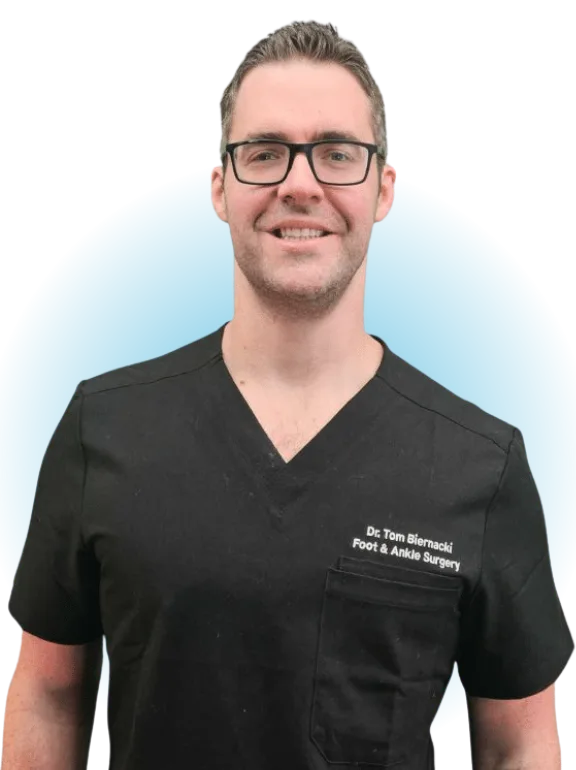
Medically Reviewed | Dr. Tom Biernacki, DPM | Board-Certified Podiatric Surgeon | Balance Foot & Ankle, Michigan

What Is Plantar Keratosis?
Plantar keratosis (also called intractable plantar keratosis, or IPK) refers to a dense, painful callus formation on the plantar (bottom) surface of the foot. Unlike diffuse callus from generalized pressure, an intractable plantar keratosis is focal—typically concentrated under one or two metatarsal heads—and has a seed-like hard core that is distinctly painful with direct pressure.
The distinction between plantar keratosis types is clinically important because treatment differs: (1) Discrete IPK is a small, very focal, highly painful lesion typically under the 2nd or 3rd metatarsal head, often with a hard white seed at its center—caused by a single, prominently dropped metatarsal. It is often confused with a plantar wart (verruca plantaris). (2) Diffuse IPK is a broad area of callus under one or more metatarsal heads, less focally painful, caused by generalized metatarsal overload rather than a single structural prominence. These require different management.
The seed-like nucleus of a discrete IPK differs from a plantar wart in that it is comprised of compressed keratin—dead skin—rather than virally infected skin. Distinguishing features: squeezing a plantar wart sideways causes more pain than direct pressure; squeezing an IPK causes less pain than direct pressure. Warts also interrupt the skin’s normal dermatoglyphic lines (skin prints), which IPK does not. These distinctions are important because acid treatment for warts applied to an IPK (or vice versa) is ineffective and potentially harmful.
Conservative and Podiatric Treatment
Conservative management of plantar keratosis: custom orthotics with metatarsal pads or metatarsal bars to redistribute pressure off the prominent metatarsal head—this is the most effective long-term approach because it addresses the structural cause; footwear modification with extra-depth, wide-toe-box shoes; and regular debridement to manage symptomatic callus buildup.
Podiatric debridement (sharp scalpel debridement under sterile technique) removes the lesion and its core, providing immediate pain relief. Debridement every 4–8 weeks manages symptomatic lesions. Adding topical salicylic acid (applied precisely to the lesion, avoiding surrounding skin) between debridement visits reduces recurrence rate and depth of buildup.
Patient self-care: emollient foot cream containing urea (20–40%) applied daily softens plantar keratosis and reduces thickness. Pumice stone use after soaking reduces surface callus. Do NOT use salicylic acid corn pads if you have diabetes, poor circulation, or neuropathy—use only under podiatric guidance.
Surgical Options for Intractable Cases
When discrete IPK fails conservative management—continuing to be severely painful despite orthotics, appropriate footwear, and regular debridement—surgical options address the underlying bony prominence.
Metatarsal osteotomy (a controlled bone cut that elevates or shortens the dropped metatarsal) corrects the structural cause of the IPK. A Weil osteotomy shortens the affected metatarsal to reduce its plantar prominence; a DuVries plantar condylectomy removes the plantar condyle of the metatarsal head that is causing point pressure. Both procedures are performed as outpatient surgeries under regional anesthesia.
Surgical outcomes for IPK are generally good: 80–90% resolution of pain from the specific IPK location. However, transfer lesions (new IPK developing under an adjacent metatarsal whose load increases after shortening) occur in a subset of patients. Metatarsal osteotomy is a carefully planned procedure that requires assessment of the entire forefoot architecture to minimize transfer lesion risk. Recovery involves 4–6 weeks in a surgical shoe.
Dr. Tom's Product Recommendations
PowerStep Pinnacle Insoles
⭐ Highly Rated
Metatarsal support to redistribute pressure off the prominent metatarsal causing plantar keratosis. Combined with a custom metatarsal pad addition from your podiatrist for targeted offloading.
PowerStep
⭐⭐⭐⭐⭐
Disclosure: We earn a commission at no extra cost to you.
Foot Petals Tip Toes Ball of Foot Cushions
⭐ Highly Rated
Metatarsal cushioning pads that redistribute forefoot pressure for immediate relief from plantar keratosis pain. Available in different thicknesses for degree of offloading needed.
Foot Petals
⭐⭐⭐⭐½
Disclosure: We earn a commission at no extra cost to you.
✅ Pros / Benefits
- Conservative care (orthotics, debridement) manages most plantar keratoses effectively
- Surgical correction has 80-90% success rate for intractable discrete IPK
❌ Cons / Risks
- Conservative care requires ongoing maintenance—underlying bony prominence doesn’t change without surgery
- Transfer lesions can develop after metatarsal surgery if the forefoot architecture isn’t carefully assessed
Dr. Tom Biernacki’s Recommendation
Plantar keratosis is one of those conditions where getting the diagnosis precisely right matters. Diffuse vs. discrete IPK, IPK vs. wart—they look similar but the treatment is different. I see patients who’ve been using wart acid on an IPK for months without any effect. Proper podiatric diagnosis, debridement, and orthotic offloading resolves most of these definitively. For the ones that don’t respond—metatarsal osteotomy gives excellent results.
— Dr. Tom Biernacki, DPM | Board-Certified Podiatric Surgeon | Balance Foot & Ankle
Frequently Asked Questions
How do I know if I have a plantar keratosis or a wart?
Squeeze the lesion sideways—warts are painful with side pressure; IPK is not. Also: warts interrupt the skin’s print lines; IPK does not. Your podiatrist can confirm with certainty.
Can plantar keratosis be permanently cured?
Without addressing the underlying bony prominence (through orthotics or surgery), keratoses recur. Orthotics manage the condition ongoing; metatarsal surgery can provide permanent correction.
Is plantar keratosis dangerous?
Not in most patients. In diabetics with neuropathy, a plantar keratosis can hide a pre-ulcer pressure wound underneath—which can progress to a serious diabetic foot ulcer requiring urgent care.
Michigan Foot Pain? See Dr. Biernacki In Person
4.9★ rated | 1,200+ Reviews | 3,000+ Surgeries
Book online 24/7 · Howell & Bloomfield Township
📞 (810) 206-1402 Book Online →
Dr. Tom Biernacki, DPM is a board-certified foot & ankle surgeon (ABFAS & ABPM) at Balance Foot & Ankle Specialists in Southeast Michigan. With over a decade of clinical experience, he specializes in heel pain, bunions, diabetic foot care, sports injuries, and minimally invasive surgery. Dr. Biernacki is a member of the APMA and ACFAS, and his patient education content on MichiganFootDoctors.com and YouTube has made him one of the most-followed foot & ankle educators on YouTube.