
Quick answer: Both specialists diagnose and treat nail fungus and plantar warts, so the choice comes down to what gets solved in one visit. Start with a podiatrist if the problem is confined to your feet and the nail is thick or painful — reducing the nail, sending a clipping for testing and removing a non-responding nail all happen chairside. Start with a dermatologist if your feet are one part of a wider skin condition such as psoriasis. A new dark streak under a nail should be examined promptly by either.

![Tea Tree Oil Toenail Fungus Home Treatment [Doctor Cure!]](https://www.michiganfootdoctors.com/wp-content/cache/flying-press/a434e04a532dc4826563b11aa0541dd4.jpg)
Watch: Tea Tree Oil Toenail Fungus Home Treatment [Doctor Cure!] — MichiganFootDoctors YouTube
Podiatrist vs Dermatologist Toenail Fungus Warts is one of the most common reasons patients book a podiatry visit with Balance Foot & Ankle. Our three board-certified podiatrists — Dr. Tom Biernacki DPM (950K+ YouTube subscribers, 156M+ educational views), Dr. Carl Jay DPM, and Dr. Daria Gutkin DPM — have evaluated and treated this exact concern thousands of times. On this page you’ll find the clinical context, the evidence-based home-care options most patients try first, the three products our doctors recommend most often, and the warning signs that mean it’s time to call a podiatrist instead of continuing home treatment.
If the discomfort has been present for more than a few weeks, if it disrupts sleep, walking, or your usual activity, or if there is visible redness, swelling, bruising, drainage, numbness, or color change, an in-office evaluation with a podiatrist is the fastest path to relief. Home care alone rarely resolves a condition that has become structural. Our diagnostic workup includes same-day digital X-ray, in-office diagnostic ultrasound, and a gait evaluation — results are explained to you during the visit, and we build a written treatment plan with clear next steps.
What to expect at your first visit:
- Same-week appointments — most patients seen within 3-7 days of calling
- Digital X-ray and ultrasound available on-site (no second trip)
- Most insurance accepted — BCBS, Aetna, UHC, Cigna, HAP, Priority Health, Medicare
- Conservative care first, with surgery only when truly needed
- Written treatment plan with specific milestones
- Offices in Howell and Bloomfield Township, Michigan
The Real Difference Is What Gets Solved in One Visit
Both specialists can diagnose nail fungus and prescribe the medication that clears it, so the choice is rarely about who knows more. It is about how much of the problem can be handled while you are in the chair, and whether the problem is confined to your feet.
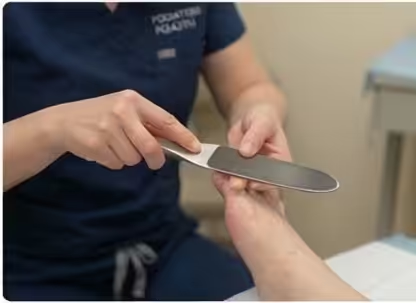
Nail fungus is a mechanical problem as well as an infectious one. The nail is thick, the thickness itself causes pain against the shoe, and the medication has to get through that thickness to reach the infection. A podiatrist can reduce the nail, send a clipping for testing, and start treatment in the same appointment. A dermatologist brings the stronger skill set when the nail is one sign of a wider skin condition — psoriasis, lichen planus, or a rash involving more than the feet — and when a skin biopsy is what is actually needed.
What Each Specialist Does in the Room
| In a typical visit | Podiatrist | Dermatologist |
|---|---|---|
| Diagnose nail fungus | Yes | Yes |
| Prescribe oral or topical antifungals | Yes | Yes |
| Reduce (debride) a thickened nail | Routine, same visit | Usually referred out |
| Send a nail clipping for confirmatory testing | Routine | Routine |
| Remove a painful or non-responding nail | Routine, same visit | Usually referred out |
| Pare the callus over a plantar wart | Routine | Sometimes |
| Skin biopsy for a suspected skin disease | Referred | Routine |
| Assess footwear, gait and repetitive nail trauma | Routine | Not typically |
| Diabetic foot risk assessment | Routine | Not typically |
When to Start With a Podiatrist
- The nail hurts. Pain usually means the nail has thickened enough to press on the nail bed underneath. That is a mechanical problem, and reducing the nail relieves it immediately — medication will not.
- You have diabetes, neuropathy or reduced circulation. Nail and skin problems on an at-risk foot need a lower threshold for in-person review, and the foot exam matters as much as the nail.
- The wart is on the sole and you are walking on it. See the section below on why the callus has to come off first.
- Nothing over the counter has worked. Topical antifungals only penetrate the surface of the nail plate. If the infection sits near the cuticle or involves much of the nail, the question is whether oral medication or laser is appropriate — and that decision starts with confirming the diagnosis.
- The nail keeps catching, tearing or growing in. Recurrent nail trauma has mechanical causes — shoe fit, toe length, gait — that are podiatric territory.
When to Start With a Dermatologist
- Your feet are one part of a wider picture. Nail changes alongside scaly plaques on the elbows, knees or scalp point toward psoriasis rather than fungus, and the skin disease is what needs treating.
- You already have a diagnosed skin condition. If eczema, psoriasis or lichen planus is being managed, the nails belong in that same plan.
- A skin biopsy is likely. Persistent rashes and unexplained skin lesions are core dermatology work.
One exception that overrides both: a new dark streak, a pigmented patch, or a nail change that bleeds, ulcerates or will not heal should be examined promptly by either specialist. Melanoma can occur under a nail and on the sole of the foot, and it is not something to work through a treatment ladder for.
Plantar Warts: Why the Callus Comes Off First
A wart on the sole behaves differently from a wart anywhere else on the body, because you stand on it. Instead of growing outward it is pressed inward, and the skin responds by laying down a thick callus over the top. That callus is the reason so many plantar warts fail over-the-counter treatment: the salicylic acid or the freezing never reaches the wart at all.
Paring that callus back before treating is routine podiatric work, and it is also diagnostic. A wart shows pinpoint dark dots — thrombosed capillaries — once the overlying skin is reduced, and it interrupts the normal skin lines rather than running through them. A callus with no wart underneath shows neither, which changes the treatment entirely.
Confirm the Diagnosis Before Months of Medication
A substantial share of thick, discoloured nails are not fungal. Old trauma, nail psoriasis and lichen planus all produce nails that look the part, and none of them respond to an antifungal. This matters most when oral medication is being considered, because a course runs for months and is usually accompanied by liver function monitoring — that is a real commitment to make on appearance alone.
A nail clipping sent for PAS staining or culture settles it. Either specialist can take one. Ask for confirmation before starting an oral antifungal, and treat a clinician who wants to confirm first as a good sign rather than a delay.
Get Seen This Week at Balance Foot & Ankle
Three board-certified podiatrists · 1,123+ five-star reviews · same-week appointments · most insurance accepted.
Howell · 4330 E Grand River | Bloomfield Township · 43494 Woodward
More Podiatrist-Recommended Fungus Essentials
Kerasal Fungal Nail Renewal
Top-recommended OTC keratolytic — improves nail appearance in 2-4 weeks.
Nonyx Nail Clarifying Gel
Exfoliates keratin debris to reveal clearer nail beneath the discoloration.
Lamisil AT Antifungal
Terbinafine 1% — the active ingredient podiatrists recommend for skin fungus.
As an Amazon Associate, Balance Foot & Ankle earns from qualifying purchases. Product recommendations are based on clinical experience; prices and availability shown above update live from Amazon.
When to See a Podiatrist
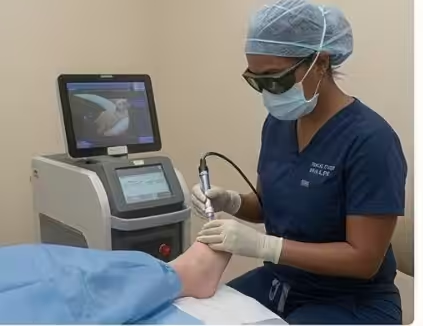
Topicals only penetrate the top 30% of the nail plate — if the fungus is near the cuticle or under 50% of the nail, oral terbinafine or laser is usually required for full clearance. Balance Foot & Ankle offers in-office fungal nail diagnostics and laser treatment that reaches the nail matrix where topicals can’t. We’ll examine the nail and recommend the fastest path to clear, healthy regrowth.
Call Balance Foot & Ankle: (810) 206-1402 · Book online · Offices in Howell & Bloomfield Township
In-Office Treatment at Balance Foot & Ankle
When home care and over-the-counter steps haven’t resolved your symptoms, it’s time for an in-office evaluation. At Balance Foot & Ankle in Howell and Bloomfield Township, Michigan, Dr. Tom Biernacki, DPM and team provide diagnostic imaging, a clinical exam, and a plan tailored to your foot type — most patients are seen same-day.
Same-week appointments available. Book online or call (810) 206-1402. Full treatment overview: Foot & Nail Fungus Treatment. Nails too thick or brittle to trim safely at home are handled in-office as a medical pedicure — sterile instruments, performed by a podiatrist, not a salon service.
Frequently Asked Questions
Should I see a podiatrist or a dermatologist for toenail fungus?
Both can diagnose it and prescribe treatment. The difference is what happens in the same visit. A podiatrist can debride the thickened nail, take a clipping for confirmatory testing, and remove a painful or non-responding nail chairside. Dermatologists generally manage nail fungus medically and refer the procedural work out. If the nail hurts, is thick enough to press on the nail bed, or you have diabetes or reduced circulation, start with a podiatrist.
Who should treat a plantar wart — a podiatrist or a dermatologist?
Either can treat warts, but plantar warts sit under weight-bearing skin and are usually buried beneath a callus that has to be pared down before any treatment reaches the lesion. That debridement is routine podiatric work. For a wart on the sole that has not responded to over-the-counter treatment, a podiatrist is usually the more direct route.
American Academy of Dermatology: Nail Fungus
Do I need a confirmed diagnosis before starting treatment?
For oral antifungals, yes. Many thick, discoloured nails are not fungal at all — old trauma, psoriasis and nail lichen planus all look similar. A nail clipping sent for PAS staining or culture confirms the diagnosis before anyone commits to months of medication and the bloodwork that goes with it.

Dr. Tom Biernacki, DPM is a board-certified foot & ankle surgeon (ABFAS & ABPM) at Balance Foot & Ankle Specialists in Southeast Michigan. With over a decade of clinical experience, he specializes in heel pain, bunions, diabetic foot care, sports injuries, and minimally invasive surgery. Dr. Biernacki is a member of the APMA and ACFAS, and his patient education content on MichiganFootDoctors.com and YouTube has made him one of the most-followed foot & ankle educators on YouTube.