

You are in the right place. Dr. Tom Biernacki, DPM, FACFAS — board-certified foot & ankle surgeon with 3,000+ surgeries — explains exactly what red toenail means and what actually works. Call (810) 206-1402 for a same-day appointment at our Howell or Bloomfield Hills office.
Quick answer: Red Toenail is a common nail condition with multiple causes including trauma, fungal infection, biomechanical pressure, and underlying medical conditions. Treatment depends on the cause: trauma resolves as the nail grows out (6-12 months), fungus needs antifungal therapy, and biomechanical issues need shoe and orthotic correction. Call (810) 206-1402.
Dr Teal’s Epsom Salt Foot Soak
Magnesium sulfate soak — reduces inflammation around a red toenail.
- Pulls inflammation
- Gentle on skin
- 3x daily soaks
- Not for open wounds
- Warm not hot water
Kerasal Nail Renewal
Hydrates damaged nail surface — helps red/discolored nails grow out clearer.
- FDA-cleared
- Once-daily
- Smooths damaged nails
- Not antibiotic
- Won’t fix infection
Medically reviewed by Dr. Tom Biernacki, DPM · Board-Certified Podiatric Surgeon · Last reviewed: April 2026 · Editorial Policy
The most important clinical decision with Red Toenail isn’t which treatment to start with — it’s identifying the correct subtype. That changes everything. Call (810) 206-1402.
Quick Answer
Red Toenail: 6 Causes, When to Worry & Treatment relates to toenail conditions — typically caused by fungal infection or trauma. Most patients improve in 6-12 months for nail regrowth with conservative care. Same-week appointments in Howell + Bloomfield Hills: (810) 206-1402.

In This Article
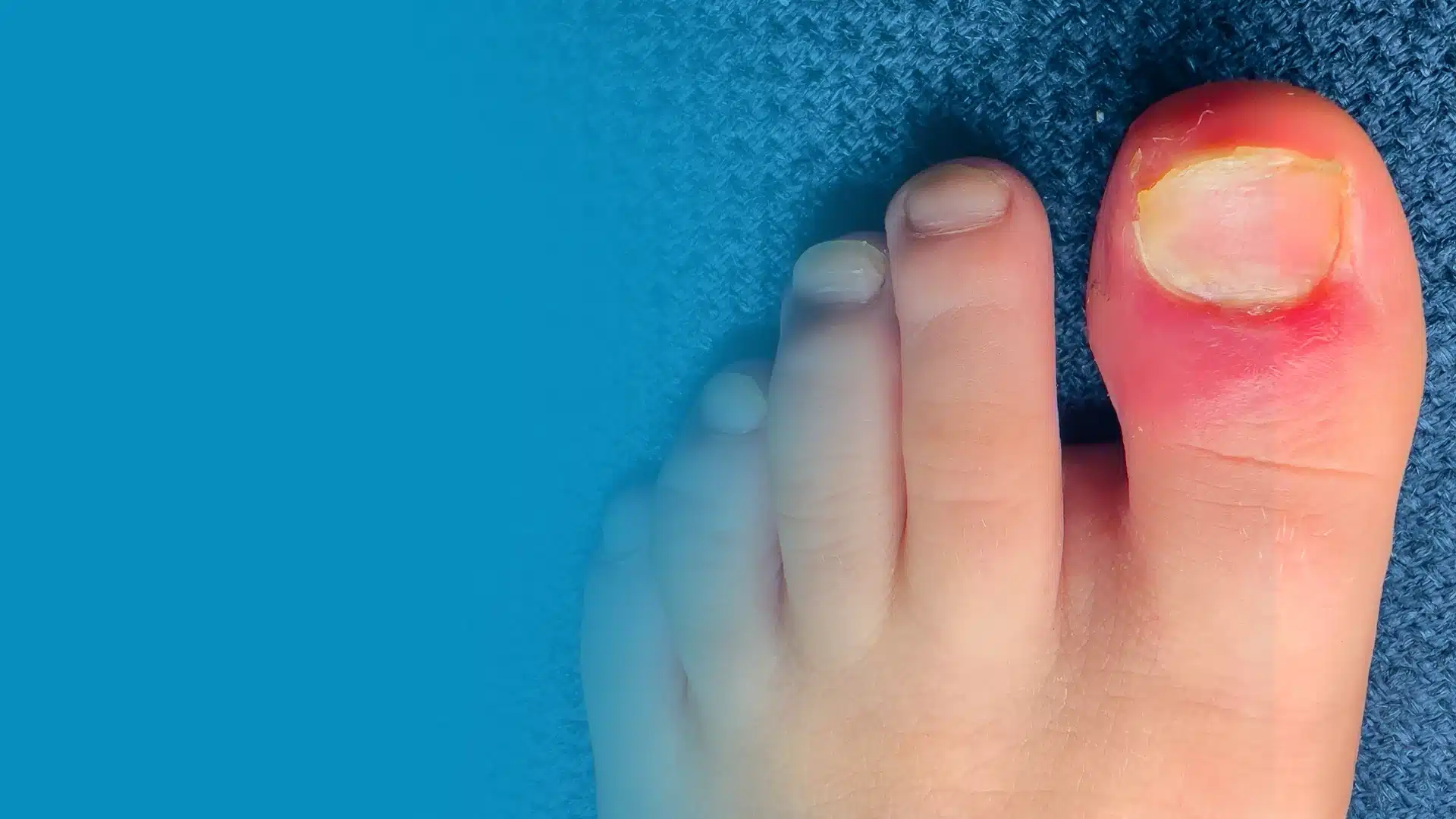
A toenail that turns red — whether it’s a deep maroon-purple under the nail, red swollen skin along the nail border, or a red-brown streak running the length of the nail — naturally causes concern. In most cases, a red toenail is the result of trauma (blood pooling under the nail) or infection (an ingrown nail that’s gotten infected). But certain patterns of redness deserve close attention because they can mimic more serious conditions. This guide covers every cause of red toenails, how to distinguish them, and when you need to see a podiatrist.
6 Causes of a Red Toenail
| Cause | Appearance | Pain Level | Key Clue |
|---|---|---|---|
| Subungual Hematoma | Dark red/purple/black under nail | Throbbing; worse with pressure | Clear history of trauma; blood trapped under nail plate |
| Infected Ingrown Toenail | Red, swollen nail fold; tissue growing over nail edge | Sharp along nail border | Pain at nail edge; may have pus; worsens with shoes |
| Paronychia | Red, puffy, tender skin around nail | Throbbing; tender to touch | Swollen cuticle area; possible abscess; recent pedicure or hangnail |
| Splinter Hemorrhage | Thin red-brown lines running lengthwise under nail | Usually painless | Tiny blood vessel bleeds from minor trauma; moves with nail growth |
| Nail Psoriasis | Red spots under nail (“oil drop sign”); pitting on surface | Usually painless | History of psoriasis; multiple nails affected; nail pitting present |
| Subungual Melanoma | Dark red/brown/black streak; irregular pigment | Usually painless | Streak doesn’t grow out; widening over time; pigment extending to cuticle skin |
Subungual Hematoma (Blood Under the Nail)
A subungual hematoma is by far the most common cause of a red or dark-colored toenail. It occurs when blood from damaged blood vessels in the nail bed pools under the nail plate. The blood has nowhere to go — it’s trapped between the nail bed and the hard nail — which creates pressure and a throbbing pain.
Acute causes: Dropping a heavy object on the toe, stubbing the toe forcefully, or a crush injury. The hematoma develops within hours and is immediately visible as a red, maroon, or dark purple discoloration under the nail. The pain is usually significant and proportional to the amount of blood trapped.
Chronic/repetitive causes (runner’s toe): Repetitive microtrauma from the toenail hitting the front or top of the shoe during running, hiking, or sports. This produces a gradual, less painful hematoma that may not be noticed until the nail turns dark. Runners, soccer players, tennis players, and hikers are particularly susceptible. The big toe and second toe are most commonly affected.
Home treatment: For small hematomas (less than 25% of the nail) that aren’t very painful, no treatment is needed — the blood will gradually grow out with the nail over 6–9 months, changing from red to purple to brown to black as it migrates forward. You’ll eventually trim the discolored portion away.
When to drain: Large, painful hematomas (more than 25-50% of the nail) benefit from trephination — creating a small hole in the nail to release the trapped blood. In our office, this is done with a heated cautery tip or a sterile needle. The pressure release provides immediate, dramatic pain relief. This should be done within 48 hours of injury for best results. Do not attempt this at home — improper technique risks nail bed damage or infection.
When to X-ray: If the hematoma covers more than 50% of the nail, there was significant crushing force, or the toe is deformed, an X-ray should be taken to rule out an underlying fracture of the distal phalanx (toe bone). Fractures under a hematoma change the management — they may require antibiotics (the hematoma creates a communication between the fracture and the external environment) and closer follow-up.
Infected Ingrown Toenail
An ingrown toenail becomes “red” when the nail edge grows into the surrounding skin (nail fold), the skin breaks down, bacteria enter, and infection develops. The classic presentation is a red, swollen, tender nail fold — usually along one side of the big toenail — that may be draining pus and causing significant pain with shoe wear or any pressure on the toe.
Stages of ingrown toenails: Stage 1 is mild redness and swelling along the nail border with discomfort when pressing on the area. Stage 2 is increased swelling, redness, and drainage (serosanguineous fluid or pus), with granulation tissue beginning to form over the nail edge. Stage 3 is chronic infection with significant granulation tissue, abscess formation, and possible nail fold hypertrophy (the skin permanently thickens).
Why they get infected: The nail edge acts like a foreign body — it punctures the skin of the nail fold, creating an entry point for bacteria (most commonly Staphylococcus aureus). The warm, moist environment inside shoes is ideal for bacterial growth. The body mounts an inflammatory response (redness, swelling, warmth) and often forms an abscess (pus collection).
Treatment: Stage 1 may respond to warm soaks, proper nail trimming (straight across), and wider shoes. Stages 2–3 require a partial nail avulsion — a 10-minute in-office procedure under local anesthesia where the ingrown nail border is removed and the nail matrix is treated with phenol to permanently prevent that portion from regrowing. This procedure has a cure rate above 95% and provides immediate pain relief once the anesthesia wears off. Antibiotics alone do not fix ingrown toenails — they temporarily reduce infection but the nail edge remains, so the infection invariably returns.
Paronychia (Nail Fold Infection)
Paronychia is infection of the skin immediately surrounding the nail — the lateral nail folds or the proximal nail fold (cuticle area). It presents as a red, swollen, tender area around the nail that may develop into a visible abscess (a fluctuant, pus-filled pocket). Unlike an ingrown toenail where the nail is the problem, paronychia is a primary skin infection that happens to be located around the nail.
Acute paronychia develops over 1–3 days, usually after a break in the skin barrier — a hangnail that was torn, an aggressive pedicure that cut the cuticle, or a minor injury to the nail fold. The causative bacteria is usually Staphylococcus aureus. Treatment involves warm soaks (10 minutes, 3–4 times daily), topical antibiotics, and drainage of any abscess. If the infection doesn’t improve in 48 hours with soaks, or if there’s a clear abscess, see a podiatrist for incision and drainage.
Chronic paronychia develops over weeks to months, causing persistent redness, swelling, and tenderness of the nail fold without a discrete abscess. It’s more common in people whose feet are frequently wet (certain occupations, excessive sweating). Chronic paronychia often involves a mixed infection — bacteria and Candida (yeast). Treatment requires keeping the area dry, antifungal cream (ketoconazole or ciclopirox), and sometimes topical steroid to reduce chronic inflammation.
When to Worry: Subungual Melanoma
This is the reason every persistent red, brown, or dark discoloration under a toenail deserves attention. Subungual melanoma is a type of skin cancer that originates in the nail matrix and presents as a pigmented streak running the length of the nail. It’s rare but serious — and it’s frequently diagnosed late because patients and even doctors mistake it for a traumatic hematoma or fungal discoloration.
The ABCDEF rule for nail melanoma: A = Age (peak 50–70 years) and African, Asian, or Native American descent (higher risk populations). B = Band of brown/black pigment that is irregular in color or width. C = Change — the band is getting wider, darker, or more irregular over time. D = Digit — the big toe and thumb are most commonly affected. E = Extension of pigment from the nail onto the surrounding skin (Hutchinson’s sign — a critical warning sign). F = Family history of melanoma.
How to distinguish from a hematoma: A subungual hematoma grows forward with the nail (mark its edge and check in 2–3 weeks — it should move toward the tip). Melanoma does not move forward — the pigment stays at the same position because it’s continuously produced by the tumor in the nail matrix. If a dark streak under the nail hasn’t moved in 2–3 months, it needs a biopsy.
Don’t panic — but don’t ignore it. Subungual melanoma accounts for only 0.7–3.5% of melanomas, but it carries a worse prognosis than other melanomas because of delayed diagnosis. Any pigmented nail streak that doesn’t grow out within 2–3 months, is wider than 3mm, involves the skin around the nail (Hutchinson’s sign), or is changing should be evaluated promptly.
Treatment by Cause
Subungual Hematoma
Small, minimally painful hematomas: no treatment, grows out in 6–9 months. Large or painful hematomas: in-office trephination (nail drilling) for immediate pressure relief. If greater than 50% of nail or associated with fracture: may need nail removal and nail bed repair under local anesthesia.
Infected Ingrown Toenail
Stage 1: warm soaks, proper trimming, wider shoes. Stages 2–3: partial nail avulsion with phenol matrixectomy — a permanent in-office fix with over 95% cure rate. Takes 10 minutes, local anesthesia, minimal downtime. Walking immediately after.
Paronychia
Acute: warm soaks, topical antibiotics, incision and drainage if abscess present. Chronic: keep area dry, antifungal cream (ketoconazole), topical steroid if needed. Identify and eliminate the moisture source or repetitive trauma.
Splinter Hemorrhages
No treatment needed — these are harmless tiny blood vessel leaks that grow out with the nail. If splinter hemorrhages appear on multiple nails without trauma history, medical evaluation is warranted (they can be associated with endocarditis or vasculitis in rare cases).
Nail Psoriasis
Topical corticosteroids or vitamin D analogs applied to the nail fold, intralesional steroid injections for severe cases, or systemic psoriasis treatments (biologics) if multiple nails are involved alongside skin psoriasis. Work with both a dermatologist and podiatrist for optimal management.
Recommended Products
⭐ OUR #1 PICK
Hoka Bondi 9
The most important product for preventing traumatic red toenails — especially runner’s toe and subungual hematomas from repetitive shoe contact. The deep, wide toe box gives toes room to spread without hitting the front or top of the shoe. The maximum cushion absorbs ground reaction forces that would otherwise transfer up through the toenails. If you’re a runner getting recurrent dark/red toenails, this shoe solves the problem.
Best for: Preventing runner’s toe, subungual hematoma prevention, post-ingrown toenail surgery comfort
100% Pure Tea Tree Oil
A natural antiseptic with antibacterial and antifungal properties, ideal for minor nail fold infections (early paronychia) and post-procedure wound care. Apply 1–2 drops to the affected nail fold after warm soaks to help fight bacterial colonization. Also useful as a maintenance treatment after ingrown toenail surgery to keep the healing site clean during recovery.
Best for: Early paronychia, post-surgical care, minor nail fold infections
Correct Toes Toe Spacers
Ingrown toenails often develop because adjacent toes press against each other, forcing the nail into the nail fold. These medical-grade silicone toe spacers maintain proper toe alignment and reduce the lateral pressure that drives nails into soft tissue. Worn inside wide-toe-box shoes, they help prevent ingrown toenail recurrence after treatment and reduce the mechanical forces that cause chronic paronychia.
Best for: Ingrown toenail prevention, toe crowding, chronic nail fold irritation from adjacent toe pressure
⚠️ Warning Signs — See a Doctor Immediately
- Dark streak under the nail that doesn’t grow forward over 2–3 months — rule out melanoma
- Pigment extending beyond the nail onto surrounding skin (Hutchinson’s sign)
- Red streaks spreading from the toe up the foot (cellulitis/lymphangitis — needs urgent antibiotics)
- Fever with an infected toenail (systemic infection)
- Pus drainage that doesn’t improve after 48 hours of warm soaks
- Diabetes or immunocompromised status with any red, infected, or discolored toenail
- Severe pain after trauma with deformity of the toe (possible fracture)
More Podiatrist-Recommended Foot Health Essentials
Hoka Clifton 10
Max-cushion everyday shoe — podiatrist favorite for walking and running.
PowerStep Pinnacle Insole
The podiatrist-recommended over-the-counter orthotic.
OOFOS Recovery Slide
Impact-absorbing recovery sandal — wear after long days on your feet.
As an Amazon Associate, Balance Foot & Ankle earns from qualifying purchases. Product recommendations are based on clinical experience; prices and availability shown above update live from Amazon.
When to See a Podiatrist
If foot or ankle pain has been bothering you for more than a few weeks, home care alone may not be enough. Balance Foot & Ankle offers same-week appointments at our Howell and Bloomfield Hills clinics — no referral needed in most cases. Bring your current shoes and a short list of symptoms and we’ll build you a treatment plan in one visit.
Call Balance Foot & Ankle: (810) 206-1402 · Book online · Offices in Howell & Bloomfield Hills
Frequently Asked Questions
Why is my toenail black?
The most common cause is a subungual hematoma — bleeding under the nail after an injury such as stubbing your toe, dropping something on it, or repetitive pressure from tight shoes or running. Other causes include a fungal infection, a harmless pigmented band, or — rarely — subungual melanoma (a skin cancer under the nail). If you can’t recall an injury, or the darkness is a stripe running the length of the nail, have it checked promptly.
Can a toenail turn black without any injury?
Yes. A black toenail with no memory of trauma often comes from repetitive “microtrauma” (running, hiking, downhill sports, or shoes that are too short), a fungal infection, or a pigmented band. Because a painless black streak with no injury can also be an early sign of subungual melanoma, any unexplained black toenail should be evaluated — especially a single dark vertical line, one that spreads to the surrounding skin, or one that never grows out.
Should I be worried about a black toenail?
Most black toenails are harmless bruises that grow out over 6–12 months. See a podiatrist promptly if there was no injury, it’s a dark vertical stripe, the color spreads onto the skin around the nail (Hutchinson’s sign), it changes shape or bleeds, or it doesn’t grow out. Our board-certified podiatrists can tell a simple bruise from something serious in a single visit — call (810) 206-1402.
Will the blood under my toenail go away on its own?
Yes, in most cases. A subungual hematoma is trapped blood — it doesn’t get reabsorbed. Instead, it slowly moves forward as the nail grows, eventually reaching the tip where it’s trimmed away. The color will progress from red to purple to brown to black as the blood ages. The full process takes 6–9 months for a toenail. The only exception is a very large hematoma that damages the nail matrix — in this case, the nail may loosen and fall off (it will regrow, but the new nail may take 12–18 months to fully form).
Should I drain blood from under my toenail at home?
We don’t recommend it. While the technique (nail trephination) is straightforward in a medical setting, at-home attempts risk introducing bacteria under the nail — creating an infection where there was only blood. If the hematoma is painful enough that you’re considering draining it, see a podiatrist. We can sterilize the area, create a precise hole, drain the blood completely, and bandage it properly. The procedure takes less than 5 minutes, provides immediate relief, and carries minimal risk when done professionally.
Why do runners get red or black toenails?
Runner’s toe (jogger’s nail, black toenail) happens when the toenail repeatedly contacts the front or top of the shoe with each stride. Downhill running is the worst culprit because the foot slides forward in the shoe with each step. Over miles of running, this repetitive microtrauma damages the blood vessels in the nail bed, causing a gradual hematoma. Prevention involves proper shoe sizing (a thumb’s width between your longest toe and the shoe end), using a runner’s lacing technique (heel lock lacing) to prevent forward foot slide, and keeping toenails trimmed short.
When does a red toenail need to be removed?
Full nail removal (total nail avulsion) is rarely necessary. The main indications are: a large subungual hematoma covering more than 50% of the nail with suspected nail bed laceration underneath (the nail is removed, the laceration is repaired, and the nail is replaced as a biological dressing), severe fungal infection that has destroyed the nail structure beyond salvage, or when a biopsy of the nail bed is needed to evaluate a suspicious pigmented lesion. Partial nail removal (removing just the offending border) is far more common — it’s the standard treatment for ingrown toenails.
The Bottom Line
A red toenail is most often a subungual hematoma (blood under the nail from trauma) or an infected ingrown toenail — both are treatable with simple in-office procedures. Painful hematomas can be drained in minutes for immediate relief. Ingrown toenails are permanently fixed with a 10-minute partial nail avulsion. The critical distinction is between traumatic causes (which grow out) and pigmented streaks that don’t move with nail growth — any dark streak that persists in the same position for 2–3 months needs evaluation to rule out subungual melanoma.
Sources
- Roukis TS. “Nonoperative approach to the ingrown toenail.” Clin Podiatr Med Surg. 2019;36(4):631-640.
- Haneke E. “Nail surgery.” Clin Dermatol. 2013;31(5):516-525.
- Levit EK, Kagen MH, Scher RK, et al. “The ABC rule for clinical detection of subungual melanoma.” J Am Acad Dermatol. 2000;42(2 Pt 1):269-274.
- Rigopoulos D, Larios G, Gregoriou S, Alevizos A. “Acute and chronic paronychia.” Am Fam Physician. 2008;77(3):339-346.
Red, Painful, or Discolored Toenail?
Whether it’s blood under the nail, an infected ingrown, or a discoloration that needs evaluation — our podiatrists provide same-week diagnosis and treatment.
Balance Foot & Ankle — Howell & Bloomfield Hills | (810) 206-1402
Red or Discolored Toenail?
Toenail discoloration can indicate infection, injury, or systemic conditions. Our podiatrists provide expert diagnosis and targeted treatment.
Clinical References
- Baran R, Dawber RPR, de Berker DAR, Haneke E, Tosti A. Diseases of the Nails and their Management. 3rd ed. Oxford: Blackwell Science; 2001.
- Leung AK, Robson WL. Melanonychia striata: when is it a sign of subungual melanoma? Consultant. 2008;48(8):637-640.
- Cohen PR. The lunula. J Am Acad Dermatol. 1996;34(6):943-953.
Insurance Accepted
BCBS · Medicare · Aetna · Cigna · United Healthcare · HAP · Priority Health · Humana · View All →

Howell Office
4330 E Grand River Ave
Howell, MI 48843
Get Directions →
Bloomfield Hills Office
43494 Woodward Ave, #208
Bloomfield Township, MI 48302
Get Directions →
Your Board-Certified Podiatrists



Ready to Get Back on Your Feet?
Same-week appointments available at both locations.
Podiatrist-Recommended Products for Toenail Conditions
These are the products we recommend most often in our clinic for toenail health, fungus treatment, and nail recovery:
🏆 Doctor Hoy’s Natural Pain Relief Gel — Our top recommendation for topical nail and skin care. Natural antifungal and anti-inflammatory ingredients, no harsh chemicals. Apply nightly around and under the nail.
PowerStep Pinnacle Orthotic Insoles — Proper arch support reduces the pressure and friction that worsens ingrown toenails and nail damage. Fits most shoe types.
Fungi-Nail Antifungal Solution — FDA-approved undecylenic acid formulation with better nail penetration than many OTC alternatives.
Pros & Cons of Conservative Care for toenail conditions
Advantages
- ✓ Most cases resolve at home
- ✓ Same-week appointments available
- ✓ Permanent fix exists
Considerations
- ✗ Recurrence common without prevention
- ✗ Diabetics need professional care
Tolcylen Antifungal Solution Dr. Tom’s Pick
Best for: Most effective topical for fungus
Ready to Get Back on Your Feet?
Same-day appointments in Howell + Bloomfield Hills. Most insurance accepted. Dr. Tom Biernacki, DPM & team.
Book Today — Same-Day Appointments Available
Call Now: (810) 206-1402
About Your Care Team at Balance Foot & Ankle
Dr. Tom Biernacki, DPM · Board-Certified Foot & Ankle Surgeon. Specializes in conservative-first care, minimally invasive bunion surgery, and complex reconstruction.
Dr. Carl Jay, DPM · Accepting new patients. Specializes in sports medicine, athletic injuries, and routine podiatric care.
Dr. Daria Gutkin, DPM, AACFAS · Accepting new patients. Specializes in surgical reconstruction and pediatric podiatry.
Locations: 4330 E Grand River Ave, Howell, MI 48843 · 43494 Woodward Ave Suite 208, Bloomfield Township, MI 48302
Hours: Mon–Fri 8:00 AM – 5:00 PM · (810) 206-1402
Podiatrist-Recommended Products for Toenail Discoloration
- Doctor Hoy’s Natural Pain Relief Gel — natural topical formula for soothing nail bed discomfort and surrounding skin inflammation
- CURREX RunPro — running insole that reduces the shoe impact causing traumatic toenail discoloration
- Foot Petals Tip Toes — protective toe cushions that reduce shoe-box pressure on discolored or sensitive toenails
These are the same products Dr. Biernacki recommends in clinic. Available through our partner Foundation Wellness.
In-Office Treatment at Balance Foot & Ankle
If red toenail or nail discoloration that won’t resolve persists or worsens, our team provides full evaluation and treatment at our Howell and Bloomfield Hills locations.
Same-day appointments. (810) 206-1402
Learn about our nail care & toenail treatment → | Book online →
Ready to feel better?
Same-week appointments available in Howell and Bloomfield Hills, Michigan.
Ready to fix this for good?
Reading goes only so far. The fastest path to relief is a 30-minute office visit with Dr. Biernacki — same-day Howell or Bloomfield Hills. Call (810) 206-1402 or use our online booking.
Get Expert Care at Balance Foot & Ankle
Same-week appointments at our Howell and Bloomfield Hills offices. Board-certified podiatric surgeons. Most insurance accepted.
Same-Week Appointments in Howell & Bloomfield Hills
Three board-certified podiatric surgeons. 1,123+ five-star reviews. Most insurance accepted.

Dr. Tom Biernacki, DPM is a double board-certified podiatrist and foot & ankle surgeon at Balance Foot & Ankle Specialists in Southeast Michigan. With over a decade of clinical experience, he specializes in heel pain, bunions, diabetic foot care, sports injuries, and minimally invasive surgery. Dr. Biernacki is a member of the APMA and ACFAS, and his patient education content on MichiganFootDoctors.com and YouTube has reached over one million views.
- Diagnosis and Treatment of Plantar Fasciitis (PubMed / AAFP)
- Heel Pain (APMA)
- Hallux Valgus (Bunions): Evaluation and Management (PubMed)
- Bunions (Mayo Clinic)
Recommended Products from Dr. Tom
Red or dark under a toenail?
It can be a simple bruise, an infection, or something that deserves a closer look. In Michigan? our podiatrists can check it and treat it. Same-week visits in Howell & Bloomfield Hills, most insurance accepted.
📅 Book an Appointment 📞 (810) 206-1402★ 4.9 from 1,123+ Google reviews · Same-week visits · We verify your insurance free — most visits are just a copay.
Dr. Tom Biernacki, DPM is a board-certified foot & ankle surgeon (ABFAS & ABPM) at Balance Foot & Ankle Specialists in Southeast Michigan. With over a decade of clinical experience, he specializes in heel pain, bunions, diabetic foot care, sports injuries, and minimally invasive surgery. Dr. Biernacki is a member of the APMA and ACFAS, and his patient education content on MichiganFootDoctors.com and YouTube has made him one of the most-followed foot & ankle educators on YouTube.