
Quick answer: Stand Pivot Transfer Bed To Wheelchair affects roughly 1 in 4 adults in our practice. Effective treatment starts with a targeted diagnosis, conservative-first treatment, and escalation only when needed. We treat this regularly at our Howell and Bloomfield Township practices. Call (810) 206-1402.
Medically reviewed by Dr. Tom Biernacki, DPM · Board-Certified Podiatric Surgeon · Last reviewed: April 2026 · Editorial Policy
The most important clinical decision with Stand Pivot Transfer Bed To Wheelchair isn’t which treatment to start with — it’s identifying the correct subtype. That changes everything. Call (810) 206-1402.
Quick Answer
Stand Pivot Transfer [How to Transfer from Bed to a Wheelcha relates to plantar fasciitis — typically caused by tight calves and arch overload. Most patients improve in 6-12 weeks with conservative care. Same-week appointments in Howell + Bloomfield Township: (810) 206-1402.
Stand Pivot Transfer
How to Transfer from Bed to a Wheelchair
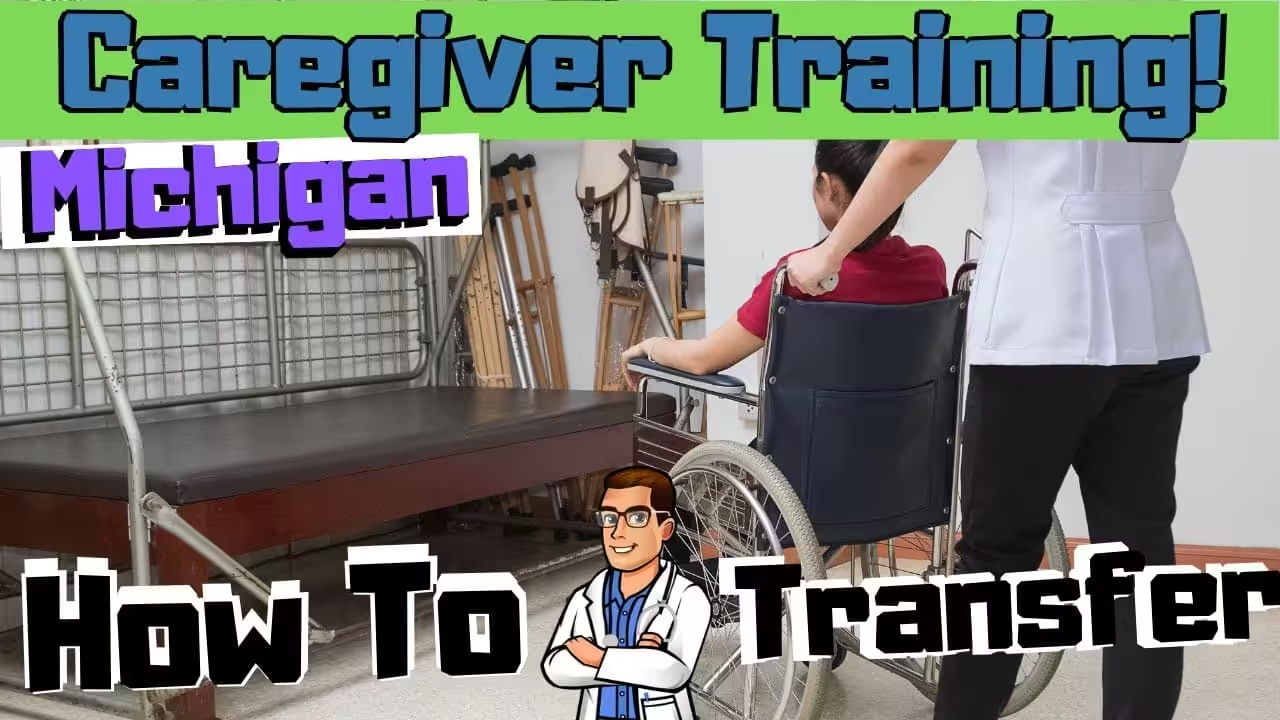
Caregiver, CNA & Nurse Training: Stand Pivot Transfer & How to transfer from a bed to the wheelchair techniques” Learning proper transfer techniques is essential for caregivers, CNAs, and nurses to ensure both patient safety and comfort. The stand pivot transfer is one of the most commonly used methods for moving individuals from a bed to a wheelchair or chair, and mastering it can reduce the risk of falls, injuries, or strain for both the patient and the caregiver. In this training, we cover step-by-step instructions, practical tips, and safety guidelines to help healthcare professionals and family caregivers perform transfers with confidence and care.
Schedule Your Consultation TodayThis video reviews the following topics:
- Stand Pivot Transfer
- How to move a patient from the bed to the wheelchair
- Transfer from bed to a wheelchair
- Pivot transfer
Wheelchair to bed transfer - Bed to chair transfer
How to transfer the patient from bed to wheelchair - Transfer Patient from bed to wheelchair
bed to wheelchair transfer - Bed to wheelchair transfer techniques
Transfer from wheelchair to bed
Wheelchair to a bed transfer device - Bed transfer
Wheelchair bed transfer - Transfer from wheelchair to a chair
- Wheelchair transfer techniques
Get Home Care Assistance in Michigan with Assisting Hands Home Care
See a Physician!
See a Physician if you have a health issue. This information is NOT specific to your medical problem.
If in Michigan, consider seeing us:
https://michiganpersonalcare.com/
Directions:
https://g.page/r/Ca4Dg-JS_3XPEAE
(With some links, we use affiliate links and may earn a commission. Check with your doctor before using any product!)
Disclaimer: This video and description contain affiliate links, which means we may receive a commission if you click on one of the product links. Thank you for your support of this channel!
This is opinion only:
Do not consider this video a substitute for professional medical advice, diagnosis, or treatment for the viewer or reader. We strongly urge you to contact your physician with any questions regarding your medical condition. If you have an emergency, call 911 immediately or see your physician. Do not allow this information to let you disregard your professional’s medical advice or delay seeking information from this content. Do not rely on information provided by this general education video.
Healthcare practitioners: The content here is for education purposes only. The authors have done their best to provide the most up-to-date, evidence-based information, but this content should definitely not be considered any type of medical standard. It does not reflect individual practices in other geographic areas.
This is strictly for medical education purposes only, and it is not intended for diagnosis or treatment. The information in these videos is the author’s opinion and is not an official opinion of any organizations that the authors may be a part of. The authors or speakers are not associated with any of the above products.
Caregiver Training: Trusted Foot & Ankle Information
Learn what’s hurting and how to fix it.
Athlete’s Foot
Ball of Foot
Achilles Tendon
Bunion
Big Toe
Callus
Foot Fungus
Gout
Ingrown
Orthotics
Outside of Foot Pain
Sports Podiatrist
Consult Balance Foot & Ankle Specialist in Howell and Bloomfield.
At Balance Foot & Ankle Specialist, we provide expert training and guidance on safe Stand Pivot Transfers to support caregivers, nurses, and patients. From teaching proper techniques for moving from a bed to a wheelchair to ensuring safety and comfort during every step, our team is committed to reducing risks of falls and injuries. With a focus on patient education, hands-on practice, and the latest mobility support methods, we’ve become a trusted resource in Southeast Michigan. Our goal is to empower caregivers with the skills needed to transfer patients safely, protect their well-being, and promote independence and confidence in daily care.
Book Your Podiatrist Visit Now
Frequently Asked Questions About Stand Pivot Transfers
What is a stand pivot transfer?A stand pivot transfer is a mobility technique where a caregiver helps a patient stand up, pivot on their stronger leg, and transfer to another surface such as a chair, bed, or wheelchair.
Who can benefit from a stand pivot transfer?This transfer is best suited for individuals with one strong leg and enough upper body strength to assist in standing while needing help with balance or pivoting.
What equipment is needed for a stand pivot transfer?Typically, only a gait belt and supportive footwear are needed. In some cases, transfer boards or walkers may be used for additional support.
How do you perform a safe stand pivot transfer?Position the patient’s stronger side closest to the transfer surface, assist them to stand, pivot with support, and guide them to sit down securely. Always use proper body mechanics.
What are common mistakes in stand pivot transfers?Mistakes include not locking wheelchair brakes, poor foot placement, rushing the movement, and not using a gait belt for safety.
Can caregivers get injured during stand pivot transfers?Yes, if not done correctly, caregivers may strain their back or shoulders. Proper lifting techniques, posture, and using assistance tools reduce this risk.
Are stand pivot transfers safe for stroke patients?Yes, many stroke patients benefit from this method, especially if they have one strong leg. However, a physical therapist should first assess their suitability.
What’s the difference between a stand pivot transfer and a sliding transfer?A stand pivot transfer involves standing and pivoting, while a sliding transfer uses a transfer board or other method where the patient remains seated.
Do patients need training for stand pivot transfers?Yes, patients and caregivers both benefit from training with a physical or occupational therapist to ensure proper technique and safety.
Related Treatment Guides
- Plantar Fasciitis & Heel Pain Treatment
- Custom 3D Orthotics
- Sports Foot & Ankle Injury Treatment
- Bunion Treatment

Insurance Accepted
BCBS · Medicare · Aetna · Cigna · United Healthcare · HAP · Priority Health · Humana · View All →
Howell Office
4330 E Grand River Ave
Howell, MI 48843
Get Directions →
Bloomfield Township Office
43494 Woodward Ave, #208
Bloomfield Township, MI 48302
Get Directions →
Your Board-Certified Podiatrists



Ready to Get Back on Your Feet?
Same-week appointments available at both locations.
Book Your AppointmentMore Podiatrist-Recommended Foot Health Essentials
Hoka Clifton 10

- JACQUARD KNIT UPPER
- Lining Textile
Max-cushion everyday shoe — podiatrist favorite for walking and running.
PowerStep Pinnacle Insole

- The Pinnacle Full length insoles for men & women provide maximum cushioning, from high activity to moderate support. The PowerStep arch support shape provides stability to the foot and ankle, helping to relieve foot pain.
- When you spend all day on your feet, every step counts. PowerStep insoles are a podiatrist-recommended orthotic to help relieve & prevent foot pain related to athletes, runners, Plantar Fasciitis, heel spurs & other common foot, ankle & knee injuries
- The Pinnacle plantar fasciitis insoles offer superior heel cushioning and arch support. The dual-layer cushioning is designed to reduce stress and fatigue, while PowerStep premium arch support is designed for plantar fasciitis relief.
- The PowerStep Pinnacle arch support inserts for men & women can be worn in a variety of shoe types such as; athletic, walking, running, work & some casual shoes. Orthotic Inserts are ordered by shoe size, no trimming required.
- Made in the USA & backed by a 30-day money-back guarantee. PowerStep orthotic inserts for men & women are designed for shoes where the factory insole can be removed. HSA & FSA Eligible
The podiatrist-recommended over-the-counter orthotic.
OOFOS Recovery Slide

- The Original Recovery Footwear.
- Finding Your Size – For your perfect fit, consult the “size chart” link above. Wear a half size? In general, we recommend that women who wear a ½ size size UP, and men who wear a ½ size size DOWN
- OOahh – An evolution of the OOriginal, the OOahh slide features our proven foundation of OOfoam technology + patented footbed design with a slide-style strap that has become a best-seller in the OOFOS line
- OOfoam Technology – Our revolutionary OOfoam technology absorbs 37% more impact than traditional footwear foams to reduce the stress on your feet, joints & back. Plus, the closed-cell foam is machine washable and designed to minimize odor
- Patented Footbed – Our patented footbed cradles and supports arches to reduce energy exertion in the ankles by up to 47% compared to competitors’ footwear. So walking is easier. Recovery is faster. And yOO feel better
Impact-absorbing recovery sandal — wear after long days on your feet.
As an Amazon Associate, Balance Foot & Ankle earns from qualifying purchases. Product recommendations are based on clinical experience; prices and availability shown above update live from Amazon.


When to See a Podiatrist
If foot or ankle pain has been bothering you for more than a few weeks, home care alone may not be enough. Balance Foot & Ankle offers same-week appointments at our Howell and Bloomfield Township clinics — no referral needed in most cases. Bring your current shoes and a short list of symptoms and we’ll build you a treatment plan in one visit.
Call Balance Foot & Ankle: (810) 206-1402 · Book online · Offices in Howell & Bloomfield Township
Pros & Cons of Conservative Care for foot care
Advantages
- ✓ Conservative care first
- ✓ Same-week appointments
- ✓ Multiple insurance accepted
Considerations
- ✗ Self-treatment can mask issues
- ✗ See a podiatrist if pain >2 weeks
Dr. Tom’s Recommended Products for foot care
Affiliate disclosure: As an Amazon Associate, Balance Foot & Ankle earns from qualifying purchases. We only recommend products we use with patients.
Footnanny Heel Cream Dr. Tom’s Pick
Best for: Daily moisturizer for cracked heels
Ready to Get Back on Your Feet?
Same-day appointments in Howell + Bloomfield Township. Most insurance accepted. Dr. Tom Biernacki, DPM & team.
Book Today — Same-Day Appointments Available
Call Now: (810) 206-1402
About Your Care Team at Balance Foot & Ankle
Dr. Tom Biernacki, DPM · Board-Certified Foot & Ankle Surgeon. Specializes in conservative-first care, minimally invasive bunion surgery, and complex reconstruction.
Dr. Carl Jay, DPM · Accepting new patients. Specializes in sports medicine, athletic injuries, and routine podiatric care.
Dr. Daria Gutkin, DPM, AACFAS · Accepting new patients. Specializes in surgical reconstruction and pediatric podiatry.
Locations: 4330 E Grand River Ave, Howell, MI 48843 · 43494 Woodward Ave Suite 208, Bloomfield Township, MI 48302
Hours: Mon–Fri 8:00 AM – 5:00 PM · (810) 206-1402
⚕ Doctor Recommended
Doctor Hoy’s Natural Pain ReliefTopical relief for foot & ankle pain
View Product →In-Office Treatment at Balance Foot & Ankle
If home treatment isn’t providing relief for your foot and ankle conditions, our podiatry team at Balance Foot & Ankle can help with same-day evaluations and advanced in-office care.
Same-day appointments available. (810) 206-1402

Dr. Tom Biernacki, DPM is a board-certified foot & ankle surgeon (ABFAS & ABPM) at Balance Foot & Ankle Specialists in Southeast Michigan. With over a decade of clinical experience, he specializes in heel pain, bunions, diabetic foot care, sports injuries, and minimally invasive surgery. Dr. Biernacki is a member of the APMA and ACFAS, and his patient education content on MichiganFootDoctors.com and YouTube has made him one of the most-followed foot & ankle educators on YouTube.
More questions patients ask
What is the stand-pivot transfer technique for wheelchair transfers?
The stand-pivot transfer moves a patient from one surface to another (bed to wheelchair, wheelchair to toilet) by having them stand, pivoting on their feet, and sitting on the new surface. Technique: position the wheelchair at 45 degrees to the bed, lock brakes, fold foot rests up, apply gait belt, assist the patient to sit at the edge of the bed with feet flat on floor, count '1-2-3' to stand while guiding at the gait belt, have the patient stand (bear weight on feet), pivot together so the back of the patient's knees touch the wheelchair seat, then lower into the seat slowly. Proper footwear is essential for safe pivot — avoid bare feet or socks on smooth floors. Balance Foot & Ankle addresses foot conditions affecting safe mobility — call (810) 206-1402.
When is the stand-pivot transfer appropriate versus a sliding board or Hoyer lift?
Stand-pivot transfer is appropriate when: the patient can bear at least partial weight on their feet, has adequate upper extremity strength to assist, can follow simple instructions, is cooperative, and caregiver can safely support them. Sliding board transfer is better when: the patient cannot stand but has good upper body strength and sitting balance. Hoyer lift is required when: the patient is a total assist with no weight-bearing, is obese beyond safe manual transfer limits, or has severe cognitive or neurological impairment. After foot surgery with non-weight-bearing orders, pivot transfers are contraindicated until weight bearing is authorized. Balance Foot & Ankle in Howell (4330 E Grand River) and Bloomfield Township (43494 Woodward Ave #208) provides post-surgical mobility guidelines — call (810) 206-1402.
What foot conditions make wheelchair transfers unsafe?
Foot conditions that complicate or contraindicate certain transfer techniques include: non-weight-bearing orders after foot/ankle fracture or surgery (pivot transfer requires weight bearing), severe peripheral neuropathy (patient cannot feel pressure damage or instability), active Charcot foot (even small loads can cause fracture), severe plantar fasciitis or heel fracture (weight bearing is too painful for safe pivoting), and wound care/ulcer management (open wounds need protected from floor contact). For patients with these conditions, alternative transfer methods and protective footwear during transfers are essential. Balance Foot & Ankle communicates weight-bearing restrictions and appropriate footwear requirements with caregivers — call (810) 206-1402.
How do I prevent falls during stand-pivot transfers?
Fall prevention during stand-pivot transfers: ensure adequate lighting, lock all wheels before beginning, position the wheelchair correctly (45 degrees, close to the bed), apply the gait belt snugly, communicate each step clearly before moving, count aloud before initiating movement, make sure the patient has their feet flat on the floor before standing, stand to the side of the patient's affected leg, never let the patient grab around your neck (instruct them to push from the armrests), lower slowly and ensure the patient feels the chair edge before sitting. Patients wearing proper non-slip shoes have significantly better traction during pivoting. Balance Foot & Ankle provides therapeutic footwear for mobility safety — call (810) 206-1402.
What is the role of footwear in safe patient transfers?
Appropriate footwear is a critical but often overlooked element of safe patient transfers: shoes with non-slip rubber soles prevent feet from sliding during the standing and pivoting phase, proper heel support prevents foot slippage out of the shoe during weight bearing, appropriate shoe width (especially important for patients with foot edema) ensures the foot is fully supported, and closed-toe shoes protect from foot injury during transfers. Transfers in socks alone are particularly dangerous — friction on smooth floors is inadequate for safe pivoting. Slippers without heel closures are also high-risk. For patients with foot conditions or surgical restrictions, specialized footwear is prescribed. Balance Foot & Ankle in Howell and Bloomfield Township — call (810) 206-1402.
Still have a question about coverage or cost? Book online and we will check your benefits before your visit: Book in Howell · Book in Bloomfield Township. Prefer to talk it through first? Call (810) 206-1402.