
Medically reviewed by Dr. Tom Biernacki, DPM
Board-certified podiatric surgeon | Balance Foot & Ankle
Last reviewed: May 2026
You are in the right place. Dr. Tom Biernacki, DPM, FACFAS — board-certified foot & ankle surgeon with 3,000+ surgeries — explains exactly what top of foot pain means and what actually works. Call (810) 206-1402 for a same-week appointment at our Howell or Bloomfield Township office.
✅ Medically reviewed by Dr. Tom Biernacki, DPM — Board-Certified Podiatrist · Last updated April 6, 2026
Top Of Foot Pain? [Causes, Symptoms & BEST Home Treatment]
You have top of the foot pain? We go over the 100% Best home treatment options to fix the 5 most common causes of top of the foot pain! Top Of Foot Pain: The most common symptoms seen are numbness, burning and tingling. Especially while running or walking!Causes:
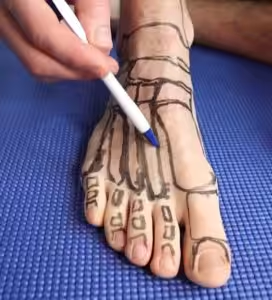
The most common causes of top of the foot pain are: Top of the foot nerve pain: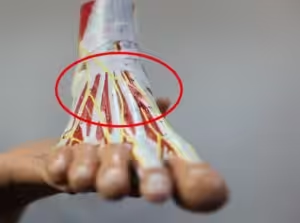

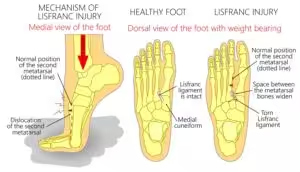
Symptoms:
The most common symptoms of top of the foot pain and on the above-mentioned causes. The most common symptoms include:- Numbness, burning and tingling.
- A deep aching throb.
- Pain that is worse in the morning if there is dorsal compression syndrome.
- Bruising and extensive pain with sprain or bruising to the top of the foot.
Is Your Problem At The Top Of The Foot?
Note: Say no if it is anything but at the top. Say Yes To Top Of Foot Pain If:- If the pain is at the front of your ankle or top of the foot.
- If you have any bumps or lumps on top of the foot.
- If you have numbness, burning or tingling.
- If the problem at your heel.
- If the problem is at the bottom of the foot or the arch.
- If the problem is at the ball of the foot.
- If the problem is at the toes or toenails.
Top Of Foot Pain Causes:
Top Of Foot Numbness Or Tingling:
- The top of foot tingling is usually due to a nerve irritation.
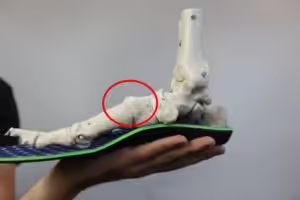
Top Of The Foot Bone Spur:
- A bone spur on top of the foot forms due to abnormal friction and stress on the bone.
Metatarsal Stress Fracture:
- If you are a runner or started heavy walking. It is a slow aching pain.
- This happens gradually over days or weeks.
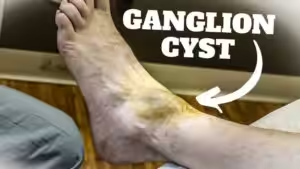
Fluid Cyst:
- Ganglionic cysts are soft masses across the top of the foot which are not immediately dangerous!
- These are simply pockets of fluid that pouches out from the joints of your foot bones like a balloon.
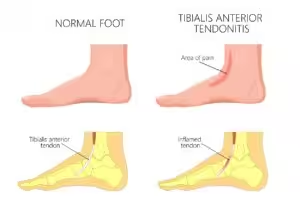
Extensor Tendonitis:
- Just like a nerve can get irritated on top of the foot, so can tendons.
- Extensor tendons are the ones responsible for lifting your foot toward your shin.
- They can become irritated from being over worked.
Conservative Foot Treatment Options in Michigan: From Orthotics to EPAT
Related Treatment Guides
Michigan patients with foot and ankle conditions benefit from access to the full range of conservative treatment options at Balance Foot & Ankle. Custom orthotics fabricated from a 3D scan of the patient’s foot provide structural correction for flatfoot, high arch, and biomechanical overload conditions that OTC insoles cannot adequately address. EPAT (extracorporeal pulse activation therapy) provides a non-surgical treatment option for plantar fasciitis, Achilles tendinopathy, and other tendon conditions that resist initial conservative care — clinical evidence shows 70-80% cure rates for chronic plantar fasciitis. Ultrasound-guided injection therapy allows precise corticosteroid, PRP, or local anesthetic delivery to specific anatomical targets including the plantar fascia insertion, retrocalcaneal bursa, Morton’s neuroma interspace, and ankle joint. Physical therapy coordination with specific home exercise prescription addresses strength and flexibility deficits that perpetuate foot and ankle conditions. Michigan patients who want conservative treatment options before considering surgery can call Balance Foot & Ankle at (810) 206-1402 for an evaluation at our Howell or Bloomfield Township office.
Suffering From Top of Foot Pain?
Our board-certified podiatrists specialize in diagnosing and treating all causes of top of foot pain — from tendonitis and stress fractures to nerve compression. Get expert care and fast relief.
📞 Or call us directly: (810) 206-1402
Clinical References
- Manganaro D, Dollinger B. Stress fractures of the foot and ankle. StatPearls. 2023.
- Chiodo CP, Herbst SA. Extensor tendonitis of the foot. Foot Ankle Int. 2004;25(10):718-723.
- Ferran NA, Maffulli N. Epidemiology of sprains of the lateral ankle ligament complex. Foot Ankle Clin. 2006;11(3):659-662.
Insurance Accepted
BCBS · Medicare · Aetna · Cigna · United Healthcare · HAP · Priority Health · Humana · View All →
👟 Dr. Tom Also Recommends
Podiatrist Recommended Shoes 2026: Dr. Tom’s Top Picks for Every Condition
The right footwear can make or break your recovery. Dr. Tom’s complete guide to the best shoes for plantar fasciitis, flat feet, neuropathy, bunions & more — with clinical picks for every foot type.
See Dr. Tom’s Top Shoe Picks →Howell Office
4330 E Grand River Ave
Howell, MI 48843
Get Directions →
Bloomfield Township Office
43494 Woodward Ave, #208
Bloomfield Township, MI 48302
Get Directions →
Your Board-Certified Podiatrists



Ready to Get Back on Your Feet?
Same-week appointments available at both locations.
Book Your AppointmentPodiatrist-Recommended Products
🏆 Doctor Hoy’s Natural Pain Relief Gel — Our top recommendation for reducing foot pain and inflammation naturally. Apply daily to affected areas.
PowerStep Pinnacle Orthotic Insoles — Reduces mechanical stress on the foot structures that cause pain. Physician-grade support in an OTC package.
CURREX Support Insoles — Dynamic arch support available in low, medium, and high arch profiles for a personalized fit.
Ready to feel better?
Same-week appointments available in Howell and Bloomfield Township, Michigan.
Book Your VisitDr. Tom’s Picks: Dorsal Foot Pain Relief
Reduces the arch collapse that tightens extensor tendons on top of the foot. The biomechanical root cause of most dorsal pain.
View on Amazon →
Apply along the top of the foot over the extensor tendons 3-4x daily. Menthol + arnica for fast-acting topical relief.
View on Amazon →
As an Amazon Associate I earn from qualifying purchases. As a Foundation Wellness partner I may also earn commission.
Ready to fix this for good?
Reading goes only so far. The fastest path to relief is a 30-minute office visit with Dr. Biernacki — same-week, Howell or Bloomfield Township. Call (810) 206-1402 or use our online booking.
In-Office Treatment at Balance Foot & Ankle
If home treatment isn’t providing relief for your foot and ankle conditions, our podiatry team at Balance Foot & Ankle can help with same-week evaluations and advanced in-office care.
Ready for Expert Care?
Same-week appointments in Howell & Bloomfield Township, MI.
4.9★ | 1,123 Reviews | 3,000+ Surgeries
Or call: (810) 206-1402

Dr. Tom Biernacki, DPM is a board-certified foot & ankle surgeon (ABFAS & ABPM) at Balance Foot & Ankle Specialists in Southeast Michigan. With over a decade of clinical experience, he specializes in heel pain, bunions, diabetic foot care, sports injuries, and minimally invasive surgery. Dr. Biernacki is a member of the APMA and ACFAS, and his patient education content on MichiganFootDoctors.com and YouTube has made him one of the most-followed foot & ankle educators on YouTube.