Dr. Tom Biernacki, DPM · FACFAS · 1,123+ 5★ Reviews
Swelling on Top of Foot: 6 Causes & When to Worry
Swelling on top of the foot is most often caused by extensor tendonitis (overuse from running/walking), a stress fracture in a metatarsal, arthritis (early midfoot osteoarthritis), gout (sudden severe swelling, redness, detailed pain — classically the big toe but can hit the dorsum), cellulitis (skin infection), or chronic venous insufficiency / lymphedema (both feet, worse at end of day).
In my Michigan podiatry clinic, extensor tendonitis is the #1 cause of top-of-foot swelling I see — loosen your top laces, ice 15 min after activity, and the swelling resolves in 7-10 days. Red flags requiring same-week visit: warm + red + sudden onset (gout/cellulitis), inability to bear weight (stress fracture), bilateral swelling with shortness of breath (heart/kidney/liver), or diabetic patient with any new foot swelling (urgent).
★ DR. TOM BIERNACKI, DPM, FACFAS · BOARD-CERTIFIED PODIATRIST
Top of Foot Swollen: Quick Answer
Swelling on the top of your foot most commonly comes from one of six causes: (1) extensor tendonitis from tight laces or overuse, (2) acute gout flare (sudden onset, intensely red and warm), (3) stress fracture in a metatarsal bone (worsens with activity, point tenderness on bone), (4) midfoot sprain or Lisfranc injury (post-trauma, severe), (5) ganglion cyst over a tendon or joint, or (6) cellulitis/infection (red, warm, possible fever).
Red flags requiring same-week podiatrist evaluation: swelling that came on suddenly without obvious cause, intense redness with warmth (rule out infection or gout), inability to bear weight, pain that worsens with activity (suspect stress fracture), or pulse changes in the foot. Mild swelling that comes and goes with activity is usually extensor tendonitis — loosen laces, ice 15 minutes 3x daily, switch to looser shoes.
Medically reviewed by Dr. Tom Biernacki, DPM — Board-certified foot & ankle surgeon, 3,000+ surgeries performed. Updated April 2026 with current clinical evidence. This article reflects real practice experience from Balance Foot & Ankle Specialists in Howell and Bloomfield Township, Michigan.
Quick Answer
Top-of-foot swelling looks like 4 different conditions that are nearly impossible to distinguish without specific tests — and the most commonly missed cause has a 6-week treatment window after which outcomes permanently worsen. Our podiatrists see patients who self-treated the wrong diagnosis for months. If swelling appeared suddenly after activity or you have point tenderness over a specific bone, call (810) 206-1402 — same-week appointments in Howell & Bloomfield Township.
Watch: Dr. Tom Biernacki, DPM
Swelling on the Top of Your Foot?
Book Your Appointment Online
Get an accurate diagnosis and effective treatment from trusted Michigan foot specialists. We identify the cause of your swelling and create a personalized plan to relieve pain and restore comfort.
A swollen top of foot is most commonly caused by extensor tendonitis (from tight shoes or overuse), a stress fracture (from repetitive impact), or a ganglion cyst (fluid-filled lump near a joint). Start with RICE — rest, ice 15–20 min several times daily, compression, and elevation above heart level. Loosen your shoe laces immediately. If swelling doesn’t improve within 5–7 days, or you can’t bear weight, see a podiatrist for X-rays to rule out a fracture. Bilateral foot swelling (both feet) with no injury suggests a systemic cause like venous insufficiency or fluid retention — see your doctor.
⚠️ Most Common Mistake
The biggest mistake is continuing to exercise through dorsal foot pain and swelling, thinking it’s “just a strain.” If you have a metatarsal stress fracture, continued activity can convert it to a complete fracture that requires weeks in a boot or even surgery. Another common error: tying shoes too tightly over a swollen foot, which compresses the extensor tendons and makes inflammation worse. Skip-lacing or switching to a wider shoe gives immediate relief. For swelling after a midfoot twist injury, don’t ignore it — a Lisfranc injury is commonly missed and leads to chronic problems if untreated.
🔍 Differential Diagnosis
Extensor Tendonitis — Pain and swelling along the tendons on top of the foot; worsens with toe extension against resistance; caused by tight shoes or overuse
Metatarsal Stress Fracture — Localized swelling and point tenderness over a metatarsal shaft; pain worsens with activity and improves with rest; may not show on initial X-ray
Ganglion Cyst — Soft, compressible, round lump on top of the foot near a joint; may fluctuate in size; transilluminates with light
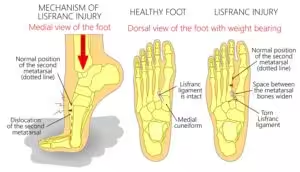
Lisfranc (Midfoot) Injury — Swelling and bruising on top of the midfoot after a twisting injury; pain with weight-bearing; widening of the midfoot on X-ray
Gout — Sudden onset intense pain, redness, warmth, and swelling; often affects the big toe joint but can occur on the dorsum; elevated uric acid
Swollen Top of the Foot Causes & Best Treatment Video
Causes of a Swollen Top of the Foot
Top of Foot Swollen Causes, Symptoms & Best Home Treatment Overview:
The goal is to see whether just one foot is swollen or both feet are swollen.
If just 1 foot is swollen, this is most likely an injury to 1 of the feet or too much rubbing to the top of the foot.
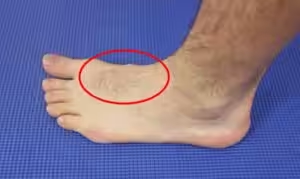
The most common cause of just 1 top of the foot being swollen is a Lisfranc fracture or sprain or rubbing against the top of the foot in a tight shoe.
Usually, one foot is flatter than the other to become more swollen and painful than the other foot.
It is also common to have extensor tendonitis to the top of both feet. It is also possible to have heart problems, liver problems, kidney problems, or breathing problems that can lead to swelling in her feet.
If both feet are swollen equally, see your doctor or podiatrist and have your feet evaluated!
Symptoms:
The symptoms can usually depend on what is the cause of your top of the foot swelling or your swollen top of the foot:
Numbness burning and tingling can be caused by irritation to the nerves on top of her foot.
A deep aching throb can be due to rubbing or extensor tendonitis to the top of your foot.
If you have prominent bone, this may be a bone spur or a bone prominence.
If you have redness, this may be skin irritation to the top of the foot.
This is most common in people who start working in a new job with a lot of walking on a hard floor or an athlete who has started extensive training.
This does not happen instantly, But gradually over time.
It can take days or weeks to start hurting and causing pain gradually.
Eventually, this will get too excruciating to continue walking or running.
This can take 10-21 days to show up on X-ray.
In our office, in option is to use ultrasound to detect the stress fracture.
The more sensitive test can be an MRI or a CT scan, leading to an extensive co-pay fracture. For this reason, we try to focus on using the ultrasound or trying to see if the treatment causes relief of symptoms.
For managing foot pain from conditions like plantar fasciitis, flat feet, or diabetic neuropathy, the best orthotics can offer crucial support and relief.
Choosing the best shoes for foot conditions like neuropathy, plantar fasciitis, or flat feet is essential for pain relief and long-term foot health.
Athlete’s Foot
Ball of Foot
Achilles Tendon
Bunion
Big Toe
Callus
Foot Fungus
Gout
Ingrown
Orthotics
Outside of Foot Pain
Sports Podiatrist
Why Choose Balance Foot & Ankle Specialist in Howell and Bloomfield Township?
If you are experiencing swelling on the top of your foot, it’s important to identify the underlying cause and receive the right care. At Balance Foot & Ankle Specialist, with locations in Howell and Bloomfield Township, Michigan, our experienced podiatrists provide thorough evaluations and customized treatment plans to reduce swelling, relieve pain, and restore healthy foot function. Whether your condition is due to injury, inflammation, or an underlying medical issue, we are here to provide advanced solutions and compassionate care to help you get back on your feet comfortably.
Dr. Tom Biernacki, Head Podiatrist at Balance Foot & Ankle Specialist, brings years of experience diagnosing and treating complex foot and ankle conditions—including heel nerve pain.
Experienced in geriatric foot conditions, chronic pain treatment, and difficult toenail management. Highly rated by Michigan seniors for comfort-focused care.
If home care isn’t resolving your your foot or ankle concern, a visit with a board-certified podiatrist is the fastest path to accurate diagnosis and a personalized plan. At Balance Foot & Ankle Specialists, Dr. Tom Biernacki, Dr. Carl Jay, and Dr. Daria Gutkin offer same-week appointments at both our Howell and Bloomfield Township offices. We perform on-site diagnostic ultrasound, digital X-ray, conservative care, advanced regenerative treatments, and minimally invasive surgery when indicated.
Impact-absorbing recovery sandal — wear after long days on your feet.
As an Amazon Associate, Balance Foot & Ankle earns from qualifying purchases. Product recommendations are based on clinical experience; prices and availability shown above update live from Amazon.
When to See a Podiatrist
If foot or ankle pain has been bothering you for more than a few weeks, home care alone may not be enough. Balance Foot & Ankle offers same-week appointments at our Howell and Bloomfield Township clinics — no referral needed in most cases. Bring your current shoes and a short list of symptoms and we’ll build you a treatment plan in one visit.
If you ever asked yourself “Why is the top of my foot swollen?” Your foot is swollen most commonly due to dorsal compression syndrome and overpronation of your foot. With over pronation of your foot the dorsal portion of the foot can compress and caused swelling and tenderness to the top of the foot.
If you ever asked yourself “Why is the top of my foot swollen & hurt?” In our experience the top of the foot being swollen and her is almost always due to overuse and overpronation. It usually happens in either the left foot or the right foot depending on who is tighter through the hamstring or the calf muscle on that foot. This versus the foot to externally rotate more on that side causing the Lisfranc joint to compress at the top and stretch at the bottom.
If you ever asked yourself “Why is the top of my foot swollen and red?” The redness can be due to the overpronation of your foot as well as rubbing against the top of your shoe. The best relief that we have found towards the top of the foot turning red is to change the Lasix so that it is not squishing or squeezing against the top of the foot.
Not always. Mild swelling can come from overuse, standing too long, or minor irritation. However, persistent or painful swelling should be checked by a podiatrist.
Yes. Arthritis in the midfoot joints can trigger inflammation and swelling, especially after walking or physical activity.
Is the Swelling on the Top of Your Foot Getting Worse?
Don’t wait for the pain or swelling to interfere with your daily life. The right diagnosis and treatment can bring lasting relief and prevent more serious problems.
At Balance Foot & Ankle Specialist, we provide personalized care to identify the cause of your foot swelling and help you return to comfortable, pain-free movement.
Menz HB, Jordan KP, Roddy E, Croft PR. Characteristics of primary care consultations for musculoskeletal foot and ankle problems in the UK. Rheumatology. 2010;49(7):1391-1398.
Rome K, Survepalli D, Sanders A, et al. Functional and biomechanical characteristics of foot disease in chronic gout. Arthritis Rheum. 2011;63(11):3318-3327.
Rao S, Riskowski JL, Hannan MT. Musculoskeletal conditions of the foot and ankle: assessments and treatment options. Best Pract Res Clin Rheumatol. 2012;26(3):345-368.
🛒 DR. TOM’S RECOMMENDED PRODUCTS
As an Amazon Associate, Balance Foot & Ankle earns from qualifying purchases.
Common causes include extensor tendinitis from tight shoes, Lisfranc sprain, stress fracture, gout flare, or ankle sprain with edema spreading to the dorsum. Sudden severe swelling after injury always needs imaging to rule out fracture.
Can a Lisfranc injury cause top-of-foot swelling?
Yes — and it’s frequently missed. Lisfranc injuries involve the midfoot ligaments and are marked by swelling and bruising across the top of the midfoot after a twisting injury. A standing X-ray or MRI is required for diagnosis.
How long does top-of-foot swelling last?
Minor tendinitis resolves in 1-2 weeks. Stress fractures take 6-8 weeks. Lisfranc injuries 3-6 months. Gout resolves in 3-10 days with treatment. Unexplained swelling beyond 2 weeks warrants evaluation.
Should I see a doctor for a swollen top of foot?
See a podiatrist if swelling lasted more than 3-5 days, followed an injury, includes bruising across the midfoot, or isn’t explained by obvious causes. Balance Foot & Ankle in Howell and Bloomfield Township MI offers same-week appointments.
What is extensor tendinitis of the foot?
Extensor tendons run across the top of the foot and lift the toes. Tendinitis causes swelling, tenderness, and pain when flexing upward. Common causes: too-tight laces, new shoes, rapid activity increase, or downhill running.
Dr. Tom’s Dorsal Foot Swelling Management Protocol
Plantar Fasciitis Compression Socks — Dorsal foot swelling from venous insufficiency, lymphedema, or post-injury edema: graduated compression socks are the most clinically effective OTC intervention.
Doctor Hoy’s Natural Pain Relief Gel — Pain and inflammation with dorsal swelling: arnica + camphor topical reduces periarticular and soft tissue inflammation.
PowerStep Pinnacle — Arch collapse causing extensor tendinitis with swelling: PowerStep corrects the mechanical trigger.
Dorsal foot swelling with warmth, redness, or sudden onset? Same-day evaluation for Lisfranc, stress fracture, or vascular causes. (810) 206-1402
Swelling on the top of the foot most commonly results from extensor tendonitis (inflammation of the tendons that run across the dorsum), an insect bite or allergic reaction, a ganglion cyst, a stress fracture of the metatarsals or tarsal bones (especially after sudden increase in activity), acute ankle sprain with dorsal edema, or lymphedema. Less commonly, gout can flare on the dorsum. A podiatrist uses X-ray, ultrasound, or MRI to distinguish tendon inflammation from fracture and from soft-tissue masses.
How do I reduce swelling on the top of my foot?
For acute swelling without a known injury: rest, elevate the foot above heart level for 20u201330 minutes several times daily, apply ice for 15 minutes on/off during the first 48 hours, and compress with a light ACE bandage. Avoid NSAIDs for more than a few days without medical guidance, particularly if you have kidney disease or take blood thinners. If swelling is from tendonitis, a short period in a stiff-soled shoe or CAM walker often resolves it within 2u20134 weeks. Persistent, unexplained, or asymmetric swelling warrants same-week evaluation.
When is swelling on the top of the foot serious?
Seek prompt evaluation if swelling is accompanied by significant pain, bruising, or inability to bear weight (possible fracture or tendon rupture); if the foot is red, warm, and you have fever (infection or septic arthritis); if you have diabetes or poor circulation (even minor swelling can signal a Charcot flare u2014 a limb-threatening emergency); or if swelling persists more than 2 weeks without an obvious cause. In diabetic patients, unexplained warm foot swelling should be evaluated as a Charcot neuroarthropathy until proven otherwise.
For a complete clinical overview:Extensor Tendonitis & Top-of-Foot Pain Guide — Dr. Biernacki explains causes, taping, best shoes, and treatment for pain on the top of the foot at Balance Foot & Ankle.
The National Library of Medicine notes that persistent foot swelling may result from injury, venous insufficiency, or systemic conditions and warrants professional evaluation when it does not resolve within 48 hours.
Dr. Tom Biernacki, DPM is a board-certified foot & ankle surgeon (ABFAS & ABPM) at Balance Foot & Ankle Specialists in Southeast Michigan. With over a decade of clinical experience, he specializes in heel pain, bunions, diabetic foot care, sports injuries, and minimally invasive surgery. Dr. Biernacki is a member of the APMA and ACFAS, and his patient education content on MichiganFootDoctors.com and YouTube has made him one of the most-followed foot & ankle educators on YouTube.
More questions patients ask
What causes swelling on top of the foot?
Common causes of swelling on top of the foot include stress fracture, extensor tendinitis, ganglion cyst, gout, bone spur, or dorsal compression syndrome. Sudden swelling after injury may indicate a fracture. Persistent swelling without injury warrants a podiatric evaluation.
Is swelling on top of the foot serious?
It can be—swelling from a stress fracture or ligament injury needs prompt treatment to prevent chronic instability. Gout flares require medication. While minor extensor tendinitis resolves with rest, swelling that worsens, persists beyond 2 weeks, or is accompanied by redness and warmth should be evaluated by a podiatrist.
How do podiatrists diagnose swelling on top of the foot?
Podiatrists use physical examination, X-ray to rule out fracture or bone spur, ultrasound to visualize tendons and soft tissue masses, and sometimes MRI for stress fractures not visible on X-ray. Blood tests help diagnose gout or inflammatory arthritis as underlying causes.
Is top-of-foot swelling serious?
Top-of-foot swelling ranges from benign (mild tendinitis or ganglion cyst) to serious (stress fracture, Lisfranc injury, infection, or vascular problem). Rapid swelling after an injury, severe swelling in a diabetic patient, swelling with warmth and redness, or swelling that worsens progressively despite rest warrants prompt evaluation. Balance Foot & Ankle recommends not dismissing persistent dorsal foot swelling — early diagnosis leads to better outcomes.
How do you reduce swelling on top of the foot?
Reduce top-of-foot swelling by: elevating the foot above heart level, applying ice (20 minutes on, 40 minutes off), using a compression bandage, resting from aggravating activities, and taking anti-inflammatory medications if appropriate. If swelling is due to an underlying structural cause (stress fracture, ganglion, arthritis), treating the cause is necessary for lasting reduction. Balance Foot & Ankle provides comprehensive evaluation of top-of-foot swelling.
Can I walk with swelling on top of my foot?
Walking with top-of-foot swelling is possible for mild cases but should be avoided or minimized for significant swelling, especially after an acute injury. Using a protective shoe or walking boot reduces further stress on swollen structures. At Balance Foot & Ankle, we determine weight-bearing appropriateness based on the cause of swelling — stress fractures, for example, require protected weight bearing to prevent further injury.
When should top-of-foot swelling be evaluated by a podiatrist?
See a podiatrist promptly for top-of-foot swelling that: follows an injury, is severe or rapidly worsening, is accompanied by skin redness or warmth (possible infection or gout), is not improving after 5-7 days of rest and icing, or is occurring in a patient with diabetes or circulatory problems. Balance Foot & Ankle provides urgent evaluation for acute foot swelling. Call (810) 206-1402.
Should I see a doctor for swelling on top of my foot?
See a podiatrist promptly if: swelling is associated with point tenderness over a bone (stress fracture), appeared suddenly with severe pain without trauma (could be gout), accompanied by redness and warmth suggesting infection or gout, you have diabetes (foot swelling can indicate serious vascular or infectious complications), or swelling persists more than 2 weeks without clear cause. Stress fractures in particular have a 6-week treatment window — delayed diagnosis leads to complete fracture and significantly longer recovery.
How do I reduce swelling on top of my foot?
For extensor tendonitis (most common cause): loosen laces immediately — lace pressure is the #1 trigger. Apply ice for 15-20 minutes, switch to wider footwear with room over the instep, and reduce activity for 48-72 hours. For other causes: RICE (rest, ice, compression, elevation) provides symptomatic relief but does not treat the underlying cause. Do not compress a potential stress fracture without imaging confirmation. Anti-inflammatory medication reduces swelling but can mask pain signals that indicate injury severity.
Can tight shoelaces cause swelling on top of the foot?
Yes — tight or incorrectly-laced shoes are one of the most common causes of extensor tendonitis and top-of-foot swelling. The extensor tendons run in a narrow channel across the foot dorsum and are extremely sensitive to lace pressure. Symptoms: burning or aching across the top of the foot during or after activity, swelling that is worse with specific shoes and better barefoot. Treatment: try parallel or gap lacing that skips the eyelet over the tender area, and switch to a shoe with a lower instep profile.
Balance Foot & Ankle surgeons are affiliated with Trinity Health Michigan, Corewell Health, and Henry Ford Health — three of Michigan’s largest health systems.