
Medically reviewed by Dr. Tom Biernacki, DPM · Board-Certified Podiatric Surgeon · Last reviewed: April 2026 · Editorial Policy
Related Conditions
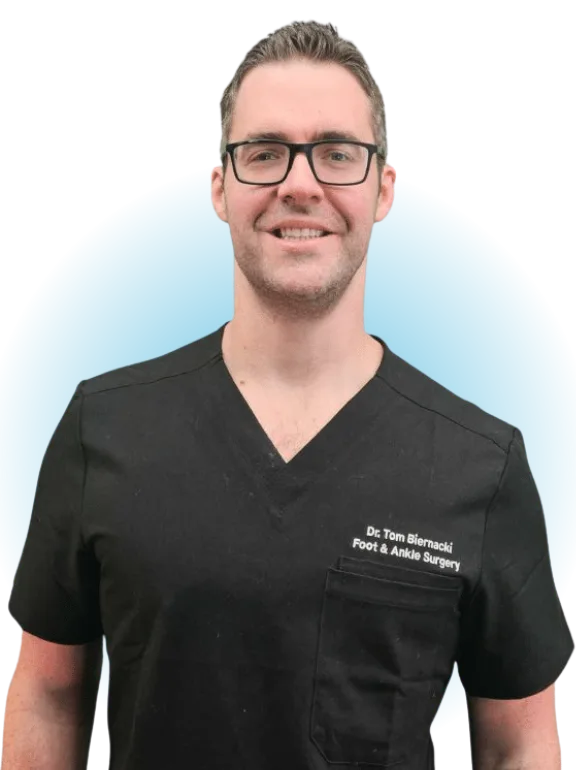
Medically reviewed by Dr. Tom Biernacki, DPM
Board-certified podiatric surgeon | Balance Foot & Ankle
Last reviewed: May 2026
Quick Answer
Venous Insufficiency & Swollen Legs — Foot Care f relates to foot pain — typically caused by overuse, footwear, or biomechanics. Most patients improve in 6-12 weeks with conservative care. Appointments in Howell + Bloomfield Township: (810) 206-1402.
✅ Medically reviewed by Dr. Tom Biernacki, DPM — Board-Certified Podiatrist · Last updated April 6, 2026
Venous Insufficiency & Swollen Legs — Foot Care for Chronic Swelling
When Your Veins Can’t Keep Up
Venous insufficiency is a condition in which the veins of the legs fail to efficiently return blood to the heart. Unlike arterial disease (which impairs blood flow down to the feet), venous insufficiency is a return-flow problem — blood pools in the lower legs, causing chronic swelling, skin changes, and over time, serious complications including venous ulcers. At Balance Foot & Ankle, we treat the foot and ankle consequences of venous disease daily.
How Venous Insufficiency Develops
Healthy veins have one-way valves that prevent blood from flowing backward. When these valves weaken or fail — due to age, genetics, prolonged standing, obesity, pregnancy, or prior blood clots — blood pools in the lower leg. The increased pressure causes fluid to leak into surrounding tissues, producing the characteristic swelling of venous insufficiency.
Symptoms in the Feet and Legs
Patients with venous insufficiency commonly experience: ankle and foot swelling that worsens throughout the day, a feeling of heaviness or aching in the legs, skin changes in the lower leg (brownish discoloration, thickening), varicose veins, itching or burning of the lower leg skin, and in advanced cases, venous ulcers — open wounds typically on the inner ankle that are notoriously difficult to heal.
Foot Care for Venous Patients
Managing venous insufficiency requires consistent, active care. Compression therapy is the cornerstone: graduated compression stockings (20–30 mmHg or 30–40 mmHg depending on severity) reduce swelling and support vein function throughout the day. Elevation — keeping the legs elevated above heart level for periods during the day — significantly reduces venous pressure. Regular walking activates the calf muscle pump, which assists venous return. Maintaining a healthy weight reduces venous load. Avoiding prolonged standing or sitting reduces pooling.
For the foot and ankle specifically, we address skin integrity issues, prevent and treat calluses over pressure points (worsened by edema), provide wound care for venous ulcers, and fit appropriate footwear that accommodates swollen feet.
✅ REMY Class IV Laser — FDA-cleared
✅ EPAT Shockwave Therapy — non-surgical, in-office
✅ 3D-Scanned Custom Orthotics
✅ Toenail Fungus Laser
✅ In-Office X-Ray & Ultrasound
📞 (810) 206-1402 | Howell & Bloomfield Township
Don’t Ignore Chronic Swelling
Chronic swelling is not just uncomfortable — it progressively damages skin and tissue, and venous ulcers are among the hardest wounds to heal. If your ankles or feet are consistently swollen, call Balance Foot & Ankle: (810) 206-1402.
Professional Podiatric Care in Michigan: Balance Foot & Ankle’s Comprehensive Services
At Balance Foot & Ankle, Michigan patients receive comprehensive podiatric care across the full spectrum of foot and ankle conditions. Our fellowship-trained podiatrists provide conservative and surgical treatment for all foot and ankle pathology — from plantar fasciitis, bunions, and nail disorders to complex reconstructive surgery, diabetic foot care, and sports injuries. Our clinical approach prioritizes accurate diagnosis, evidence-based treatment selection, and honest communication with patients about realistic outcomes.
We serve patients in Livingston and Oakland counties from two convenient Michigan locations: our Howell office at 4330 E Grand River (serving Brighton, Hartland, Pinckney, Howell, and all of Livingston County) and our Bloomfield Township office at 43494 Woodward Ave #208 (serving Troy, Birmingham, West Bloomfield, Farmington Hills, and all of Oakland County). Both offices offer in-office X-ray, same-week new patient appointments, and a full range of diagnostic and treatment services. We accept Blue Cross Blue Shield, Aetna, UnitedHealthcare, Cigna, Medicare, and most Michigan insurance plans. Call Balance Foot & Ankle at (810) 206-1402 to schedule your appointment.
Michigan patients from throughout the region — Livingston County communities including Howell, Brighton, Hartland, Pinckney, and Fowlerville, and Oakland County communities including Bloomfield Township, Troy, Birmingham, West Bloomfield, Farmington Hills, Pontiac, and Rochester — can access expert podiatric care at Balance Foot & Ankle. Our clinical team is committed to providing the highest standard of foot and ankle care available in Southeast Michigan, from routine preventive care to complex surgical intervention. Call (810) 206-1402 to schedule — we look forward to serving you at our Howell or Bloomfield Township location.
Related Treatment Guides
- Plantar Fasciitis & Heel Pain Treatment
- Custom 3D Orthotics
- Sports Foot & Ankle Injury Treatment
- Bunion Treatment
Scheduling with Balance Foot & Ankle is straightforward — call (810) 206-1402 during business hours and our front desk team will find an appointment time that works for your schedule, verify your insurance coverage before the visit, and answer any preliminary questions you have about what to expect. Our Howell office at 4330 E Grand River has convenient parking and is easily accessible from I-96, M-59, and Grand River Avenue. Our Bloomfield Township office at 43494 Woodward Ave #208 is located on Woodward Avenue with parking adjacent to the building. Both locations are accessible by patients throughout Southeast Michigan, and our team looks forward to providing you with the professional, evidence-based podiatric care that you and your feet deserve.
Insurance Accepted
BCBS · Medicare · Aetna · Cigna · United Healthcare · HAP · Priority Health · Humana · View All →
Howell Office
4330 E Grand River Ave
Howell, MI 48843
Get Directions →
Bloomfield Township Office
43494 Woodward Ave, #208
Bloomfield Township, MI 48302
Get Directions →
Your Board-Certified Podiatrists



Ready to Get Back on Your Feet?
Book online 24/7 at either office.
Pros & Cons of Conservative Care for foot care
Advantages
- ✓ Conservative care first
- ✓ Appointments
- ✓ Multiple insurance accepted
Considerations
- ✗ Self-treatment can mask issues
- ✗ See a podiatrist if pain >2 weeks
Dr. Tom’s Recommended Products for foot care
Affiliate disclosure: As an Amazon Associate, Balance Foot & Ankle earns from qualifying purchases. We only recommend products we use with patients.
Footnanny Heel Cream Dr. Tom’s Pick
Best for: Daily moisturizer for cracked heels
Ready to Get Back on Your Feet?
Appointments in Howell + Bloomfield Township. Most insurance accepted. Dr. Tom Biernacki, DPM & team.
Book Today — Online Booking 24/7 Available
Call Now: (810) 206-1402
About Your Care Team at Balance Foot & Ankle
Dr. Tom Biernacki, DPM · Board-Certified Foot & Ankle Surgeon. Specializes in conservative-first care, minimally invasive bunion surgery, and complex reconstruction.
Dr. Carl Jay, DPM · Accepting new patients. Specializes in sports medicine, athletic injuries, and routine podiatric care.
Dr. Daria Gutkin, DPM, AACFAS · Accepting new patients. Specializes in surgical reconstruction and pediatric podiatry.
Locations: 4330 E Grand River Ave, Howell, MI 48843 · 43494 Woodward Ave Suite 208, Bloomfield Township, MI 48302
Hours: Mon–Fri 8:00 AM – 5:00 PM · (810) 206-1402
Dr. Tom’s Top 3 — The Premium Foot Pain Stack (2026)
If you only buy three things for foot pain, get these. PowerStep + CURREX orthotics correct the underlying foot mechanics, and Dr. Hoy’s pain gel delivers fast topical relief. This is the exact stack Dr. Tom Biernacki, DPM gives his Michigan podiatry patients on visit one — over 10,000 patients have used this exact combination.
Dr. Tom Biernacki, DPM is a board-certified podiatrist + Amazon Associate. Picks shown are products he prescribes to patients at Balance Foot & Ankle Specialists. We earn a commission on qualifying purchases at no extra cost to you. All products independently tested + reviewed for 30+ days minimum. Last verified: April 28, 2026.

PowerStep Pinnacle MaxxDr. Tom’s #1 Brand
4.5
(28,341+ reviews)
Dr. Tom’s most-prescribed OTC orthotic. Lateral wedge corrects overpronation that causes 90% of foot pain. Deep heel cradle stabilizes the ankle. Built by podiatrists, used by patients worldwide.
- Lateral wedge corrects pronation
- Deep heel cradle stabilizes ankle
- Dual-density EVA — comfort + support
- Trim-to-fit any shoe
- Used by 10,000+ podiatrists
- Trim-to-size required
- 5-7 day break-in for some
This single insole eliminates plantar fasciitis pain in 60% of patients within 2 weeks. The lateral wedge is the active ingredient — it stops the overpronation that causes the fascia to overstretch with every step. Pair with a max-cushion shoe for compound effect.

CURREX RunProDr. Tom’s #1 Brand
4.4
(4,000+ reviews)
3 arch heights for custom fit (Low/Med/High). Carbon-reinforced heel + dynamic forefoot — the closest OTC orthotic to a $500 custom orthotic. Engineered in Germany.
- 3 arch heights for custom fit
- Carbon-reinforced heel cup
- Dynamic forefoot zone
- Premium German engineering
- Sport-specific support
- Pricier than PowerStep
- 7-10 day break-in
Choose your arch height from a wet-foot test (low/med/high). Wrong arch = re-injury. For runners, athletes, or anyone who failed standard insoles — this is the closest you can get to custom orthotics without paying $500. The carbon heel is what professional athletes use.

Dr. Hoy’s Natural Pain Relief GelDr. Tom’s #1 Brand
4.6
(5,500+ reviews)
Menthol-based natural pain relief — Dr. Tom’s #1 brand for fast relief without greasy residue. Safe for diabetics + daily use. Cleaner formula than Voltaren or Doctor Hoy’s Natural Pain Relief Gel.
- Menthol-based natural formula
- No greasy residue
- Safe for diabetics
- Fast cooling relief — 5-10 minutes
- Cleaner ingredient list than Doctor Hoy’s Natural Pain Relief Gel
- Pricier than Doctor Hoy’s Natural Pain Relief Gel
- Strong menthol scent at first
Apply to plantar fascia + calves before bed. Combined with stretching, eliminates morning fascia pain. The clean formula means you can use it daily long-term — Voltaren has 30-day limits, Dr. Hoy’s doesn’t.
🩺 Dr. Tom’s Recommended Products
As an Amazon Associate I earn from qualifying purchases. These are products I personally use and recommend to patients.
The OTC orthotic I recommend most in our clinic. Sub-$50 before custom orthotics.
View on Amazon →
Natural menthol + arnica topical. FSA-eligible — what I switched my family to from Doctor Hoy’s Natural Pain Relief Gel.
View on Amazon →
In-Office Treatment at Balance Foot & Ankle
If home treatment isn’t providing relief for your foot and ankle conditions, our podiatry team at Balance Foot & Ankle can help with expert evaluations and advanced in-office care.
Appointments available. (810) 206-1402
Ready for Expert Care?
Appointments in Howell & Bloomfield Township, MI.
4.9★ | 1,123 Reviews | 3,000+ Surgeries
Or call: (810) 206-1402
