Board Certified Podiatrists | Expert Foot & Ankle Care
(810) 206-1402 Patient Portal

Accessory Navicular Syndrome: Causes, Diagnosis & Treatment | Michigan

Quick answer: Accessory Navicular Syndrome Michigan is a clinical condition that responds to evidence-based treatment when caught early. Symptoms include pain, swelling, and altered function. Diagnosis requires clinical exam, often imaging. Treatment ladder: conservative care first (4-6 weeks), then targeted interventions if needed. Call (810) 206-1402.

Medically reviewed by Dr. Tom Biernacki, DPM · Board-Certified Podiatric Surgeon · Last reviewed: April 2026 · Editorial Policy

MICHIGAN PODIATRIST INSIGHT

The most important clinical decision with Accessory Navicular Syndrome Michigan isn’t which treatment to start with — it’s identifying the correct subtype. That changes everything. Call (810) 206-1402.

Quick Answer

Accessory Navicular Syndrome: Causes, Diagnosis & Treat relates to foot pain — typically caused by overuse, footwear, or biomechanics. Most patients improve in 6-12 weeks with conservative care. Same-week appointments in Howell + Bloomfield Hills: (810) 206-1402.

Video by Dr. Tom Biernacki, DPM — Michigan Foot Doctors
Watch: Dr. Tom Biernacki explains the topic in detail · Subscribe to Michigan Foot Doctors on YouTube

Medically reviewed by Dr. Tom Biernacki, DPM — Board-Certified Podiatric Surgeon — Balance Foot & Ankle, Howell & Bloomfield Hills, MI. Last updated April 2026.

▶ Watch

YouTube video

Medically Reviewed by Dr. Tom Biernacki, DPM — Board-Certified Podiatrist, Balance Foot & Ankle Specialists, Michigan. Last updated April 2026.

Accessory navicular syndrome is pain arising from an extra bone (os tibiale externum) on the inner side of the foot adjacent to the navicular — present in approximately 10–14% of the population as a normal variant but symptomatic in a smaller subset, particularly after trauma, overuse in athletic adolescents, or in patients with flat feet who place increased strain on the tibialis posterior tendon that inserts near this extra bone. Dr. Tom Biernacki, DPM at Balance Foot & Ankle in Howell and Bloomfield Hills, Michigan diagnoses and treats accessory navicular syndrome with conservative and surgical options.

What Is an Accessory Navicular?

The navicular is a boat-shaped bone on the inner midfoot that serves as the insertion point for the tibialis posterior tendon — the primary dynamic arch support structure. An accessory navicular is an additional ossicle (small bone) located medial to the navicular tuberosity. There are three types: Type I (os tibiale externum) is a small sesamoid bone within the tibialis posterior tendon, typically asymptomatic; Type II is the most symptomatic — a larger ossicle connected to the navicular by a fibrocartilaginous synchondrosis that can become painful when the synchondrosis is stressed; Type III is a fused cornuate navicular creating a prominent medial navicular bump. Type II is the primary focus of clinical management as it accounts for most symptomatic accessory navicular cases.

Who Gets Symptomatic Accessory Navicular

Symptomatic accessory navicular most commonly presents in two populations: adolescent athletes during growth spurts (particularly girls age 10–15 involved in running and dance) whose navicular growth plates are still open and vulnerable to stress injury; and adults with flat feet (pes planus) where the collapsed arch places the tibialis posterior tendon under increased tension, stressing the synchondrosis between the accessory navicular and the main navicular. Acute trauma — a direct blow or forceful inversion injury — can also acutely inflame a previously asymptomatic accessory navicular in any age group.

Diagnosis

The diagnosis is typically straightforward: a prominent bony bump on the inner arch, tender directly over the accessory navicular, with pain worsening with walking or athletic activity. Weight-bearing X-rays confirm the ossicle and classify its type. MRI is used when the diagnosis is uncertain, to assess the synchondrosis for edema (bone marrow edema pattern indicating active stress injury), and to evaluate the tibialis posterior tendon for associated tears. Bone scan or SPECT-CT can confirm activity at the accessory navicular in cases where MRI is inconclusive.

Conservative Treatment

The majority of symptomatic accessory navicular cases resolve with conservative management. First line: activity modification (reduced or eliminated athletic activity during the painful period), custom orthotics to support the arch and reduce tibialis posterior tension, and padding over the bony prominence to reduce shoe friction. Immobilization in a CAM boot for 6–8 weeks is the treatment of choice for acute painful episodes with MRI evidence of synchondrosis edema — it stops the repetitive stress and allows the fibrocartilaginous connection to stabilize. Physical therapy addressing tibialis posterior strengthening and posterior chain flexibility follows immobilization. Corticosteroid injection directly at the synchondrosis can reduce inflammation when pain is refractory.

Surgical Treatment: Kidner Procedure

The Kidner procedure (accessory navicular excision with tibialis posterior tendon reattachment) is indicated when conservative management of 6–12 months has failed to resolve symptoms. The accessory ossicle is removed, the fibrocartilaginous synchondrosis is excised, and the tibialis posterior tendon is reattached to the navicular in a more plantar position — theoretically improving arch support mechanics. Results are generally good for isolated accessory navicular, with over 85% of patients achieving satisfactory symptom resolution. In patients with significant flatfoot as an underlying cause, flatfoot reconstruction may be combined with accessory navicular excision to address both the structural and symptomatic components.

Most Common Mistake

The most common mistake is treating accessory navicular pain as generic arch pain or plantar fasciitis and prescribing standard plantar fascia stretching and insoles without addressing the specific navicular prominence. Generic insoles do not offload the specific stress at the Type II synchondrosis — a custom orthotic with appropriate navicular offloading and arch support is required. Equally, aggressive tibialis posterior stretching can worsen the synchondrosis stress in a symptomatic Type II — stretching should be focused on the gastrocnemius, not the tibialis posterior tendon directly.

When to See Dr. Biernacki

See a podiatrist if you have an inner arch bump that is tender and painful with activity, if a teenage athlete has inner arch pain that is not responding to rest and OTC arch support, or if you have been told you have “flat feet” with inner arch pain and standard flat foot treatment is not helping. Dr. Biernacki provides weight-bearing X-rays, MRI coordination, custom orthotics with navicular accommodation, CAM boot immobilization, and surgical consultation for refractory cases.

Book online or call (810) 206-1402 — Howell and Bloomfield Hills, Michigan.

🧦 Dr. Tom’s Pick: DASS Medical Compression Socks

📍 Located in Michigan?

Our board-certified podiatrists treat this condition at two convenient locations. Same-day appointments often available.

Book Now → (810) 206-1402

Medical-grade 15-20 mmHg graduated compression. DASS socks are the brand I recommend most to patients with swollen feet, poor circulation, and post-surgery recovery. Graduated compression means tightest at the ankle, gradually releasing up the leg — promoting upward venous blood flow.

View DASS Compression Socks on Amazon →

Affiliate disclosure: As an Amazon Associate, Balance Foot & Ankle earns from qualifying purchases.

Join 950,000+ Learning About Foot Health

Dr. Tom shares honest medical advice, supplement reviews, and treatment guides you won’t find anywhere else.

Subscribe on YouTube →

🔗 Related Care & Resources

Treated by Dr. Tom Biernacki DPM — Board-certified podiatric surgeon at Balance Foot & Ankle in Howell & Bloomfield Hills, MI.

Schedule an Appointment → or call (810) 206-1402
Watch on YouTube

Insurance Accepted

BCBS · Medicare · Aetna · Cigna · United Healthcare · HAP · Priority Health · Humana · View All →

Ready to Get Back on Your Feet?

Same-week appointments available at both locations.

Book Your Appointment

(810) 206-1402

Differential Diagnosis: What Else Could It Be?

Not every case of accessory navicular syndrome is straightforward. In our clinic we routinely rule out three look-alike conditions before confirming the diagnosis. If your symptoms don’t match the classic presentation, one of these may explain the pain — which is why physical exam matters more than self-diagnosis.

ConditionHow It Differs
Posterior tibial tendon dysfunctionPain along the tendon course with progressive flatfoot; may coexist.
Medial midfoot sprainLigamentous tenderness without a prominent bony bump.
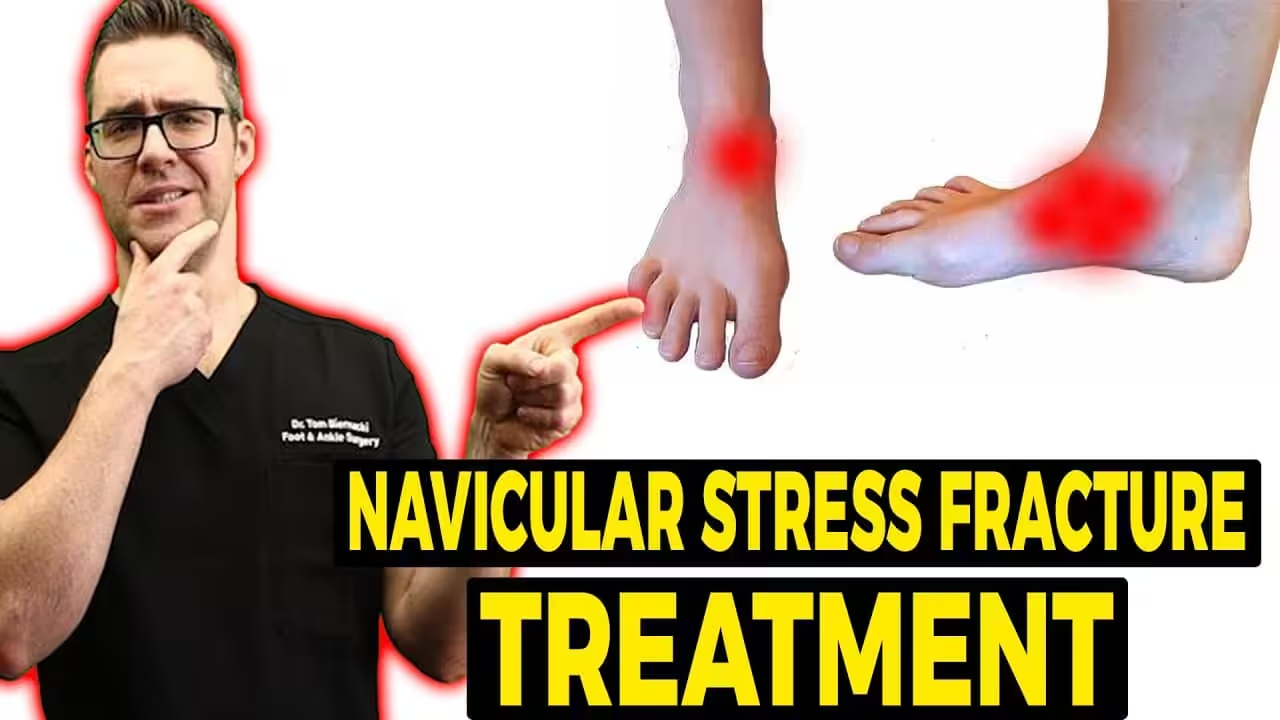
Navicular stress fractureDorsal midfoot pain with impact; confirmed on MRI, not an accessory bone.

Red Flags — When to See a Podiatrist Now

Seek same-day evaluation at Balance Foot & Ankle if you notice any of the following:

  • Visible bony bump on the medial midfoot with redness
  • Collapsing arch in a child or adolescent
  • Pain preventing participation in sport
  • Failed 6 weeks of orthotic and activity modification

Call (810) 206-1402 or request an appointment. Our Howell and Bloomfield Hills offices reserve same-day slots for urgent foot and ankle issues.

In Our Clinic: What We See

Clinical perspective from Dr. Tom Biernacki, DPM — Balance Foot & Ankle, Howell & Bloomfield Hills, MI:

Accessory navicular syndrome shows up in active adolescents and sometimes adults with a visible medial bump. In our clinic the exam finding is tenderness directly over the ossicle and pain with resisted inversion. X-rays confirm the accessory bone; MRI shows whether the ossicle is inflamed. Most patients respond to custom orthotics, activity modification, and short-term boot immobilization over 6-12 weeks. When conservative care fails, a Kidner procedure — excising the ossicle and re-attaching the posterior tibial tendon — restores arch function. Dr. Biernacki counsels families to try orthotics for 6 weeks first; surgery when needed is predictable but usually preventable.

Watch: Dr. Tom explains

Dr. Tom Biernacki explains

Podiatrist-recommended products

As an Amazon Associate, Dr. Tom earns from qualifying purchases.

PowerStep Pinnacle Orthotics

Medial posting unloads the accessory navicular.

View on Amazon →
FlexiKold Gel Pack

Ice the medial arch after activity.

View on Amazon →
Doctor Hoy’s Natural Pain Relief

Topical relief for posterior tibial tenderness.

View on Amazon →
Medical CAM Walker Boot

Immobilize during acute flares to reset symptoms.

View on Amazon →

Ready to solve this? Book today.

Same-week appointments · Howell & Bloomfield Hills · 4.9★ (1,123+ reviews)

☎ (810) 206-1402Book Online →

More Podiatrist-Recommended Foot Health Essentials

Hoka Clifton 10

Hoka Men's Clifton 10

Max-cushion everyday shoe — podiatrist favorite for walking and running.

PowerStep Pinnacle Insole

The podiatrist-recommended over-the-counter orthotic.

OOFOS Recovery Slide

Impact-absorbing recovery sandal — wear after long days on your feet.

As an Amazon Associate, Balance Foot & Ankle earns from qualifying purchases. Product recommendations are based on clinical experience; prices and availability shown above update live from Amazon.

Accessory Navicular Ap Anatomy - Balance Foot & Ankle

When to See a Podiatrist

If foot or ankle pain has been bothering you for more than a few weeks, home care alone may not be enough. Balance Foot & Ankle offers same-week appointments at our Howell and Bloomfield Hills clinics — no referral needed in most cases. Bring your current shoes and a short list of symptoms and we’ll build you a treatment plan in one visit.

Call Balance Foot & Ankle: (810) 206-1402  ·  Book online  ·  Offices in Howell & Bloomfield Hills

Pros & Cons of Conservative Care for foot care

Advantages

  • ✓ Conservative care first
  • ✓ Same-week appointments
  • ✓ Multiple insurance accepted

Considerations

  • ✗ Self-treatment can mask issues
  • ✗ See a podiatrist if pain >2 weeks

Dr. Tom’s Recommended Products for foot care

Affiliate disclosure: As an Amazon Associate, Balance Foot & Ankle earns from qualifying purchases. We only recommend products we use with patients.

Hoka Bondi 9 Dr. Tom’s Pick

Best for: Max cushion daily wear

Check Price on Amazon

PowerStep Pinnacle Dr. Tom’s Pick

Best for: General arch support

Check Price on Amazon

KT Tape Pro Synthetic Dr. Tom’s Pick

Best for: Multi-purpose taping

Check Price on Amazon

Footnanny Heel Cream Dr. Tom’s Pick

Best for: Daily moisturizer for cracked heels

Check Price on Amazon

Ready to Get Back on Your Feet?

Same-day appointments in Howell + Bloomfield Hills. Most insurance accepted. Dr. Tom Biernacki, DPM & team.

Book Today — Same-Day Appointments Available

Call Now: (810) 206-1402

About Your Care Team at Balance Foot & Ankle

Dr. Tom Biernacki, DPM · Board-Certified Foot & Ankle Surgeon. Specializes in conservative-first care, minimally invasive bunion surgery, and complex reconstruction.

Dr. Carl Jay, DPM · Accepting new patients. Specializes in sports medicine, athletic injuries, and routine podiatric care.

Dr. Daria Gutkin, DPM, AACFAS · Accepting new patients. Specializes in surgical reconstruction and pediatric podiatry.

Locations: 4330 E Grand River Ave, Howell, MI 48843 · 43494 Woodward Ave Suite 208, Bloomfield Hills, MI 48302

Hours: Mon–Fri 8:00 AM – 5:00 PM · (810) 206-1402

⚕ Doctor Recommended

PowerStep Pinnacle Insoles

Podiatrist-recommended arch support

View Product →

What is Foot pain?

Foot pain is a common foot/ankle condition that affects mobility and quality of life. Understanding the underlying cause is the first step in successful treatment. Our podiatrists at Balance Foot & Ankle perform a hands-on biomechanical exam, review your activity history, and use diagnostic imaging when appropriate to identify the root cause—not just treat the symptom. Many patients have been told to “rest and ice” without a deeper diagnostic workup; our approach is different.

Symptoms and warning signs

Common signs of foot pain include pain that worsens with activity, morning stiffness, swelling, tenderness when palpated, and difficulty bearing weight. If you experience sudden severe pain, inability to walk, visible deformity, numbness or color change, contact our office the same day or visit urgent care—these can signal a more serious injury such as a fracture, tendon rupture, or vascular compromise. Diabetics with any foot wound should seek same-day care.

Conservative treatment options

Most cases of foot pain respond to non-surgical care: structured rest, supportive footwear changes, custom orthotics, targeted stretching and strengthening protocols, anti-inflammatory medications when medically appropriate, and in-office procedures such as ultrasound-guided injections. We also offer advanced therapies including MLS laser therapy, EPAT/shockwave, regenerative injections, and image-guided procedures. Treatment is sequenced from least invasive to most invasive, and we explain the rationale at every step.

When is surgery considered?

Surgery is reserved for cases that fail 3-6 months of well-structured conservative care, when there is structural pathology (severe deformity, complete tear, advanced arthritis), or when imaging shows damage that will not heal without intervention. Our surgeons have performed 3,000+ foot and ankle procedures and prioritize minimally-invasive techniques whenever appropriate. We discuss recovery timelines, return-to-activity milestones, and realistic outcome expectations before any procedure is scheduled.

Recovery timeline and prevention

Recovery from foot pain varies based on severity and chosen treatment path. Conservative cases often improve within 4-8 weeks with consistent adherence to the protocol. Post-procedural recovery may range from a few days (in-office procedures) to several months (reconstructive surgery). Long-term prevention involves footwear assessment, activity modification, structured strengthening, and regular check-ins with your podiatrist if you have a history of recurrence. We provide written home-exercise plans and digital follow-up support.

Reviewed by Dr. Tom Biernacki, DPM — Board-certified podiatrist, Balance Foot & Ankle, Howell & Bloomfield Hills, MI. 4.9-star rating across 1,123+ patient reviews. Schedule an evaluation | (810) 206-1402

Ready to feel better?

Same-week appointments available in Howell and Bloomfield Hills, Michigan.

Book Your Visit
Related care from Balance Foot & Ankle

Our podiatrists treat the underlying cause, not just the symptom. Same-week appointments at our Howell and Bloomfield Hills, Michigan offices.

Call (810) 206-1402 or book online.

Visit Balance Foot & Ankle — Same-Day Appointments Available

Our podiatry team serves patients throughout Michigan including Howell, Brighton, and Bloomfield Hills. If you’re dealing with heel pain, ingrown toenails, or a foot injury, we have same-day appointment availability.

Same-day appointments available. (810) 206-1402

Book online →  |  Meet Dr. Tom Biernacki →

Ready for Expert Care?

Same-day appointments in Howell & Bloomfield Hills, MI.

4.9★ | 1,123 Reviews | 3,000+ Surgeries

Or call: (810) 206-1402

Balance Foot & Ankle surgeons are affiliated with Trinity Health Michigan, Corewell Health, and Henry Ford Health — three of Michigan’s largest health systems.